Daniel Carter knew something was wrong before he understood what had changed. He stood barefoot in the backyard of his Pine Ridge home, holding a cup of coffee that had already gone cold, while the early morning breeze moved through the maple trees. His grill appeared too close to the patio, the garden looked strangely compressed, and the cedar fence no longer aligned with the corner of the garage. When he paced the distance with careful steps, the truth settled into his chest like a stone.
Eight feet of his backyard had disappeared.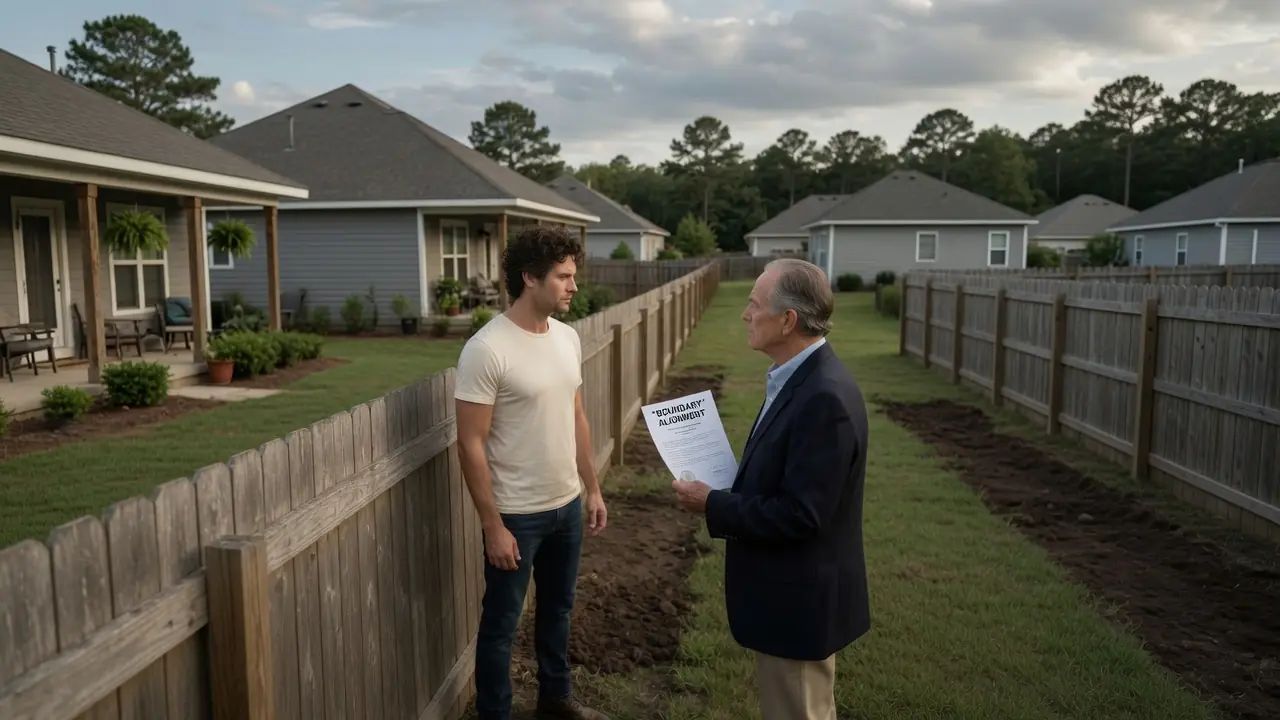
Daniel was thirty-one, tall and athletic, with thick, tousled dark-brown curls, hazel-green eyes, and a strong jaw covered by neatly trimmed stubble. Even in a fitted cream T-shirt, dark jeans, and worn brown leather boots, he carried the composed confidence of someone accustomed to solving expensive problems without raising his voice. He worked as a commercial property analyst, reviewing land records, distressed assets, and development contracts for investors throughout the state. Boundaries, titles, and hidden clauses were not abstract concepts to him.
They were his profession.
The fence had stood in the correct location when Daniel went to work Friday morning. By Saturday, the original posts had been removed, new holes had been dug, and the entire structure had been rebuilt eight feet inside his property. Tire tracks from a contractor’s truck still crossed the grass. Whoever had done it had not made a mistake.
They had measured carefully.
Daniel returned to the kitchen and opened the fireproof cabinet where he kept the closing documents from purchasing the house three years earlier. He spread the deed, title policy, inspection records, and stamped boundary survey across the island. The western property line ran exactly where Daniel remembered it, beginning beside a mature maple and extending sixty-seven feet toward the drainage easement.
The new fence stood well inside that line.
Daniel telephoned the fencing contractor whose small metal tag remained attached to one post. A nervous receptionist confirmed that Benton Community Management had ordered and paid for the work. When Daniel asked who had authorized entry onto his property, she placed him on hold for several minutes before returning with a carefully rehearsed answer.
“We were informed that the HOA controlled that section under a revised alignment plan.”
Daniel’s eyes narrowed. “Did anyone ask to see a recorded easement or my written permission?”
“I’ll have the project manager call you.”
Nobody called.
By nine that morning, Daniel was walking into the Pine Ridge Estates management office. The building sat near the neighborhood entrance behind sculpted hedges and a stone monument bearing the association’s name. Everything about it communicated order: identical flower beds, symmetrical windows, polished brass numbers, and a flag hanging at the precise angle required by the community handbook.
The receptionist looked startled when Daniel entered without an appointment.
“I need to speak with Harold Benton.”
“Mr. Benton is in a meeting.”
“Tell him Daniel Carter is here regarding the fence his contractors moved across my property.”
Her expression changed immediately.
Five minutes later, Daniel sat across from the HOA president in a cold conference room. Harold Benton was fifty-eight, silver-haired and thin, with perfect posture and the patient smile of a man who had spent years mistaking slow speech for authority. A navy folder lay open before him, containing photographs of Daniel’s yard and a document titled Revised Community Boundary Alignment Initiative.
Harold did not apologize.
“We moved the fence for uniformity,” he said. “Eight feet of your yard now belongs to the HOA.”
Daniel placed his stamped survey on the table. “Your board vote doesn’t erase the deed in my hand.”
“The association has broad authority to correct inconsistent boundaries.”
“Not private ownership boundaries.”
Harold leaned back. “Pine Ridge was designed with a continuous green corridor behind the western homes. Previous boards allowed inconsistencies to remain, but we are correcting them.”
Daniel studied the photograph clipped inside Harold’s folder. The reclaimed strip connected his backyard to a narrow landscaped path leading toward the clubhouse. Moving the fence gave the HOA enough width to extend the path behind three additional houses.
“You want a walking trail,” Daniel said.
“We want a unified community feature.”
“So you entered my property, removed my fence, and stole enough land to build it.”
Harold’s smile disappeared. “Be careful with accusations.”
“Be careful with excavators.”
The room became quiet.
Harold folded his hands. “The board has already approved the project. If you interfere with association improvements, you may face fines for obstructing community development.”
“My land is not an association improvement.”
“Fight us,” Harold said coldly, “and I’ll fine you until this house is gone.”
Daniel gathered his survey and stood.
Harold appeared satisfied, believing the threat had ended the argument. Most Pine Ridge residents responded to official letters the same way. They became angry, called a friend, complained privately, and eventually paid because defending themselves seemed more expensive than surrendering.
Daniel paused at the door.
“Keep the fence there,” he said with a faint smile. “Tomorrow, I’m buying the property your entire board stands on.”
Harold laughed after he left.
Daniel heard it through the closed door.
He did not return home immediately. Instead, he drove to the county records office and ordered every recorded document connected to Pine Ridge Estates, Benton Community Management, and the association’s shared properties. By the afternoon, he had subdivision plats, development agreements, lien records, tax filings, and amendments dating back twenty-four years.
The neighborhood’s legal structure was unusual.
When Pine Ridge was developed, the original builder retained ownership of the clubhouse, management office, entry gardens, and several strips of community land through a separate company called Pine Ridge Facilities LLC. The HOA leased those properties under a thirty-year agreement rather than owning them outright. Monthly dues covered maintenance payments, insurance, and a scheduled purchase fund intended to transfer the shared properties to residents when the lease expired.
The arrangement should have been simple.
It was not.
Buried inside the original facility agreement was a clause allowing the property owner to terminate the lease if the HOA failed to maintain the purchase reserve, missed three consecutive facility payments, or used shared assets to facilitate unlawful encroachments. Upon default, the owner could sell the management parcel and related contractual rights to any qualified purchaser.
Daniel read that section twice.
Then he searched the financial records.
Pine Ridge Facilities LLC had been transferred between investors several times before landing inside a distressed-property portfolio controlled by North Valley Commercial Bank. The bank had recently initiated collection proceedings because the HOA was behind on facility payments. Public filings showed unpaid landscaping invoices, delinquent insurance premiums, and a tax lien against the management parcel.
The association looked powerful because Harold sent expensive letters on embossed stationery.
Financially, it was collapsing.
Daniel called Sandra Cole, a real-estate attorney he had worked with on several commercial acquisitions. She arrived at his house that evening carrying a laptop, two legal pads, and the expression of someone who disliked wasting time.
Daniel showed her the survey, photographs, and facility agreement.
Sandra read quietly for nearly twenty minutes.
“You’re not asking me merely to move the fence back,” she said.
“No.”
She looked toward the management office visible beyond the neighborhood trees. “Good. Moving the fence would be thinking too small.”
Sandra explained that the HOA could not be purchased like an ordinary business because it belonged to the homeowners. However, its management building, clubhouse lease, common-land contracts, and facility debt could be acquired from the bank. Whoever controlled those assets would gain substantial negotiating power over the board.
Daniel did not want control over his neighbors.
He wanted the system forcing them into silence to lose its weapon.
Before making an offer, they needed evidence. Daniel hired an independent surveyor who confirmed the eight-foot encroachment and documented the destroyed landscaping. Sandra sent a preservation notice ordering the HOA to retain board minutes, contractor communications, financial statements, and every document related to the boundary project.
Harold responded with a one-paragraph rejection.
He claimed the fence adjustment was lawful and warned Daniel against harassing board volunteers.
Sandra smiled when she read it.
“He just put their position in writing.”
The following morning, Daniel found a violation notice taped to his front door. It accused him of storing unauthorized survey stakes in the yard and imposed a two-hundred-dollar fine. Another letter arrived that afternoon, demanding removal of his security camera because it allegedly recorded common property.
Daniel paid nothing.
He photographed everything.
Then he began speaking with neighbors.
The first was Maria Lopez, a single mother living three houses away. The HOA had narrowed her driveway by eighteen inches during a drainage project, making it difficult for her disabled son’s transport van to enter. Harold told her the change was necessary and threatened fines when she placed temporary ramps over the curb.
The second was Frank and Elise Warner, a retired couple whose rear trees had been removed without consent because they obstructed the proposed trail. The association billed them for the removal.
Another resident, Paul Jensen, lost part of his side yard after contractors shifted decorative stones across his surveyed boundary. He complained once, received three violations within a week, and decided remaining silent was cheaper.
Daniel collected photographs, deeds, receipts, and written statements.
A pattern emerged.
The board was not correcting old inconsistencies. It was quietly taking narrow strips from several properties to widen common paths without purchasing the land. Harold believed homeowners would not spend thousands of dollars defending a few feet.
Each surrender made the next encroachment easier.
Sandra requested the association’s financial records under state disclosure law. The board refused, claiming operational accounts were confidential. That refusal allowed Sandra to petition for a court-supervised inspection.
Before the hearing occurred, an anonymous envelope appeared in Daniel’s mailbox.
Inside were copies of bank statements, unpaid invoices, and internal emails. Someone on the board had become frightened enough to leak them.
The documents revealed that Pine Ridge was nearly four hundred thousand dollars behind on its facility reserve. Harold had redirected money from the purchase fund toward legal consultants, landscaping redesigns, and a company owned by his brother-in-law. The “boundary alignment project” had cost eighty-seven thousand dollars, though the actual fence and trail work appeared worth less than half that amount.
Daniel found one email that changed everything.
Harold had written to the contractor: Move the fences first. Most owners will assume we have authority once the work is complete.
Sandra read the line aloud and looked at Daniel.
“That is not arrogance anymore.”
“What is it?”
“Evidence of deliberate trespass.”
They filed claims for property encroachment, destruction of landscaping, abuse of association authority, and fraudulent assessment practices. Six neighboring homeowners joined. The court issued a temporary order preventing additional boundary changes and requiring the HOA to disclose financial records.
Harold responded publicly.
At an emergency community meeting, he claimed Daniel was attempting a hostile takeover. He stood beneath the clubhouse lights and described the lawsuit as an attack on neighborhood stability. Residents filled the rows of folding chairs, many holding violation letters of their own.
Daniel waited until Harold finished.
Then he walked to the front wearing a dark suit, white shirt, and no tie. His thick curls were neatly styled, his hazel-green eyes calm despite the hostility in the room. He connected a laptop to the projector and displayed the stamped property survey.
“My fence was moved eight feet,” Daniel said. “Maria’s driveway was narrowed. The Warners’ trees were removed. Paul’s boundary markers were buried beneath association landscaping.”
Harold interrupted. “These were approved improvements.”
Daniel changed the slide.
The contractor email appeared across the screen.
Move the fences first. Most owners will assume we have authority once the work is complete.
The room became silent.
Harold’s face drained of color.
Daniel displayed invoices showing payments to Harold’s brother-in-law, followed by bank records documenting the missing facility reserve. Residents began whispering, then raising questions from every direction.
“How much debt does the HOA have?”
“Where did our dues go?”
“Why weren’t we told the building was under a lien?”
Harold struck the table with a wooden gavel. “These documents were obtained unlawfully.”
Sandra stood near the rear wall. “They were produced under a valid court order.”
The gavel stopped.
Daniel faced the homeowners. “The management building and clubhouse are not owned by the HOA. They are leased from a company now controlled by North Valley Commercial Bank. The association is in default.”
A woman near the front asked what that meant.
“It means Harold threatened to take my house while failing to make payments on the building where he issued the threat.”
The room erupted.
Three board members demanded an executive session. Harold refused, but the meeting no longer belonged to him. Residents called for an independent audit, suspension of the boundary project, and removal of every unauthorized fine connected to property disputes.
Daniel left before the shouting ended.
The next morning, he submitted an offer to North Valley Commercial Bank.
The management parcel included the HOA office, clubhouse, swimming pool, equipment garage, and contractual rights connected to the facility lease. Because the debt was distressed and environmental maintenance costs were rising, the bank was willing to negotiate below market value. Daniel formed a limited company with two silent investors and offered enough to satisfy the lien while preserving existing resident access.
He did not use secret money or a sudden inheritance.
He used professional knowledge, savings from eight years of commercial acquisitions, and financing secured against the property itself. The investment was risky, but the records showed that properly managed facility payments could support it.
Three weeks later, North Valley accepted.
Daniel became the owner of Pine Ridge’s management property and the successor landlord under the facility agreement.
Harold learned through a certified notice.
He stormed into Daniel’s front yard that evening, holding the transfer documents in one shaking hand. The fence still stood eight feet inside Daniel’s property because the court had ordered it preserved as evidence.
“You bought the building,” Harold said.
“Yes.”
“That doesn’t give you authority over the board.”
“No.”
Relief briefly touched Harold’s face.
Daniel continued. “But your board is three payments behind under a lease I now control.”
Harold’s relief vanished.
“You cannot evict an HOA.”
“I don’t intend to.”
“Then what do you want?”
Daniel looked toward the stolen section of yard. “Restoration of every encroached property. Cancellation of the unlawful assessments. A forensic audit. Repayment of diverted funds. Independent management until the residents elect a new board.”
Harold stared at him. “You’re blackmailing us.”
“No. I’m offering terms before enforcing the contract you ignored.”
“The residents will turn against you.”
“They have already seen your email.”
Harold lowered his voice. “You think owning one building makes you powerful?”
Daniel stepped closer. “No. Owning the debt attached to your lies makes your threats useless.”
The board’s attorney contacted Sandra the following morning.
Negotiations lasted twelve days.
Daniel agreed not to terminate the facility lease or restrict resident access to the pool and clubhouse. In return, the HOA accepted an independent audit, removed Harold from financial authority, suspended all disputed fines, and approved immediate restoration of affected property lines.
The audit findings were worse than expected.
Harold had redirected more than one hundred and sixty thousand dollars through inflated contracts. His brother-in-law returned part of the money under a civil settlement, while the remaining claims were referred to investigators. Two board members resigned after admitting they signed documents without reviewing them.
Residents scheduled a recall vote.
Harold entered the clubhouse on election night still wearing his dark suit and association pin. He attempted to defend the boundary project as a misunderstood effort to improve property values. Maria Lopez stood and described being unable to maneuver her son’s transport van after the driveway alteration.
Frank Warner held up a photograph of the trees planted by his late wife.
Paul Jensen displayed the fine notices sent after he questioned his property line.
Then Daniel played Harold’s contractor email again.
The recall passed with eighty-nine percent support.
Harold remained seated after everyone else stood. For the first time, he looked less like a ruler and more like an aging man surrounded by the consequences of his own certainty.
A temporary board took control under independent supervision. New elections followed three months later, and none of Harold’s allies retained their positions. Residents adopted rules requiring recorded surveys before any project touched private boundaries. Contracts above ten thousand dollars required competitive bids, and financial statements became accessible through an online portal.
Daniel refused every invitation to become HOA president.
He had not fought to replace Harold’s power with his own.
He did, however, offer a long-term facility agreement giving residents the option to purchase the clubhouse and management property at a transparent price after the association rebuilt its reserve. Monthly payments decreased because Daniel removed inflated maintenance contracts and hired vendors through open bidding.
The neighborhood began recovering.
The fence crew returned to Daniel’s house on a clear Saturday morning. Harold was no longer present to issue instructions. The workers removed the misplaced posts, filled the holes, and restored the fence exactly along the surveyed boundary.
Eight feet of land returned.
Daniel replanted the grass and rebuilt the narrow garden beneath the maple tree. Max, his energetic black Labrador, ran the full length of the yard as though he understood what had changed.
Neighbors watched from nearby patios.
Some applauded when the final post went into the correct location.
Daniel did not.
He simply checked the measurement, signed the completion form, and went inside for coffee.
Several weeks later, Harold arrived at the management office carrying a cardboard box. His personal items had remained locked inside while investigators reviewed the records. Daniel happened to be inspecting roof damage when Harold walked out for the final time.
The former president stopped beside him.
“You went too far,” Harold said.
Daniel looked toward the fence lines visible behind the homes.
“No,” he replied. “You did.”
“You could have sued for your eight feet and left the rest alone.”
“And you would have taken eight feet from the next person.”
Harold tightened his grip on the box. “This community needed strong leadership.”
“It needed honest boundaries.”
“You humiliated me.”
Daniel’s expression remained calm. “I showed people what you did. The humiliation came from recognizing it.”
Harold walked away without another word.
One year later, Pine Ridge looked almost the same from the road. The lawns remained trimmed, the entrance gardens stayed neat, and the clubhouse lights still reflected across the community pool. Yet the neighborhood felt different.
Residents questioned budgets.
Board meetings included genuine debate.
Violation notices required evidence and an appeal process.
The association still enforced reasonable rules, but it could no longer use fines as weapons against homeowners who asked inconvenient questions.
Maria’s driveway was restored. The Warners received funds to replace their trees. Paul’s landscaping was moved back to the recorded boundary. Eleven other property owners requested surveys and discovered smaller encroachments that were corrected without litigation.
Daniel’s backyard became quiet again.
One evening, he sat beneath the maple tree while Max moved through the grass. The fence stood where it had stood when Daniel purchased the home, neither farther outward nor inward. He had taken nothing that did not belong to him.
That mattered.
Sandra joined him with two glasses of iced tea and looked toward the management building in the distance.
“You told Harold you were going to buy the property his board stood on,” she said.
“I was angry.”
“You still did it.”
Daniel smiled faintly. “He should have believed me.”
“You could sell it now.”
“I will.”
“To whom?”
“The homeowners.”
Sandra looked surprised.
Daniel had prepared a purchase plan allowing the HOA to buy the shared property through fixed payments with no hidden fees. Once the association demonstrated three years of responsible management, Daniel would transfer the buildings at a price covering his investment and a reasonable return.
He had never wanted to become the neighborhood’s landlord permanently.
He wanted the residents to own the ground beneath their own institution so no future president could hide power inside a complicated lease.
Three years later, Pine Ridge completed the purchase.
At the transfer ceremony, the new board placed the property deed inside a glass case temporarily before filing it with the county. Daniel signed the final page and handed the documents to Maria, who had become association president after residents encouraged her to run.
She looked at him. “You’re giving up a profitable asset.”
“I’m selling it according to our agreement.”
“You could have demanded more.”
“So could the people who owned it before me.”
Maria smiled. “What will you do now?”
Daniel glanced toward his home. “Enjoy all eight feet of my backyard.”
The crowd laughed.
The dispute began with a fence moved in darkness by people who believed the homeowner would notice, complain, and eventually surrender. Instead, the theft revealed unpaid debts, fabricated authority, and a system built on the assumption that nobody would read closely enough to challenge it.
Harold believed a board vote could transform private land into community property.
Daniel proved that ink on an internal document meant nothing beside a lawful deed.
The HOA threatened to take his home.
He purchased the property supporting its entire operation, protected the residents it had intimidated, and later returned ownership to the community under rules no president could secretly rewrite.
In the end, Daniel did not win because he shouted louder.
He won because he measured every inch, read every clause, followed every dollar, and waited until Harold’s arrogance opened a door the entire board could not close.
The fence was only eight feet out of place.
But those eight feet exposed everything.