Samuel Whitaker stepped through the revolving glass doors of the Valiant Hotel in Midtown Manhattan at exactly 9:17 on a rainy Tuesday morning.
He wore a faded brown flannel shirt, old denim jeans, and boots that still carried dry Missouri dust in their cracked seams.
In his right hand, he carried a scratched leather suitcase with brass corners worn dull from years of travel.
The lobby around him glittered with marble floors, polished columns, velvet chairs, gold lettering, and a crystal chandelier large enough to make strangers look upward in silence.
Samuel did not look upward.
He looked around slowly, taking in the front desk, the concierge stand, the guests in expensive coats, and the employees moving through the lobby with trained smiles.
For fifty years, he had owned pieces of hotels, land, restaurants, and farmland, but he still moved like a man who trusted fence posts more than boardrooms.
He had come to the Valiant Hotel not for comfort, but for truth.
He wanted to know how his company treated people when no one thought the owner was watching.
The Valiant Hotel had been his wife’s dream before it became a chain.
Eleanor Whitaker had loved old buildings, grand staircases, handwritten welcome notes, and the quiet dignity of giving tired people a clean room and a safe place to sleep.
When Samuel first invested in hotels, he had promised her that no property carrying their name would ever make ordinary people feel small.
Eleanor had been gone for nine years now, but that promise still lived inside him.
That was why he came without an assistant, without a driver, without a tailored suit, and without warning.
Behind the marble front desk stood Gregory Madson, the hotel manager.
Gregory wore a black suit, a silver tie, and a gold nameplate that seemed to shine brighter than his manners.
He had sharp hair, perfect teeth, and the impatient eyes of a man who measured worth before people finished speaking.
Samuel watched him greet a wealthy couple with a smooth bow and a polished smile.
Then Gregory turned and saw the old farmer standing near the desk.
The smile changed immediately.
It did not disappear all at once.
It cooled first, then stiffened, then turned into something closer to disgust.
Gregory looked at Samuel’s boots, his weathered hands, his old suitcase, and the rain-darkened edge of his flannel shirt.
Several guests nearby noticed the look and slowed their steps.
Samuel walked to the counter anyway.
“Good morning,” Samuel said.
His voice was quiet, roughened by age and years of calling cattle across fields.
“I have a reservation for the penthouse suite.”
Gregory blinked once, then leaned forward as if he had misheard a joke.
“The penthouse suite?”
“Yes.”
Samuel set the old suitcase beside his boot.
“The Whitaker Suite, top floor.”
Gregory glanced at the suitcase again, then at Samuel’s face.
A thin smile pulled at one corner of his mouth.
“Sir, I think you may be in the wrong hotel.”
Samuel rested one hand on the marble counter.
“I don’t believe I am.”
Gregory’s smile sharpened because the old man had not stepped back.
A woman in a cream coat turned from the lobby sofa to watch.
A bellman paused near the luggage cart, pretending to adjust a strap.
The lobby began to sense entertainment.
Gregory lowered his voice, but not enough to keep others from hearing.
“The Whitaker Suite is twelve thousand dollars a night.”
Samuel nodded.
“I know.”
“It is reserved for private clients, executives, and international guests.”
Samuel’s eyes remained calm. “Then it should be ready.”
Gregory laughed softly.
It was not a happy laugh.
It was the kind of laugh meant to tell everyone nearby that the person in front of him was embarrassing himself.
“Look at you, poor old man,” Gregory said, looking Samuel up and down.
“You’re standing in my lobby with dusty boots and a broken suitcase, pretending you belong anywhere near a penthouse suite.”
A few guests gasped, but nobody stepped forward.
Samuel’s fingers tightened briefly around the suitcase handle.
He thought of his father, who had died with dirt under his nails and kindness still in his voice.
He thought of Eleanor, who would have frozen Gregory with one look.
Then he breathed out slowly and kept his tone even.
“I asked for my room, Mr. Madson, not your opinion of my clothes.”
Gregory’s face twitched.
He was not used to being answered calmly by someone he had already decided was beneath him.
“Do not read my nameplate like we know each other,” he said.
“This is a luxury hotel, not a bus station waiting room.”
Samuel looked at the gold letters behind the desk that read Valiant Hotel, Midtown Manhattan.
“I know exactly what this hotel is supposed to be.”
Gregory tapped the counter with two fingers.
“What you know is not the issue.”
Then he looked past Samuel and raised his hand toward security.
Two guards near the entrance noticed and began walking over.
The lobby grew quieter as phones appeared in guests’ hands.
Gregory saw the attention and decided to enjoy the stage he had created.
“Sir,” Gregory said, louder now, “you need to leave.”
Samuel did not move.
“I have business here.”
Gregory leaned over the counter, his polished smile gone.
“Your business ended the second you walked in looking like you slept behind a train station.”
The guards stopped a few steps behind Samuel.
Samuel turned slightly and looked at them.
They were younger men, broad-shouldered and uncertain, wearing earpieces and dark jackets.
One of them avoided his eyes.
The other looked at Gregory, waiting for an order.
Samuel felt no anger toward them.
They were doing what men with rent and families often did when a louder man gave commands.
Gregory pointed toward the revolving doors.
“Walk out now, or I will have security drag you through that door.”
A sharp silence struck the lobby.
The woman in the cream coat covered her mouth.
The bellman lowered his eyes.
A young guest near the elevator whispered, “Is he serious?”
Samuel looked back at Gregory.
His face remained still, but something in his eyes turned colder.
“Before anyone touches me,” he said, “you should read what is inside this suitcase.”
Gregory scoffed.
“I have no interest in your belongings.”
“You will.”
Samuel bent slowly and placed the old leather suitcase on top of the marble counter.
Gregory stepped back as if the suitcase itself might dirty the surface.
The brass latches clicked open with a sound small enough to hear because the lobby had gone nearly silent.
Inside were not clothes, food, or scraps.
Inside was a leather document folder, a silver fountain pen, and a framed photograph of a young woman standing in front of the first Valiant Hotel in 1972.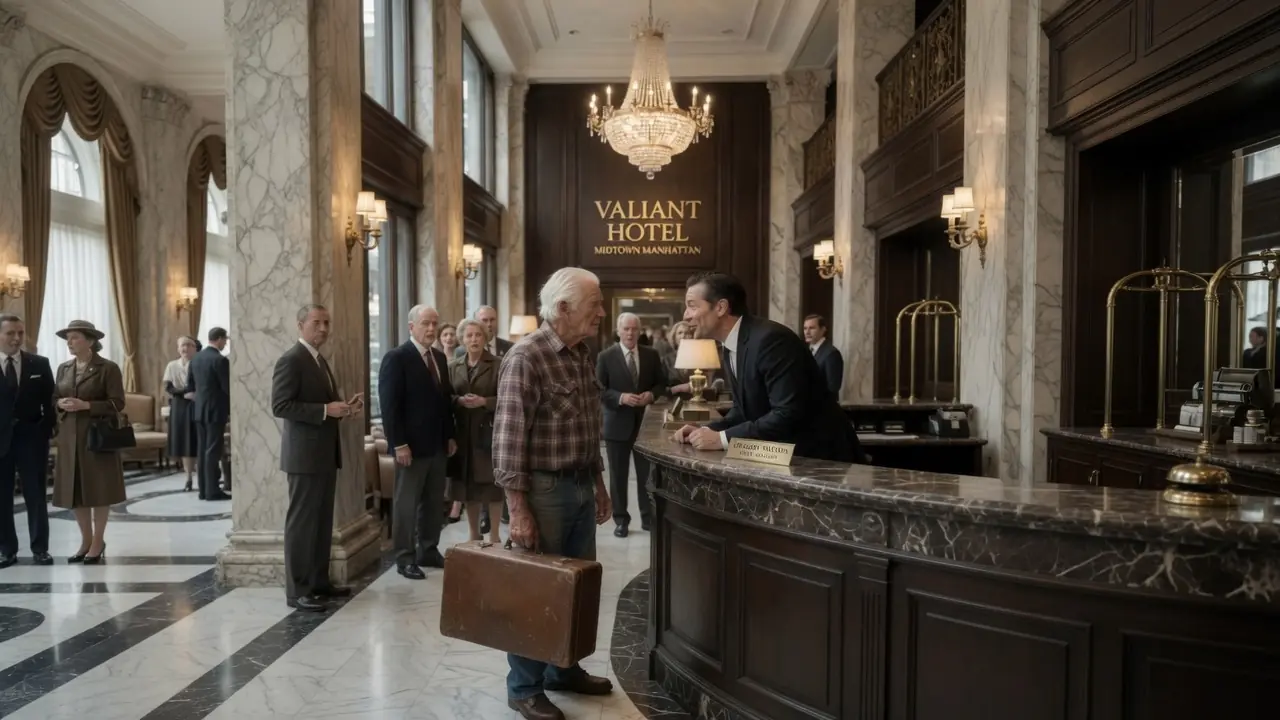
Samuel removed the folder and opened it carefully.
His hands were old, but they did not shake.
He placed the first document on the counter and turned it toward Gregory.
At the top were the words Whitaker Hospitality Holdings.
Below them were signatures, seals, and a controlling ownership agreement listing Samuel Elias Whitaker as majority owner and chairman emeritus.
Gregory glanced at it, then frowned.
For one second, his arrogance tried to protect him.
Then his eyes moved across the page again, slower this time.
The color drained from his face.
He looked at Samuel, then at the document, then at Samuel again.
His mouth opened, but no words came out.
Samuel placed a second document beside the first.
“This is the ownership structure of the Valiant Hotel chain.”
He placed a third page on top of it.
“This is your management contract.”
Then he placed a final sheet in front of Gregory, crisp and unsigned.
“This is the termination authority granted to me by the board.”
The lobby did not breathe.
Gregory’s hand moved toward the document, but he stopped before touching it.
His voice came out thin.
“Mr. Whitaker?”
Samuel looked at him quietly.
“Yes.”
Gregory swallowed hard.
“You own the Valiant Hotel chain?”
Samuel closed the folder halfway.
“I own enough of it to know when its name is being disgraced.”
Behind him, someone whispered, “Oh my God.”
Another guest lifted a phone higher.
The security guards stepped back, both of them suddenly very interested in the marble floor.
Gregory tried to recover his posture.
It was painful to watch.
His shoulders straightened, his chin lifted, and his voice searched for the smooth confidence that had failed him.
“Mr. Whitaker, there has clearly been a misunderstanding.”
Samuel’s eyes did not move.
“There was no misunderstanding.”
Gregory forced a weak smile.
“I did not recognize you.”
“That is exactly why I came.”
Gregory’s smile broke.
Samuel let the words settle over the counter, over the lobby, over every employee listening from the edges of the room.
Then he continued in the same quiet tone.
“My wife built the first Valiant Hotel on a simple rule,” Samuel said.
“No guest should have to prove they are worthy of basic respect.”
His fingers rested on the photograph of Eleanor.
“She believed a hotel is judged not by how it treats the rich, but by how it treats the tired, the lost, the grieving, and the ordinary.”
He looked at Gregory’s nameplate.
“You failed that rule before I gave you my name.”
Gregory’s face reddened.
“Sir, I was protecting the property.”
Samuel’s eyes narrowed.
“No. You were protecting your pride.”
A few people in the lobby shifted, and the words seemed to strike harder than shouting.
“You looked at my shirt and decided I was poor. You looked at my boots and decided I was dirty. You looked at my suitcase and decided I was a problem.”
Gregory looked toward the watching guests.
The phones made him nervous now.
“Please, Mr. Whitaker, can we discuss this privately?”
Samuel shook his head.
“You humiliated me publicly.”
Then he glanced around the lobby.
“So the correction will be public too.”
A senior woman in a dark blazer appeared from the elevator bank.
Her name was Marlene Cross, regional director of operations, and she had been upstairs preparing for a corporate meeting.
She stopped when she saw Samuel at the desk.
Her face changed from confusion to shock to horror in three quick seconds.
“Mr. Whitaker,” she said, rushing forward.
“I had no idea you had arrived.”
Samuel turned to her.
“That was the point, Marlene.”
Marlene looked at Gregory, then at the documents, then at the guests watching.
Her jaw tightened.
“Gregory, what happened?”
Gregory said nothing.
Samuel answered for him.
“Mr. Madson told me I did not belong here.”
Marlene’s face hardened.
“He said what?”
Samuel continued, “He called me a poor old man, mocked my suitcase, and threatened to have security drag me out.”
Marlene slowly turned toward Gregory.
Her expression was no longer shocked.
It was controlled fury.
Gregory lifted both hands.
“I did not know who he was.”
Marlene’s voice was cold.
“And that is your defense?”
Gregory looked trapped.
Samuel watched him without satisfaction.
He had not come to destroy a man for sport.
He had come to see whether dignity still lived inside the company that carried Eleanor’s dream.
A young housekeeper stood near the hallway with tears in her eyes.
Samuel noticed her before anyone else did.
She was gripping a stack of towels too tightly, as if she had heard this kind of voice before and felt it in her bones.
Samuel looked from her to Gregory.
He understood then that this moment was bigger than one insult.
Cruelty rarely appears for the first time in public.
“Marlene,” Samuel said.
“Yes, sir.”
“I want employee complaints from this property reviewed for the past eighteen months.”
Gregory flinched.
Samuel did not look away from him.
“I want every dismissal, every resignation, every guest complaint involving disrespect, discrimination, or intimidation placed on my desk by tomorrow morning.”
Marlene nodded.
“Yes, sir.”
Gregory tried again.
“Mr. Whitaker, I have given eight years to this company.”
Samuel’s face softened only slightly.
“Then you had eight years to learn what this company stands for.”
Gregory’s eyes dropped.
The lobby remained still.
Then Samuel picked up Gregory’s nameplate from the desk.
It was heavier than it looked, polished brass, engraved with authority that Gregory had worn like armor.
Samuel held it for a moment, then set it gently beside the termination document.
“Effective immediately, you are suspended pending review.”
Gregory looked up sharply.
“Suspended?”
Samuel’s voice hardened. “Be grateful I am still allowing review.”
Marlene stepped beside the desk.
“Gregory, please leave your keys and access card.”
The words hit him like a door closing.
For the first time since Samuel had entered, Gregory looked small.
He removed the card from his jacket pocket, then the keys from his belt, and placed them on the counter.
No one laughed.
Samuel would not have allowed it if they had.
Gregory walked from behind the desk into the same lobby where he had tried to shame an old man minutes earlier.
The guests parted silently.
He passed Samuel without meeting his eyes.
At the revolving doors, he paused as if he wanted to say something.
But nothing useful came to him, so he stepped outside into the rain.
Only then did the lobby begin to murmur.
Samuel turned to the two security guards.
Both looked terrified.
He stepped toward them, and they straightened.
“What are your names?” he asked.
“Daniel, sir,” said the first.
“Marcus,” said the second.
Samuel nodded.
“Did either of you touch me?”
“No, sir,” Marcus said quickly.
“Did either of you insult me?”
“No, sir.”
Samuel looked at them for a long moment.
“Next time a manager orders you to remove someone who has done nothing wrong, you may ask one question first.”
Daniel swallowed.
“What question, sir?”
Samuel said, “What rule did they break?”
The guards nodded.
Samuel’s voice softened.
“Authority does not excuse you from judgment.”
Then he turned toward the young housekeeper near the hallway.
“You there.”
She startled.
“Yes, sir?”
“What is your name?”
“Lucia, sir.”
Samuel noticed her hands trembling around the towels.
“Lucia, have you seen guests treated this way before?”
The whole lobby seemed to tighten.
Lucia looked at Marlene, then at the floor.
Marlene spoke gently.
“You may answer honestly.”
Lucia’s eyes filled.
“Yes, sir.”
Samuel closed his eyes for one second, and the pain in his face was deeper than anger.
“How often?”
Lucia whispered, “Often enough that staff stopped being surprised.”
That sentence did more damage to Gregory Madson than the documents had.
Samuel nodded slowly.
“Thank you for telling the truth.”
Lucia wiped her cheek quickly with the back of her hand.
Samuel looked at Marlene.
“Lucia will be part of the review. So will front desk staff, housekeeping, bell staff, kitchen, security, and maintenance. No retaliation.”
Marlene answered immediately.
“Understood.”
A man in a tailored coat stepped forward from the crowd.
“I filmed the entire thing,” he said.
“I can delete it if you prefer, Mr. Whitaker.”
Samuel looked at him.
The lobby waited.
Then the old farmer gave a tired smile.
“No. Keep it.”
Marlene’s eyes widened slightly.
Samuel explained before she could speak.
“People should see what happened here. Not because I enjoy embarrassment, but because companies keep secrets until someone records the truth.”
He looked around the lobby at every employee and guest.
“But let them also record what happens next.”
His voice lifted just enough to carry across the marble floor.
“This hotel will not answer cruelty with more cruelty,” Samuel said.
“We will answer it with correction.”
He looked at the staff first, then the guests.
“Every employee here will receive new training on dignity, bias, and guest care. Every complaint that was ignored will be reopened. Every manager in this chain will be reminded that luxury is not permission to despise ordinary people.”
No one clapped at first.
The words were too heavy for applause.
Then the woman in the cream coat began softly.
The bellman joined.
Within seconds, applause moved through the lobby, not loud like celebration, but steady like agreement.
Samuel did not smile.
He only nodded once.
Marlene personally checked him into the Whitaker Suite.
Samuel almost refused the ceremony of it, but he allowed her to escort him because the staff needed to see the truth completed.
As they walked toward the elevator, the bellman reached for Samuel’s suitcase.
Samuel handed it over with a grateful nod.
“Careful with that,” he said.
“It’s older than half the buildings in this city.”
The bellman smiled nervously.
“Yes, sir.”
Samuel looked at him.
“What’s your name?”
“Eddie, sir.”
“Thank you, Eddie.”
The young man stood a little taller.
The Whitaker Suite looked out over Manhattan from the top floor.
It had tall windows, cream walls, dark wood furniture, fresh flowers, and a piano Eleanor had chosen herself years before.
Samuel entered slowly, removed his cap, and placed the framed photograph of his wife on the writing desk.
Outside, the city moved like it had no memory.
Inside, Samuel let himself feel tired.
By evening, the video had spread everywhere.
The headline wrote itself before any reporter touched it: Hotel Manager Tells Poor Old Farmer He Doesn’t Belong — Learns He Owns the Chain.
Millions watched Gregory lean over the counter and say, “Look at you, poor old man.”
Millions watched Samuel open the suitcase.
Millions watched the lobby go silent.
Some laughed at Gregory, some praised Samuel, and some argued as strangers always do online.
Samuel ignored most of it.
The next morning, he sat in the conference room with Marlene, the company counsel, two board members, and Lucia from housekeeping.
On the table were printed complaints, exit interviews, ignored emails, and guest statements.
Gregory’s behavior had not been a single mistake.
It had been a pattern polished into professionalism.
Samuel read every page.
By noon, Gregory Madson was terminated.
But Samuel did not stop there.
He created a policy named after Eleanor, though he did not allow marketing to turn it into a slogan.
The Eleanor Standard required every Valiant property to treat a guest’s dignity as part of the room they paid for, and part of the lobby they entered even before they paid.
Managers would be reviewed not only by revenue, but by employee trust and guest respect.
Anonymous staff reporting would go directly to regional leadership instead of dying under local managers.
Lucia was promoted six months later into guest relations.
Daniel and Marcus became trainers for security de-escalation.
Eddie the bellman received a scholarship through the company’s hospitality education fund.
Marlene Cross became chief operations officer the following year.
The Valiant Hotel in Midtown Manhattan became profitable again, not because Samuel went viral, but because people could feel the difference when they walked in.
Samuel returned to his Missouri farm after three days.
He took off the city coat Marlene had insisted he use and went back to feeding cattle before sunrise.
The old suitcase returned to the shelf beside the mudroom door.
His boots returned to the porch.
Yet something from Manhattan stayed with him.
A month later, an envelope arrived from Lucia.
Inside was a handwritten note and a photograph of the lobby staff standing together beneath the chandelier.
The note said, “Mr. Whitaker, thank you for seeing us before you saw the hotel.”
Samuel read that line three times.
Then he placed it beside Eleanor’s photograph.
Years later, people still told the story of the old farmer at the Valiant Hotel.
Some told it as a revenge story.
Some told it as a lesson about not judging by appearances.
Some told it because they loved the moment Gregory’s face went pale.
But Samuel never told it that way.
When asked about that day, he always shook his head and said the same thing.
“The point was never that I owned the hotel,” he would say.
“The point was that I should not have needed to.”
And that was the lesson the Valiant Hotel never forgot.
A man in faded flannel walked into a marble lobby and asked for the room that already belonged to him.
A manager saw poverty because he did not know how to recognize dignity.
Then an old farmer opened a suitcase, and the whole room learned that power does not always arrive in a suit.
Sometimes it comes in dusty boots, holding a scratched leather suitcase, waiting quietly to see who you really are.