Samuel Whitmore had promised his granddaughter that the Christmas tree at The Aurelius New York would look like a piece of winter sky brought indoors. He told Emily that thousands of white lights would cover its silver branches, while glass stars would hang so delicately that they seemed to float in the air. He also told her that her grandmother, Margaret, had designed the first version of that tree more than thirty years earlier. What Samuel did not tell her was that he had avoided entering the hotel since the day Margaret died.
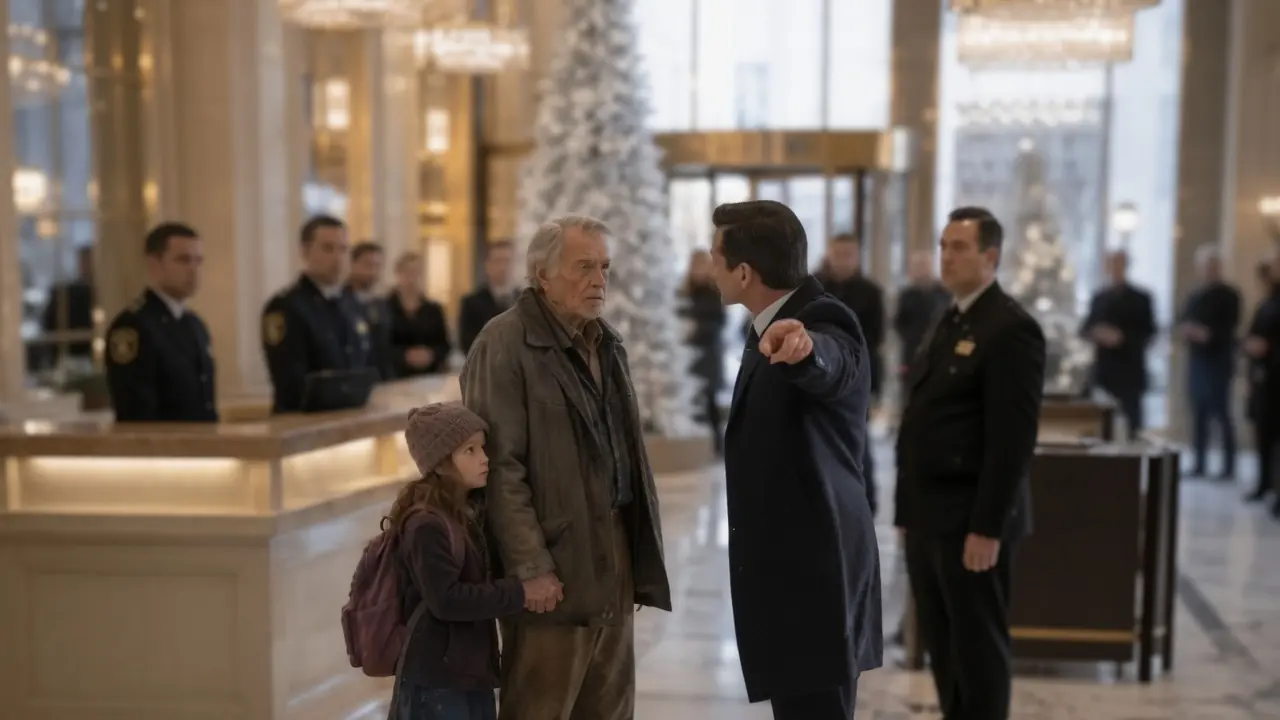
The cold December wind followed them along Fifth Avenue as evening settled over Manhattan. Samuel wore a faded brown coat that had belonged to him for nearly twenty years, while Emily wore a knitted hat, an inexpensive wool jacket, and a small backpack with one broken zipper. They had taken the train from Queens because Samuel no longer trusted himself to drive through city traffic. Emily held his hand tightly as pedestrians rushed past them beneath decorated storefronts.
“Is it really taller than our building?” she asked.
“Not quite.”
“Grandpa, our building only has four floors.”
“Then perhaps I have exaggerated slightly.”
Emily smiled. “You always do that when you tell stories.”
Samuel looked down at her and felt a familiar ache beneath his ribs. She had Margaret’s curious gray eyes and the same habit of tilting her head whenever she suspected someone was hiding part of the truth. Emily’s mother, Samuel’s only daughter, had died two years earlier after a brief illness, leaving the child in his care. Since then, Samuel had learned how to pack school lunches, braid hair badly, and hide his grief until Emily had gone to sleep.
He had also learned that children remembered promises adults considered small.
Margaret had spoken often about taking Emily to see the tree when she became old enough to understand its history. She had designed it when The Aurelius was still being rebuilt from an aging commercial building into one of New York’s most celebrated hotels. The tree became a permanent holiday tradition, appearing every December in the marble lobby beneath crystal chandeliers.
Margaret never saw the final renovation completed.
Cancer took her during the hotel’s second year of construction. Samuel attended the opening alone and stood beneath the silver tree while strangers praised its beauty. He left after ten minutes and never returned.
Until that evening.
The Aurelius rose above the avenue in limestone, brass, and illuminated glass. Uniformed attendants opened car doors while guests entered beneath a canopy lined with white lights. Through the enormous front windows, Emily could already see the upper branches of the Christmas tree.
Her mouth opened.
“Grandma made that?”
“She imagined it.”
“That means she made it first inside her head.”
Samuel squeezed her hand. “Exactly.”
They approached the revolving doors.
A doorman looked at Samuel’s worn coat, Emily’s scuffed boots, and the small backpack. His professional smile weakened, though he did not block them. Samuel thanked him and guided Emily into the lobby.
Warm air surrounded them.
The marble floor reflected hundreds of lights from the chandeliers above. Gold columns rose toward an ornate ceiling, and a string quartet played near the lounge. Guests in expensive coats paused for photographs beside the towering silver tree.
Emily stopped walking.
The tree reached nearly three stories, its branches covered with white ornaments, crystal birds, and delicate stars. A spiral of lights moved upward like a frozen river beneath moonlight. At the top rested one large glass star with a blue center.
Samuel felt Margaret beside him.
Not as a ghost, but as memory.
He remembered her sitting at their kitchen table with pencils scattered around her, sketching branches on tracing paper. She had rejected ordinary red and green decorations because she wanted the tree to make tired travelers feel as though they had stepped into a quiet snowfall. Samuel had built the first wooden model for her in their garage.
Emily pulled his hand. “Can we go closer?”
“Yes.”
They walked toward the tree, careful not to disturb the guests taking photographs. Emily studied each decoration with solemn attention. Samuel pointed toward a small silver bird near the lower branches.
“Your grandmother designed that one after a sparrow landed on our kitchen window.”
Emily leaned closer. “Did she make all of them?”
“She drew the first designs. Artists made the glass.”
“Did they put her name somewhere?”
Samuel looked toward the brass plaque near the base of the tree.
The plaque had once read: Original Holiday Design by Margaret Whitmore.
Now it displayed only a list of corporate sponsors.
His expression changed.
Emily noticed. “What’s wrong?”
“Nothing.”
“That means something.”
Before Samuel could answer, a man in a dark navy suit approached them.
Victor Lang was forty-six, polished, athletic, and proud of the silver hotel pin attached to his lapel. He had managed The Aurelius for less than a year but spoke as though he had personally placed every stone in the building. He stopped several feet from Samuel and looked him over without attempting to hide his suspicion.
“May I help you?” Victor asked.
Samuel recognized the tone.
It was not an offer.
“My granddaughter wanted to see the tree,” he said.
Victor looked toward Emily. “Are you hotel guests?”
“No.”
“Do you have a restaurant reservation?”
“No.”
“Are you meeting someone?”
Samuel kept his voice calm. “We are only looking.”
Victor glanced toward the nearby guests. Several had already noticed the conversation.
“The lobby is reserved for registered guests and patrons,” he said.
A couple walked past carrying shopping bags without being questioned.
Samuel watched them, then looked back at Victor. “They do not appear to be registered guests.”
Victor’s jaw tightened. “I am not discussing other visitors.”
“Then why discuss us?”
Emily moved closer to Samuel.
Victor lowered his voice. “Sir, this property attracts people who enter during the holidays hoping to solicit money from wealthy guests. We have strict policies.”
Samuel looked at his granddaughter’s backpack. “Do you see us asking anyone for money?”
“Not yet.”
Emily’s fingers tightened around Samuel’s hand.
He felt anger rising, but he controlled it. He had promised her a memory connected to Margaret, not a public argument with a stranger.
“We will look at the tree for five minutes and leave,” Samuel said.
Victor stepped into their path. “No.”
The word carried enough force to draw more attention.
A security officer near the reception desk began watching. Two employees behind the counter exchanged uncertain glances, while the quartet continued playing as if nothing had happened.
Emily looked up at Samuel. “Grandpa, we can go.”
The fear in her voice made his anger sharper.
Samuel faced Victor. “You are frightening a child.”
“I am enforcing hotel policy.”
“Which policy permits you to accuse an elderly man and his granddaughter of begging?”
Victor’s eyes hardened. “Your clothing, your lack of a reservation, and your behavior indicate that you do not belong in this lobby.”
Samuel looked down at his old coat.
Margaret had bought it for him on their twentieth wedding anniversary. One sleeve had been repaired twice, and the lining had torn near the pocket. He could easily afford another, but wearing it still felt like carrying something she had touched.
Emily’s coat came from a discount store.
Her boots were worn because she grew quickly and Samuel refused to replace them two months before spring unless necessary. None of those facts explained character, intention, or worth.
Victor saw only evidence of exclusion.
Samuel’s voice became quieter. “My granddaughter came to see something her grandmother created.”
Victor gave a dismissive laugh. “I have heard many stories from people trying to remain inside expensive properties.”
“That tree was designed by Margaret Whitmore.”
Victor looked toward it. “The holiday installation was commissioned by Aurelius Hospitality.”
“After Margaret completed the original design.”
“Sir, I know this hotel’s history.”
Samuel studied him. “Do you?”
The question irritated Victor more than an accusation would have.
He turned toward the security officer. “Mr. Cole.”
The officer approached.
His name was David Cole, and unlike Victor, he looked uncomfortable. He was in his early thirties, broad-shouldered, and careful to keep his hands visible.
Victor pointed toward Samuel and Emily. “Escort them outside.”
David hesitated. “They haven’t caused a disturbance.”
“I am giving you an instruction.”
Samuel looked at the officer. “You do not need to touch us.”
Emily clung to his arm.
Victor stepped closer. “Leave now, or security will remove both of you.”
Samuel looked at him for a long moment.
Then he asked, “What is your full name?”
Victor almost smiled. “Victor Lang, general manager.”
“And you personally authorize our removal?”
“Yes.”
“Please say the reason clearly.”
Victor glanced toward the guests listening nearby. His pride would not allow him to retreat.
“You entered without a reservation, appear unable to purchase any service, and are making guests uncomfortable.”
A woman standing near the tree spoke softly to her husband. “They were not bothering anyone.”
Victor ignored her.
Samuel reached inside his coat.
David Cole moved slightly, but Samuel raised one empty hand.
“I am retrieving a document.”
Victor laughed. “A document will not change the dress code.”
“There is no lobby dress code,” said a young receptionist from behind the desk.
Victor turned sharply. “Lauren, return to your duties.”
Lauren Brooks lowered her eyes but did not withdraw the statement.
Samuel removed an old brown envelope from the inner pocket of his coat. The paper was worn at the edges and protected inside a clear plastic sleeve. He had not carried it to threaten anyone.
He had intended to show Emily.
Inside were Margaret’s original sketches, a photograph of the building before renovation, and a copy of the land deed she had insisted Samuel preserve. The hotel company owned the structure, but the land beneath it had never been sold.
Samuel’s family still held it through the Whitmore Property Trust.
Decades earlier, Aurelius Hospitality had signed a ninety-nine-year ground lease with Samuel and Margaret. The arrangement allowed the company to construct and operate the hotel while paying the trust annually. It also included strict clauses concerning historical attribution, public access during designated cultural displays, and conduct that could damage the property’s legacy.
Victor knew none of this.
Most hotel managers did not need to.
Corporate legal staff handled the lease, and annual payments passed through accounting without appearing in ordinary property records. Samuel had avoided involvement for years because the memories attached to the building were painful.
He opened the envelope and removed the deed.
Victor barely looked at it. “You expect me to believe that old paper gives you permission to loiter?”
“No,” Samuel said. “It gives me ownership of the land beneath your shoes.”
The lobby became silent around them.
Victor’s expression remained confident for two seconds longer, then uncertainty entered his eyes.
“That is absurd.”
Samuel unfolded the document.
The original owner line bore the names Samuel and Margaret Whitmore. A later amendment placed the property into the Whitmore Family Trust, with Samuel listed as surviving trustee. The hotel’s legal description appeared beneath the embossed county seal.
Victor did not read it carefully.
He pointed toward the door again. “Anyone can produce a false document.”
Samuel nodded. “That is why I asked your name.”
He removed his phone.
Victor’s face tightened. “Who are you calling?”
“The attorney responsible for your company’s ground lease.”
Samuel dialed a number he had not used in nearly three years.
Margaret Sloan answered on the second ring.
She was not related to Samuel’s wife, though the shared first name had once amused both women. Margaret Sloan had represented the Whitmore trust for nearly twenty-five years and had repeatedly encouraged Samuel to review how Aurelius Hospitality maintained the original agreement.
“Samuel?” she said. “Is everything all right?”
“I am inside The Aurelius with Emily.”
A pause followed.
“You went back?”
“I did.”
“How was the tree?”
Samuel looked toward Victor. “We were not permitted to see it.”
Margaret’s voice changed. “Explain.”
Samuel placed the call on speaker.
He described Victor’s accusation, the threat of physical removal, and the absence of Margaret Whitmore’s name from the tree plaque. The guests around them listened openly now.
Margaret remained silent until he finished.
Then she asked, “Is the general manager present?”
Victor looked toward the phone. “This is Victor Lang.”
“Mr. Lang, I am Margaret Sloan, counsel for the Whitmore Property Trust.”
Victor folded his arms. “I cannot verify that.”
“You do not need to. Your corporate counsel will do it momentarily.”
As if summoned by the sentence, Lauren Brooks approached from the reception desk carrying a tablet.
“Mr. Lang,” she said, “corporate legal is calling.”
Victor did not take the device.
“Tell them I’m handling a security issue.”
Lauren looked pale. “They asked for you immediately. They mentioned the Whitmore lease.”
The confidence left Victor’s face.
Samuel watched without satisfaction.
He had not wanted revenge. He had wanted Emily to stand beneath a tree connected to the grandmother she barely remembered. Victor had transformed that quiet wish into a public test of ownership because he could not imagine dignity existing without visible wealth.
Victor accepted the tablet.
“This is Lang.”
Everyone near him heard only his side of the conversation.
His expression changed rapidly.
“Yes, I understand.”
A pause.
“No, I did not know he was the trustee.”
Another pause.
“I was enforcing lobby access.”
His shoulders lowered.
“No, I have not reviewed that specific clause.”
Victor looked toward Samuel.
“Yes, he is still here.”
The call ended.
The manager held the tablet at his side.
Samuel waited.
Victor forced the words out. “Corporate counsel confirmed the deed.”
Emily looked up at her grandfather.
“You own the hotel?”
“No,” Samuel said. “I own the ground beneath it.”
She considered that. “That seems more important.”
Several guests smiled.
Victor did not.
The entrance doors opened, and a woman in a charcoal coat entered quickly with two corporate employees behind her. She was Elena Marlowe, chief legal officer of Aurelius Hospitality. Samuel recognized her from annual reports but had never met her in person.
Elena approached and extended her hand.
“Mr. Whitmore, I am deeply sorry.”
Samuel shook it. “For which part?”
Her expression tightened because the question was fair.
“For Mr. Lang’s conduct, the failure to maintain the historical plaque, and the fact that your first return to this property became an act of humiliation.”
Victor stepped forward. “Elena, I made a reasonable security decision based on—”
“Stop,” she said.
One word silenced him.
Elena looked toward David Cole and Lauren Brooks. “Were Mr. Whitmore and the child soliciting guests?”
“No,” David answered.
“Were they disruptive?”
“No.”
“Did they refuse a lawful security request?”
Lauren spoke next. “Mr. Whitmore only asked to see the tree.”
Elena turned toward Victor. “Then your decision was based on appearance.”
Victor looked around the lobby, realizing every employee and guest now understood the same truth.
“I was protecting the hotel’s image,” he said.
Samuel’s voice remained steady. “From an old man and a child?”
Victor did not answer.
Emily had remained silent until then.
She looked toward the manager. “You said we made people uncomfortable.”
Victor’s face tightened.
Emily continued, “But you were the only one being mean.”
The simplicity of the sentence struck harder than anything Samuel or Elena could have said.
Victor lowered his eyes.
Elena requested his hotel credentials and suspended him pending investigation. He attempted to argue that immediate discipline would undermine management authority, but Elena refused to discuss the matter in front of guests.
David Cole escorted Victor away from the lobby.
This time, the security officer did not look uncomfortable.
Samuel watched the man disappear through a staff corridor. He felt no pleasure, only exhaustion. Margaret had always said cruelty exposed itself most clearly when consequences finally reversed direction.
Elena turned toward the tree.
“The plaque should never have been removed.”
“What happened to it?” Samuel asked.
A marketing renovation two years earlier replaced historical credits with sponsor information. The design team apparently considered the old plaque visually outdated. No one reviewed the ground lease clause requiring permanent acknowledgment of Margaret Whitmore’s original contribution.
Samuel looked at the blank sponsor list.
“They erased her name because it interrupted the branding.”
Elena did not defend the decision. “Yes.”
Emily squeezed his hand. “Can we put it back?”
Elena crouched slightly so she could meet the child’s eyes. “We will.”
“Today?”
The executive glanced toward Samuel.
He smiled faintly. “She has inherited her grandmother’s patience.”
“I don’t think that means yes,” Emily said.
Elena almost laughed. “We can install a temporary plaque today and restore the original properly within one week.”
Emily nodded. “That is acceptable.”
Samuel looked toward the tree again.
The blue-centered star at the top had been Margaret’s favorite element. She designed it after the winter night they first learned they were expecting their daughter. To her, the blue light represented finding one fixed point when life became uncertain.
He had not remembered that until now.
“Would you like to see the original sketches?” he asked Emily.
Her eyes widened.
Samuel opened the envelope and removed the drawings.
They sat together on a bench near the tree while guests moved around them. Emily studied every pencil line, handwritten note, and tiny measurement. One page contained Margaret’s instruction for the glass birds.
They should appear ready to fly, not trapped on the branches.
Emily traced the sentence gently.
“She wrote like Mom.”
“Your mother wrote like her.”
“Do I write like them?”
“You write like a hurricane.”
She smiled.
Elena returned twenty minutes later with the hotel’s archivist, Helen Ward. Helen was an older woman who had worked at The Aurelius since its opening. The moment she saw Samuel, tears entered her eyes.
“I wondered whether you would ever come back.”
“So did I.”
Helen embraced him.
She remembered Margaret well. She described the nights Margaret stayed in the unfinished lobby adjusting light positions and arguing that the tree should feel beautiful to children before it impressed adults. Helen had kept several photographs and early design notes in the hotel archive.
Emily listened to every word.
By late afternoon, staff installed a temporary brass-colored plaque beneath the tree.
The Aurelius Holiday Tree was originally designed by Margaret Whitmore, whose vision transformed this lobby into a place of winter wonder. Her work remains part of the hotel’s permanent legacy.
Samuel read it twice.
Emily took a photograph.
Then she asked an employee to take one of her and Samuel standing beside the tree. In the picture, Samuel’s coat still looked old, Emily’s boots remained scuffed, and the magnificent hotel surrounded them with light.
Nothing about their clothing changed.
Only other people’s understanding did.
The corporate investigation began the following morning.
Victor’s treatment of Samuel was not an isolated event. Complaints showed that he had ordered staff to remove elderly visitors, delivery workers, tourists with inexpensive clothing, and families who entered only to view seasonal displays. He created an unofficial appearance policy despite corporate rules guaranteeing public lobby access during holiday hours.
Several employees had objected.
Victor reduced their shifts or threatened poor performance reviews. Lauren Brooks had documented three incidents but was instructed to remove them from official records. David Cole admitted he had followed previous removal orders because he feared losing his job.
The hotel terminated Victor’s employment.
Elena offered Lauren a role in guest-relations compliance and promoted David to shift supervisor after he completed additional training. Every employee received new instruction emphasizing behavior-based security decisions rather than assumptions connected to clothing, age, disability, race, or visible income.
Samuel demanded more than training.
The Whitmore trust issued a formal lease compliance notice requiring the hotel to restore all historical acknowledgments, guarantee public holiday access, and establish an independent process for reporting discriminatory treatment. Aurelius Hospitality had sixty days to respond.
Some board members resisted.
They argued Samuel was using a personal incident to interfere with operations. Elena reminded them that the ground lease gave the trust significant authority and that Victor’s behavior exposed the company to legal, financial, and reputational risk.
The board approved every change.
Samuel did not threaten to terminate the lease.
Doing so would damage thousands of employees who had no role in the humiliation. Instead, he used the rights Margaret helped preserve to ensure the hotel returned to the values built into its beginning.
One month later, The Aurelius hosted a small ceremony beneath the tree.
The restored original plaque had been cleaned and mounted at the base. Beside it, the hotel installed a photograph of Margaret holding the first glass bird. The display also explained that the lobby remained open to the public during designated holiday hours.
Samuel nearly refused the invitation.
Emily insisted.
“You promised Grandma’s tree was for everyone,” she told him. “We should see if they mean it.”
They arrived wearing the same coats.
A new manager named Jasmine Ellis met them near the entrance. She recognized Samuel but greeted the tourists behind him with equal courtesy. No one asked whether they had reservations before allowing them to approach the tree.
That mattered more to Samuel than the ceremony.
After the speeches, he noticed an elderly woman near the revolving doors. Her coat was thin, and she carried two plastic shopping bags. She stood uncertainly while looking toward the decorations.
A security officer approached her.
Samuel watched.
“Would you like to see the tree?” the officer asked.
The woman nodded.
“I can hold those bags if they’re heavy.”
She smiled and entered.
Samuel looked toward Elena.
She had noticed too.
“That is what the hotel should have been,” he said.
“That is what we are trying to become.”
Emily pulled him toward the tree before he could answer.
They sat on the same bench and looked through Margaret’s sketches again. Emily had placed copies inside a new folder decorated with silver stars. She said she wanted to become a designer, though the previous week she had wanted to be a veterinarian.
“You may become both,” Samuel said.
“Can a veterinarian design Christmas trees?”
“Your grandmother would have found a way.”
A year passed.
Samuel returned to The Aurelius the following December without fear. Emily helped the hotel’s design team create a small children’s ornament display inspired by Margaret’s glass birds. Her name appeared on a plaque, though she repeatedly checked to ensure her grandmother’s name remained larger.
The lobby became known for its open holiday afternoons.
School groups, elderly residents, tourists, hotel guests, and families from shelters visited the tree without being separated by status. The hotel served hot chocolate at no cost during two evenings each week, funded jointly by Aurelius Hospitality and the Whitmore trust.
Victor Lang never returned.
Months after his dismissal, he sent Samuel a letter.
He wrote that losing his position forced him to confront how thoroughly he had confused wealth with worth. He claimed pressure from wealthy guests and corporate expectations had shaped his decisions. Samuel believed some of it, but not all.
Pressure revealed character more often than it created it.
Samuel sent one response.
The lesson was never that you should have recognized the landowner. The lesson was that you should not need a deed before treating someone with dignity.
He received no reply.
That was enough.
On the second anniversary of their first visit, Samuel and Emily stood beneath the blue-centered star as snow fell beyond the windows. The lobby was crowded, but no one hurried them. A young employee offered to take their photograph.
Samuel looked at Emily.
She had grown taller, and her boots were new, though the same small backpack rested on her shoulders. She held Margaret’s original sketch inside a protective folder.
“Ready?” the employee asked.
Emily leaned against Samuel.
“Yes.”
The camera flashed.
Years earlier, Margaret had designed the tree because she wanted weary travelers to feel wonder when they entered the hotel. Victor Lang believed the lobby’s beauty belonged only to people wealthy enough to purchase it.
Samuel’s deed changed the balance of power.
But the deed was never the most important truth revealed that day.
The most important truth was that Emily had entered holding her grandfather’s hand and asking for nothing except permission to remember someone she loved. Victor saw worn clothing and decided they threatened the hotel’s image.
Samuel saw the tree, the child beside him, and the promise he had carried for years.
When the manager ordered them into the cold, Samuel revealed the name controlling the land beneath the entire building. The lobby fell silent because everyone suddenly understood that the elderly man possessed power.
But Samuel never forgot how they treated him before they knew.
That was the part that changed everything.