Richard Morgan arrived at the Grand Aurelia Hotel shortly after four on a cold Thursday afternoon. He wore a faded brown jacket, a wrinkled plaid shirt, beige trousers repaired at one knee, and leather shoes so worn that rain had darkened the toes. A wooden cane supported his left side, while an old travel bag hung from his right hand. Nothing about him suggested that his signature appeared on the ownership documents for the entire building.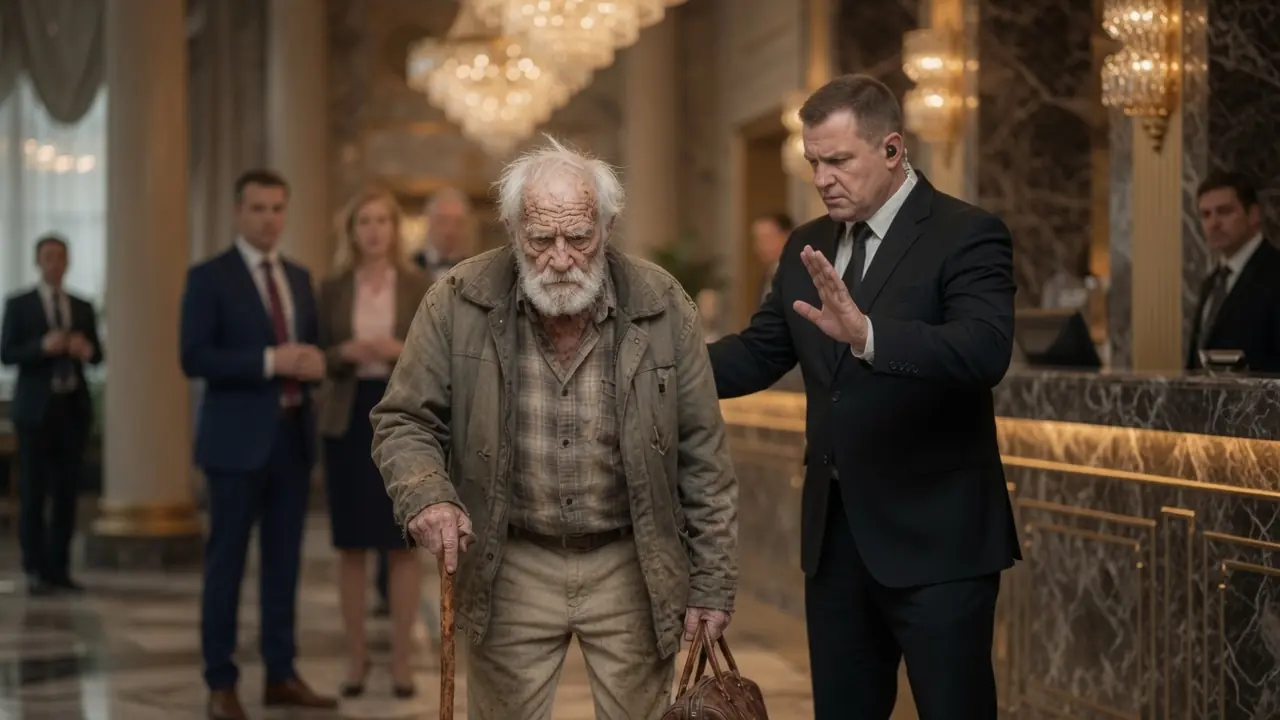
The Grand Aurelia stood in the center of Philadelphia like a monument to expensive confidence. Crystal chandeliers hung above black marble floors, polished gold counters reflected every movement, and fresh white orchids decorated tables beneath enormous framed mirrors. Wealthy guests entered beneath a covered driveway where attendants opened car doors before the vehicles fully stopped. Richard paused outside the revolving entrance and studied the hotel he had not visited publicly in nearly four years.
He had purchased the property fifteen years earlier through Morgan Hospitality Holdings. At the time, the hotel was old, nearly bankrupt, and known only for its beautiful ballroom and failing plumbing. Richard invested heavily, restored the historic interior, protected more than three hundred jobs, and allowed professional executives to manage daily operations. He avoided public photographs because he believed hotels should become known for their service rather than the face of the person collecting profits.
During the previous year, the reports reaching his private office had changed. Older guests complained that employees ignored them, visitors wearing simple clothing were questioned by security, and several job applicants said managers judged them before reviewing their experience. One elderly veteran claimed he was removed from the lobby while waiting for his daughter because a supervisor believed he was homeless. Every complaint had been marked investigated and resolved.
Richard did not trust the word resolved when the same accusation kept returning. He requested security footage, employee statements, and internal records, but hotel general manager Edward Sloan insisted the complaints were misunderstandings. Edward claimed the Grand Aurelia still delivered the finest service in the city. Richard decided that reports written inside executive offices would no longer be enough.
He created an unannounced inspection with only two people knowing the plan. His attorney, Grace Whitman, waited in a nearby office with the ownership records, while regional director Claire Benton remained inside the hotel under an ordinary reservation. Richard left his driver, tailored suits, and assistants behind. He wanted to discover how the Grand Aurelia treated a man who appeared to possess nothing valuable.
The revolving door resisted slightly against his cane. A bell attendant saw Richard struggling but turned away to greet a couple stepping from a black limousine. Richard pushed harder and entered alone. Cold rain clung to his jacket, and a few drops landed on the polished marble beneath his shoes.
A receptionist named Olivia Price looked up from behind the gold front desk. She was thirty-two, perfectly dressed, and visibly skilled at producing smiles that changed according to the customer. Her expression brightened for a businessman wearing an expensive watch, softened politely for a well-dressed older couple, and disappeared completely when she noticed Richard. She glanced at his worn bag before looking toward the nearest security officer.
Richard approached the counter slowly. “Good afternoon.”
Olivia continued typing. “May I help you?”
“I would like a room for the evening.”
She finally looked at him directly. “Do you have a reservation?”
“No.”
“The hotel is extremely expensive.”
“I am aware.”
Olivia examined his jacket again. “The shelter on Jefferson Street begins accepting guests at six.”
Richard rested one hand on the counter. “I did not ask for a shelter.”
Several people waiting nearby turned toward them. Olivia lowered her voice, but her words still carried clearly across the quiet lobby. “Sir, rooms here begin at nine hundred dollars per night.”
“Then please show me what is available.”
“Payment is required.”
“That is generally how hotels operate.”
A young receptionist beside Olivia covered a surprised smile. Olivia noticed and became more rigid. “Do you have a valid credit card?”
Richard reached into his jacket. “I have sufficient payment.”
Before he could remove his wallet, Olivia stepped backward. “Please keep your hands where I can see them.”
The request silenced the second receptionist. Richard slowly returned his hand to the counter. He had spent seventy-six years learning that humiliation often arrived disguised as caution, policy, or concern. The person delivering it usually believed careful wording made cruelty respectable.
“I was reaching for my card,” Richard said.
“You entered without luggage suitable for a luxury reservation.”
Richard looked toward his weathered bag. “That is luggage.”
Olivia gave a small laugh. “That is not what our guests usually carry.”
“Does the hotel rent rooms to bags or people?”
Her face tightened. “You are becoming argumentative.”
“I am requesting service.”
A tall man in a black suit approached from the center of the lobby. His name badge identified him as Victor Kane, Director of Hotel Security. He was broad-shouldered, clean-shaven, and wearing an earpiece through which junior officers reported every movement in the building.
“What is the problem?” Victor asked.
Olivia gestured toward Richard. “He refuses to leave the desk.”
“I asked for a room.”
Victor looked him over from head to shoes. “This property is for registered guests.”
“I am attempting to become one.”
“We do not allow people to enter from the street and disturb customers.”
Richard glanced toward the revolving doors. “Every guest enters from the street.”
The younger receptionist looked down quickly. Victor stepped closer until his expensive cologne overwhelmed the faint smell of rain on Richard’s clothing. “Do not try to be clever with me.”
“I am trying to be clear.”
“Then clearly understand that you need to leave.”
Richard placed his old bag beside his shoe. “Call the general manager.”
Victor laughed. “Mr. Sloan does not interrupt his schedule for people who wander into the lobby.”
“Tell him Richard Morgan is waiting.”
Olivia and Victor exchanged a look. Neither name recognition nor concern appeared on their faces. Morgan Hospitality Holdings was publicly represented by a board and executive office, while Richard himself remained largely unknown outside business filings.
Victor folded his arms. “Anyone can invent a name.”
“Then call the corporate office.”
“We are not wasting anyone’s time.”
Richard glanced toward the clock above the front desk. “I have already waited nine minutes without being allowed to present payment.”
Olivia sighed loudly. “You are counting?”
“I count many things.”
One wealthy guest standing near the concierge desk laughed. “Perhaps he wants to write a review.”
Another man answered, “He probably wants free coffee.”
Richard heard both comments but did not turn. The employees heard them too and offered no correction. Their silence gave the guests permission to treat him as entertainment.
He lifted his bag again and moved toward a velvet chair near the lobby fireplace. Victor stepped in front of him. “Where do you think you are going?”
“To sit while you contact the manager.”
“You are not permitted to wait here.”
“Why?”
“Because paying guests use this area.”
“There are twelve empty chairs.”
Victor’s expression hardened. “Your appearance is making guests uncomfortable.”
Richard looked down at his old jacket. “Which part?”
“All of it.”
The answer came without hesitation. Victor reached for Richard’s bag, but Richard pulled it back before the security director could take it. The sudden movement drew attention from everyone nearby.
“Do not touch my belongings,” Richard said.
Victor leaned closer. “Leave now, old beggar. People like you do not belong here.”
The younger receptionist gasped quietly. Olivia stared at her computer as though she had heard nothing. Several guests lifted phones, not to defend Richard but to record whatever humiliation might happen next.
Richard’s hand tightened around his cane. “Call the corporate office before you touch me again.”
Victor smiled. “A man like you does not know anyone in this hotel.”
“I know every floor, every account, and the name of the employee I am about to remove.”
Laughter rose from the wealthy couple near the concierge desk. Victor’s smile widened because he believed Richard’s words proved confusion rather than authority. He motioned toward another security officer named Paul Jenkins.
“Escort him outside.”
Paul approached but did not immediately touch Richard. He was older than Victor, with calm eyes and the cautious manner of someone who had spent years preventing conflict rather than enjoying control. “Sir, have you threatened anyone?”
“No.”
“Refused lawful instructions?”
“I requested a room and asked for management.”
Paul looked toward Victor. “Then perhaps we should let the desk verify payment.”
Victor’s eyes narrowed. “I gave you an order.”
Paul remained still. “Removing someone physically without documented cause may create liability.”
Richard noticed the word physically change Victor’s posture. The security director did not want advice from a subordinate in front of guests. His authority mattered more to him than resolving the situation.
A hotel maintenance employee entered carrying a plastic bucket and mop. His name was Derek Cole, and irritation covered his face before anyone spoke. He pointed toward the rainwater near Richard’s shoes.
“Who tracked this across my floor?”
Victor nodded toward Richard. “Our unwanted visitor.”
Derek looked at the muddy water and then at Richard’s worn clothing. “People like that never care who cleans up after them.”
Richard answered calmly. “I apologize for the rain. I would have wiped my shoes if someone had opened the door.”
Derek laughed. “You want a servant too?”
“I wanted ordinary courtesy.”
Victor pointed toward the exit. “Remove him.”
Paul still did not move.
Derek lifted the bucket. The water inside had turned gray from cleaning the entrance mats and smelled of soap, mud, and old dirt. He looked toward Victor, who gave a slight nod.
The movement happened quickly.
Derek stepped forward and threw the bucket’s contents across Richard’s head and chest. Dirty water struck his white hair, soaked the faded jacket, and splashed across his face before running down onto the marble floor. His old bag fell from his hand, opening as it hit the ground.
The entire lobby froze.
No one laughed.
Water dripped from Richard’s beard and sleeves. A framed photograph, several papers, and an old silver hotel key slid partly from the open bag. Richard remained standing, one hand on his cane and the other hanging at his side.
Paul grabbed the bucket from Derek. “What have you done?”
Derek’s confidence disappeared. “He needed to move.”
“You assaulted him.”
Victor raised one hand. “Everyone calm down.”
Richard slowly removed his soaked jacket. Beneath it, he wore the same wrinkled plaid shirt, now stained with dirty water. His breathing was steady, but pain moved through his left knee where he had nearly lost balance.
Olivia stepped from behind the counter. “Sir, we can provide a towel.”
Richard looked at her. “You had fifty minutes to provide service.”
“It has not been fifty minutes.”
He glanced toward the clock. “Forty-seven.”
Victor spoke quickly. “The employee acted without authorization.”
Paul stared at him. “You nodded.”
“I did not instruct him to throw water.”
Richard bent carefully and picked up the old silver key from the floor. A brass tag attached to it carried the number 301 and the faded name Aurelia House. Victor watched him turn it inside his wet hand.
“What is that?” Olivia asked.
“The first room key issued after this hotel reopened fifteen years ago.”
She looked confused.
Richard opened the inner pocket of his soaked jacket and removed a black card protected inside a clear sleeve. He placed it on the front desk beside the key. Morgan Hospitality Holdings appeared at the top, with his photograph and title beneath it.
Richard Alexander Morgan
Founder and Controlling Owner
Grand Aurelia Hotel
Olivia read the card twice.
Victor laughed weakly. “That can be manufactured.”
Richard turned toward the security director. “Call the corporate office.”
Before Victor could answer, his earpiece activated. Everyone near him heard only part of the urgent voice, but the final words were clear.
“Mr. Morgan is confirmed inside the lobby. The owner has arrived for inspection.”
Victor stopped breathing.
The elevator doors opened behind the front desk. General manager Edward Sloan stepped into the lobby beside regional director Claire Benton, attorney Grace Whitman, and two corporate compliance officers. Edward had been smiling until he saw Richard’s soaked clothing, the bucket, and the muddy water surrounding him.
His expression collapsed.
“Mr. Morgan,” Edward whispered.
Victor looked from Edward to Richard. “You know him?”
Edward ignored the question and hurried forward. “Richard, are you injured?”
“My dignity has endured worse.”
“We need to get you somewhere private.”
Richard looked around the crowded lobby. “They did not humiliate me privately.”
Grace Whitman reached him and examined the water dripping from his face. “Do you want medical attention?”
“After we preserve the evidence.”
One compliance officer immediately photographed the floor, bucket, open bag, and soaked clothing. Claire instructed the front desk not to delete security footage or alter incident reports. Paul Jenkins removed the memory card from his body camera and handed it directly to Grace.
Victor attempted to step away. “This has been misunderstood.”
Richard turned toward him. “Which part?”
“I believed you were trespassing.”
“I asked for a room.”
“You refused to leave.”
“After you refused to check availability or payment.”
“You became confrontational.”
Richard’s voice remained quiet. “I asked for your manager.”
Victor looked toward Edward for support. None came.
Derek stood beside the mop with both hands shaking. “I did not know who he was.”
Richard faced him. “Would the water have been acceptable if I owned nothing?”
Derek lowered his eyes.
“That question applies to all of you,” Richard continued.
Olivia began crying. “I am sorry, Mr. Morgan.”
“For believing my card would be invalid?”
“For the way the situation developed.”
“The situation did not develop by itself.”
She covered her mouth.
Richard picked up the wet photograph from the floor. It showed a younger Richard standing beside his late wife, Evelyn, on the Grand Aurelia’s reopening day. They had purchased the hotel together, believing luxury should mean exceptional care rather than exceptional exclusion.
The old room key had belonged to Evelyn.
Room 301 was the first suite they stayed in after the restoration. She died three years later, and Richard carried the key whenever he visited the hotel. No employee in the lobby could have known its meaning, but that ignorance did not excuse their cruelty.
Edward stepped forward. “Richard, I accept responsibility for what happened under my management.”
“Do you?”
“Yes.”
“Then explain the complaints.”
Edward’s face changed. “What complaints?”
“The elderly veteran removed from the lobby. The housekeeper questioned when she entered through the guest doors. The family denied service because their clothing was considered inappropriate.”
Edward glanced toward Victor.
Richard understood immediately.
Victor controlled security reports, while Olivia managed front-desk complaints. Edward had trusted their summaries without examining original statements or recordings. Whether that was deliberate blindness or careless leadership still needed to be determined.
Claire opened her tablet. “The corporate office has forty-two complaints from this property in twelve months.”
Edward looked shocked. “I received seven.”
“Thirty-five were marked resolved before reaching you.”
Olivia’s face turned white.
Richard looked at her. “Who closed them?”
She did not answer.
Victor spoke instead. “Routine complaints are handled at department level.”
“By you?” Grace asked.
“By management.”
“Who classified older visitors and simply dressed guests as security concerns?”
Victor folded his arms. “We protect the hotel’s image.”
Richard looked toward the chandeliers, marble columns, and wealthy guests watching from a distance. “You believed the hotel’s image was more important than the human beings entering it.”
“We serve a demanding clientele.”
“You taught them to demand cruelty.”
The older couple near the concierge desk lowered their phones.
Richard asked every employee and guest who witnessed the incident to remain available for statements. He promised no worker would face retaliation for speaking honestly. Paul Jenkins immediately described Victor’s nod before Derek threw the water.
The younger receptionist spoke next.
Her name was Maya Chen, and she had worked at the hotel for seven months. She explained that Olivia instructed staff to delay guests who looked unable to pay, even when valid cards or reservations were presented. Employees were expected to contact security before completing verification.
A bell attendant added that Victor regularly ordered elderly people away from the lobby if they sat too long. A housekeeper said she had been stopped twice while wearing ordinary clothing on her days off. A Black physician attending a conference described being followed to the elevator after showing his room key.
Each statement changed the lobby.
What began as one attack against an elderly stranger became evidence of a culture many employees had learned to survive. The Grand Aurelia’s polished appearance hid a system that measured dignity through clothing, race, age, wealth, and visible status.
Richard listened without interrupting.
He had entered the hotel believing the complaints might reveal poor training or isolated misconduct. Instead, he discovered managers had built exclusion into ordinary operations. Every cruel decision had been described as protecting luxury.
Police arrived after Grace reported the assault.
Derek admitted throwing the water but claimed he believed Victor wanted the old man removed. The officers collected the bucket, reviewed recordings, and took statements. Richard did not demand immediate arrest, but he refused to describe the attack as an accident.
Victor was suspended before sunset.
Olivia and Derek were removed from duty pending investigation. Edward remained temporarily in position only to preserve records and assist independent reviewers. Richard appointed Claire Benton to oversee the hotel during the inquiry.
Before leaving the lobby, Richard requested one thing.
“A room.”
The front desk remained silent.
Maya Chen stepped forward. “Mr. Morgan, what type of room would you prefer?”
Richard looked at her.
“Whatever is available at the standard rate.”
She checked the computer. “Room 301 is open.”
Emotion moved across his face before he controlled it. “Then I will take that one.”
Maya accepted the black payment card he had originally tried to present. She verified it, issued a receipt, and returned everything with both hands. Richard paid the full nightly rate even though the hotel belonged to him.
Ownership did not make service meaningless.
It made fair service more important.
The investigation lasted six weeks.
It found that Victor had instructed security teams to profile visitors by appearance and remove anyone he believed lowered the atmosphere of the lobby. Olivia created informal customer categories based on clothing, accent, age, and visible wealth. Derek had complained repeatedly about “street people” despite many being legitimate guests, workers, or family members.
Edward had not ordered the behavior.
However, he ignored warning signs because revenue remained high and wealthy guests rarely complained. His failure was quieter than Victor’s, but no less important. Leadership had become a comfortable office where unpleasant truth could not enter without permission.
Victor’s employment was terminated.
Olivia was dismissed after investigators confirmed she falsified complaint resolutions and pressured junior employees to support her descriptions. Derek lost his job because the assault was deliberate and because previous records showed similar aggressive behavior.
Edward resigned before the board completed disciplinary proceedings.
Paul Jenkins became interim security director. His first change required officers to document behavior rather than appearance when reporting concerns. Sitting quietly, carrying old luggage, wearing worn clothing, or asking questions could no longer be listed as suspicious conduct.
Maya Chen was promoted to front-desk training coordinator.
Richard required every employee, including executives, to complete new service training built from real incidents. The sessions did not teach workers to identify hidden millionaires. They taught them that hidden wealth should never be necessary for receiving respect.
The hotel also created a welcoming desk near the entrance.
Anyone waiting for a guest, seeking directions, escaping bad weather, or needing assistance could speak to a trained employee before security became involved. Free water, seating, phone charging, and local service information were available without requiring a room reservation.
Some board members objected.
They feared the Grand Aurelia would lose exclusivity.
Richard answered during the first meeting after the investigation. “Exclusivity is deciding what we sell and how we serve it. Cruelty is deciding who counts as human before they speak.”
The policy remained.
Three months later, Richard returned to the hotel wearing the same repaired jacket. The dirty water stains had been removed, but a faint mark remained near one sleeve. Grace offered to purchase him a new coat, and Richard refused.
The jacket had become evidence.
Nobody at the entrance recognized him immediately because several new employees had joined the staff. A young bell attendant opened the revolving door and asked whether Richard needed help with his bag. Richard accepted without revealing his name.
At the front desk, an older woman wearing a grocery-store uniform stood beside him. She explained that her daughter worked in the ballroom and had forgotten her phone. The receptionist invited her to sit while contacting the employee.
No one asked the woman to leave.
No security officer watched her bag.
Richard waited quietly.
Paul approached after recognizing him. “Good afternoon, Mr. Morgan.”
Richard looked toward the seated woman. “Did anyone know who she was?”
“No.”
“And she was still welcomed?”
“Yes.”
“Good.”
That evening, Richard gathered the hotel staff inside the restored ballroom. He stood beneath the chandeliers wearing his old jacket rather than a suit. The soaked photograph of Evelyn had been professionally restored and placed beside him.
“My wife believed this hotel could be beautiful without becoming cold,” he said.
Employees listened in silence.
“She used to say the finest room means nothing if the person entering it is made to feel small. Over time, we protected the marble, chandeliers, reputation, and price while forgetting what they were meant to support.”
Richard looked toward the younger workers who had spoken during the investigation.
“A hotel is not measured only by how it serves someone carrying a platinum card. Character appears when the person at the door seems unable to reward or punish us.”
He did not describe himself as the hero of the incident.
He admitted that his distance from daily operations helped the culture grow. An owner who trusted reports without visiting ordinary employees and guests had accepted convenience over understanding. Richard promised to conduct regular inspections, but not all of them would be secret.
The Grand Aurelia changed slowly.
Some employees left because they disliked the new expectations. Others discovered that treating people with patience did not reduce professionalism. Customer loyalty increased, employee turnover fell, and several guests returned after hearing complaints would now be reviewed independently.
One year later, an elderly veteran entered the lobby carrying a worn canvas bag.
He sat near the fireplace while waiting for his grandson, who worked in the kitchen. A security officer approached, but instead of ordering him out, she offered coffee and asked whether he needed help contacting anyone.
Richard watched from the mezzanine.
The veteran smiled and accepted the coffee.
No ownership card appeared.
No powerful son arrived.
No hidden fortune waited inside his bag.
The man was treated with dignity because he was there.
That was the victory Richard had wanted.
Victor Kane once believed his greatest mistake was insulting the man who owned the entire hotel. The truth was simpler and more serious.
His greatest mistake was believing an old man needed to own anything before he deserved kindness.