In the spring of 2009, State Agricultural Inspector Dennis Hargrove drove his white government pickup down the dirt road outside Mill Haven, Indiana, and stopped in Earl Cotter’s farmyard like he was arriving with a final verdict. Earl was sixty-seven years old, standing beside his faded 1948 Oliver 88 tractor, a machine his father had bought new when Harry Truman was still president. The tractor had worked the Cotter land for more than six decades, pulling plows, wagons, cultivators, and memories through every hard season the family survived. But Dennis stepped out with a clipboard, a clean khaki shirt, and a two-page regulation summary that said the old tractor was now illegal.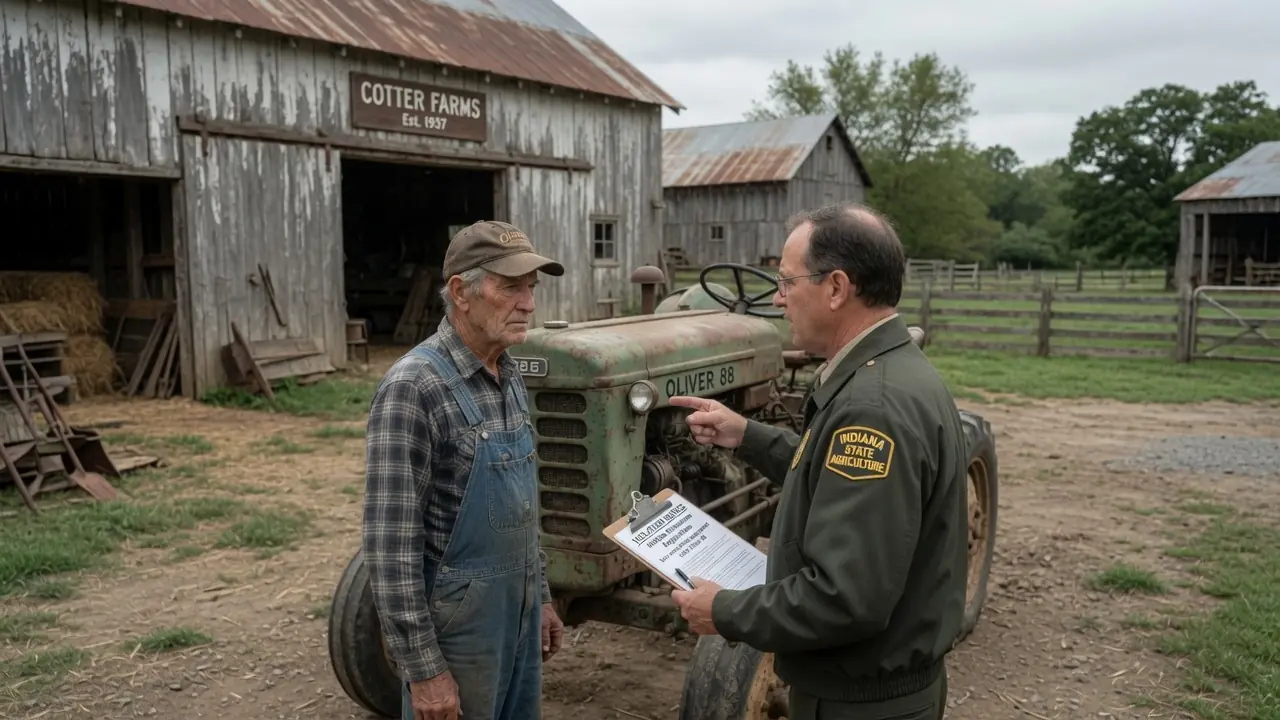
Earl did not speak at first. He looked at the inspector, then at the Oliver, its olive-green paint dulled by time and its metal darkened with years of oil, dust, and work. To Dennis, it was outdated equipment that failed to meet a new emissions rule. To Earl, it was his father’s hands still holding the steering wheel, his childhood still riding on the fender, and sixty-one years of honest maintenance written into every bolt.
Dennis cleared his throat and lifted the clipboard. “Mr. Cotter, this tractor can no longer be used for commercial agriculture under the updated state emissions standards.”
Earl’s face remained still. “Commercial agriculture?”
“You farm two hundred and twenty acres,” Dennis said. “That puts you above the threshold.”
“And because I farm above the threshold, my father’s tractor is illegal?”
Dennis shifted slightly. “That is what the regulation requires.”
The word illegal bothered Earl more than unsafe would have. Unsafe could be argued with grease, repairs, brakes, tires, lights, and common sense. Outdated could be accepted because everything old eventually became outdated in someone’s eyes. But illegal made the Oliver sound like a criminal sitting in his yard, when all it had ever done was work.
Dennis handed him the notice. “You can retire the tractor, or you can have it modified to meet compliance standards.”
“How much?”
“Depending on parts and contractor rates, between forty-two hundred and sixty-eight hundred dollars.”
Earl looked at the notice but did not take the pen Dennis offered. He had learned long ago that a pen was more dangerous than a wrench when a man did not understand what he was signing. His father, Thomas Cotter, had taught him that at the same kitchen table where seed catalogs and contracts once spread out every winter. Other men trust the fellow across the desk, Thomas used to say. I trust the paper.
Dennis tapped the notice. “I just need your signature acknowledging receipt.”
Earl looked up. “I’ll need to see the full regulation text.”
Dennis blinked. “The summary is right here.”
“I don’t want the summary.”
“The regulation is clear, Mr. Cotter.”
“Then the full text should say so.”
The inspector’s jaw tightened. He was used to farmers complaining, grumbling, and then signing. He was not used to a man in worn overalls and work boots calmly requesting the actual statute behind the clipboard. Earl held out his hand, not for the pen, but for the document Dennis had not brought.
Dennis exhaled. “I can have the office mail it to you.”
“Good.”
“You still have to comply.”
“When I read what the rule says, I’ll know what I have to do.”
For a moment, the two men stood in silence, the old Oliver between them like a witness. Dennis finally lowered the pen and wrote something on his inspection sheet. Earl watched him carefully. He was not angry yet. Anger wasted energy, and spring was not a season for wasting anything.
Dennis left without a signature.
As the white pickup disappeared down the dirt road, Earl walked to the Oliver and rested his hand on the hood. The metal was cool in the morning air. He remembered being six years old when his father drove it home, sitting up straighter than any man in Franklin County because it was the first real tractor the Cotter family had ever owned. Thomas had paid $1,650 for it, more money than Earl could understand at the time, and then wrote the purchase down in a ledger that still sat in the farmhouse office.
That ledger mattered now.
Earl went inside, washed his hands, and pulled the old maintenance books from the cabinet beside his father’s desk. The first entry was dated 1948, written in Thomas Cotter’s careful, slanted handwriting. Dealer delivery. Oliver 88 gasoline. Paid in full. After that came oil changes, spark plugs, belts, carburetor repairs, clutch replacements, hydraulic work, engine rebuilds, and every small repair the tractor had ever needed.
Earl ran his fingers over the old pages. His father had not kept records because he expected praise. He kept them because proof was a crop of its own. It had to be planted early, tended carefully, and harvested when needed.
The full regulation arrived eleven days later in a thick envelope from the Indiana Department of Agriculture. Forty-seven pages. Earl cleared the kitchen table, made a pot of coffee, found his reading glasses, and began. He read slowly, just as Thomas had taught him, one page at a time, with a yellow pad beside him for notes.
The first evening, he read twenty-four pages. The next evening, he started again after supper and continued into the night. The rules described thresholds, equipment types, emissions categories, approved contractors, enforcement steps, deadlines, penalties, appeals, and compliance options. Earl underlined nothing at first. Then he reached page thirty-one.
Section 7. Subsection C. Paragraph 4.
He read it once.
Then he read it again.
Then he pushed back from the table and looked through the dark kitchen window toward the barn.
The rule said equipment classified as historic agricultural machinery under Indiana law was exempt from the emissions compliance requirement if it had been manufactured before January 1, 1955, and continuously maintained in operational condition. Earl sat very still. His Oliver had been manufactured in 1948. It had been maintained continuously for sixty-one years. He had the ledger, the original receipt, the repair records, and the machine itself.
The tractor was not illegal.
The inspector’s summary had simply left out the one paragraph that mattered.
Earl did not celebrate. He did not call Dennis that night. He folded the regulation, marked page thirty-one with a slip of paper, and slept better than he had since the white pickup entered his yard. In the morning, he walked to the barn and opened both doors. Sunlight fell across the Oliver’s hood.
“All right,” he said softly. “Let’s make sure they can’t pretend not to see you.”
For the next three months, Earl worked like a man preparing for trial. He pulled the engine and inspected it carefully. New rings, new bearings, cleaned valves, a rebuilt carburetor, fresh fuel lines, and every rubber hose replaced before it could betray him. He did not restore the Oliver into some painted parade toy. He preserved it as a working tractor, honest and clean, carrying its age with pride.
He organized the maintenance records into binders. Thomas’s handwriting from 1948 to 1971 went into the first section. Earl’s own records from 1971 onward filled the rest. He photographed the serial numbers, engine stampings, identification plates, and every major component. Then he contacted the Oliver Heritage Foundation and requested documentation confirming the tractor’s production year and model history.
When the packet arrived, Earl added it to the binder.
His daughter Patricia came by one Saturday with groceries and found him at the kitchen table surrounded by documents. She looked at the papers, then at her father. “Dad, are you fighting the state?”
“No,” Earl said. “I’m reading what the state wrote.”
“That sounds like fighting.”
He smiled faintly. “Only if they didn’t read it first.”
Patricia picked up the photograph of the tractor’s serial plate. “Grandpa would love this.”
“He’s the reason I’m doing it right.”
“He’s the reason you do everything that way.”
Earl did not deny it. Thomas had been dead for years, but his habits still worked the farm. They lived in the ledger, the tool wall, the labeled jars of bolts, the dictionary still tucked in the bottom shelf near the old contracts. Some fathers leave land. Thomas had left land, yes, but he had also left a method.
Earl mailed the historic classification application to the Indiana State Historic Preservation Commission with copies of every document he had gathered. Then he called Dennis Hargrove.
“Mr. Hargrove,” Earl said when the inspector answered, “this is Earl Cotter on County Road 14.”
There was a pause. “Yes, Mr. Cotter.”
“I read the full regulation.”
Another pause.
“Section 7, Subsection C, Paragraph 4 contains an exemption for historic agricultural machinery manufactured before January 1, 1955, if continuously maintained in operational condition. My Oliver qualifies. I’ve applied for historic classification.”
Dennis said nothing for a long moment. “I wasn’t aware of that exemption.”
“I wasn’t either until I read page thirty-one.”
Earl did not say it cruelly. That made it worse.
Dennis promised to review the matter. Three weeks later, Earl received a letter withdrawing the violation notice. The Department of Agriculture acknowledged that his tractor might qualify under the historic machinery exemption pending final classification. There was no apology in the letter, but Earl had not expected one from a department.
He tacked the letter on the barn wall beside the Oliver.
By fall, the Historic Preservation Commission approved the classification. The formal certificate arrived just before the first hard frost. Earl held it in his hands longer than he needed to. The paper did not make the tractor valuable. The tractor had always been valuable. But the paper proved that the rule itself protected what the summary had nearly erased.
Word traveled fast after that.
Harold Fenwick came first. He owned a 1951 Farmall M that he had planned to park forever after getting the same kind of inspection notice. Earl showed him page thirty-one, the application packet, and the binder. Harold sat at the table reading in silence, his lips moving slightly as he followed the exemption. When he finished, he looked up with wet eyes.
“They never told me this.”
“They didn’t tell me either.”
Harold swallowed. “I was going to sell it at auction.”
“Then don’t.”
Within a month, Harold had his own historic classification approved. Another farmer who had already paid for unnecessary modifications wrote to the state demanding a review. He did not get all his money back, but he got enough to prove the mistake had not been imaginary.
Dennis Hargrove returned in October.
This time, he came without the stiff confidence of a man carrying a summary. He brought the full regulation text clipped to his board. Earl saw it before Dennis said a word. That mattered.
Dennis stood beside the Oliver and removed his cap. “Mr. Cotter, I came to apologize.”
Earl wiped his hands on a rag. “For what?”
“For issuing a violation without understanding the full rule.”
“You were working from what they gave you.”
“Yes,” Dennis said. “But I should have known what it left out.”
Earl studied him. The inspector looked younger than he had in the spring, or maybe just less certain. The badge on his shirt did not seem as heavy now. Earl had never hated him. A man could be wrong without being wicked. The question was whether he stayed wrong after the truth was put in his hands.
“What will you do differently?” Earl asked.
Dennis lifted the full document. “I’m carrying this now. Every visit.”
“That’s a start.”
“I also reviewed the other inspections I made this spring. There are farms that may qualify. I’m going back.”
Earl nodded once. “Good.”
Dennis looked at the Oliver. “Your father kept every record?”
“Every one.”
“Mine threw papers away.”
“Then start keeping yours.”
Dennis looked at him, surprised.
Earl picked up a wrench from the workbench. “A mistake can become useful if a man changes what he does after making it.”
The inspector nodded slowly. “I’ll remember that.”
Earl farmed with the Oliver for three more years. Not because it was the biggest or fastest machine on the farm, but because it still had work left in it. It pulled wagons, ran small field jobs, and moved through the farmyard with the same steady sound Earl had known since childhood. Every time he climbed into the seat, he felt the continuity of it: Thomas’s hands, his hands, the same steering wheel, the same land.
In 2012, at seventy, Earl decided to retire the Oliver from daily work. Not to rust, not to sit forgotten behind the barn, and not to be sold to a collector who would polish away its history. He wanted it retired properly. That winter, he restored it more carefully than he had ever restored anything.
He matched the paint to the original 1948 Oliver green. He rebuilt the hydraulics, inspected the engine, replaced the seat with the correct canvas style, cleaned every plate, and mounted the maintenance binder in a custom wooden case. When he was finished, the Oliver looked neither new nor old. It looked honored.
Then the Indiana State Museum called.
A curator named Dr. Sarah Elroy had followed the historic classification case since 2009. She told Earl the museum considered the Oliver exceptional, not just because of the machine, but because of the documentation and the story behind it. The museum wanted to acquire it for the agricultural heritage collection. They would display it with the original dealer receipt, the maintenance ledger, the historic certificate, and the full regulation open to page thirty-one.
Earl was quiet for a long time.
“It has to run,” he finally said.
“It will,” Dr. Elroy replied. “We operate certain machines for demonstrations.”
“And the records go with it. Not copies. The originals.”
There was a respectful silence on the other end. “Of course.”
“My father’s handwriting belongs beside the tractor.”
“We agree.”
The day the Oliver left the farm was clear and cold. Patricia came. Her husband Gary came. Harold Fenwick stood near the fence with his cap in his hands. Dennis Hargrove came too, because Earl had called and told him he should see what page thirty-one had saved.
The Oliver was running when the museum transport arrived. Earl had started it at dawn, letting the engine settle into the deep, familiar note that had carried across the farm for sixty-four years. He climbed into the seat one last time and rested his hands on the steering wheel. He looked past the barn, past the south field, past the old corn crib, and saw his father driving the tractor home in 1948.
Then Earl climbed down.
“She’s ready,” he said.
At the museum opening in 2013, the Oliver stood beneath warm display lights, cleaner than it had ever looked in a barn but still carrying the soul of a working machine. The maintenance ledger sat open to the first page, Thomas Cotter’s handwriting visible under protective glass. Nearby, the regulation document was open to page thirty-one with the exemption highlighted. Visitors stopped, read, and then looked back at the tractor differently.
Dr. Elroy spoke that day.
She said the Oliver represented American agricultural durability, three generations of family farming, and a rare complete record of continuous maintenance. But then she said something that made Earl lower his eyes. “This tractor was saved not only by an exemption, but by a habit. Thomas Cotter taught his son to read the full paper, not the summary. Earl Cotter read to page thirty-one. Because he did, this machine and its story are here today.”
Patricia squeezed Earl’s hand.
Dennis Hargrove stood near the back, listening.
After the ceremony, Dennis approached Earl beside the exhibit. For a while, both men looked at the tractor without speaking. The museum had placed a photograph nearby showing Thomas Cotter on the Oliver in 1952, young and serious, his hand resting on the same steering wheel Earl had touched that final morning.
“You were right to ask for the full document,” Dennis said.
“My father taught me to ask.”
“He taught you well.”
Earl looked at the highlighted page under glass. “He taught me slowly. That’s the only way lessons last.”
Dennis nodded. “I went back to seven farms.”
“I heard.”
“Four qualified. Two had already sold the machines before I got there.”
Earl’s face darkened slightly. “That’s a hard thing.”
“Yes,” Dennis said. “It is.”
“But you went back.”
“I did.”
“Then the mistake did not stop with you.”
Dennis looked at him carefully. “What does that mean?”
“It means you carried it farther than shame. That matters.”
Years later, schoolchildren visiting the museum often asked why an old tractor had a book beside it. Their teachers explained that the book was the reason the tractor survived. The machine had worked the land, but the records had defended it. Thomas’s first entry and Earl’s last entry told a story no inspector’s summary could erase.
Back on the Cotter farm, Gary used modern equipment now. Efficient machines with screens, sensors, and guidance systems worked the fields that Thomas had once broken with the Oliver. Earl did not resent that. New tools had their place when a farmer understood them and did not forget the old lessons.
Still, every spring, Gary walked into the barn and stood where the Oliver had once sat. A darker rectangle remained on the concrete floor, marked by decades of oil, weight, and time. It was not empty to the family. It was an outline of what had endured.
One winter evening, Earl’s granddaughter Megan sat at the kitchen table after visiting the museum with her school class. She was fourteen and had the sharp eyes of a child beginning to understand adults were not always right. She asked why the inspector had not known about the exemption if it had been right there in the rules.
“Because he read the summary,” Earl said.
“Why didn’t he read the full rule?”
“Most people don’t.”
“But you did.”
“My father taught me.”
Megan thought about that for a long time. Then she said, “So the museum didn’t really want the tractor. It wanted the records. And it didn’t really want the records. It wanted the habit.”
Earl smiled in the quiet kitchen, the same kitchen where Thomas had once read contracts with a dictionary beside him.
“That’s exactly it,” he said.
The Oliver 88 still runs twice a year at the Indiana State Museum. Its engine starts with the same deep note that once echoed across the Cotter farm, and visitors gather to listen without always knowing why the sound matters. Beside it, under glass, are the papers: the original receipt, the maintenance ledger, the historic classification, and page thirty-one. The tractor did not survive because it was lucky. It survived because one farmer refused to sign a summary and asked to read the rule himself.
And that, Earl Cotter would say, was the whole lesson.
A badge can be wrong.
A summary can be incomplete.
A clipboard can miss what matters.
But the paper says what it says, and a man who reads all the way to page thirty-one may save more than a tractor. He may save a piece of his father, a piece of his land, and a habit strong enough to outlast every rule written by people who never learned to read what they were enforcing.