Tom Henderson had built his John Deere dealership on one simple belief: successful farmers bought new iron.
Inside Henderson’s John Deere in Ames, Iowa, the showroom floor gleamed like a cathedral for green paint. Two brand-new tractors sat beneath the bright lights, polished so clean that a man could see his own reflection in the hood. Finance tags hung from the steering wheels, promising easy monthly payments, modern comfort, and the kind of pride a farmer could park beside his barn for neighbors to admire.
Then Charlie Morrison walked through the glass door in muddy boots.
He was sixty-one years old, with faded overalls, a worn International Harvester cap, and hands that looked permanently stained by oil, soil, and time. He farmed two hundred eighty acres outside Nevada, Iowa, drove a rusted 1976 Ford F-150, and spoke so quietly that men often mistook him for simple. Tom saw him step toward the parts counter and immediately smiled, already preparing the kind of friendly sales talk he used on farmers who needed convincing.
Charlie did not look at the new tractors.
He looked through the side window toward the back lot, where old trade-ins sat behind the dealership like forgotten dogs at a pound. There, half-hidden behind a row of used implements, sat a faded red 1962 Farmall 560 with tired tires, dull paint, and rust chewing along the fenders. It had been sitting there for months, ignored by every customer who had come through the lot.
Tom followed Charlie’s gaze and laughed before Charlie even spoke.
“You looking for parts off that old thing?” Tom asked.
Charlie turned toward him. “I want that Farmall.”
Tom blinked, then laughed harder. “You want what?”
“The 1962 Farmall 560 out back,” Charlie said. “How much?”
A salesman near the desk looked up from his paperwork. Tom leaned one elbow on the counter, his grin widening as if Charlie had just offered him entertainment on a slow Tuesday morning. “Charlie, that tractor’s a piece of junk. Why would you want that when I’ve got a clean 4050 sitting right here with financing ready?”
Charlie’s face did not change.
“I don’t want new,” he said. “I want that Farmall.”
Tom shook his head, glancing around the showroom to make sure the others were hearing this. “That machine has eight thousand hours on it. Transmission needs work, hydraulics are weak, paint is gone, and those tires are halfway to dead. It’s worth maybe four thousand on a good day, and that’s if the buyer doesn’t know better.”
“I’ll give you six thousand cash,” Charlie said.
The laughter in Tom’s throat stopped for half a second.
“Six thousand?” he asked.
Tom studied him more carefully now. The worn overalls, cracked boots, and old cap still told the same story Tom had always believed about Charlie Morrison. Small farmer. Old equipment. No real money. Probably stubborn enough to buy junk because he hated payments and too proud to admit he needed something better.
“Charlie,” Tom said, softening his voice in the way salesmen do before pushing harder, “you could finance a new Deere for a few hundred a month. Better power, better hydraulics, better parts support, a cab, air conditioning, everything. Why spend cash on ancient iron?”
Charlie tapped one finger on the counter.
“Because I know what I’m buying.”
Tom smirked. “No, Charlie. You know what you think you’re buying.”
The words were gentle in volume but sharp in meaning. The salesman at the desk gave a low chuckle, and Tom felt encouraged by it. He walked around the counter and pointed toward the shiny tractor near the showroom window. “Real farmers are moving forward. You keep trying to drag the past behind you like it still has horsepower.”
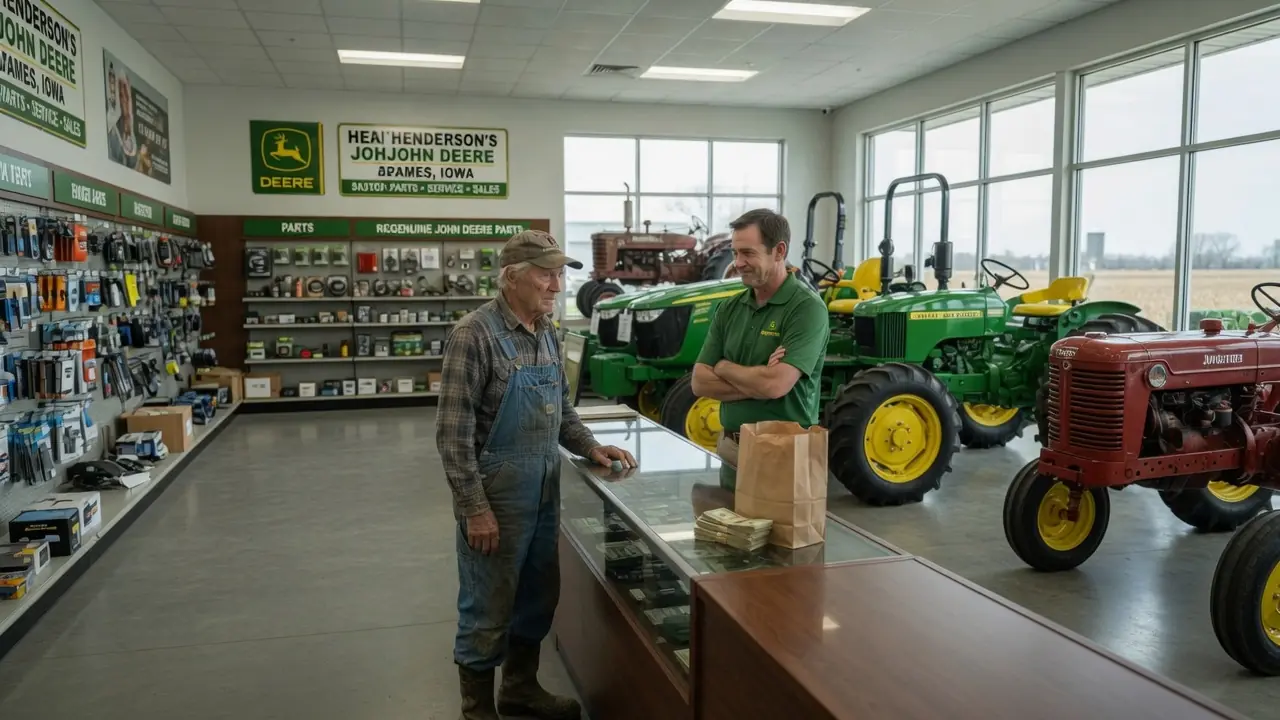
Charlie’s eyes moved from the new Deere back to Tom.
“Real farmers own what they buy,” Charlie said. “They don’t worship monthly payments.”
That made the showroom go quieter.
Tom’s smile tightened. He was used to farmers negotiating prices, complaining about interest, or bragging about what they could afford. He was not used to a man in muddy boots standing under his lights and making debt sound like weakness. “That rusty machine fits you perfectly,” Tom said, leaning slightly closer. “Old, worn out, and behind the times.”
Charlie held his gaze for a long moment.
Then he reached into the pocket of his overalls and pulled out a folded piece of paper.
“Write it up,” he said. “Six thousand.”
Tom exhaled through his nose, half amused and half irritated. “Fine. Bring the money this afternoon, and it’s yours. But I’m telling you now, you’re making a mistake.” Charlie nodded once, as if Tom had confirmed something he already knew, then turned and walked out of the dealership without looking at a single new tractor.
After he left, Tom turned to his sales manager, Kevin, and laughed again.
“Can you believe that?” Tom said. “Charlie Morrison wants to spend six grand on a tractor older than some of my mechanics.”
Kevin shook his head. “That man has always been strange. Farms like it’s still 1965. Probably thinks that old Farmall is all he deserves.”
Tom looked out the showroom window as Charlie climbed into his rusted Ford and drove away. “Old farmer, old truck, old tractor,” he said. “At least he’s consistent.”
By two-fifteen that afternoon, Charlie returned.
This time he carried a brown paper grocery bag.
The bell above the dealership door jingled as he stepped inside, and Tom looked up from the counter with a grin already waiting. He expected Charlie to say he had changed his mind, or that he needed a few days, or that he wanted to bargain lower. Instead, Charlie walked to the counter, placed the grocery bag down, and opened it.
Stacks of bills sat inside.
Tom’s grin disappeared.
Charlie pushed the bag forward. “Count it.”
The showroom went still. Kevin walked over from his desk, eyes narrowing as Tom reached into the bag and pulled out the first stack. There were twenties, fifties, and hundreds, old bills folded and worn as if they had lived for years inside a safe or a coffee can. Tom counted once, then again, the sound of paper brushing against paper suddenly louder than the hum of the showroom lights.
“Six thousand exactly,” Tom said, staring down at the money.
Charlie nodded. “That’s what I offered.”
Tom looked at him differently now, but not respectfully yet. The cash confused him more than impressed him. “Where does a farmer like you keep six thousand dollars in cash?”
Charlie’s expression stayed flat.
“In my safe.”
Tom gave a short laugh, though it came out weaker than before. “You keep that much at home?”
“I keep more than that,” Charlie said. “But six is what the tractor costs.”
Kevin’s eyebrows lifted. Tom felt something small and uncomfortable move inside his chest. It was not admiration. It was the first crack in an assumption he had carried so long that it felt like fact.
He cleared his throat. “All right. I’ll get the title.”
While Tom prepared the paperwork, Charlie stood quietly near the counter, hands in his pockets. He did not wander through the showroom, did not sit in the new tractors, did not ask about horsepower, rebates, or warranty. His eyes kept returning to the back-lot window, where the old Farmall sat in the sun like a secret no one else could read.
Tom brought the papers back.
Charlie signed carefully, each letter slow and steady. Tom handed him the title and keys. “She’s yours,” he said. “You hauling it today?”
“Tomorrow,” Charlie replied. “I’ll bring my trailer.”
Tom could not stop himself. “Charlie, seriously. What are you going to do with it?”
“Farm with it,” Charlie said.
“You already have tractors.”
Charlie tucked the title into his shirt pocket. “I wanted that one.”
“Why?”
For the first time, Charlie almost smiled.
“You’ll see.”
Over the next week, Tom told the story to almost every farmer who came through the dealership. He described the grocery bag full of cash, the rusty Farmall, the old overalls, and Charlie’s stubborn refusal to even look at a new Deere. The customers laughed the way Tom expected them to laugh. Men liked stories that confirmed what they already believed, and everyone believed Charlie Morrison was cheap, outdated, and strange.
But the story began to trouble Tom after a while.
It started with a call from Carl Jensen, who ran a parts shop over in Nevada. Carl mentioned that Charlie had ordered a complete rebuild kit for a Farmall 560 and paid cash. Then the tire shop told Kevin that Charlie had bought new rear tires, also cash. A paint supplier later joked that old Charlie must be feeling fancy because he had bought primer, Harvester Red paint, decals, and finishing supplies like a man preparing for a show tractor.
Tom began adding numbers in his head.
Six thousand for the tractor. Hundreds for tires. More for parts. More for paint. More for whatever else Charlie had hidden in that barn. None of it made sense if Charlie was just a stubborn old farmer trying to keep a dying tractor alive.
In early May, curiosity finally beat pride.
Tom was driving past Charlie’s farm on his way to a service call when he slowed near the lane and saw something red shining from the open machine shed. He almost kept driving, but the color caught him. It was not dull red. It was deep, polished, perfect Harvester Red.
Tom turned into the driveway.
The Farmall sat inside the shed, transformed.
The faded old tractor he had sold as worn-out junk looked like it had rolled out of a factory dream. The paint was smooth as glass, the tires were new, the chrome stack gleamed, the seat was recovered, the sheet metal straightened, and every bolt looked either polished, painted, or placed with a kind of care Tom rarely saw outside high-end restorations. He walked closer without realizing his mouth had opened.
Charlie stepped from the barn carrying a rag.
“Afternoon, Tom.”
Tom barely heard him. “Charlie… you restored it.”
“I did.”
“This is professional work.”
Charlie wiped his hands slowly. “I’ve been restoring tractors for thirty years.”
Tom turned toward him. “Thirty years?”
Charlie nodded toward the barn. “Come on.”
Inside the barn sat five more tractors, all International Harvester, all restored with the same breathtaking precision. A Farmall H. A Farmall 450. Another 560. A 706. A 1056 that looked better than most new machines Tom had ever sold. The barn did not look like the hiding place of a poor farmer. It looked like a private museum built by a man who understood value more deeply than any salesman in Ames.
Tom walked between the tractors in stunned silence.
“You did all these?”
“Every one.”
“You sell them?”
“Some. Keep some.”
“For how much?”
Charlie looked at a polished Farmall H. “One like that brought eighteen thousand last year. The 450 brought twenty-two. The 706 should bring twenty-five or thirty if I let it go.”
Tom turned slowly.
“You sold a 1951 Farmall H for eighteen thousand dollars?”
“Correct.”
Tom looked around the barn again, and his salesman’s brain began calculating faster than his pride could stop it. “How many tractors have you restored?”
“Sixty-three total,” Charlie said. “Sold forty-eight.”
Tom’s voice dropped. “How much profit?”
“Depends how you count it. I don’t count my labor because I enjoy the work. Cash profit over the years is a little over four hundred thousand.”
The barn seemed to tilt around Tom.
“Four hundred thousand?”
Charlie nodded as if they were discussing weather.
Tom thought of every joke he had told that week, every customer who had laughed at Charlie, every assumption he had made because of a rusted truck and stained overalls. He looked at the restored Farmall again, and the word “junk” suddenly tasted ugly in his mouth.
Charlie walked toward a small office attached to the barn.
“I’ll show you something else.”
Tom followed like a man being led to confession.
Inside, Charlie opened a file cabinet and removed several bank statements. He laid them on the desk without ceremony. Tom looked down and saw balances that made his throat tighten. Savings accounts. Investment accounts. Certificates of deposit. More money than Tom had ever imagined Charlie Morrison touching.
“You have over six hundred thousand dollars in the bank,” Tom whispered.
Charlie nodded. “About that.”
“And cash?”
“Some.”
“How much?”
Charlie looked mildly uncomfortable for the first time. “Around a hundred forty thousand in the safe.”
Tom sat down hard in the wooden chair behind him.
Charlie leaned against the desk. “Farm is paid off. Land is worth good money. Equipment is paid for. No debt. On paper, I suppose I’m worth a little over a million.”
Tom stared at him.
The old farmer in worn overalls. The rusty truck. The man everyone called cheap. The man Tom had mocked for wanting an old Farmall instead of a financed Deere.
A millionaire.
Tom covered his mouth with one hand, not from envy but from shame.
“Charlie,” he said quietly, “I owe you an apology.”
Charlie did not answer.
“I laughed at you. I assumed you couldn’t afford better. I thought you were stuck in the past because you didn’t understand value.” Tom looked toward the barn full of restored tractors. “You understood it better than I ever did.”
Charlie folded the statements and returned them to the drawer. “Most people look at the surface and stop there.”
Tom swallowed. “Why let them?”
Charlie shrugged. “Because it keeps life simple. Nobody asks me for money. Nobody tries to sell me things I don’t need. Nobody treats me different. I’m just old Charlie with the rusty truck.”
Tom looked down at his polished shoes.
He thought of his own house, his new cars, his country club bills, his vacations, and the way he liked being seen as successful. He made good money, but most of it left as quickly as it came. He sold farmers machines on payments and called it progress. Charlie earned less, spent less, owed nothing, and quietly built wealth while everyone mistook him for poor.
“How did you do it?” Tom asked.
Charlie looked out toward the fields. “Bought used. Fixed things myself. Never borrowed unless I had no choice, and I haven’t owed a man money since 1979. Lived below what I made. Saved the rest. Restored tractors because I loved it, and the hobby paid better than people expected.”
Tom laughed once, softly and painfully. “I sell new tractors for a living.”
Charlie’s eyes met his. “Nothing wrong with new if a man can afford it.”
“And if he can’t?”
“Then selling it to him is just dressing a chain in green paint.”
That sentence stayed with Tom all the way back to the dealership.
For days, he could not look at the showroom the same way. The tractors still shone, but now the finance tags looked different. They no longer seemed like invitations. They looked like promises that could become traps for men trying to look successful before they were secure.
The first test came the following week.
A young farmer named Brad Miller walked in wanting to finance a brand-new tractor he clearly could not afford. Tom listened to him explain his acreage, debts, repair bills, and hope that a new machine would finally help him “get ahead.” Old Tom would have smiled, run the numbers, and pushed the papers across the desk. New Tom thought of Charlie’s barn.
“You don’t need new,” Tom said.
Brad blinked. “You’re a dealer.”
“I know what I am,” Tom replied. “I also know that payment will choke you before that tractor saves you.”
He took Brad out back and showed him a good used machine at one-third the price. He explained maintenance, expected repairs, and how much money Brad would keep by avoiding the new loan. Brad left confused but grateful, and Tom’s salesman Kevin looked at him like he had lost his mind.
“You just threw away a sale,” Kevin said.
Tom watched Brad drive away. “No. I saved a farmer.”
That became the beginning of a different dealership.
Tom still sold new equipment to farmers who could afford it, but he stopped pushing debt on men who were already stretched thin. He started asking what they needed, not what he could sell. He explained total cost instead of monthly payments. Some customers walked away and bought elsewhere, but others came back because honesty had a longer memory than pressure.
At first, the dealership lost money.
Kevin complained constantly and eventually left to work for a competitor. Tom let him go. In his place, he hired a younger salesman who had grown up watching his father struggle under equipment loans and understood exactly what Tom was trying to change.
Word spread slowly.
Farmers began saying Henderson’s John Deere would tell you the truth even if the truth cost them a sale. That reputation became worth more than any finance bonus Tom had ever chased. Men drove past other dealers to see him because trust, once earned, traveled farther than advertising.
But the deeper change happened inside Tom himself.
He sold his oversized house and bought a smaller one. He kept his car longer than he ever had before. He quit spending money to prove he had money. His wife noticed first that he slept better, smiled more easily, and stopped measuring every man by what he drove.
Years later, Tom visited Charlie again.
The Farmall 560 sat in the barn, perfect as ever, now with a small ribbon hanging from the steering wheel. It had won best of show at the Iowa State Fair. Charlie had turned down offers far above what Tom had sold it for, not because he needed more money, but because the tractor completed something in his heart.
Tom stood beside it and ran one hand carefully along the red hood.
“I called this junk,” he said.
Charlie chuckled. “You did.”
Tom looked at him. “You knew what it was.”
“I knew what it could be.”
That was the lesson Tom finally understood.
Some men saw value only when it was polished, financed, labeled, and displayed under bright showroom lights. Charlie saw value when it was rusted, dismissed, and waiting for someone patient enough to restore it. He saw it in tractors, in land, in young farmers, and eventually even in Tom Henderson.
When Charlie Morrison died many years later, the church was full.
Farmers came in muddy boots. Collectors came with old tractor pins on their jackets. Young men and women stood in the back, wiping their eyes as the preacher told stories Tom had never heard. Charlie had quietly loaned money to young farmers who could not get bank financing. He had sold tractors below value to families trying to start. He had given advice freely, charged interest to no one, and helped without ever announcing himself as a helper.
At the funeral, Tom stood and spoke last.
He told the room about April 1987, the old Farmall, the grocery bag of cash, and the arrogant dealer who thought success meant new paint and monthly payments. His voice trembled when he reached the part about Charlie’s barn and the bank statements that changed his life. “Charlie Morrison taught me that wealth is not what people see,” Tom said. “It is what you own, what you owe no one for, and what you are free to give away.”
No one in the church moved.
Tom looked toward Charlie’s family, then toward the farmers who had filled the pews.
“I laughed when he wanted that old Farmall,” he said. “But that tractor was never junk. It was a mirror. It showed me how blind I had been.”
After the service, Tom walked outside and stood beside his truck for a long time.
He thought about the day Charlie placed the grocery bag on the counter, the sound of old bills being counted, and the calm voice that had said, “I carry enough to buy what fools are too blind to value.” At the time, Tom thought Charlie was talking about the tractor. Now he knew Charlie had been talking about life.
The old Farmall had been restored, shown, admired, and eventually sold for more money than anyone at the dealership would have believed.
But that was not its greatest value.
Its greatest value was the man it changed.
Tom Henderson spent the rest of his life teaching younger farmers what Charlie had taught him: buy only what you need, own more than you owe, never confuse appearance with success, and never laugh at a man just because his wisdom arrives in muddy boots.
Because sometimes the richest farmer drives the rustiest truck.
Sometimes the smartest investment sits forgotten behind a dealership.
And sometimes the old machine everyone calls junk is only waiting for the right hands to reveal what it was worth all along.