Rick Torrence loved the sound of a crowded showroom. To him, it meant power, trust, money, and proof that his name still mattered in southeast Missouri. Inside Torrence Ag Solutions in Dexter, polished green tractors sat under bright dealer lights, their tires cleaned, their paint shining, their price tags hanging like quiet promises. Farmers walked between the machines with coffee cups in their hands, talking about horsepower, trade-ins, diesel, and the kind of debt that either built a farm or buried it.
Rick stood beside the largest John Deere on the showroom floor, a proud smile fixed beneath his neatly trimmed mustache. He wore a pressed shirt with the dealership logo stitched over his heart, boots clean enough to reflect the light, and a wireless microphone clipped in one hand. Behind him, the service bay door stood open, showing the gravel lot and the heavy 12-bottom moldboard plow waiting outside. He had arranged everything carefully, because Rick Torrence did not believe in accidental sales.
Across the room stood Vernon Gast. He was fifty-eight years old, broad-shouldered, quiet, and dressed in a faded blue work shirt that looked as if it had survived more seasons than some men survived arguments. His cap had no logo, his boots were dusty, and his face carried the patient hardness of a farmer who had fought weather, bankers, breakdowns, and low prices without making speeches about any of it. Through the open service bay door behind him, his red Massey Ferguson 8680 waited on the gravel lot. It did not shine like the tractors inside, but Vernon knew what it could do.
Rick had seen Vernon walk in earlier and had smiled the way a dealer smiles at a man he does not expect to buy anything. Vernon had never been a John Deere customer. He farmed outside Advance, working corn, soybeans, and winter wheat on land that demanded more patience than profit. Two years earlier, he had bought a used Massey Ferguson 8680 from a dealer in Poplar Bluff, and people had questioned him ever since. Vernon never argued much. He only said, “The tractor does what I need it to do.”
That sentence had irritated Rick more than he admitted. It was simple, stubborn, and hard to sell against. Rick preferred charts, brochures, system comparisons, and polished claims about hydraulic architecture. Farmers listened when he spoke because he had been selling equipment for nineteen years, and because his dealership carried enough inventory to make a man believe he was looking at the future. But Vernon’s quiet faith in that red tractor had always sat in the county like a stone in Rick’s boot.
That morning’s dealership event was supposed to be a clean victory. Rick had invited farmers from across the county to see a controlled plow demonstration tied to a sales presentation. He had the green tractor ready, the 12-bottom moldboard plow displayed near the service entrance, and enough coffee and biscuits to keep men talking until they forgot how expensive the machine really was. His plan was simple. Show them strength, show them confidence, then remind them that cheaper machines could not do serious work.
Vernon had not come looking for trouble. He had only needed a filter from the parts counter and had decided to stay when he saw the crowd gathering near the showroom floor. He stood near the open bay door, arms crossed, saying nothing while Rick spoke into the microphone. At first, the presentation sounded like any other dealer talk: horsepower, torque, flow rate, traction, field speed. Then Rick’s smile sharpened.
“Now, you can paint a tractor any color you want,” Rick said, tapping the green hood beside him. “You can put a big number on the side, make the brochure look impressive, and tell a farmer he’s saving money. But when that plow drops fourteen inches into Missouri clay, the truth comes out.”
A few farmers chuckled. Vernon did not move.
Rick pointed toward the moldboard plow outside the service bay. “That is a 12-bottom plow. Full depth. Heavy ground. Real load. And I’ll tell you plainly, no Massey Ferguson currently being run around this county is going to pull that plow through that clay without choking, downshifting, or forcing the operator to fight the machine.”
The showroom went still in a way Rick noticed but misunderstood. Some men looked at the plow. Some looked at the green tractor. But several turned toward Vernon. Rick followed their eyes, saw the red Massey outside, and made the mistake pride often makes when it has already gone too far. He smiled wider.
“Vernon,” Rick said, raising the microphone slightly, “you run one of those red machines, don’t you?”
Vernon’s jaw tightened. “I do.”
Rick gave a soft laugh. “Then you know what I mean.”
“No,” Vernon said. “I don’t.”
The words were not loud, but they carried across the room. Rick’s smile held, though something behind his eyes hardened. Farmers shifted their weight, sensing that the presentation had become something different. Rick turned fully toward Vernon, one hand resting on the green tractor as if the machine itself was backing him up.
“You don’t agree?” Rick asked.
“I think you’re wrong.”
Rick’s face stayed pleasant, but his voice cooled. “Vernon, I’m not insulting you personally. I’m talking about engineering. Your tractor is a good machine for certain jobs, but not for this load.”
Vernon stepped forward once. “Then open the service bay, hook that plow to my tractor, and let it tell you.”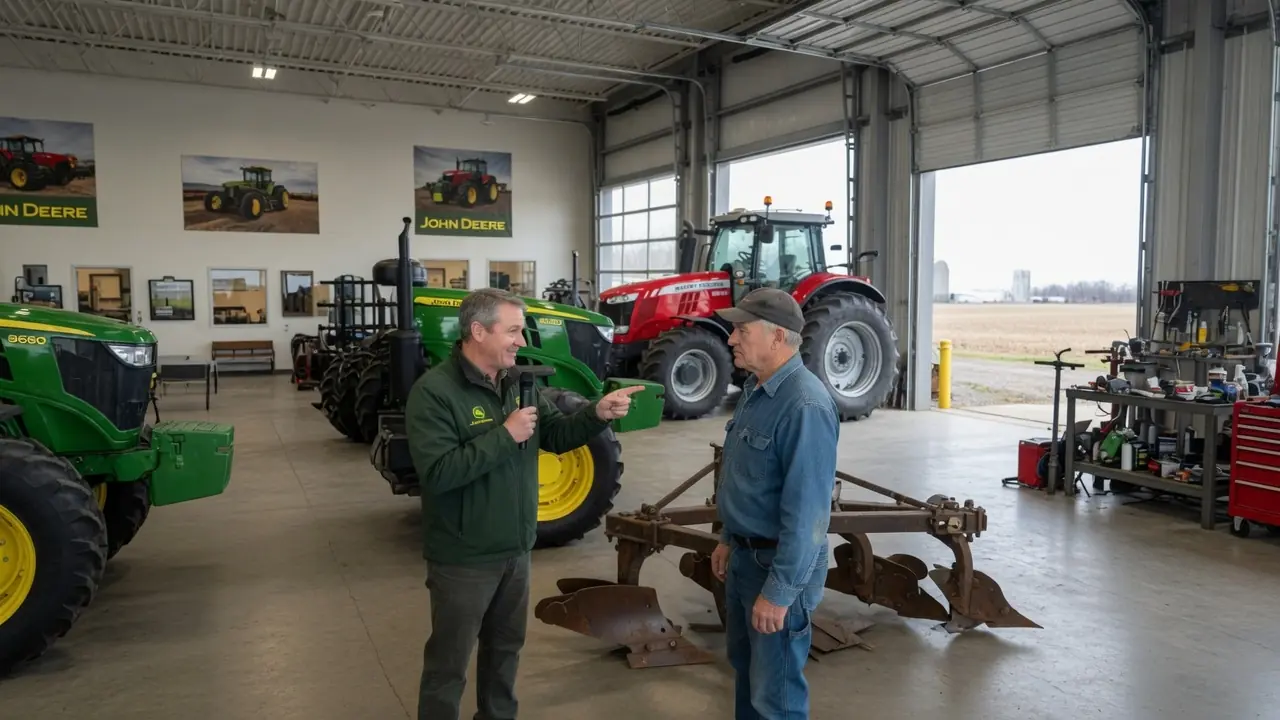
A low murmur moved through the showroom. Rick heard it and felt the dangerous pull of pride. He could have laughed it off. He could have said the demonstration had already been scheduled for the John Deere only. He could have claimed liability, timing, or insurance. But backing away in front of farmers felt worse than taking the risk.
Rick lifted the microphone again. “You want to embarrass yourself inside my own dealership?”
Vernon looked at him without blinking. “No, Rick. I brought a tractor. You brought a mouth.”
The murmur stopped.
Rick’s cheek twitched. For one second, he looked not like a confident dealer, but like a man who had been struck in a place no one else could see. Then he nodded toward the service bay. “Fine. Hook it up.”
Vernon turned and walked outside. He moved slowly, not because he lacked urgency, but because he refused to perform for the room. Rick followed, microphone still in hand, and the crowd poured out behind them into the gravel lot. The red Massey Ferguson sat there with dust on the steps and sun faded along the hood. Beside the showroom’s polished machines, it looked plain, work-worn, and almost too quiet.
Rick stood near the plow with his arms crossed. “This plow is set for full depth,” he said, partly to Vernon and partly to the farmers gathering around them. “Fourteen inches. I’m not lightening it for you.”
Vernon climbed into the cab. “Didn’t ask you to.”
The engine turned over with a low, steady growl. Vernon backed the Massey carefully toward the plow, watching through the mirrors as the drawbar lined up. Rick watched every movement, waiting for some hesitation he could use later. There was none. Vernon climbed down, connected the hitch, locked the pin, and attached the hydraulic lines with hands that knew their work.
For a brief moment, Rick and Vernon stood only a few feet apart between the green showroom and the red tractor. The crowd had faded behind them in Vernon’s mind. All he saw was the man who had told everyone his machine could not do what Vernon already knew it could. All Rick saw was a farmer about to challenge a sales story that had worked for years.
Rick leaned closer. “Last chance.”
Vernon looked at the plow, then back at him. “That’s what I was about to tell you.”
The words landed quietly, but Rick felt them. He stepped back. Vernon climbed into the cab again, closed the door, and adjusted the hydraulic flow. The plow lifted smooth and level. A few farmers noticed it immediately, though no one said much yet.
Rick pointed toward the test strip behind the dealership, a long stretch of heavy clay soil kept for demonstrations. “Run it there.”
Vernon eased the tractor forward, the plow following behind like a question waiting to be answered. The Massey moved from gravel to dirt, tires pressing into the ground. Rick walked to the edge of the strip, microphone lowered now, his eyes locked on the red tractor. He had wanted a sales event. He had created a trial.
Vernon stopped at the starting line. He breathed once, slowly, then set the tractor into field mode. He lowered the plow until all twelve bottoms bit into the clay at full depth. The tractor settled under the load. For one second, everything seemed to hold its breath.
Then Vernon moved forward.
The Massey Ferguson pulled.
The sound changed from idle to work, deep and firm, not screaming, not struggling. The tires gripped, the plow cut, and thick black Missouri clay began to roll over in clean furrows behind it. Vernon kept his hands steady on the wheel. He did not touch the throttle. He did not fight the machine. He simply drove.
Rick’s mouth tightened.
At first, he told himself the tractor would falter after a few yards. Then he told himself the plow would lift. Then he told himself the transmission would hunt, the engine would sag, the hydraulics would show weakness. But the red tractor kept pulling. The furrows stayed even. The plow stayed buried.
The farmers watched in a silence that hurt Rick worse than laughter. They had heard his claim. They were now watching the answer. Every clean strip of turned clay behind Vernon’s tractor erased another sentence from Rick’s presentation. Every steady yard made the green banners behind him feel less like confidence and more like decoration.
Halfway down the strip, Vernon glanced once at the gauges. Everything held. The engine note remained strong, the transmission smooth, the hydraulic pressure steady. He felt no triumph yet. Triumph was for men who needed applause. Vernon only felt the plain satisfaction of watching a machine do the job it had been accused of being too weak to do.
Rick shifted his stance. He wanted to say something, anything, but the microphone suddenly felt heavy in his hand. If he spoke too soon and the tractor completed the pass, he would look smaller. If he stayed silent, the silence belonged to Vernon. For the first time all morning, Rick Torrence had no sales language ready.
The Massey reached the end of the strip. Vernon made the turn, brought it back along the edge, and stopped near the plow’s starting point. He raised the implement cleanly, parked, and shut down the engine. The sudden quiet pressed hard against everyone present.
Vernon climbed down from the cab. Dust clung to his boots. He walked toward Rick without smiling. Behind him, the furrows lay dark, straight, and consistent. Not perfect because of luck, not impressive because of sympathy. They were simply proof.
Rick looked at the field, then at Vernon. “You made your point.”
Vernon stopped in front of him. “I’m not making a point. I’m correcting what you told these men.”
Rick’s jaw flexed. “The John Deere is still the better machine.”
“Maybe for some jobs,” Vernon said. “Maybe for some farms. But that’s not what you said.”
Rick gripped the microphone tighter. “You pulled it once.”
Vernon nodded. “And that was enough to prove you shouldn’t have said it couldn’t.”
The farmers began moving toward the furrows. Some crouched to inspect depth. Others looked at the plow, then at the tractor, then at Rick. No one needed to shout. The damage did not come from noise. It came from the quiet, practical judgment of men who had spent their lives trusting what the ground showed them.
Rick tried to recover. He stepped toward the crowd and raised the microphone. “Gentlemen, one pass does not define long-term performance. We’re talking about sustained work, total service network, resale value, hydraulic design, and field efficiency over hundreds of acres.”
The words were correct enough to sound professional, but too late to sound honest. Vernon stood a few feet away, listening without expression. Rick could feel him there, not interrupting, not arguing, and somehow that made it worse. The red tractor had already spoken more clearly than Rick could.
One farmer pointed to the furrows. “It stayed at depth.”
Rick nodded sharply. “For a pass, yes.”
Another said, “You said it couldn’t pull it at all.”
“I said under true sustained load.”
Vernon finally spoke. “No, Rick. You said no Massey Ferguson in this county could pull that plow full depth without choking.”
Rick turned on him. “You want to split words?”
“No,” Vernon said. “I want you to own yours.”
That struck harder than the plow pull. Rick’s face reddened. The farmers went quiet again, and this time every eye sat on him, waiting. A good dealer knew when to concede gracefully, but Rick had built too much of his pride into certainty. Apologizing would mean admitting that the showroom, the microphone, the banners, and the polished green paint had all been used to say something he could not back up.
So he did what proud men do when truth corners them. He made the corner smaller.
“The John Deere still pulled faster,” Rick said.
Vernon looked toward the test strip. “By a few seconds?”
“Seconds matter.”
“Money matters too.”
Rick’s eyes sharpened. “Now you want to talk cost?”
“I always talk cost,” Vernon said. “Farmers have to.”
That line moved through the crowd because every man standing there understood it. A few looked back toward the green tractor inside the showroom, then toward Vernon’s red Massey. The difference was no longer color or loyalty. It was value. It was whether a farmer needed the most expensive answer when a less expensive one had just done the work.
Rick sensed the room slipping away even though they were no longer inside it. His dealership stood behind him, bright and polished. His signs promised reliability, leadership, and performance. But the ground in front of him had become a ledger, and the numbers were not friendly.
Vernon turned back toward his tractor. “Unhook the plow.”
Rick stared at him. “That’s it?”
“That’s it.”
“You challenge me in front of my customers, and now you walk away?”
Vernon paused at the cab step. “I didn’t challenge you, Rick. You challenged every man who ever bought something different from you and trusted his own field. I just answered.”
For a moment, Rick had no reply. Vernon unhooked the plow, checked the lines, climbed into the cab, and started the engine. The red tractor rolled slowly across the gravel lot, past the open service bay, past the polished green machines, past the dealership sign with Rick’s name on it. Vernon did not look back.
Inside the showroom, the mood had changed. Farmers still drank coffee, still walked around equipment, still asked questions, but now their questions had sharper edges. They asked about price differences. They asked about hydraulic flow. They asked whether Rick had compared machines directly before making his claim. Each question sounded polite, but together they formed a verdict.
Rick answered as best he could. He talked about resale value, service availability, parts support, and long-term brand strength. Those points mattered, and he knew they mattered. But the farmers had not come to watch a chart. They had watched a tractor do the work Rick said it could not do.
By noon, the crowd had thinned. The coffee went cold. The green tractor still shone under the lights, but now it seemed less like a champion and more like a machine forced to share the floor. Rick stood near the service bay door, staring at the strip of clay behind the dealership. Vernon’s furrows ran beside the green tractor’s earlier demonstration path. They were clean enough to haunt him.
For the next week, Rick told himself the moment would pass. Farmers loved stories, but stories faded when weather changed and bills came due. He believed loyalty would hold. He believed his sales team could smooth things over. He believed too much in the power of explanation.
But the county did not remember his explanation. It remembered the sentence he had said and the tractor that had answered it.
At the co-op, men talked about the red Massey that pulled the 12-bottom plow behind Rick’s own dealership. At church parking lots, they talked about Vernon’s calm face and Rick’s tightened jaw. At kitchen tables, wives asked why a tractor costing far less had done the job just fine. Sales calls that once ended with confidence now ended with, “I’m going to look around first.”
Rick hated those words.
A month later, one of his longtime customers postponed a purchase. Then another canceled a planned trade. Then a third asked for numbers on a different brand before making a decision. Rick’s sales manager tried to explain gently that the demonstration had changed the conversation. Rick snapped that one plow pass did not change market share.
But it had.
Vernon did not celebrate it. He kept farming his 520 acres, kept changing filters, kept greasing fittings, kept doing the work he had always done. When men asked him about that day, he never made himself the hero. He only shrugged and said, “The tractor pulled.” That was enough.
The line became famous in the county because it had no decoration. The tractor pulled. Not the salesman promised. Not the brochure claimed. Not the dealer argued. The tractor pulled.
Months passed, and Rick’s dealership numbers began to show what pride had cost. Deals slipped away to Poplar Bluff. Farmers who had never considered Massey Ferguson began test-driving them. Some still bought John Deere, but they negotiated harder. Others walked into Rick’s showroom and looked at his machines with new doubt.
One evening, after closing, Rick stood alone beside the tractor where he had made his claim. The showroom lights hummed overhead. The service bay was quiet. Outside, the test strip had been smoothed over, but he could still see the furrows in his mind.
He remembered Vernon’s face. Not angry. Not smug. Just certain.
That certainty bothered Rick more than any lost sale. He had built a career on convincing farmers what they needed. Vernon had reminded them they could see for themselves. A salesman could compete with another salesman. Competing with proof was harder.
Years later, people still told the story. They told it at equipment auctions, around grain elevators, and whenever a dealer talked too confidently about what another brand could not do. Rick’s name stayed attached to the mistake because pride has a long memory in farm country. Vernon’s name stayed attached to the answer because he had not needed to shout.
The red Massey Ferguson kept working. Its paint faded, its seat wore down, and its hours climbed. But it still pulled. Every time Vernon lowered an implement into Missouri clay and felt the tractor settle into the load, he remembered the showroom, the microphone, and Rick’s polished smile.
He did not remember it with bitterness. He remembered it as a lesson the ground had taught in front of everyone. Machines did not care about pride. Clay did not care about brand loyalty. Work did not care what color the paint was.
One Saturday years later, Vernon drove past Torrence Ag Solutions on his way to pick up parts from another dealer. The green sign still stood. The showroom still looked clean. But Rick no longer sponsored big public demonstrations, and everyone knew why.
Vernon slowed at the light near the dealership. For a moment, he looked through the window and saw Rick standing beside a customer, talking with careful hands and a smaller smile than before. Rick glanced up and recognized him. Their eyes met through the glass.
Neither man waved.
The light changed. Vernon drove on.
Behind him, the JD dealer remained where it had always been, selling polished machines under bright lights. Ahead of him, his red Massey waited in a field that did not care about speeches. And that suited Vernon just fine.
Because on that morning in Dexter, Rick Torrence had brought a microphone.
Vernon Gast had brought a tractor.
And when the talking stopped, only one of them had anything left to prove.