The county assessor pulled up to the farm, stepped out of his car, and just stood there. He counted the acres twice because the first number couldn't be right. 1,200 acres, all owned by one man, all paid for, all worked with equipment that should have been in a junkyard twenty years ago.
The assessor looked at his paperwork, looked at the farm, and said out loud to nobody, How did he do this?
The answer to that question starts in 1961 on a dirt road in Leflore County, Mississippi, in front of a dealership that wouldn't open its door.
In September of 1961, a thirty-year-old man named Henry Tate drove his uncle's truck twelve miles into Greenwood, Mississippi, to buy a plow point for a Farmall H. That's all he needed, a six-dollar plow point, the kind of part any equipment dealer keeps in a bin behind the counter.
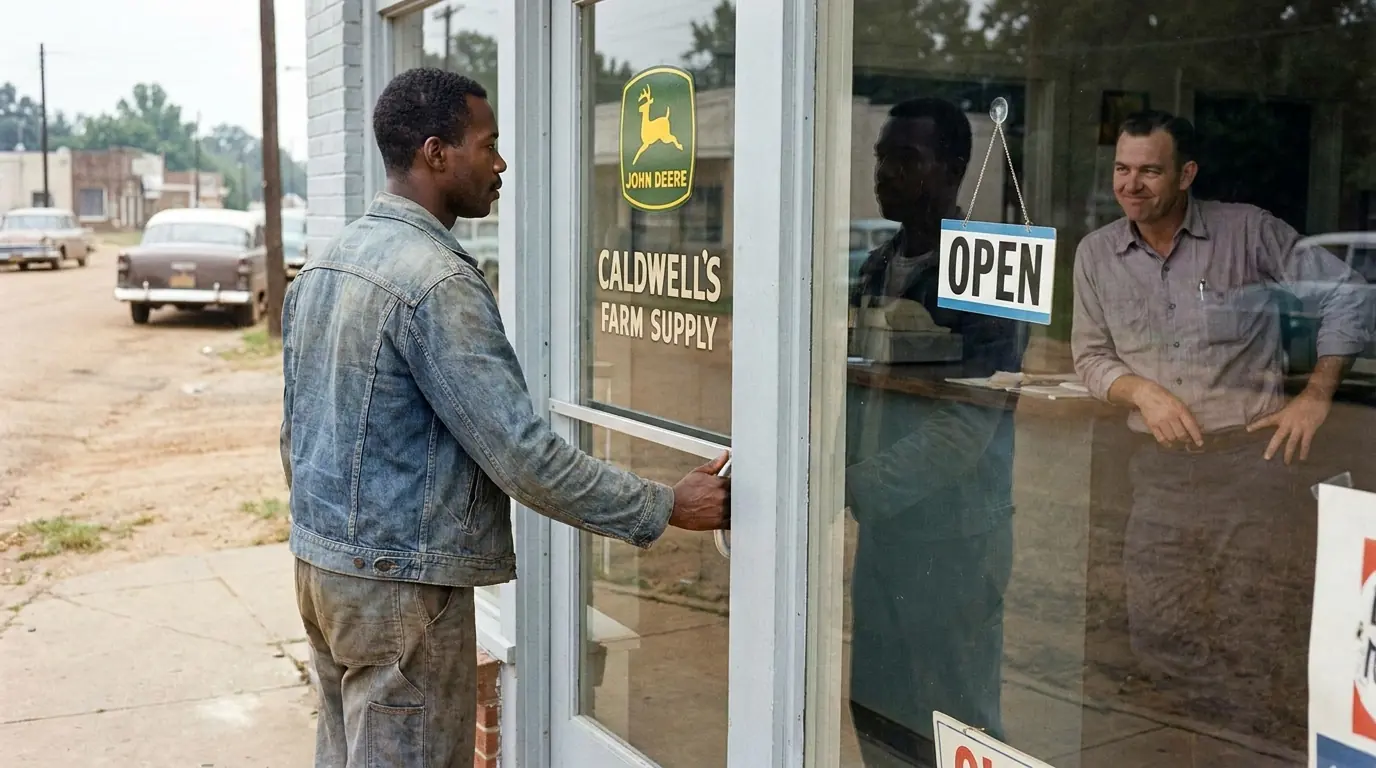
Henry parked outside Caldwell's John Deere, the only equipment dealer in Leflore County that carried International Harvester parts alongside the green and yellow machines.
He walked to the front door, tried the handle. It was locked.
He could see people inside. Roy Caldwell, the owner, was leaning against the counter talking to two farmers. A parts man was behind the shelf pulling stock. The lights were on. The sign said open.
Henry knocked.
Roy looked up, looked at Henry through the glass, and turned back to his conversation.
Henry knocked again. Roy didn't move. One of the farmers glanced at the door, then looked away.
Henry stood there for ten minutes. Then he drove home without the plow point.
He didn't need anyone to explain what had just happened.
Henry Tate was a Black man in Mississippi in 1961. Some doors didn't open for him. Not because they were locked, but because the people inside chose not to turn the handle.
Henry was born in 1931 in a shotgun house on a cotton plantation outside Itta Bena, Mississippi. His father, Moses Tate, was a sharecropper who worked forty acres of somebody else's land for thirty years and never owned a single one of them.
Every fall, Moses would settle up with the landowner, and every fall, the numbers came out the same. What he owed for seed, fertilizer, and equipment rental was almost exactly what the crop had earned. Some years, Moses owed more than the crop. Those years, the debt carried over, chaining him to the same land for another season.
Henry watched this his entire childhood. He watched his father work from dark to dark on ground he'd never own, watched the ledger book that always came out even or worse, watched the system that was designed, deliberately designed, to keep his family working but never building.
Henry, the only way out of this is to own the dirt you stand on. Not rent it. Not sharecrop it. Own it. Because as long as someone else owns your ground, they own your life.
Moses Tate never got out. He died in 1958 still sharecropping the same forty acres he'd started on in 1928. Thirty years of labor, and he left his family nothing but that one sentence.
Henry swore he'd live differently.
After his father died, Henry worked for three years as a hired hand on a large operation outside Greenwood. He was the hardest worker on the crew, and everyone knew it. He could fix any piece of equipment on the place. He could read weather better than the Almanac. He could look at a field and tell you within five bushels what it would yield.
The owner, a white farmer named Jack Parsons, once told his wife, Henry Tate knows more about farming than I do. If he had his own land, he'd outproduce half this county.
But Henry didn't have his own land.
And in 1961 Mississippi, banks didn't lend to Black farmers. The Farmers Home Administration, which was supposed to serve all farmers, routinely denied Black applicants or gave them smaller loans with worse terms than white farmers received. The USDA county committees that controlled agricultural programs were all white.
The system wasn't broken. It was built this way.
Henry had saved $4,800 from three years of hired work. Every dollar he could keep, he kept. He lived in a one-room cabin on the edge of the Parsons place, ate what he grew in a garden patch behind the cabin, owned two sets of clothes and one pair of boots.
He saved the way his father should have been allowed to save but never could.
In the spring of 1961, a piece of land came up for sale that nobody else wanted. Eighty acres of low ground near the Tallahatchie River, four miles south of Money, Mississippi. The soil was heavy clay, hard to work, prone to flooding in wet years. The timber had been logged twenty years earlier, leaving stumps everywhere.
It wasn't farmland yet. It was potential farmland, the kind of land that would take years of clearing and working before it produced anything useful.
The owner was an elderly white woman named Mrs. Adeline Cross, whose husband had logged it and died. She wanted thirty dollars an acre. Twenty-four hundred dollars for eighty acres.
Henry went to the First National Bank of Greenwood and asked for a loan.
The loan officer, a man named William Hartley, listened politely for about two minutes.
We don't make agricultural loans for that type of property.
Henry knew what that type meant. It didn't mean the property.
He went to the Farmers Home Administration office. Same result, different words.
Your application doesn't meet our current lending criteria.
Henry drove out to Mrs. Cross's place himself, knocked on her door, explained who he was, what he wanted, and what he could pay.
Mrs. Cross was eighty-one years old. She looked at Henry for a long time.
You have cash?
Twenty-four hundred dollars. I can pay the full amount.
That land is rough. You know that.
I know it. I'll clear it myself.
My husband always said that ground had good soil under all those stumps. He just never got around to proving it.
She sold him the eighty acres, signed the deed herself, didn't ask the bank, didn't ask anyone's permission.
Henry Tate owned land.
For the first time in his family's history going back as far as anyone could remember, a Tate owned the ground he stood on.
He needed equipment to work it.
At an estate sale in Tallahatchie County, he found a 1947 Farmall H for two hundred eighty dollars. The tractor was rough, faded paint, oil leak, worn clutch, but the engine was strong, and Henry could fix everything else.
He also bought a single-bottom plow for forty dollars and a disc harrow for sixty-five dollars. Total equipment investment, three hundred eighty-five dollars.
But the plow needed a new point. The disc needed bearings. And the only dealer within thirty miles that carried International Harvester parts was Caldwell's John Deere in Greenwood.
That was when Henry drove to Caldwell's for a six-dollar plow point, and that was when the door stayed locked.
Henry couldn't buy parts from Caldwell's, but he could buy parts from salvage yards, mail-order catalogs, and farm auctions, where nobody cared what you looked like as long as your money was real.
Within a month, he'd found everything he needed. A plow point from a salvage yard in Clarksdale, disc bearings from a mail-order catalog out of Indiana, a fuel filter from another Farmall he found rusting in a field and bought for twenty dollars just for the parts.
He spent the rest of 1961 and all of 1962 clearing stumps from his eighty acres by hand. No bulldozer, no chain saw, no help, just a shovel, an axe, a Farmall, and a chain Henry welded together from scrap.
He'd dig around a stump, wrap the chain, hitch it to the Farmall, and pull. Some stumps took an hour, some took a day, a few took a week of digging before the roots let go.
He cleared forty acres the first year, planted cotton on twenty of them in the spring of 1962. The other twenty went into soybeans.
The cotton made half a bale per acre, not good, but not nothing. The soybeans did better. That heavy clay soil held moisture that sandy ground couldn't. Henry noticed. He filed it away. The soil was telling him something, and unlike most people, Henry listened.
By 1963, he had all eighty acres cleared and planted, cotton and soybeans in rotation. He added a vegetable garden that fed him year-round. He started selling surplus vegetables at the market in Greenwood, building a small cash flow outside the commodity markets.
Roy Caldwell heard about Henry through the county grapevine. A Black farmer on the old Cross place, working it with a worn-out Farmall and homemade implements.
Roy's reaction was the same as every other dealer and banker in the county.
He'll be done in two years. That ground isn't worth farming, and he doesn't have the equipment or the capital to make it work.
Henry heard the talk. Ignored it completely.
He had his father's words in his chest like a second heartbeat.
Own the dirt you stand on. Everything else is noise.
Henry farmed those eighty acres from 1962 to 1982 without borrowing a dollar. He lived on almost nothing, repaired his own equipment, fabricated parts he couldn't buy, grew food he couldn't afford.
Every dollar that didn't go to seed, fuel, or taxes went into a coffee can buried under the floor of his cabin.
By the late 1960s, his soybeans were outperforming the county average. That heavy clay soil that everyone said was worthless turned out to be perfectly suited for soybeans. It held water through the dry August weeks when sandy ground cracked and withered.
Henry had figured this out by watching, not by reading a manual. The same way his father had read weather, Henry read soil.
By 1970, he had fourteen thousand dollars saved. By 1975, twenty-eight thousand. By 1980, forty-one thousand.
In 1972, he bought a second tractor at auction, a 1955 Farmall 400 for six hundred dollars. Now he had two machines, both paid for, both maintained by his own hands in a shed he'd built from salvaged lumber.
Jack Parsons, the farmer Henry had worked for, stopped by Henry's place one evening in 1975. He'd been watching Henry's operation from a distance for years.
Henry, I owe you something I should have said a long time ago.
What's that, Mr. Parsons?
When you worked for me, I told my wife you knew more about farming than I did. I was right, but I should have told you, not her.
I appreciate that.
How many acres you farming now?
Still eighty.
Eighty acres and you're banking more money than most farmers with three hundred. How?
No debt. No payments. No overhead. Everything I make, I keep.
Parsons shook his head.
I've got three hundred twenty acres and I owe more than they're worth. How did that happen?
You borrowed. I didn't. That's the whole difference.
Then the 1980s arrived, and the world that had been built on debt came apart.
White farmers who'd borrowed from banks and the FHA lost their land when they couldn't make payments. Black farmers who'd been denied those same loans, denied the chance to borrow, found themselves in an impossible position. They'd been shut out of the system that was now destroying everyone inside it.
For Henry Tate, being denied was the thing that saved him.
While farmers around him foreclosed, Henry kept farming. His costs were minimal. No debt service, no equipment payments, no land payments.
When soybean prices dropped, Henry tightened his belt and survived. When cotton collapsed, he shifted more acres to beans and added winter wheat to his rotation.
He adapted because he had room to adapt. No bank was telling him what to plant or when to sell.
And then Henry Tate went to auctions.
The first farm he bought was 120 acres adjacent to his own, foreclosed in 1983. The bank wanted two hundred dollars an acre. Henry offered one hundred sixty cash. They took it. Nineteen thousand two hundred dollars from the coffee can under the floor.
The second was eighty acres across the road, estate sale in 1985. One hundred eighty dollars an acre. Fourteen thousand four hundred dollars cash.
The third was 160 acres a mile north, foreclosure in 1987. One hundred fifty dollars an acre. Twenty-four thousand dollars cash.
By 1988, Henry Tate owned 440 acres.
He was fifty-seven years old, a Black farmer in Mississippi who'd been turned away from a dealership, denied by banks, ignored by the USDA, and dismissed by everyone in the county, now owned more land than most of the white farmers who'd been handed every advantage he'd been denied.
And he was just getting started.
In March of 1986, Henry Tate walked into Caldwell's John Deere. This time the door was unlocked.
Times had changed, not because hearts had changed, but because money had gotten tight enough to change behavior. Roy Caldwell couldn't afford to turn away any customer anymore.
Henry walked up to the parts counter.
Roy recognized him, couldn't place where from at first, then it hit him. The man at the door twenty-five years ago.
Can I help you? Roy said. The words came out careful, like a man stepping on ice.
I need a hydraulic cylinder for a Farmall 400 and a set of disc blades and a fuel injector rebuild kit for an H.
Roy looked at the list. About three hundred forty dollars in parts. A real order. A paying customer.
I can get all of that. Take me a day or two on the injector kit.
That's fine.
Henry paid cash. Roy wrote up the ticket.
Neither man mentioned 1961, but it was in the room like a third person standing between them.
As Henry was leaving, Roy said, You're farming the old Cross place, right? And the Henderson land, and the parcel across the road?
That's right.
How many acres total?
Four hundred forty.
Roy went quiet.
Four hundred forty acres, more than most of his remaining customers, owned by the man he'd left standing outside a locked door a quarter century ago.
I didn't know that, Roy said. I didn't know you'd done all that.
Henry looked at him.
You weren't supposed to know. I wasn't doing it for you to notice.
He walked out with his parts.
Roy stood behind the counter for a long time after he left.
Between 1988 and 2001, Henry continued buying land at auctions and estate sales, always cash, always below market value, always ground that other people had given up on.
He expanded to 840 acres by 1995 and 1,200 acres by 2001.
He also did something that set him apart from every other large landowner in Leflore County. He hired young Black farmers and trained them. Not as sharecroppers, never as sharecroppers. As farm managers who earned wages, learned the operation, and were given the option to lease land from Henry on fair terms with the goal of eventually buying their own.
Between 1990 and 2005, Henry helped eleven young farmers get started. He leased them land at below-market rates. He lent them equipment. He taught them the same thing his father had taught him.
Own the dirt you stand on. Don't rent your life from someone else.
By 2010, seven of those eleven farmers owned their own land. Three had expanded beyond what they'd leased from Henry. Two had operations larger than two hundred acres.
In a county where Black land ownership had been declining for sixty years, Henry Tate had reversed the trend single-handedly.
In 2005, the Mississippi Agricultural Extension Service invited Henry to speak at a conference in Jackson. He was seventy-four years old. He'd never spoken publicly about his operation.
He stood at the podium in a room full of agricultural professionals, extension agents, and university researchers. He wore the same thing he always wore, clean work clothes and boots.
He spoke for twelve minutes, no notes, no slides, just truth.
My father was a sharecropper for thirty years. He worked forty acres of someone else's land and died owning nothing. The only thing he left me was one sentence. Own the dirt you stand on.
I've been following that advice for forty-four years. I own 1,200 acres now, never borrowed a dollar, never made a payment to a bank. Started with eighty acres of stumps and a Farmall that cost less than a good saddle.
The secret isn't complicated. Don't owe what you can't cover. Take care of your soil, take care of your equipment, and don't wait for someone to open the door for you. Build your own door.
The room was silent for a few seconds. Then they gave him a standing ovation.
Henry Tate is ninety-four years old now. He stopped farming in 2018 at eighty-seven. His 1,200 acres are managed by three of the farmers he trained. All of them now in their forties and fifties, all of them landowners themselves.
The 1947 Farmall H sits in Henry's barn, cleaned and maintained. He starts it up once a year just to hear it run.
His son, James Tate, farms four hundred acres of his own adjacent to his father's operation. James has a degree in agricultural science from Mississippi State. He uses GPS-guided equipment and satellite soil mapping, but he keeps one of his father's handwritten ledger books on his desk.
People ask me about my operation, James says. They want to know about the technology, the data, the precision agriculture. And I show them my father's ledger. Every acre tracked by hand. Every dollar counted with a pencil. No debt in any column, any year. For forty-four years. That's the technology that built this place. Everything else is just tools.
The John Deere dealer wouldn't let Henry inside the building. Twenty-five years later, Henry owned more land than the dealer's best customer.
But Henry doesn't tell this story as a story about revenge. He doesn't tell it as a story about race, though race is woven through every page.
He tells it as a story about dirt.
My father said, Own the dirt you stand on. That's what I did. Didn't matter that the door was locked. Didn't matter that the bank said no. Didn't matter that nobody thought I could do it. The dirt doesn't care who owns it. It just cares whether you take care of it. I took care of it, and it took care of me.
He pauses.
Same thing's true of people, by the way. The ones who take care of what they have, they're the ones who end up with more. The ones who borrow what they can't afford, they end up with nothing. Doesn't matter what color you are. The math is the same.
So let me leave you with this.
Right now, somewhere, someone is standing outside a locked door. Not because they can't do the work, not because they don't have the skill, just because someone on the other side decided they don't belong.
The John Deere dealer wouldn't let a thirty-year-old man inside his building to buy a six-dollar plow point. Twenty-five years later, that same man owned 440 acres free and clear, and the dealer's door was open because he couldn't afford to keep it closed anymore.
Because Henry understood something the dealer never did.
A locked door is just a wall with hinges. And walls don't stop the kind of man who clears stumps with a chain and a Farmall.