On a January morning in 1979, a man named Eldon Carver walked into the only John Deere dealership in Cass County, Nebraska, with $17 in his front pocket and a question he had been rehearsing since before sunrise.
The floor was waxed to a mirror shine. A brand-new 4440 sat under fluorescent lights like something holy, its green paint so clean it looked wet and its yellow stripe catching the light just right.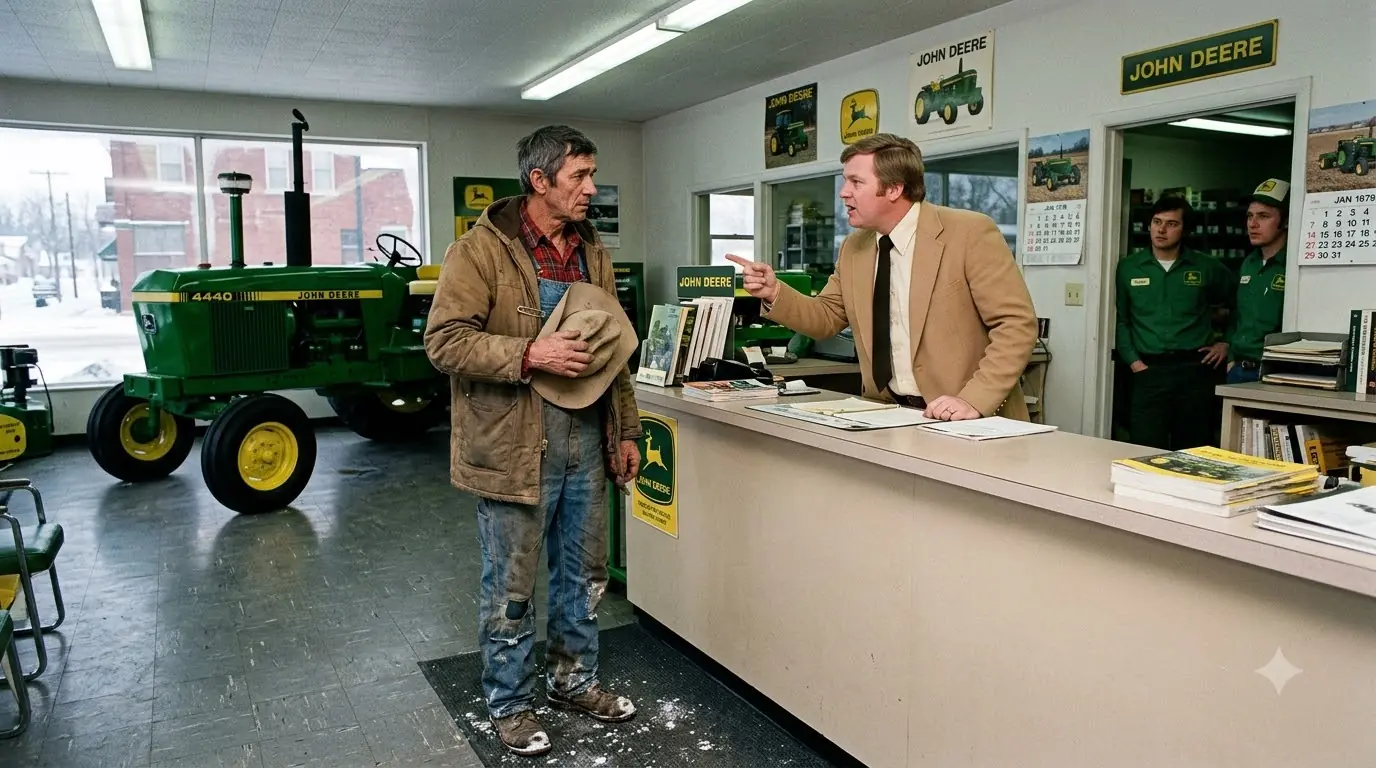
Eldon stood at the edge of the showroom floor with his coat held shut by a safety pin because the zipper had given out in October and he had not had to fix it.
He held his hat in both hands. He did not touch anything. He asked about financing.
The salesman, a man named Dale Pruitt, whose father had opened the dealership in 1951 and whose photograph still hung behind the service counter, looked at Eldon Carver the way a man looks at something that wandered in from outside.
Dale did not reach for a brochure. He did not offer a handshake. He said, loud enough for the two other men at the service counter to hear, "Son, poor men don't buy John Deere." Then he laughed.
Eldon put his hat back on. He said, "Yes, sir." He walked out into the cold. What Dale Pruitt did not know, what nobody in Plattsmouth, Nebraska, would know for years, was that Eldon Carver had a long memory and a very particular kind of patience.
It was the kind that did not announce itself. It was the kind that just worked. Eleven years later, Eldon Carver would come back through that same door. He would not be asking about financing.
You have to understand what Cass County was in 1979 to understand what Eldon Carver was up against. The farm economy in that part of Nebraska was built on borrowed time and borrowed money, and by the late 1970s, the interest clock was running fast.
Land prices had spiked through the early part of the decade on the promise of export booms. The Soviet grain deal of 1972 had made every farmer between Omaha and Lincoln feel like they were sitting on a gold mine.
Raymond had watched the men around him expand and had borrowed cautiously. He kept 240 acres of corn ground and 40 acres of soybeans, the same patch his own father had broken with a two-bottom plow in 1932.
Raymond was deliberate in a way that people in a hurry often mistook for slowness. When Raymond had his stroke in the fall of 1978, Eldon came home from Kearney, where he had spent two years working at a farm implement repair shop.
He was 26 years old. He came home to 280 acres of decent ground, a 1966 John Deere 4020 with a cracked block that Raymond had been nursing along with shade-tree fixes for nearly three seasons, and a note at First National Bank in Plattsmouth for $41,000.
He also came home to something Raymond had left him that was not listed on any balance sheet. It was a reputation in the county for fixing machines that nobody else could fix.
Raymond had built that reputation over 30 years. Eldon, who had been taking apart and reassembling engines since he was nine, had been building one of his own before he left for Kearney.
But reputations did not plant corn, and the 4020 with the cracked block was not going to make another spring. That was why he walked into Pruitt's John Deere in January of 1979 with $17 and a question.
That was also why, when he walked back out with Dale Pruitt's laughter trailing behind him, something settled in Eldon Carver that would not move again for a very long time.
What he did next was so quiet that most people in the county did not notice it until years later, when they were sitting around trying to reconstruct the story and could not quite piece together how it had happened.
He did not buy the 4020 parts he needed from Pruitt's. He drove 40 miles south to a dealership in Nebraska City and bought them there, paying cash out of what he had saved in Kearney.
He repaired the 4020 himself, pulling the block in the machine shed on a February night when the temperature dropped to 11 degrees. He worked by trouble light with a space heater aimed at his feet. He put in his first crop that spring on the repaired tractor. It was not pretty, and the 4020 smoked some, but it worked.
Then he started asking around. What Eldon had noticed, and what would prove to be the first in a long series of things he noticed that other people missed, was that the farm crisis beginning to creep across the Midwest was going to shake loose a lot of equipment at county auctions.
Men who had overborrowed in the expansion years, men whose notes were coming due just as commodity prices started softening, were going to have to liquidate. When a farmer liquidated, everything went: the livestock, the stored grain, the shop tools, and the tractors.
In the spring of 1979, Eldon went to a farm auction south of Weeping Water where a man named Gerald Brandt, a good farmer who had chosen a bad time for his land purchase, was selling 200 acres and everything on it.
There was a John Deere 4430 on the auction block that had thrown a hydraulic fitting the previous fall. It had sat in a field all winter. The auctioneer described it as being in partially working condition.
Most of the serious buyers left after the real estate sold. The crowd had thinned to maybe 30 men by the time the 4430 came up. Eldon bought it for $4,200. He loaded it on a borrowed flatbed and hauled it home.
He had the hydraulic issue diagnosed within two hours and repaired by the following evening. Three weeks later, he sold it to a farmer in Otoe County for $7,800. He had just discovered something. It was something he would spend the next decade turning into the most unlikely business the county had ever seen.
The farm crisis deepened through 1980 and into 1981 like a drought that did not announce itself until the pastures were already brown. Interest rates climbed past 15 percent. Land values that had peaked at $2,000 an acre started sliding. The operating loans that banks had handed out with such cheerfulness began to look like anchors.
Pruitt's John Deere, like every implement dealer in the region, felt it. New equipment sales collapsed. Farmers who could not afford payments on their existing machines certainly were not walking in to price a new 8440 four-wheel drive. Dale Pruitt started carrying more parts inventory and less iron.
He laid off two of his five mechanics. Eldon noticed. By 1981, Eldon had been to 43 farm auctions in a four-county area. He had bought and sold 17 tractors, mostly John Deere, some International Harvester, and a few Allis-Chalmers, and had cleared just over $29,000 above his acquisition and repair costs.
He was running his own farm on the 4020 he had rebuilt and a used 4230 he had kept back from his auction inventory after a buyer fell through. He had also picked up a reputation. People started calling him before the auction. Farmers who were facing liquidation, or farmers who knew someone facing liquidation, would find Eldon's number, which was not hard because in a county of 12,000 people, everyone knew where to look.
They would call and describe what they had. Sometimes he would go look. Sometimes he would make an offer over the phone. He had a way of being fair that people noticed, especially in a time when everyone with money was looking for a desperate man to pick clean.
He had one rule that he had made for himself without ever writing it down. He would never offer a man less than a machine was actually worth just because that man was desperate. He would offer what it was worth to him, which was already discounted for repair and carrying costs, but not a dollar less than that out of opportunism. This rule cost him on some deals.
He paid more than he had to and knew it at the time. But in Cass County in 1981, when a man was losing his farm, word traveled. The word on Eldon Carver was that he was straight. He still bought his parts from Nebraska City, 40 miles each way, sometimes once a week, and he never set foot in Pruitt's.
There are moments in a long story when the whole thing pivots, when something happens that looks small at the time and turns out to be everything. In Eldon Carver's story, that moment came in the late summer of 1982 in the form of a man named Howard Greer. Howard had farmed 480 acres east of Louisville for 30 years. He was 61 years old, his bank had called the note on his operating loan, and he was looking at losing everything by November.
Howard had a John Deere 4840 with a blown turbo sitting in his machine shed, a 6600 combine that needed a complete feeder-house rebuild, and a 7000 four-row planter that was mechanically perfect. He called Eldon. Eldon came out on a Tuesday morning. He walked around the 4840 for a long time without saying anything.
He climbed up, checked the serial numbers, and looked at the turbo. He went through the combine. He ran the planter's seed tubes. Then he sat in his truck for about 20 minutes doing figures on a notepad.
He offered Howard Greer $44,000 for all three machines. Howard's banker had told him he might get $35,000 if he was lucky. There was one condition. Eldon needed 60 days to get the money together.
He could put $10,000 down that afternoon and pay the rest in 60 days. Howard said yes. What Eldon had not told Howard, and what Howard probably sensed but did not ask about, was that Eldon had already been on the phone with a farmer in Gage County named Dennis Rutherford. Dennis needed a 4840 for the upcoming wheat harvest and had told Eldon, flat out and without being asked, that he would pay $58,000 for a working one.
Eldon had the turbo rebuilt at a machine shop in Omaha for $900. He delivered the 4840 to Dennis Rutherford on a Thursday in October. He cleared $8,000 on the transaction in six weeks. The combine and the planter he sold separately to two different buyers by December.
The total profit on the three machines was just over $19,000. But that was not the important part. The important part was that Howard Greer lost his farm that November but came through it with enough money to retire on rather than nothing. He told the story at the Plattsmouth diner to anyone who would listen.
He told it through the winter. He told it to his son-in-law. He told it to his pastor. He said, "That young Carver didn't have to give me what he gave me. He could have offered me 30, and I'd have taken it. But he didn't, and I'll never forget that."
Eldon was 30 years old. He had no storefront, no sign, and no business license beyond the basic LLC he had filed in Lincoln. He had a reputation, a battered Chevy truck, a shop full of tools, and a network of contacts in four counties that was growing every season like a corn root system going deep before the stalk even showed. He was also, finally, out of debt on his father's farm.
By 1984, Eldon had a waiting list. This was not a formal thing. Nobody sent a deposit and received a confirmation number. It was simply understood, in the way things in small counties become understood without announcement, that if you had a machine Eldon might want, you called him first.
If you needed a specific model in working condition, you called him, and he would tell you what he had coming and when. He had also begun to expand beyond tractors. A Cass County farmer named Phil Sutter came to him with a proposition in the spring of 1984. Phil had 1,200 acres and was looking to build out a complete equipment line from used iron, and he wanted one person to handle the whole acquisition.
Eldon spent the better part of that year sourcing machines across a six-state area, making one trip to Kansas, two to Iowa, and one to South Dakota. Phil Sutter's operation was running that fall on a complete set of late-1970s John Deere iron that Eldon had assembled and delivered in mechanically sound condition for 60 percent of what new equipment would have cost. Phil Sutter told a friend. That friend told two more.
By 1985, Eldon had assembled complete equipment packages for seven farming operations. He hired his first employee that year, a mechanic named Roy Diedrich, who had been laid off from Pruitt's John Deere in the second round of cuts. Roy was 52 years old and the best diesel mechanic in the county. He had been sitting at home in Murray for eight months when Eldon called him.
Roy said later in an interview with the Plattsmouth Journal that ran in 1991, "I asked him what the job was. He said, 'Fixing things that other people gave up on.' I said, 'What's the pay?' He told me it was better than Pruitt's. I said, 'When do I start?'"
Eldon built a proper shop that year, a 40-by-60-foot steel building on a concrete slab behind the farmhouse with two overhead doors and a heated interior. He did most of the work himself on weekends. Roy helped. Eldon still drove to Nebraska City for parts.
Meanwhile, something very different was happening at Pruitt's John Deere. Dale Pruitt had inherited the dealership from his father in 1971, during good times, and he had run it the way a man runs something he inherited in good times, with confidence and without much examination of the fundamentals. The dealership had been built on new equipment sales, and through the mid-1970s, new equipment sales were strong. Dale drove a new pickup every two years.
He built a house on the lake east of town. He sponsored the Little League team and the County Fair Queen pageant and sat on the board of the Chamber of Commerce. When the farm crisis hit, he did what most dealerships did. He contracted, cut staff, and focused on parts and service.
But Dale had made some decisions in the good years that could not be undone so easily. He had signed floor-plan financing agreements on new equipment inventory that tied him to purchase minimums with the manufacturer. When sales fell, that iron sat on his lot and the interest continued to run. By 1985, Pruitt's was carrying a parts inventory that was too large, a service department that was understaffed because he had cut the wrong mechanics, and a line of credit at the bank that was being reviewed every six months instead of every year.
What Dale did not see, what he genuinely could not see because he had never had reason to look, was that a significant portion of the equipment market in the county had quietly migrated. Farmers who needed a used 4240 were not calling him first anymore. They were calling a number they had gotten from a neighbor who had gotten it from someone else. That number went to a farmhouse south of town where a man answered on the second ring, talked to you straight, and usually knew exactly what you needed.
Dale Pruitt heard the name Eldon Carver in passing. He did not connect it to the young man who had stood in his showroom in 1979 with the safety pin on his coat. Why would he? That man had been nobody.
Dale was making a mistake. In the fall of 1986, something happened that Eldon did not cause, did not plan for, and could not have predicted, but it changed everything. First National Bank of Plattsmouth, which held Pruitt's operating line of credit, was acquired by a regional bank holding company out of Omaha. The new management came in with a different set of risk tolerances.
Pruitt's account, with its irregular sales figures and swollen parts inventory, was flagged in the first portfolio review. The new bank called Dale Pruitt in for a meeting in October. They did not shut him down, but they told him they would not renew his floor-plan line at existing levels. He had 12 months to reduce his new-inventory exposure by 40 percent.
This was survivable. It was painful and humiliating, but it was survivable. Except that Dale Pruitt, faced with a problem he did not know how to solve, made a sequence of decisions that made it worse. He held a clearance sale on aging new inventory at margins that did not cover his floor-plan costs.
He cut his service department to a single mechanic, not Roy Diedrich, who was gone by then, but a younger man who was competent and slow. He let three experienced parts-counter employees go and hired two part-timers. By 1987, the dealership that had turned away Raymond Carver's son was a diminished thing. The lot was thinner, and the service bays were quieter.
The men who remembered it from its peak years drove past and said, "Dale's really hurting." Eldon heard this. He heard it at the feed store. He heard it at the elevator.
He heard it from Roy Diedrich, who still had friends in the building. Eldon did not say anything. He was thinking. What he had been building toward, not consciously at first and then with increasing deliberateness, was something Cass County had never quite seen before and did not have a name for.
It was not a dealership, exactly. It was not just a repair shop. It was an equipment business that lived entirely in the space the traditional dealers had abandoned. By 1988, Eldon had four full-time employees, a second shop building, and a customer base that stretched into seven counties.
He was doing complete machine rebuilds. He would buy a worn-out tractor, completely remanufacture the engine, hydraulics, electrical system, and sheet metal, and sell it with a written warranty. In a county where a new John Deere 4255 listed at $58,000, Eldon was selling a rebuilt 4240 with a full warranty for $31,000. He had more orders than he could fill.
By this point, he had also acquired something else entirely. He had been talking quietly with an attorney in Omaha. He had been doing some reading. He had been making calls to people in the agricultural finance world who dealt in distressed business assets.
He knew what Pruitt's was worth. He did not mean the inflated legacy number that Dale Pruitt probably still believed in, the number based on what his father had built in 1951 and what the dealership had been at its peak. Eldon knew the real number. It accounted for the shrunken inventory, the reduced service capacity, the customer relationships that had eroded, and the floor-plan debt that was still hanging.
He knew that number better than Dale Pruitt did. He also knew that the John Deere regional distribution office had been watching Pruitt's for two years and was not pleased with what it saw. The call came to Dale Pruitt's attorney in March of 1989. It was not a call from Eldon directly, because that was not how these things were done.
An Omaha attorney expressed interest on behalf of an unnamed client in the possible acquisition of the Pruitt's John Deere dealership and associated real estate. The package being discussed included assumption of the remaining floor-plan debt, purchase of the parts inventory at appraised value, and an offer for the property and franchise rights. Dale Pruitt, when his attorney called him, reportedly sat in silence for a long time. Then he asked who the buyer was.
He was told the buyer preferred to remain unnamed until the letter of intent was signed. Dale thought about it for a week. Then he agreed. The closing was set for June of 1990.
It took 14 months to work through the franchise approval process. John Deere's regional office had to approve the new ownership, and this involved an extensive review of the buyer's financial position, operational capacity, and business history. The review that came back was the best one the regional representative had seen in years. The buyer had no debt.
The buyer had 11 years of documented equipment business in a seven-county area. He had a reputation that the representative had heard about from three separate dealer contacts in the region before he ever pulled the file. On a Wednesday morning in June of 1990, Eldon Carver drove to Plattsmouth in his pickup, a clean 1988 Chevy, not new but decent, and walked into the dealership that had turned him away 11 years before. He was meeting with his attorney and the title company to sign the final documents.
Dale Pruitt was required to be present for the closing. He was there when Eldon walked in. There are different accounts of what happened in that room, as there always are with moments that become legend. What everyone who was present agrees on is this: Dale Pruitt looked at Eldon Carver and clearly did not place him at first.
There was a moment, maybe three or four seconds, when he was simply looking at the man who had bought his dealership and trying to square the face with a memory he did not know he had. Then he placed him. He remembered the coat with the safety pin, the hat held in both hands, and the question about financing on a January morning in 1979. He remembered saying, "Son, poor men don't buy John Deere."
Eldon Carver, according to his attorney, did not say anything. He sat down at the table. He reviewed the documents. He signed where he was asked to sign.
He shook hands with the title company representative, with his attorney, and with the John Deere regional representative who had driven down from Omaha for the occasion. He shook hands with Dale Pruitt. He thanked everyone for their time. Then he walked out through the showroom.
The same floor was still waxed to a shine. A green tractor was still parked under fluorescent lights. Eldon got into his truck and drove south toward the farm. He told his wife that evening that it had gone fine.
The new sign went up in August of 1990. It read, "Carver Farm Equipment, John Deere Sales and Service." Roy Diedrich came back. He was the first hire.
Eldon called him on the Thursday after the closing, and Roy said yes before he finished the sentence. Eldon rebuilt the service department from scratch. It had six bays, five mechanics, and a parts counter staffed by people who could answer a question about a 1978 4240 without putting the caller on hold. He kept the floor plan on new equipment conservative because he had watched what floor-plan debt had done to the previous owner.
He stocked the used inventory deep because used equipment was what he knew and what the county needed. Within 18 months, Carver Farm Equipment was the second-highest-volume John Deere dealer in the regional territory. By 1995, it was the highest. He never changed the showroom floor.
It remained the same tile, kept waxed the same way. When people asked him why he did not renovate, he said the floor was fine. What he did not say, what he maybe only knew in the way you know things you do not put into words, was that he needed it to look the same. He needed to walk across it every morning and remember what it had felt like to stand there in a coat held shut with a safety pin, being told that a man like him had no business being there.
That feeling was the whole business. It was every auction he had driven to at five in the morning, every hydraulic line he had replaced in a frozen machine shed, and every fair offer he had made to a farmer who could not afford to hold out for better. That feeling was the reason Roy Diedrich received a pension plan and health insurance when nobody in the county was offering mechanics a pension plan. It was also the reason Eldon Carver's service department had a policy, unwritten but real, that a farmer in a bind got his machine looked at the same day he called.
Eldon Carver knew what it cost a man to be told to wait. He knew what it cost a man to be turned away. He knew it in his body, in the way cold knowledge sits in you and does not leave. He had never forgotten.
Dale Pruitt moved to Lincoln in 1991. He went into commercial real estate. He did all right by some accounts. By other accounts, he never quite recovered from the way things had ended in Plattsmouth.
Some people said he should have fought harder for the business. Some people said he had enjoyed every advantage and had simply not paid attention to the right things at the right time. Some people, the ones who had known him longest, said the problem was that he had spent his whole career believing the business was his by birthright. That belief had made him careless.
Dale never spoke publicly about Eldon Carver. Eldon never spoke publicly about Dale Pruitt. There was one moment, though, that made it into the telling of the story because a parts-counter employee named Sandra Williams was there and told it later. Sandra Williams was not the kind of woman who embellished.
A few weeks after the new sign went up, before the renovation work had started and before the new staff had all been hired, Dale Pruitt came back to the building. He said he had left some personal items in the back office. Eldon let him in. It was a Saturday afternoon, and the showroom was quiet.
Dale gathered what he had come for. On his way out, he stopped. He stood at the edge of the showroom floor for a moment, looking out at the lot. Then he turned to Eldon, who was standing near the parts counter.
He said, "I don't expect you to believe me, but I didn't mean it like that." Eldon Carver looked at him for a moment. Then he said, "I know." He did not say anything else.
Dale Pruitt walked out. Sandra Williams, who had been pretending to organize invoice folders at the parts counter, said later that she could not tell from Eldon's face whether he believed it or not. She said he looked the way he always looked, deliberate and steady, like a man who had already decided how to feel about something a long time ago and had moved on to other things. Carver Farm Equipment is still there.
The sign has been updated twice, once in 1998 and once in 2007, but the name has not changed. The showroom floor was finally refinished, though Eldon held off until 2003 and apparently had to be talked into it by his son. His son joined the business in 1999 after a three-year apprenticeship in the service department that Eldon insisted on before he would let the boy anywhere near management. Eldon Carver semi-retired in 2011.
He still comes in on Tuesday mornings. He still drives a Chevy. He still parks it in the same spot and walks in through the same door. There is a photograph in the break room, not the office, where the mechanics eat lunch, that someone dug up from the Plattsmouth Journal archives in the early 2000s.
It is a photograph from 1991, the first year the dealership ran under the new name. Eldon is standing outside next to the sign, squinting a little because the sun is in his face. He is wearing a coat with a broken zipper. Whether he planned that or whether it was simply the coat he grabbed that morning, nobody ever asked him directly.
But Roy Diedrich, who had been at the shop since day one and had a theory about most things, said it was not an accident. He said Eldon Carver had never been the kind of man who did things by accident. In Cass County, they still tell this story. They do not tell it often or loudly.
They tell it the way people tell the stories that actually matter to them. They tell it at kitchen tables, in machine sheds, and at the diner counter on a slow Tuesday. That is the way real American stories travel, not in headlines, but in the mouths of people who were there or knew someone who was. They are passed down the way a good piece of ground gets passed down, with care, because it is worth something.
They say, "You know that John Deere dealer south of town? You know how that started?" Then they tell it. They tell it because it is a story about patience. It is about the kind of work that does not look like anything from the outside until it is done.
It is about what a man can build when the only thing driving him is the memory of being told he did not belong somewhere. They tell it because, in a county that has watched many farms get sold, many businesses close, and many good men leave for cities that promised easier things, the story of Eldon Carver is proof of something. The people who remember what it felt like to be turned away are sometimes exactly the people you want holding the door open for everyone else. On a January morning in 1979, a man walked out of a dealership with nothing but $17 and a long memory.
He came back with more than money. He came back with the whole thing.