On a Tuesday afternoon in March of 1963, a 20-year-old woman named Margaret Holcomb walked into Dennison's John Deere dealership in Russell, Kansas, and asked to see their used tractors.
Roy Dennison looked up from his desk, looked her over once, and laughed.
It was not a quiet laugh. It was the kind that carried across a showroom floor and made everyone turn around to see who was being humiliated.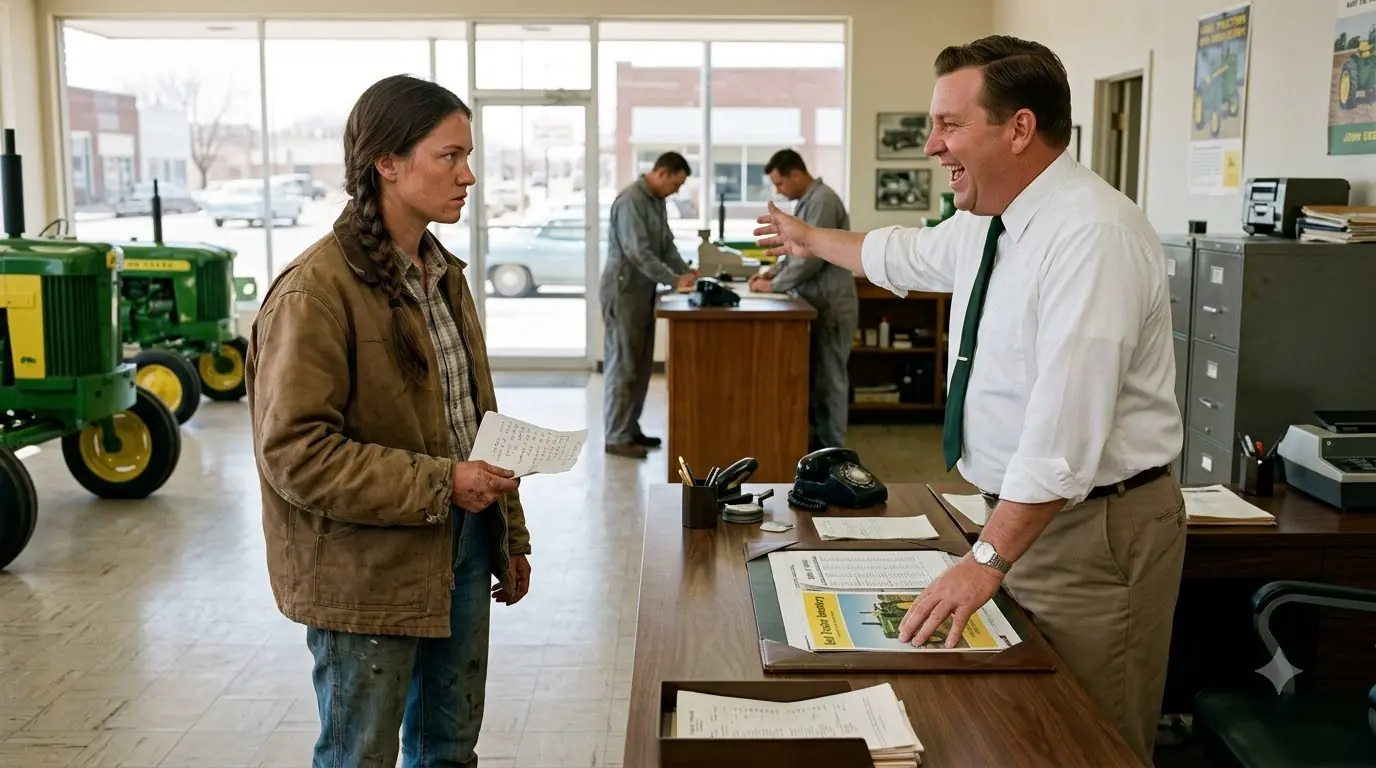
Margaret was five feet four, wore her father's work jacket two sizes too big, had dirt under her fingernails, and had not slept in three days.
Her father, Frank Holcomb, had collapsed in the barn the previous Friday morning. It was a massive stroke, and he was dead before the ambulance left town. He was 51 years old.
Frank had farmed 240 acres of dryland wheat and grain sorghum west of Russell for 26 years. He was a good farmer and a quiet man who never owed anyone a dollar he could not pay back by harvest.
He had raised Margaret alone after her mother died of pneumonia in 1951. He taught her to drive a tractor at 12, to weld at 14, and to read soil the way most people read books, slowly, carefully, and always looking for what lay underneath the surface.
Now Frank was gone, and Margaret had 240 acres, a farmhouse with a leaking roof, and no working tractor. Frank's only tractor, a 1951 Farmall M, had thrown its crankshaft two months before he died.
He had been planning to rebuild it in the spring but never got the chance. So Margaret walked into Dennison's John Deere, the only equipment dealer within 30 miles, looking for something she could afford.
Roy Dennison was 46 years old, a big man with a firm handshake who always wore a pressed shirt. He had been selling John Deere equipment in Russell County since 1952 and had strong opinions about who belonged in farming and who did not.
"Can I help you, sweetheart?" Roy asked, still smiling from his laugh.
"I need a tractor. Something I can run 240 acres with. What do you have used?"
Roy leaned back in his chair. "I heard about your daddy. Sorry for your loss. Frank was a good customer."
"Thank you."
"So, what are you planning to do with the farm?"
"Farm it."
"Yes, sir."
"Sweetheart, you're 20 years old. You can't farm 240 acres alone. That's a man's operation. Your daddy ran that place by himself for years, and it nearly broke him."
"Why don't you lease the ground to one of the neighbors? Harold Brewer's been expanding. He'd probably give you a fair price per acre."
"Or better yet, sell it. Buy yourself a nice little house in town. You're a pretty girl. You'll find a husband. Let him worry about farming."
Margaret looked at Roy Dennison, at his clean hands, pressed shirt, and confident smile. She thought about her father's hands, cracked and calloused, strong enough to pull a calf and gentle enough to replant a seedling.
"Mr. Dennison, do you have a used tractor for sale or not?"
Roy sighed like he was dealing with a child who would not listen to reason. "I've got a 1958 John Deere 730. Twelve thousand dollars. It's a fine machine."
"I can finance it for you. Ten percent down, seven years at nine percent. Your payment would be about $160 a month."
Margaret did the math. At $160 a month, she would pay $1,920 a year. Over seven years, she would pay close to $15,000 for a $12,000 tractor, nearly $3,000 in interest alone.
"That's more than I can spend."
"That's what equipment costs, sweetheart. Farming isn't cheap. You need capital to compete."
"I'm not trying to compete. I'm trying to survive."
Roy stood, walked around his desk, and put his hand on Margaret's shoulder like a father speaking to a confused daughter. "Margaret, listen to me. I knew your daddy. He was a good man, but he was stubborn. He farmed with old equipment, never upgraded, and never expanded."
"He left you 240 acres and a broken tractor. That's not a legacy. That's a burden. The smartest thing you can do is sell that land, take the money, and start a life for yourself."
Margaret stepped back, and his hand fell from her shoulder. "My father taught me everything I know. One thing he taught me is that the people who tell you what you can't do are usually the ones who are afraid you'll prove them wrong."
She walked out of the dealership. Behind her, she heard Roy say something to his mechanic. She caught two words: "Little girl."
What Margaret Holcomb did over the following 20 years would make Roy Dennison eat those two words with a side of humble pie.
Two weeks after walking out of Dennison's, Margaret heard about a farm auction 40 miles east in Ellsworth County. It was an estate sale with old equipment, the kind of auction where things sold cheaply because almost no one was looking for what was being offered. She drove out on a Saturday morning with $1,100 in cash, everything she had. Some of it was money her father had kept in a coffee can in the workshop, and the rest Margaret had saved during two summers working at the grain elevator in town.
The auction was small, with perhaps 30 people, mostly older men looking for parts. Two tractors were listed: a 1949 Farmall M and a 1953 Farmall Super M. Both were faded red, both showed their age, and both were overlooked by nearly everyone there. Margaret knew those tractors because she had grown up working on her father's Farmall M. She knew the engine, the transmission, and nearly every bolt and bearing. These machines had the same bones and the same blood.
The 1949 M went first. The auctioneer asked for a thousand dollars, received silence, then asked for five hundred. Margaret raised her hand at four hundred. No one answered, and the tractor sold to her for $400.
The 1953 Super M came next. Margaret bid five hundred. A man near the back bid five hundred and fifty, and Margaret answered with six hundred. Silence followed. It sold to her for $600.
She had bought two tractors for $1,000 and had only $100 left.
An older man named Tom Weber approached her after the sale. He farmed 300 acres near Ellsworth and had been watching her bid.
"Those are solid tractors, young lady. You know how to work on them?"
"I rebuilt my father's Farmall before I was 18."
Tom looked at her differently than Roy Dennison had. There was no pity or amusement in his face, only recognition, the way one farmer looks at another.
"Your father taught you well."
"He did."
"Then you'll be just fine."
Margaret borrowed a flatbed from a neighbor and hauled both tractors home. The M needed a clutch and new hydraulic seals. The Super M needed a fuel-pump rebuild and a complete electrical overhaul. Margaret spent three weeks in her father's workshop using his tools and following the notes he had left in a battered repair manual on the shelf. By the middle of April, both tractors were running.
Margaret's first year was where most people would have quit. She had 120 acres of winter wheat that her father had already seeded before he died, and she put the remaining 120 acres into grain sorghum. She did everything herself: plowing, planting, cultivating, and harvesting. She rose before dawn and worked until she could no longer see her hands in front of her face.
The neighbors watched, talked, and shook their heads.
"That Holcomb girl is going to kill herself trying to farm alone."
"Somebody should talk some sense into her."
"She'll be done by fall, guaranteed."
Roy Dennison heard the talk. In June, he drove to her place and found Margaret beneath the Super M replacing a hydraulic line.
"Margaret, I'm not here to sell you anything. I'm here as a friend of your father's."
Margaret slid out from beneath the tractor with grease on her face and a wrench in her hand. "What do you need, Mr. Dennison?"
"I just want to make sure you're all right out here. People are worried about you."
"People are talking about me. There's a difference."
Roy looked at the two old Farmalls, the workshop, and the fields stretching to the horizon. "Those old tractors aren't going to last, Margaret. They're 15 and 10 years old. Parts are going to be hard to find. You're going to have breakdowns at the worst possible times, and when that happens, you're going to lose your crop."
"They'll last. I know how to take care of them."
"Your daddy thought the same thing, and his tractor threw a crankshaft."
That one landed. Margaret felt it in her chest, but she did not flinch.
"My father's tractor had nearly 20,000 hours on it. These have far less. I'll take my chances."
Roy shook his head. "I hope you know what you're doing."
"I do."
He left. Margaret went back beneath the tractor, but her hands were shaking, and not from the cold.
Harvest came in September. The wheat made 28 bushels an acre, not great, but not bad for dryland Kansas in a dry year. The sorghum produced a decent yield as well. Margaret sold everything, paid her property taxes, set aside money for seed and fuel, and had $4,200 left. She put every penny in the bank.
November was the part Margaret did not like to talk about. The harvest was finished, the fields were empty, and the days grew short. Wind came down from the High Plains the way it often did in western Kansas, cold, steady, and relentless. Margaret was alone in that farmhouse for the first time since her father died, and the silence was louder than anything she had ever heard.
One evening, she sat at the kitchen table with her bank statement and a pencil. Four thousand two hundred dollars was everything. One bad year, one drought, or one equipment failure she could not repair, and she was finished. The numbers did not lie. She was one disaster away from losing the farm.
For the first time since buying the two Farmalls, she thought about Roy Dennison's words. Sell it. Buy a house in town. Let someone else handle it.
The next morning, Margaret drove into Russell. She told herself she was going to the feed store, but she did not drive there. She drove to Dennison's John Deere, parked across the street, and sat in her truck with the engine running.
She watched farmers walk in and out, men with clean boots and new hats, men who seemed to belong in that building in ways she never would. She thought about how easy it would be to walk inside, tell Roy she had changed her mind, and ask him to help find someone to lease the ground. The payments would come every year. She could get a job in town and stop worrying about rain, rust, and whether the Super M would survive another season.
Her hand was on the door handle when she saw her reflection in the side mirror. She was wearing her father's jacket, and the hands gripping the door looked like his, or close enough. Dirt sat beneath her nails, and calluses covered her palms.
She thought about her father driving that Farmall M through 30 Kansas summers without complaint. She remembered him coming home covered in dust, washing his hands at the kitchen sink, and sitting down to dinner as though it were the most natural thing in the world. She remembered how he looked through the window at his fields and smiled, not because the work was easy, but because the work was his.
Margaret removed her hand from the door handle, put the truck in gear, and drove home.
She never told anyone about that morning. She did not mention it to a single person during 45 years of farming. The only reason the story became known was that she eventually described it while sitting at that same kitchen table.
"Everyone thinks I never doubted myself," she said. "That's not true. I doubted myself every single day for the first five years. The difference between quitting and not quitting isn't confidence. It's just deciding to go home and do the work anyway."
That winter, Margaret found something that changed the direction of her life. In December of 1963, she decided to clean her father's workshop completely, not just sweep the floor, but examine every drawer, shelf, and box. She had avoided doing it because the workshop still smelled like him, oil, sawdust, and coffee. But if she was going to keep farming, she needed the space organized.
In the bottom drawer of her father's workbench, beneath a stack of old receipts, she found a leather journal. Its brown cover had been worn soft from handling, and Frank Holcomb's handwriting filled every page. It was not a diary. It was a soil record.
Frank had been documenting his soil for 23 years. He had recorded every field, season, and observation, including rainfall, soil temperature, organic matter, and worm counts. He noted which cover crops he planted each fall after harvest and what effect they had the following spring. He drew diagrams showing how he rotated fields through a seven-year cycle: wheat, sorghum, fallow, cover crop, wheat, sorghum, and cover crop, a system no one else in the county was using.
Margaret had known that her father planted cover crops. She had helped him seed rye and clover into the stubble after harvest every fall. The neighbors mocked him for it, calling it wasted seed and foolishness. Why plant something you would never sell?
The journal explained everything. Frank had been building his soil deliberately and methodically for more than two decades. While his neighbors were mining their ground, removing nutrients year after year without returning enough, Frank was feeding his land. The cover crops added nitrogen, the fallow years allowed moisture to accumulate, and the rotation reduced disease.
Every field on the Holcomb farm had more organic matter, better structure, and deeper topsoil than comparable ground in the county. Frank had known it. He had measured it and documented it. He simply had not explained himself to people who would not have understood.
On the last page of the journal was a note written in a shakier hand, probably during the weeks before he died.
"Maggie, if you're reading this, I hope you keep the farm. The land is better than it looks. I've been building it for you. Don't let anyone tell you it's just dirt."
"It's 23 years of work, and it's ready. Trust the soil. It won't let you down."
Margaret sat on the workshop floor and cried for an hour. Then she dried her face, carried the journal to the kitchen table, and began studying.
The next 17 years were where patience became power. Margaret farmed those 240 acres from 1963 through 1980 with the same two Farmalls she had bought at auction. She followed her father's rotation, planted cover crops every fall while neighbors laughed, lived below her means, saved aggressively, and never took on a dollar of debt.
The results were slow but undeniable. By the early 1970s, Margaret's wheat yields were consistently 10 to 15 percent higher than the county average. Her sorghum performed better in dry years because her soil retained more moisture. During the drought of 1974, when half the county lost its wheat crop, Margaret's fields produced 22 bushels an acre while her neighbors averaged 11.
People started noticing, though not yet with respect. Mostly, they were confused. How was the Holcomb girl outperforming farms with twice the equipment and three times the fertilizer budget? The answer was in the soil, but almost no one asked Margaret because almost no one thought to ask a woman about agronomy.
Roy Dennison did well during the 1970s. The agricultural boom was in full swing, and he sold new equipment almost as quickly as it came off the truck. Farmers bought larger tractors, took on larger loans, and expanded into more acres. Roy encouraged all of it. Every sale brought a commission, and every loan created another business relationship.
He stopped by Margaret's farm once a year, almost like clockwork. Their conversation was always the same.
"Still farming with those old Farmalls?"
"Still farming with those old Farmalls."
"You know, Margaret, I've stopped trying to sell you a tractor. I just come out here to see whether those things are still running. It's become a personal curiosity."
"They're running fine."
"How? They're more than 20 years old."
"Because I take care of them, the same way I take care of my soil."
By 1980, Margaret had $92,000 in the bank after 17 years of careful saving and modest living. She owned her 240 acres free and clear, owned her equipment outright, and owed nothing to anyone. Her neighbors, meanwhile, were leveraged heavily. New tractors were financed at 12 percent, new land was purchased at peak prices, and operating loans sat on top of equipment loans that sat on top of land loans.
Everyone was confident. Everyone was expanding. Everyone believed the good times would last forever.
Margaret read the farm magazines, watched interest rates rise, and listened to economists discuss expansion, leverage, and growth. She remembered something her father had written in the margin of his soil journal in 1958.
"The soil doesn't lie. It gives back exactly what you put in, nothing more and nothing less. Debt is the opposite. It takes back more than you borrowed every single time."
Then 1981 arrived, and the world Margaret's neighbors had built came apart like a baler in a hailstorm.
Interest rates climbed as high as 21 percent. Grain prices crashed, and land values collapsed. Farmers who had borrowed to expand discovered they owed more than everything they owned was worth. Russell County was devastated. Between 1982 and 1987, 43 farms in the county went into foreclosure. Families who had farmed for generations lost everything, and auctions took place every Saturday, sometimes two in one day.
Roy Dennison's dealership was bleeding. He had financed millions of dollars in equipment during the boom years, and now many of those loans were failing. Farmers could not pay him, and he could not pay his creditors. The gleaming showroom that once displayed six new John Deeres sat half empty.
Margaret watched her neighbors fall one by one. Harold Brewer, the man Roy had suggested she lease her land to, lost his 600 acres in 1984. He could not service his equipment debt after wheat fell below three dollars a bushel. Gene Whitfield, who had farmed beside the Holcombs since Margaret was a girl, lost everything in 1985. He had bought a new combine in 1980, financed at 14 percent, and when the rate rose at renewal, he was finished.
Each time a farm went to auction, Margaret attended. She did not go to gloat. She went because she remembered Tom Weber, the old farmer in Ellsworth who had looked at her with recognition instead of pity. She went because she was able to help and because she understood what it meant to stand in a place where other people thought you did not belong.
In 1983, she bought the Brewer quarter section at auction, 160 acres for $68,000 cash. There was no bank, no loan, and no payment book. In 1985, she bought 80 acres of the Whitfield place for $31,000 cash. In 1987, she bought another 120 acres from an estate sale two miles south for $54,000 cash.
By 1988, Margaret Holcomb owned 600 acres, all paid for and free of debt, more land than any single farmer in the Russell County ZIP code. She was 45 years old.
The conversation that changed everything between Margaret and Roy Dennison happened on a Thursday evening in October of 1986. Roy's dealership had closed that morning after 34 years in business. The bank had called his loans, and the inventory was being liquidated. Roy had spent the day watching strangers put price tags on everything he had built.
That evening, Margaret was in her workshop replacing a water pump on the Super M when she heard a truck enter the yard. She looked outside and saw Roy sitting in his pickup with the engine still running, staring at nothing. Margaret walked out and stood beside his window, but he did not look at her.
"Roy?"
Silence.
"Roy, are you all right?"
He turned. His eyes were red, and he looked ten years older than the last time she had seen him.
"I closed the dealership today."
"I heard. I'm sorry."
Roy laughed, a short, broken sound. "You're sorry? I told you to sell your farm. I told you to find a husband. I called you a little girl behind your back, and you're sorry that I lost my business?"
"I am."
"Why?"
"Because losing something you built is painful, no matter who you are."
Roy remained quiet for a long time. Then he asked something Margaret had never expected.
"How many acres do you own now? Six hundred?"
"Six hundred."
He shook his head. "I pushed debt on every farmer in this county for 20 years. I told them they needed new equipment, bigger equipment, and more equipment. I made good money doing it. Now most of them are gone. They lost their farms, their equipment, and everything else because of loans I helped them take out."
"That's not all your fault, Roy. Nobody forced them to sign."
"No, but I made it easy. I made it sound smart. And I laughed at the one person in this county who was actually doing it right." He looked at her.
"You. The little girl with two junk Farmalls. You were right about everything, and I was wrong about everything."
Margaret leaned against his truck. "I wasn't right about everything. I was just careful. My father taught me that the land will take care of you if you take care of it. He also taught me that the only person who can take your farm from you is the bank, so don't give the bank that power."
"Frank was the smartest farmer I ever knew. I just didn't realize it until now."
"He'd appreciate hearing that."
Roy started his truck. "Margaret, I owe you an apology. A real one. Not just for what happened at the dealership."
"I owe you an apology for every time I came out here and tried to convince you that you were doing it wrong. You were doing it right. You were the only one doing it right."
"Thank you, Roy."
"And those Farmalls, are they still running?"
"Every single day."
Roy shook his head slowly. "A thousand dollars for two tractors. Best investment anyone in this county ever made."
He drove away. Margaret stood in the yard and watched his taillights disappear down the county road. She did not feel victory. She felt sadness because Roy Dennison was not a bad man. He was a man who believed what the industry told him, and the industry had been wrong.
Margaret Holcomb's story did not stop at 600 acres. She farmed until 2008, a total of 45 years. Over time, she expanded to 840 acres, always buying with cash, always paying in full, and never carrying a mortgage.
She never bought a new tractor. Every piece of equipment came from auctions and was rebuilt in her father's workshop with her father's tools. The 1949 Farmall M ran until 1991, 42 years of service before Margaret retired it. It remains in her barn, cleaned and maintained, a monument to what patience and skill can accomplish.
The 1953 Super M ran until 2004, a total of 51 years. Margaret completed three full engine rebuilds during its working life. She cried the day she parked it for the last time, the way a person cries when saying goodbye to an old friend who carried them through everything.
Her father's soil journal became her Bible. She followed his methods for 45 years, improving and expanding them. When university soil scientists tested her ground in 2002, her topsoil measured nearly seven inches deep in fields where the county average was four inches. Her organic matter was three times the regional average.
The scientists asked what she had done differently.
"I listened to my father," she replied.
When Margaret retired, she leased her 840 acres to a young couple who had been working as hired hands on a corporate operation. She gave them the same terms she wished someone had offered her in 1963: fair rent, the first option to buy, and one piece of advice.
"Take care of the soil, and the soil will take care of everything else."
She also gave them the journal.
Roy Dennison died in 2001 at the age of 84. Margaret attended the funeral, sat in the back, paid her respects, and said nothing. Afterward, Roy's son found her.
"You're Margaret Holcomb?"
"I am."
"My father talked about you, especially near the end. He said you were the best farmer he ever met and the worst customer he ever had."
Margaret smiled. "That's the nicest thing anyone has ever said about me."
Margaret Holcomb is 83 years old now. She lives in the same farmhouse her father built. The roof no longer leaks because she repaired it herself in 1978. Some evenings, she reads her father's soil journal the way someone might read letters from a person they loved.
She runs her fingers over his handwriting and thinks about what he gave her. It was not just the land or the knowledge. It was the belief that a 20-year-old woman with two worn Farmalls and $1,100 could build something that would last.
The John Deere dealer had told her to sell the farm and find a husband. Twenty years later, she owned more land than anyone else in the county, and the dealer's business was gone. Margaret does not tell the story as one of revenge. She tells it as a story about soil.
"My father spent 23 years building that ground," she says. "He put in more than he took out every single year, and the land remembered. When the crisis came and everyone else's soil was exhausted, mine was rich."
"That's not luck. That's not stubbornness. That's just math. You get back what you put in."
Then she pauses before adding, "The same thing is true of people. The same thing is true of everything."
Somewhere, someone is being told they cannot do it because they are too young, too old, too small, the wrong gender, from the wrong background, or working with the wrong equipment. Someone is being laughed at for doing things carefully instead of quickly. Someone is being told to sell what they have and let someone else handle it.
Roy Dennison told a 20-year-old woman to sell her farm and find a husband. He called her two old Farmalls junk and said she could not farm alone. Twenty years later, she owned 600 acres free and clear, his dealership was gone, and those two Farmalls were still running.
Margaret understood something Roy did not. The best investment she could make was not in equipment. It was in the ground beneath her feet and the knowledge inside her head. Everything else was only noise.