The bell above Redfern’s John Deere dealership rang on a cold Thursday morning in October 1963.
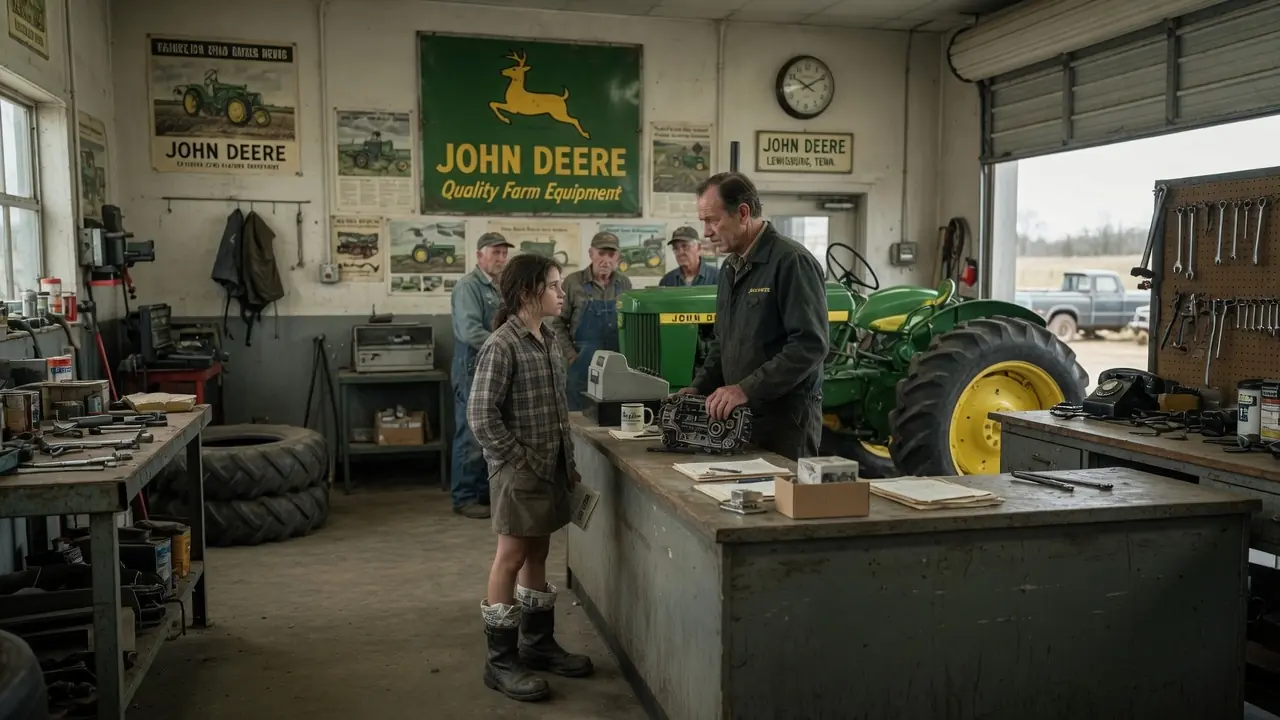
Fourteen-year-old Hattie May Vance stepped inside wearing her dead father’s boots, the toes stuffed with newspaper so they would not slide off her feet.
Her father’s canvas jacket hung too wide from her shoulders, and the sleeves had been rolled three times at the cuffs.
The dealership smelled of grease, rubber tires, fresh coffee, and new green paint.
Two farmers near a shiny John Deere 3010 stopped talking when they saw her.
Behind the counter, Silas Redfern lifted his eyes from a stack of invoices and froze for half a second.
He had known Hattie since she was small enough to ride on her father’s shoulders at the county fair.
Now she stood in front of him looking like a child trying to hold up a dead man’s life with both hands.
“Hattie,” Silas said softly.
His voice carried pity before he could hide it.
“I was sorry to hear about your daddy.”
Hattie nodded once, because if she spoke too quickly, her throat might close.
“Thank you, Mr. Redfern.”
Thomas Vance had died nine days earlier in the barn, beside the John Deere 60 he had been repairing.
A heart attack had taken him before sunrise, leaving behind 160 acres of corn, soybeans, tobacco, and a tractor with its clutch still torn apart.
Hattie had found him cold on the dirt floor, one hand still near the tool chest.
Since then, the whole farm had been waiting for someone to become strong enough to move.
Hattie reached into the pocket of her father’s jacket and pulled out a folded parts order.
The paper was creased and smudged, but the handwriting was still neat and familiar.
She placed it on the counter and flattened it with both palms.
“My daddy ordered a clutch assembly for the John Deere 60,” she said.
“I came to pick it up.”
Silas looked at the order, then looked back at her boots.
He took off his reading glasses slowly and set them beside the register.
“I’ve got the part,” he said.
“It came in Tuesday.”
Then his voice grew careful.
“But who’s going to install it, child?”
“I am,” Hattie said.
The two farmers near the tractor looked at each other.
One of them, Curtis Holloway, was an older man with thick hands and tired eyes.
He had known Thomas Vance for twenty years and had stood at the funeral with his hat pressed against his chest.
Now he stared at Hattie with the painful kindness of a man who wanted to save her from something he believed would break her.
Silas leaned both hands on the counter.
“Hattie, you are fourteen years old.”
“I know how old I am.”
“That tractor has to be split. That clutch is not a bicycle chain.”
“I know how to split it,” she said.
“My daddy taught me.”
Silas closed his eyes for a moment.
There was a secret pain in him that Hattie did not know, a wound that had sat in his chest for twenty years.
His own son had died at fifteen in a tractor accident, and Silas had never been able to look at a teenager near farm machinery without seeing that summer afternoon again.
He told himself he was protecting Hattie, but fear was already speaking through his mouth.
“Hattie,” he said gently, “listen to me.”
He picked up the order but did not move toward the parts room.
“Your daddy is gone. Your mama has four children to feed. There is no shame in leasing that ground for a year or two.”
He glanced toward Curtis, who nodded slowly.
“You need to go home and let a grown man help your family.”
Hattie’s face did not change, but her fingers curled against the counter.
“A grown man like Wendell Ashcroft?” she asked.
Silas looked startled.
Curtis lowered his eyes.
The other farmer near the tractor shifted his weight and pretended to study the tire tread.
“Wendell owns good land,” Silas said carefully.
“He could lease your fields fair.”
“My daddy said Wendell Ashcroft is not our friend.”
Silas sighed like she was too young to understand the mercy being offered.
“Your daddy was proud, Hattie. Proud men say hard things when they are worried.”
“My daddy wrote it down before he died.”
The dealership went still.
Hattie reached into the inside pocket of the jacket and pulled out a sealed envelope, softened now from being carried against her heart.
She opened it with steady hands, unfolded the letter, and turned to the second page.
The paper trembled slightly, but her voice did not.
“My daddy wrote that Wendell Ashcroft had been trying to buy our farm for twelve years.”
Silas looked at the letter as if it were a snake on the counter.
Hattie kept reading.
“He wrote that Ashcroft bought his seed loan from First National Bank through a shell company in Nashville.”
Curtis straightened.
The younger farmer whispered, “Lord have mercy.”
Silas’s face drained of color.
Hattie folded the letter, but she did not put it away.
“He wrote that when the note came due, Ashcroft would come to my mama and offer to forgive the debt if she signed over the farm.”
She looked directly at Silas.
“My daddy gave me this letter the night before he died.”
Then her voice sharpened.
“And you just told me to go home and call the man trying to take our land.”
Silas gripped the edge of the counter.
He had known Thomas Vance, eaten with him, sold him equipment, and shaken his hand after harvest more times than he could count.
He had not known about the loan.
He had not known that his advice, given with kindness, had pointed a grieving child straight toward the trap her father had feared.
For the first time that morning, he looked less like a dealer and more like a man who had been wrong.
Hattie slid the order back toward him.
“So I am going to ask you one question, Mr. Redfern.”
Her oversized boots were planted firmly on the polished concrete floor.
Her eyes were red from sleepless nights, but they did not lower.
“Are you going to sell me that clutch assembly, or do I need to drive to the next county?”
No one spoke.
A clock above the parts shelves ticked loudly in the silence.
Silas picked up his glasses, cleaned them with a handkerchief, and put them back on though he did not need them to see.
His hands shook when he reached for the order.
“I’m going to sell you the part,” he said quietly.
Hattie nodded once.
“Thank you, sir.”
Silas looked toward the back room, then stopped.
“Hattie, I was wrong to tell you to call Wendell Ashcroft.”
His voice cracked slightly on the name.
“I do not know if you can run that farm, child. God help me, I still don’t know. But I know now that sending you to Ashcroft would be the worst thing I could do.”
He disappeared into the parts room and came back carrying the clutch assembly wrapped in brown paper.
The package looked too heavy for Hattie, but she reached for it anyway.
Silas placed it gently on the counter instead of handing it across.
“Twenty-eight dollars,” he said.
Then, after a pause, “Your father already paid ten down.”
Hattie counted the money from the envelope in her father’s jacket.
Every bill felt like it still belonged to Thomas Vance.
His boots, his jacket, his cash, his handwriting, his tractor, his farm.
Everything she touched seemed to remind her that she was standing in the space he had left behind.
She placed eighteen dollars on the counter and pushed it toward Silas.
Curtis Holloway cleared his throat.
“Hattie, if you need help getting that part in the truck—”
“I can carry it,” she said.
Her voice was not rude, but it left no room for pity.
She lifted the package against her chest, staggering only slightly under the weight.
The men watched her walk toward the door.
Just before she stepped outside, Silas called her name.
She turned back.
The old dealer looked at her across the showroom, with green tractors shining behind him and shame written clearly across his face.
“If you get stuck,” he said, “you call me.”
Hattie looked at him for a long second.
“If I get stuck, I’ll get unstuck.”
Then she walked out.
Her father’s 1958 Ford F-100 waited at the curb, faded blue with mud dried along the running boards.
Hattie placed the clutch assembly in the bed and wrapped it with an old feed sack so it would not slide.
She climbed into the cab, pulling herself up by the steering wheel because the truck sat high and her legs were short.
For a moment, she sat still, staring through the windshield at the green John Deere sign hanging above the dealership door.
Then she started the truck and drove home on back roads because she could barely see over the wheel.
The Vance farm looked colder when she returned.
The corn still stood in the fields, brown and dry, waiting to be harvested.
The tobacco barn smoked gently from the curing fires, and the equipment shed stood open like a mouth.
Inside sat the John Deere 60, split and silent, its clutch torn out, its transmission waiting.
Hattie carried the part inside and placed it on the workbench beside her father’s tools.
His coffee cup was still there.
A thin skin had formed over the cold coffee he had never finished.
Hattie picked it up, carried it outside, and poured it onto the gravel.
She rinsed the cup at the pump, dried it on her skirt, and set it on a shelf in the shed.
It would stay there for decades, untouched.
Then she went into the house.
Her mother, Cordelia, sat at the kitchen table with little Clara on her lap.
Verna was writing numbers in a schoolbook, and Caleb was outside splitting firewood with more anger than skill.
Cordelia looked up when Hattie entered.
“Did you get the part?”
“Yes, ma’am,” Hattie said.
Cordelia’s tired face trembled with relief and fear at the same time.
“Hattie, I don’t know what we are supposed to do.”
Hattie looked at her mother, then at the younger children.
For nine days, every adult had been waiting for another adult to appear and fix the shape of their lives.
No one was coming.
“I’m going to fix the tractor,” Hattie said.
Cordelia closed her eyes.
“You’re a child.”
Hattie swallowed hard.
“I know.”
Then she looked toward the equipment shed.
“But the corn doesn’t.”
That afternoon, she began.
Her father had taught her to measure everything before removing anything.
She opened his small black composition notebook and wrote the date at the top of a blank page.
October 23, 1963. John Deere 60 clutch replacement. Begin 11:12 a.m.
Then she labeled coffee cans for bolts, washers, springs, and pins, just the way Thomas Vance had taught her.
The transmission housing weighed nearly twice what she did.
Hattie built a wooden cradle from old two-by-sixes, wedged the rear wheels, and rigged a block and tackle from the rafters.
She worked slowly because mistakes were expensive, and injuries were worse.
Every time the rope burned her palms, she thought of Silas Redfern telling her to go home.
Every time the tractor refused to line up, she heard Glenn-like laughter from men who had not been there but would have laughed if they had.
She worked until after midnight.
A kerosene lantern threw long shadows across the shed walls.
Her hands turned black with grease, and her shoulders ached so badly that lifting a wrench felt like lifting a fence post.
At two in the morning, she lay down on the couch in the kitchen without removing her father’s boots.
At sunrise, she got up and went back to the tractor.
On the third day, Silas Redfern drove past the Vance farm and slowed near the lane.
He saw the equipment shed open and Hattie standing under the rafters with both hands on the block rope.
For a moment, grief made him see his dead son Matthias instead of Hattie.
His foot hovered over the brake.
Then he drove on, ashamed that fear still had its hand on him.
By Sunday afternoon, the clutch was installed.
Hattie sat on the tractor seat with folded blankets beneath her so her feet could reach the pedals.
Cordelia stood in the doorway of the shed, one hand pressed to her mouth.
Caleb, Verna, and Clara watched from behind her.
Hattie turned the key.
The John Deere 60 coughed once.
Black smoke puffed from the stack.
Then the engine caught, rough and strong, shaking the whole shed with the sound of something refusing to die.
Cordelia began to cry, and Caleb shouted before catching himself.
Hattie did not cry.
She gripped the steering wheel and listened.
It had been her father’s tractor.
Now it was running under her hands.
She eased out the clutch, and the tractor moved forward into the yard.
The next morning, she hooked up the two-row corn picker.
Her back hurt, her hands were swollen, and her eyes burned from lack of sleep.
But the corn was ready, and December 15 was coming.
The bank note had to be paid, and Wendell Ashcroft was waiting for failure like a vulture on a fence post.
Hattie drove into the first row before sunrise.
For nineteen days, she harvested corn.
Curtis Holloway came with his grain truck on the fourth day, then the eighth, then the fourteenth.
He never apologized for telling her to give up inside the dealership.
He simply climbed down, loaded grain, and hauled it to Dawson’s elevator without asking for praise.
Some men say sorry with words, and some say it with diesel, time, and a truck full of corn.
At Dawson’s elevator, Earl Dawson weighed her loads and paid four cents above market without telling anyone.
When Hattie rolled up covered in dust, he did not ask where her mother was.
He did not ask whether she knew what she was doing.
He took the receipt, stamped it, and said, “Tell your mama we’re thinking of her.”
Hattie nodded and drove back to the field.
The corn check came to $4,312.
For one evening, hope sat at the kitchen table with them like a guest.
Then Cordelia opened the bank letter she had been afraid to touch.
The note for $3,200 was due December 15.
If payment was not received, foreclosure would begin on the bottom land.
Hattie read the letter twice.
Her father’s warning had been true.
Ashcroft had not come with a plow or a gun.
He had come with paper.
And paper, Hattie was learning, could cut deeper than any blade.
Two nights later, a black Cadillac came down the gravel road.
Wendell Ashcroft stepped out wearing a camel hair coat, holding a manila envelope and a bouquet of white chrysanthemums.
Hattie met him in the yard with the equipment shed lantern glowing behind her.
He smiled softly, the way men smile when they think a girl has no power.
“I’m here to help your mother,” he said.
“My daddy told me you are not our friend,” Hattie replied.
Ashcroft’s smile did not move, but his eyes hardened.
“Your daddy is dead, sweetheart.”
“I know.”
“And that note comes due whether you like it or not.”
“I know that too.”
He offered to forgive the debt if Cordelia signed over the farm.
He said the family could stay in the house for one dollar a year.
He said everyone would win.
Hattie looked at the flowers in his hand and understood the insult of bringing funeral flowers to a farm he wanted to bury.
“Get off our land, Mr. Ashcroft,” she said.
Ashcroft laughed.
“This farm does not forgive children.”
Hattie’s face stayed still.
“Then it will have to learn my name.”
For the first time, Ashcroft looked less amused.
He dropped the envelope and flowers on the ground, then drove away.
Hattie burned both in the barrel beside the barn.
By December, the whole county knew something was happening.
Silas Redfern had spent weeks carrying guilt like a stone in his chest.
The girl he had told to go home had fixed the tractor, harvested the corn, and stood against the man Silas had almost sent her to.
One cold morning, he drove to the Vance farm with filters, belts, a battery, and a canvas tarp in the back of his truck.
Hattie was sitting on the porch, staring at the fields.
“I brought supplies,” Silas said.
“I can’t pay for them,” Hattie answered.
“They are not for sale.”
“I won’t take charity.”
“It is not charity,” Silas said.
“It is a debt I owe your father, and one I owe you.”
Hattie looked at him then.
The old dealer sat beside her on the porch step and finally told her about Matthias, the son he had lost in 1943.
He told her about the tractor accident, the hospital drive, and the wife who never looked at him the same way again.
He told her he had spent twenty years calling fear by the name of kindness.
And he told her that when she walked into his dealership, he saw not Hattie Vance, but his own dead boy.
“I was wrong,” Silas said.
“You already said that.”
“No,” he replied, his voice breaking.
“I said it in my store. Now I am saying it on your land.”
Hattie looked at his bent hands.
“I’m sorry about your son, Mr. Redfern.”
Silas wiped his eyes quickly, embarrassed by the tears.
Then he stood.
“Sunday night, I’m calling a meeting at the Grange Hall.”
“What for?” Hattie asked.
“To tell this county that Thomas Vance’s daughter is not losing her farm to Wendell Ashcroft.”
He looked toward the equipment shed where the John Deere 60 sat ready.
“Not while I am still standing.”
Fourteen farmers came to the Grange Hall that Sunday.
Silas told them the truth about the note, the hidden loan, the corn harvest, and the girl in dead man’s boots who had done what grown men said she could not do.
Curtis Holloway pledged money first.
Earl Dawson followed.
Then one farmer after another stood and offered what he could.
Hattie tried to refuse.
Silas told her it was not charity but a farmers’ fund, a loan to be paid when she could afford it.
She looked around the room at the faces of people who had finally decided to stand with her instead of watching her struggle from a distance.
Then she nodded.
“I’ll pay every dollar back,” she said.
Two days later, Hattie, Silas, Curtis, Earl, and nine other farmers walked into First National Bank.
They paid the Vance note in full.
Randall Pierce, the banker who had helped Ashcroft hide behind paperwork, signed the release with shaking hands.
Silas made him mark Thomas Vance’s original note paid in full in black ink.
Then he handed it to Hattie.
She folded it carefully and placed it in the pocket of her father’s jacket, beside the letter.
For the first time since the funeral, she felt the farm breathe.
Not safe forever.
Not easy.
But still theirs.
And sometimes still theirs was enough to keep walking.
Years passed, and Hattie kept walking.
She paid back every farmer who helped her, with interest.
She finished school, bought more land, survived bad seasons, and learned never to owe more than she could sleep under.
By the time she was grown, the little girl Silas had told to go home had become one of the strongest farmers in Tennessee.
The boots that had not fit became a story people told when they wanted to explain stubborn courage.
Silas retired twenty years later from the same John Deere dealership.
On his last day, Hattie walked through the same front door where the bell still rang above the frame.
She was thirty-four then, tall, steady, and carrying the original paid bank note wrapped in paper.
Silas looked up from a cardboard box of old pens, photographs, and coffee mugs.
For a moment, neither of them spoke.
“I brought you something,” Hattie said.
She placed the framed note in his hands.
“You earned this.”
Silas shook his head.
“No, child. I told you to go home.”
Hattie smiled gently.
“Yes, sir. And then you took it back.”
Silas wept then, in the back office of the John Deere dealership, in front of the girl who had outgrown both pity and fear.
Hattie let him cry because she understood by then that grown people also carried things too heavy for them.
When he finally wiped his face, she reached for his hand.
“My daddy gave me the farm,” she said.
“You helped me keep it.”
In 2006, Hattie May Vance stood at the Tennessee State Fairgrounds and accepted the state’s highest farming honor.
Seven hundred forty acres, zero debt, forty-three years of continuous operation, and soil ratings that made county officials speak her name with respect.
When the presenter said she had begun farming alone at fourteen, the room went quiet.
A gray-haired man in the back lowered his head and closed his eyes.
He was Albert Redfern, Silas’s son.
After the ceremony, he handed Hattie a letter his father had written before he died.
In shaky handwriting, Silas had confessed again that telling her to go home was the greatest mistake of his life.
Then he wrote that watching her farm had come as close to redemption as any man could ask for.
“You are the best farmer I ever knew,” the letter said, “and I knew your daddy.”
Hattie folded the letter and placed it against her heart.
Back in Lewisburg, the John Deere 60 still sat in the equipment shed.
It started every spring for decades, coughing once before settling into the sound Thomas Vance had taught his daughter to trust.
Her father’s boots stayed on a shelf nearby, the newspaper still stuffed in the toes.
The leather was cracked now, gray with age and memory.
Hattie never threw them away.
Because those boots had been too big only at first.
The farm, the tractor, the debt, the grief, the men at the dealership, and the voice telling her to go home had all been too big at first.
But Hattie kept walking in them anyway.
And one day, not because the boots changed, but because she did, they fit.