In the spring of 1963, a young man walked into a John Deere dealership in rural Kansas with a problem that didn't seem complicated at first, but within minutes, it turned into something far more personal than he expected. The kind of problem that doesn't just test what you have, it tests what you are. His father had died just three days earlier. No warning, no time to prepare. One moment he was working in the barn and the next everything was gone. What remained was the farm. 240 acres of dry land, a small farmhouse that needed work, and a responsibility that didn't come with instructions, just pressure. And one major problem. The only tractor they had was completely unusable. The engine had failed weeks earlier. It sat in the workshop half open, unfinished, waiting for a repair that was never going to happen. His father had planned to fix it before the season started, but the timing never worked out. Now, the timing was gone entirely. The season was closing in fast. There was no backup machine, no spare money, and no one stepping in to take control. If something didn't change soon, the entire operation would collapse before it even had a chance to start.
So, he did the only thing that made sense. He went to the nearest dealership, the only place within miles where he might find something he could afford. Not something new, not something impressive, just something that could run. At first glance, it didn't seem unusual. Farmers came in all the time looking for used equipment. That part of the situation was completely normal. But this wasn't. The dealer took one look at him and understood everything he needed to know. Young, alone, no capital, no experience that mattered in a situation like this. The conclusion came quickly. He leaned back in his chair and studied him for a moment before smiling. Not a friendly smile. Not the kind that offers help. The kind that comes from already knowing how the conversation ends.
"You're here about your father's farm, right?"
The young man nodded. "I need a tractor."
The dealer didn't respond right away. He let the silence sit as if the request itself didn't quite make sense. Then he shook his head slowly. "That's not what you need."
The young man held his ground. "I just need something that runs."
The dealer leaned forward, resting his arms on the desk, his tone calm but firm, like someone explaining something obvious. "What you need is to sell that farm."
The words landed clean. No hesitation. No doubt. The young man didn't say anything. The dealer continued, more certain now. He explained it the way people explain things when they believe they're being reasonable. "240 acres wasn't a small responsibility. Not without equipment. Not without money. Not without experience. That kind of work broke people who had been doing it for years." He paused, watching for a reaction. There wasn't one. So, he repeated it, slower this time. "Sell it. Take the money. Start somewhere easier."
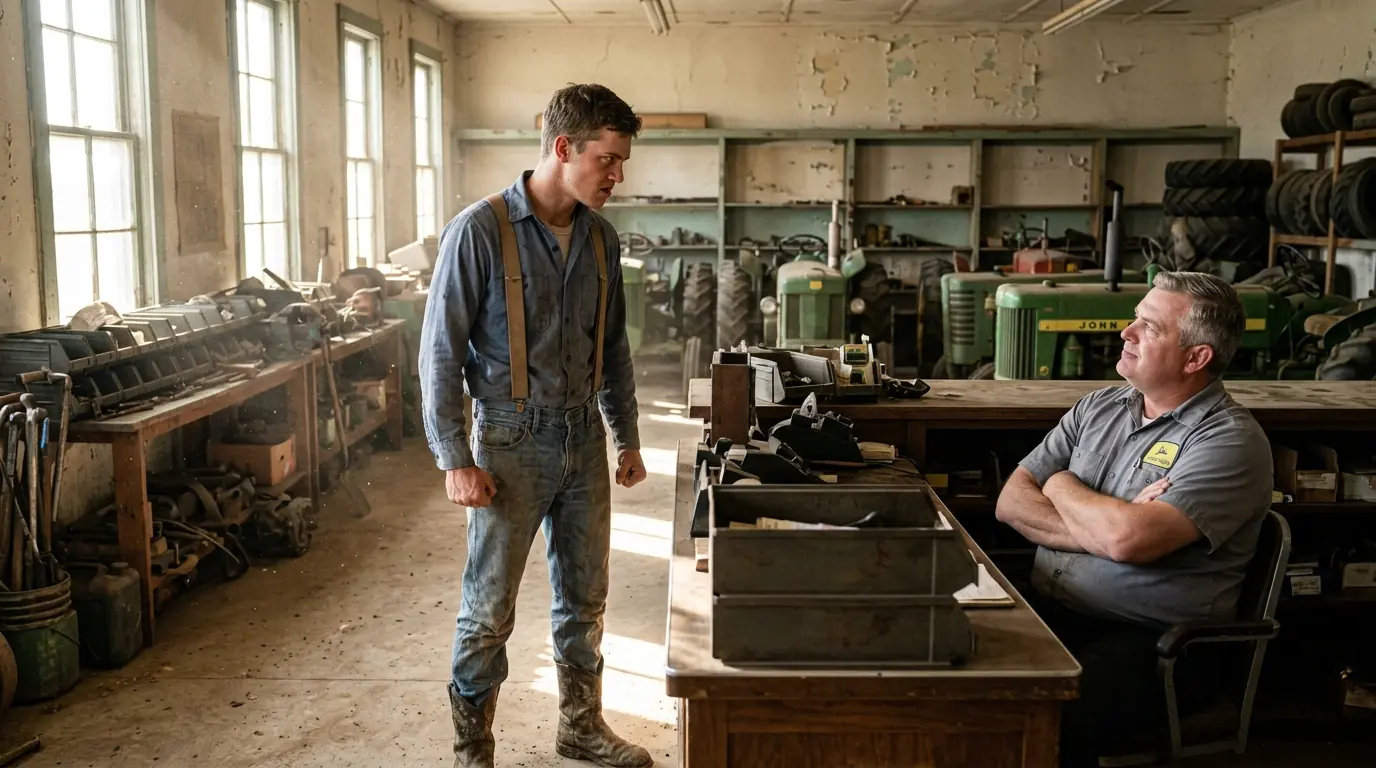 For a moment, it stopped sounding like advice. It sounded like a conclusion. Like the outcome had already been decided, and this was just the explanation that came after. The young man stood there, not arguing, not agreeing, just listening. And just before he turned to leave, the dealer added one more line. A final statement delivered with complete confidence. "Trust me, this isn't something you can handle."
The young man walked out without saying a word. Outside, the air felt different, quieter, but heavier. Because now the problem wasn't just the farm or the broken tractor or the money. It was something else. No one believed he could do it. And for the first time since his father died, that doubt started to take shape. But he didn't go home. Not yet. Because a few miles east, there was something happening that most people ignored. An auction. Old equipment, estate sale, the kind of place where things didn't sell for what they were worth. Because nobody was really looking for them. And that's where he went next.
The auction was small, not the kind that drew attention. No crowd, no urgency, no competition. Just a quiet gathering of people who had been doing this long enough to know that most of what showed up at places like this wasn't worth much. Old equipment, worn machines, things that had already given everything they had. The kind of inventory people walked past without stopping. He arrived early before most of the others. Not because he had a plan, but because he didn't have a choice. This was all he had. Whatever he found here would decide whether the farm moved forward or ended before it even began.
Two tractors were listed. Both old, both used, both overlooked. One was a 1949 model, the other slightly newer, but not by much. Faded paint, worn tires, the kind of machines that had already outlived their expected use. Most people didn't even look at them. They weren't interested. But he was because he recognized them. Not just the brand, not just the shape, the structure, the way they were built, the way they worked. These were the same type of machines his father had used for years, the same system, the same mechanics. He understood them. That changed everything.
The bidding started low, lower than expected. There wasn't much interest, and the auctioneer adjusted quickly. He called for a number, got silence, dropped it again, and then again. Finally, a hand went up. His. The first tractor sold cheap, no resistance, no competition. Just a number, a pause, and then it was done. The second one took slightly more effort. One other bidder raised the price once, maybe twice, but it didn't last. There wasn't enough demand to push it higher. And just like that, both machines were his. Two tractors for less than what most people would spend repairing one.
It didn't look like a smart decision from the outside. It looked like desperation. But to him, it looked different. It looked like a chance. Getting them back wasn't easy. He borrowed what he could, used what he had, and managed to haul both machines back to the farm. They didn't run properly. Not yet. Each one had its own problems, mechanical issues, worn parts, systems that needed attention. But they weren't dead. That was enough.
He spent the next few weeks in the workshop, the same place his father had worked in, the same tools, the same setup. Nothing new. Nothing upgraded. Just knowledge. He didn't rush it. He worked through each problem carefully, step by step, fixing what needed to be fixed, replacing what he could, adjusting what he understood, one system at a time. There were setbacks, things that didn't work the first time, parts that needed to be rechecked, adjustments that had to be done again, but slowly things started to change. One engine turned over, then the second. Not perfectly, not smoothly, but enough. Enough to move, enough to work.
By the time the season was ready to begin, both tractors were running. Not new, not powerful, but functional. And that was all he needed. The first few days in the field were harder than expected. Everything took longer. Every task required more effort. There was no margin for error, no backup if something failed. Every decision mattered. And things did fail. Small issues at first, then bigger ones. Breakdowns at the worst possible times. Delays that stacked on top of each other. The kind of problems that don't stop you immediately, but slowly wear you down.
People noticed. They watched from a distance. They talked. They made their assumptions. It didn't look like it was going to work. Not with that equipment. Not with that setup. Not alone. And the more they watched, the more certain they became this wasn't going to last. But the work didn't stop. Day after day, he kept going, fixing what broke, adjusting what didn't work, learning what needed to be learned. There was no moment where it suddenly became easy. Just small progress over time. And that was enough to keep things moving.
The first season didn't go the way anyone expected, but it didn't collapse either. It moved forward slowly, unevenly, with constant pressure behind every decision. Nothing was stable, but nothing stopped. There were days when one of the tractors refused to start, and the entire plan had to change without warning. Small problems turned into delays, and delays stretched into longer hours than planned. Every task took more effort than it should have. The machines held together, but just barely. Parts wore down faster than expected. Adjustments had to be repeated, and nothing worked perfectly the first time. It wasn't smooth progress, it was controlled survival.
People noticed from the road, from nearby fields, from quiet conversations that didn't need to be loud. It didn't look efficient, and it didn't look like something that would last. It looked temporary, like something waiting to fail. And over time, that outside doubt started to become internal. One evening, after a long day that didn't produce the results he needed, he sat alone at the table with numbers that didn't work in his favor. The margin was thin, thinner than he expected, and the space between holding on and losing everything felt dangerously small. One major breakdown, one problem he couldn't fix in time, and the entire operation would stop. Not gradually, not over time, but immediately. That was the first moment the idea became real. Not just doubt, but a possible outcome. That maybe the dealer had been right. Not about everything, but about this. That the farm might be too much to carry alone, especially with what he had.
The next morning, he drove into town without a clear plan. He told himself it was just to think, just to look at options, nothing final. But the road led him back to the same place, the dealership. He parked across the street and stayed there longer than he expected. People walked in and out like it was just another normal day. For them, it was. For him, it wasn't. Because this time the reason was different. This time he wasn't there to solve the problem. He was there to end it.
His hand moved toward the door, then stopped. It didn't feel like hesitation. It felt like something not aligning. Walking in would be easy. Explaining everything would be easy. Letting go would be easy. And that was exactly why it didn't feel right. He looked down at his hands, not clean, not rested, but steady. The same hands that had spent weeks fixing machines that weren't supposed to run, solving problems that weren't supposed to be solved. The progress wasn't perfect, but it existed and that mattered. He sat there for a few more seconds, then pulled his hand back and started the truck again. No dramatic shift, no big realization, just a decision that didn't need to be explained. He turned around and drove back. The problems didn't disappear. The risk stayed exactly the same. The work ahead was still difficult, still uncertain, but one thing had changed. He wasn't leaving. And once that option was gone, everything else became simpler, not easier, but clearer. There was only one direction left and that was forward.
The decision didn't change the situation overnight, but it changed how everything moved after that. The work became more focused, more deliberate, as if every now had direction instead of doubt. He stopped trying to make things perfect and started making them work. The tractors didn't need to run flawlessly, they just needed to run long enough to get through each stage. Every repair became faster, every adjustment more precise. Time passed. Not in big moments, but in small improvements that added up. The first season didn't break him, the second one didn't either. And with each cycle, the system became stronger than it looked from the outside. The soil began to respond. Not immediately, not dramatically, but consistently. The fields held better, the output stabilized, and the work started to produce results that didn't match what people expected from that kind of setup.
People noticed again. But this time, the conversation was different. It wasn't about when things would fail. It was about how they were still working. Years passed, and the gap between him and everyone else started to shift. Not because he had better equipment or more resources, but because he had built something that didn't rely on constant upgrades to survive. While others expanded, he stayed controlled. While others borrowed, he stayed careful. It didn't look impressive in the moment, but over time, it created something most people didn't see coming.
Then, everything changed. The market turned. Costs went up, prices dropped, and the system that had worked for years suddenly stopped working for most of the people around him. Farms that looked stable began to fall apart under pressure. Debt became the problem no one could manage. One by one, operations started to collapse. Land was sold, equipment was taken back, and years of expansion disappeared faster than it had been built. And in the middle of that shift, he wasn't struggling. He was stable. Because he hadn't built on pressure, he had built on control. When others were forced to sell, he had something they didn't. Cash. Not a lot at once, but enough. Enough to move when others couldn't.
He started showing up at auctions, not as someone trying to survive, but as someone ready to buy. One piece at a time, he expanded. Not aggressively, not recklessly, but carefully. Land that had been lost by others became part of something new. And slowly, without drawing attention, everything grew. The same farm that was supposed to be sold was getting bigger year after year.
Until one day, the difference was impossible to ignore. By the mid-1980s, everything had changed. The farm had expanded far beyond what anyone expected. The equipment was still simple, still rebuilt, still managed the same way. But the results spoke for themselves.
And then, something else happened. The dealership closed. Not suddenly, but quietly. The same place where everything had started was no longer there the way it used to be. The system it relied on had failed the same way it had failed everyone else. One evening, not long after that, a familiar truck pulled into the yard. He stepped out and saw him sitting there. Older now, quieter, not the same confidence.
For a moment, neither of them said anything. Then the dealer finally spoke, asked a simple question. "How much land do you have now?"
The answer came back just as simple. "More than before, more than expected. More than anyone had planned for."
The dealer nodded slowly as if the number itself confirmed something he had already started to understand. There was no argument this time. No advice. No conclusion being pushed. Just silence. And in that silence everything that needed to be said already was.
Before you leave, think about this for a second. Not the ending. Not the land. Not the success. Just that one moment. The moment where he sat outside the dealership and almost walked in to quit. Because that's the part most people don't see. It's not the hard work. It's not the struggle. It's that one quiet decision where nobody is watching and it would be easier to walk away than to stay.
So here's the question. If you were in that same position, same pressure, same risk, same doubt, what would you have done? Would you have walked in and ended it right there? Or would you have turned around and kept going? Not knowing if it would ever work.
Be honest. Because most people like to believe they would fight. But very few actually do. And if you've ever been in a situation like that where someone told you to quit or made you feel like you weren't capable, I want to know what you did. Did you listen? Or did you prove them wrong?