The new John Deere tractors inside Prairie Green Equipment looked too perfect to belong in a field.
Their green paint reflected the showroom lights without a single scratch, and their enormous black tires had never touched mud. Digital screens beside each machine displayed horsepower, financing options, and monthly payments large enough to buy Warren Dill’s first house twice. The air smelled of rubber, coffee, floor wax, and machinery that had never worked a day.
Warren stood at the service counter in faded denim overalls and a plaid shirt darkened with grease near one shoulder. His cap carried the name of a seed company that had gone out of business twelve years earlier. A thick repair estimate rested on the polished counter before him. At the bottom, circled in red, was the number $24,187.63.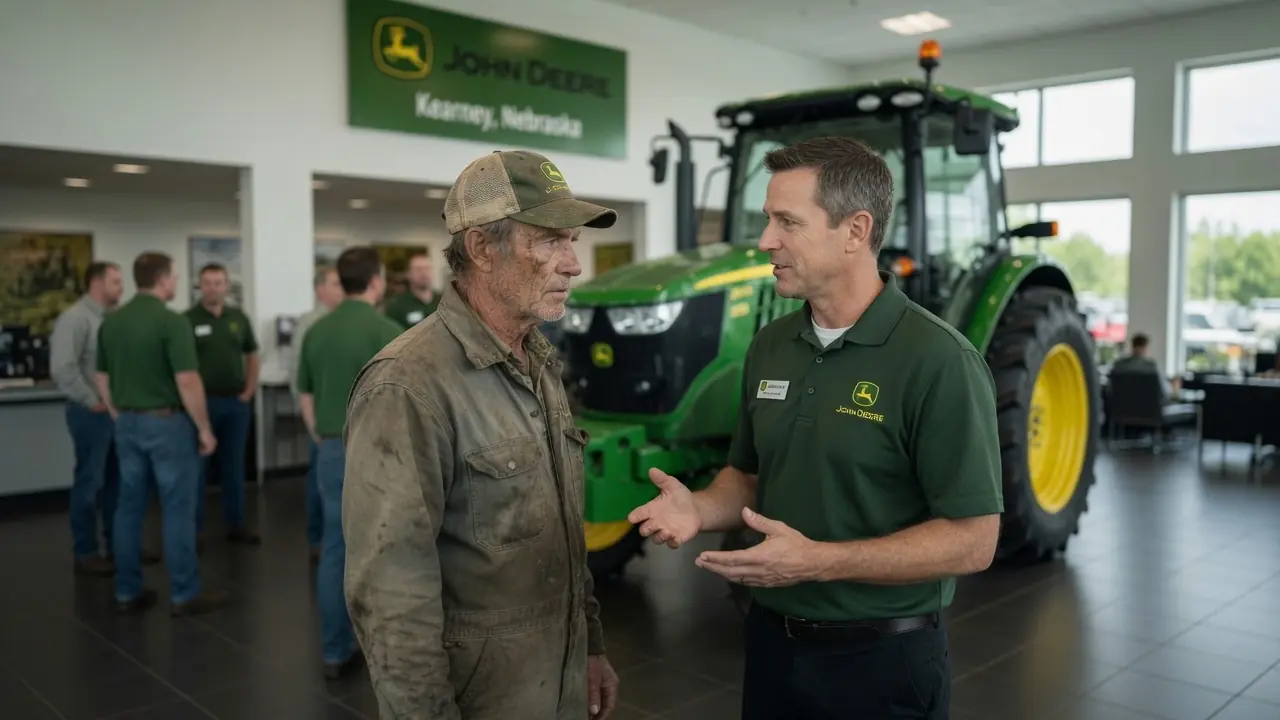
Across from him stood service manager Derek Paulson.
Derek was forty-one, neatly shaved, and dressed in a green dealership jacket with his name embroidered above the pocket. He wore spotless boots that looked designed to resemble work boots without ever being used for work. His expression held the patient irritation of a man explaining something obvious to someone he considered incapable of understanding.
“Complete transmission rebuild,” Derek said. “Labor, clutch assemblies, control valve inspection, calibration, filters, and fluid.”
Warren looked at the total again.
“You opened the transmission?”
“We ran dealer diagnostics.”
“That was not my question.”
Derek leaned one elbow on the counter.
“The codes tell us what we need to know.”
“My tractor stopped moving, so the computer says the whole transmission is ruined?”
“The PowerQuad system is more complicated than whatever you repaired forty years ago.”
Several customers stood near the parts department, waiting for orders. One of them glanced toward Warren, then toward the expensive estimate. A salesman walking past slowed long enough to hear the conversation.
Warren placed one finger on the first page.
“It ran fine before your shop serviced it last fall.”
Derek’s expression tightened slightly.
“That service has nothing to do with the current failure.”
“You changed the transmission oil.”
“We performed routine maintenance.”
“And six months later, it stopped engaging.”
“Machines break, Mr. Dill.”
Warren lifted his eyes.
“So do promises.”
Derek straightened.
The tractor was a 1998 John Deere 7810 with more than nine thousand hours on the meter. Warren’s father, Harold, had helped him buy it used twenty-two years earlier, signing the loan when the bank refused to trust a young farmer with three children and unstable corn prices. Harold had died before the final payment was made, but Warren remembered him sitting in the passenger seat during the first planting season, smiling every time the transmission shifted cleanly beneath load.
The 7810 had planted corn, pulled grain wagons, cleared snow, and carried Warren’s children across fields before any of them were tall enough to reach the steps alone. It was not the newest machine on Dill Farms. It was not the strongest either.
It was the tractor Warren trusted.
Three days earlier, he had started it before sunrise to move a planter from the machine shed. The engine ran normally, the hydraulic system built pressure, and every light on the instrument panel appeared as expected. Yet when Warren selected forward gear, nothing happened.
Reverse did not engage either.
The tractor remained motionless as though every gear had become neutral.
Warren checked the obvious things before calling Prairie Green Equipment. He inspected linkages, connectors, fuses, fluid level, and external leaks. Finding nothing conclusive, he agreed to let the dealer transport it to the shop.
Now Derek wanted nearly twenty-five thousand dollars.
“The tractor is worth maybe thirty-five thousand on a generous day,” Derek said. “Putting twenty-four into the transmission makes no financial sense.”
“That sounds like advice against accepting your own estimate.”
Derek gave a thin smile.
“It sounds like an opportunity to move into something reliable.”
He pointed toward a newer tractor displayed beneath a hanging banner.
“We can give you eighteen thousand on trade, even with the transmission failure. Put that toward the 6155M, finance the balance, and you leave with a machine covered by warranty.”
Warren looked toward the new tractor.
“How much is the balance?”
“With the current incentive, approximately one hundred and forty-eight thousand.”
A man near the parts counter quietly whistled.
Warren returned his attention to Derek.
“You want me to trade a tractor worth thirty-five thousand for eighteen, then borrow another hundred and forty-eight because you say one sensor code means the transmission is destroyed.”
Derek’s smile disappeared.
“I did not say one sensor code.”
“Then show me the full diagnostic report.”
“That information is internal.”
“I paid for the diagnosis.”
“You paid for our professional conclusion.”
Warren folded the estimate once.
“Professional conclusions usually include evidence.”
Derek placed both hands on the counter.
“Why are you wasting our time with that old tractor when you clearly cannot afford to fix it?”
The showroom became quieter.
The salesman near the display stopped walking. A young parts clerk looked down at his keyboard, pretending not to hear. Warren did not raise his voice.
“Because your shop caused the failure you’re charging me twenty-four thousand dollars to repair.”
Derek’s face reddened.
“That is a serious accusation.”
“It is a serious invoice.”
“You have no proof.”
“Not yet.”
Derek pointed toward the row of new machines.
“Trade it now, or that worthless tractor will die in your field.”
Warren picked up the estimate.
“Bring it back to my farm.”
“You’ll still owe transport and diagnostic fees.”
“I’ll pay legitimate work.”
“You cannot repair that transmission in a farm shed.”
Warren placed the folded estimate inside his coat.
“We’ll see.”
The 7810 returned to Dill Farms the following afternoon on a lowboy trailer.
Warren’s son Travis watched from beside the machine shed as the dealership driver unloaded it. At thirty-one, Travis had grown up farming with his father but preferred the newer equipment, especially the 8370R equipped with guidance, mapping, and remote diagnostics. He respected the 7810, though he did not share Warren’s attachment to it.
“Twenty-four thousand?” Travis asked after the truck left.
“Plus tax.”
“For a tractor with nine thousand hours?”
“That is what they want.”
Travis walked around the machine.
“We could sell it as-is.”
“We could.”
“And use the money toward something newer.”
“We could do that too.”
Travis recognized the tone.
“But we’re not going to.”
Warren opened the cab door.
“Not until I know what failed.”
They pushed the tractor into the heated workshop using another machine. Warren began with the service manual, wiring diagrams, and a yellow legal pad. He wrote down every symptom before touching a wrench.
The engine started normally.
Hydraulic steering and rear remotes functioned.
Transmission pressure appeared low only after the control module failed to detect input shaft speed. A warning code repeatedly indicated that the controller could not confirm rotation where the engine transferred power into the transmission.
Travis studied the laptop connected to the diagnostic port.
“That could mean internal damage.”
“It could.”
“It could also mean the shaft is not moving.”
“Yes.”
“Or the sensor is lying.”
Warren nodded.
“Now we are asking the right question.”
They drained a small sample of transmission fluid into a clear glass jar. Instead of the clean amber color Warren expected, the oil appeared dull brown with a faint cloudy layer suspended inside it. The odor was different too—less like proper transmission oil and more like generic hydraulic fluid overheated under pressure.
Warren held the jar beneath the shop light.
“This is not what I told them to use.”
Travis examined the color.
“Could it be old fluid left in the system?”
“They billed me for a complete change.”
Warren removed the transmission filter. Fine dark material covered its inner pleats, but there were no large metal fragments suggesting catastrophic gear damage. The magnetic plug carried normal wear particles rather than broken teeth or bearing pieces.
That discovery mattered.
A destroyed transmission usually left evidence.
This one looked contaminated, not shattered.
Warren traced the wiring toward the input speed sensor mounted near the transmission housing. The connector was secure, though a film of dirty oil covered the surrounding area. After removing the sensor, he tested it on the bench.
It produced no consistent signal.
Travis looked at the multimeter.
“How much does that part cost?”
“Depends whether the dealership sells it alone.”
Prairie Green listed the sensor as part of a larger harness assembly costing more than six hundred dollars. Warren called an independent agricultural electrical supplier in Iowa and read the manufacturer number from the sensor body. The supplier had the identical component in stock for forty-two dollars.
“It ships today,” the man said.
Warren ordered two.
The following morning, he sent the fluid sample to a laboratory in Lincoln. He asked for viscosity, additive content, contamination, and comparison against John Deere’s required transmission specification. The analysis would take several days.
While waiting, Warren flushed the system.
He removed the control valve, cleaned narrow passages, inspected the clutch pressure circuits, and checked the accessible friction components. There was wear, but nothing requiring a full rebuild.
The transmission was not new.
It was also not dead.
The new sensor arrived two days later.
Warren installed it, replaced the filters, and filled the system with the correct fluid purchased from a different dealer. The parts and oil cost just under nine hundred dollars, most of that being the large volume of proper transmission fluid.
Travis climbed into the cab.
“Ready?”
“No.”
“When will you be ready?”
“After we know whether I missed something.”
Warren checked every connection again, then moved away from the wheels. Travis started the engine and allowed it to warm. The warning code cleared from the display.
Warren raised one hand.
“Select first forward.”
Travis moved the lever.
The tractor rolled ahead.
He immediately pressed the clutch and stopped. Neither man spoke for several seconds.
“Reverse,” Warren said.
The tractor moved backward smoothly.
They tested every range inside the yard, then drove the 7810 along a gravel road without a load. Shifts remained firm, pressures stayed stable, and no warning returned.
Travis pulled beside the machine shed and shut down the engine.
“Nine hundred dollars.”
“Eight hundred ninety-four.”
“Prairie Green wanted twenty-four thousand.”
“They also wanted the tractor.”
Travis climbed down.
“You think they knew?”
Warren looked toward the jar of brown fluid.
“I think knowing and caring are different questions.”
The laboratory report arrived Friday afternoon.
Its conclusion was direct: the sample did not match the additive package or viscosity characteristics of the fluid required for the tractor’s transmission and hydraulic system. It most closely resembled low-cost universal tractor fluid intended for broader, less demanding applications.
Under high temperature and clutch pressure, the oil could contribute to poor lubrication, deposit formation, filter restriction, and sensor contamination.
Warren read the report twice.
Then he went into the farmhouse office.
His wife, Carol, had kept every major equipment invoice since they married. File drawers contained receipts organized by machine, year, and type of work. Warren located the folder marked 7810—SERVICE.
The last Prairie Green invoice listed a complete transmission and hydraulic service.
Under materials, the line read:
Bulk UTF—Universal Tractor Fluid, 31 gallons.
Warren checked the invoice from the service before that.
The same fluid appeared.
He kept reading.
Three separate dealership services over five years listed universal fluid, despite a printed warning in the operator’s manual requiring oil meeting a specific transmission standard. The dealership had charged a premium rate while using cheaper bulk fluid.
Carol stood in the doorway.
“Did you find what you needed?”
Warren held up the invoices.
“I found what they hoped I wouldn’t.”
He called two neighboring farmers who used Prairie Green Equipment. One owned a John Deere 7600 that had begun shifting harshly after a dealership service. The other had paid nearly eleven thousand dollars to repair clutch damage on an older tractor less than a year after its fluid was changed.
Both invoices listed the same bulk universal oil.
By Monday morning, Warren had copies from five machines belonging to three farms.
He did not call Derek.
He loaded the records, laboratory report, failed sensor, and repair receipts into a grease-stained folder. Then he drove the repaired 7810 seventeen miles toward Prairie Green Equipment.
Travis followed in a pickup.
The tractor moved through every gear without hesitation.
Customers near the dealership entrance turned as the older machine entered the lot. Warren parked directly outside the showroom glass, where Derek could see it from the service counter.
Then he carried the folder inside.
Derek spotted him immediately.
“You brought the tractor back?”
“No.”
“I can see it outside.”
“I drove it here.”
Derek looked through the glass.
The 7810 idled steadily near a row of new machines.
“You got it moving?”
“I repaired it.”
“With what?”
Warren placed the failed sensor on the counter.
“Forty-two dollars.”
Derek picked it up, then set it down quickly.
“A failed sensor does not explain the contaminated fluid or clutch debris.”
“You are correct.”
Warren opened the folder.
“This does.”
The first document was the laboratory report.
The second was the operator’s manual specification.
The remaining pages were dealership invoices showing repeated use of universal tractor fluid. Warren arranged them across the polished service counter as customers began watching.
Derek glanced at the documents without reading them fully.
“Universal fluid is acceptable in many applications.”
“Not this one.”
“Fluid manufacturers make broad compatibility claims.”
“John Deere’s own manual does not.”
“These tractors operate under different conditions.”
“The laboratory says your oil was outside specification.”
Derek lowered his voice.
“Take these papers into my office.”
“No.”
“Customer service discussions are private.”
“You mocked me in this showroom.”
Warren placed one finger on the invoice.
“You can explain your service in the same place.”
Derek looked toward the parts employees.
“Your tractor had nine thousand hours. Any number of factors could cause failure.”
“Then why did it return to service after one sensor, two filters, and correct fluid?”
“That repair may not last.”
“It pulled a loaded grain cart yesterday.”
“You should not be operating it without dealer calibration.”
“The calibration completed normally.”
Derek’s mouth tightened.
“Who gave you access to that procedure?”
“The service manual.”
“That is not dealer-authorized work.”
Warren stared at him.
“My tractor does not need your permission to function.”
The dealership’s general manager, Laura Kendall, emerged from an office overlooking the showroom. She had managed Prairie Green for only eight months and appeared irritated until she saw the records spread across the counter.
“What is happening?”
Derek answered first.
“Mr. Dill is blaming us for a transmission issue on a twenty-five-year-old tractor.”
Warren turned the laboratory report toward her.
“Your shop used the wrong fluid three times.”
Laura picked up the document.
Her expression changed as she read.
“Where did this sample come from?”
“My tractor before I drained it.”
“Can the chain of custody be verified?”
“I watched the laboratory bottle get sealed, and Travis signed the submission form.”
Derek folded his arms.
“This proves only what was in the tractor when he sampled it.”
Warren slid the invoices toward Laura.
“This proves who put it there.”
The showroom fell silent.
Laura examined each invoice. She then asked the parts manager to retrieve Prairie Green’s bulk-fluid purchase history and internal service guidelines. Derek objected, saying the discussion could be handled later.
Laura ignored him.
The parts manager returned with a printed product sheet. The universal fluid was not approved for Warren’s transmission application. A note in the dealership’s internal manual explicitly warned technicians to verify manufacturer specifications before using bulk oil.
Laura looked at Derek.
“Who authorized this fluid for the 7810 service?”
“Our standard practice has always been to use bulk UTF on older machines.”
“That was not my question.”
Derek glanced toward the technicians standing near the service entrance.
“It was cost-effective.”
“For whom?” Warren asked.
Derek faced him.
“You saved money on each service.”
“I paid the amount listed for a complete manufacturer-standard service.”
“Labor and disposal costs are included.”
“You charged me for the wrong product, damaged my transmission, declared it destroyed, offered half its value, and tried to sell me a new tractor.”
The accusation hung in the showroom.
Laura looked through the glass at the running 7810.
“How much did your repair cost?”
Warren handed her his receipts.
“Eight hundred ninety-four dollars.”
“And our estimate?”
“Twenty-four thousand one hundred eighty-seven.”
Laura closed the folder.
“Derek, disable outgoing service estimates until we review this.”
His face changed.
“You cannot stop the department over one farmer’s claim.”
“It is no longer one claim.”
Warren placed the neighboring farmers’ invoices on the counter.
Five machines.
Three families.
The same unapproved oil.
One customer near the parts counter stepped forward. He had been quietly listening while holding a receipt in his hand.
“You serviced my 7710 in May,” he said. “What did you put in mine?”
Derek looked toward Laura.
She answered.
“We will verify it today.”
Another farmer asked the same question.
Then another.
Within twenty minutes, seven customers had requested full service histories. Laura closed the service lanes and called the dealership owner, corporate counsel, and John Deere regional support.
Derek was ordered into the conference room.
Before leaving, he looked at Warren.
“You have no idea what this will do to this dealership.”
Warren’s voice remained quiet.
“You should have asked that before doing it to our tractors.”
The internal review lasted six weeks.
Investigators found that Derek had directed technicians to use the cheaper bulk fluid across several older tractor models. The dealership saved between two hundred and six hundred dollars per service, depending on capacity, while charging customers rates based on approved products.
Some technicians had questioned the practice.
Derek told them older farmers would never notice the difference.
One technician produced emails proving that he warned Derek about clutch and transmission compatibility. His concerns were dismissed because ordering multiple approved fluids complicated inventory and reduced profit margins.
Prairie Green identified forty-three questionable services completed over four years.
Not every machine suffered damage.
Some had accumulated too few hours for symptoms to appear. Others used designs less sensitive to the fluid difference. Yet eleven tractors showed shifting problems, pressure warnings, abnormal deposits, or early component wear after dealership service.
Laura contacted every owner.
The dealership offered free fluid replacement, filters, inspections, oil analysis, and compensation for documented damage connected to improper service. Farmers who had already paid for repairs received individual reviews.
Warren received reimbursement for transport, diagnostic charges, laboratory testing, and all repair materials.
He refused payment for his labor.
“Why?” Laura asked.
“Because I was repairing my tractor, not working for your dealership.”
She also offered an additional settlement if Warren agreed not to discuss the incident publicly.
He pushed the document back.
“I will not be paid to hide information other farmers need.”
The dealership withdrew the confidentiality clause.
Derek was dismissed after investigators concluded that he knowingly ignored specifications and concealed the practice from upper management. The general manager who preceded Laura had allowed service supervisors broad control without audits, but Derek had signed every internal authorization.
Warren felt no satisfaction when he heard.
A man losing his job did not restore damaged machines or wasted money. Accountability mattered, but it did not need celebration.
The young technician who had written the warning emails was promoted to interim service manager. His first policy required every service invoice to list the exact fluid brand, specification, and quantity.
Customers could compare the information directly with their manuals.
Prairie Green also created a sample-retention program. A small sealed bottle from every major transmission service would be labeled and stored for one year. If a dispute arose, neither the dealership nor the farmer would have to rely only on memory.
The repaired 7810 returned to work.
During spring planting, it pulled a twelve-row planter across nearly seven hundred acres. The transmission shifted smoothly from dawn until evening, and the sensor code never returned.
Travis drove it during the final week.
He had once considered the tractor outdated. After the dealership dispute, he began studying its service manuals and asking Warren why particular adjustments mattered.
One evening, they stopped at the edge of a cornfield while the sun lowered behind the irrigation towers.
“You think we should ever replace it?” Travis asked.
“Everything is replaced eventually.”
“That does not sound like you.”
Warren rested one hand on the steering wheel.
“Keeping a machine forever is not the same as respecting it. Respect means knowing when repair makes sense, when replacement makes sense, and who benefits from telling you the difference.”
Travis looked across the field.
“Derek wanted the trade.”
“He wanted the sale.”
“And you wanted the truth.”
“I wanted the tractor to move.”
The distinction mattered to Warren.
He had not entered the dealership seeking to expose anyone. He had wanted an accurate diagnosis and a fair repair. The broader consequences began only because the evidence showed his experience was not isolated.
Months later, Prairie Green hosted a free maintenance seminar for local farmers.
Warren was invited to speak.
He stood inside the same showroom where Derek had mocked his clothing and his ability to pay. Behind him, the 7810 rested beside a new tractor costing five times more.
Warren held up the failed sensor.
“This part cost forty-two dollars.”
Then he held up the laboratory report.
“This paper cost one hundred and thirty.”
Finally, he raised the old service invoice.
“This almost cost me a tractor.”
The farmers listened without laughing.
Warren explained how to keep records, request exact product specifications, preserve oil samples, and ask for diagnostic codes instead of accepting broad conclusions. He did not tell anyone to distrust every dealership.
He told them not to surrender judgment.
“A good technician will show you what failed,” he said. “A good dealer will explain the repair. If someone becomes angry because you asked for evidence, the evidence may be exactly what they do not want you to see.”
After the seminar, an elderly farmer approached the 7810.
“My father had one of these,” he said.
“Good tractor.”
“He traded it after a dealer said the transmission was going.”
“Was it?”
The farmer looked toward the service counter.
“I never found out.”
Warren understood that regret.
The 7810 accumulated another thousand hours over the next four years. It needed hydraulic hoses, front axle seals, and eventually a clutch calibration. Those repairs were ordinary, documented, and honestly explained.
The transmission never required rebuilding.
Prairie Green Equipment slowly recovered its reputation. Not every customer returned, and perhaps they should not have. Trust repaired more slowly than machinery.
Laura kept Warren’s laboratory report framed inside the service office.
Beneath it, she placed a short sentence:
Cutting corners does not remove the cost. It transfers the cost to someone who trusted you.
Warren saw the frame during a later parts visit.
“You made me sound philosophical,” he said.
“You were expensive enough to become educational.”
“I paid my own repair bill.”
“You cost us several years of bad habits.”
Warren considered that.
“Then it was money well spent.”
Years later, Travis took primary responsibility for Dill Farms. He operated newer tractors for most heavy work, but the 7810 remained in the machine shed, clean enough to show care and scratched enough to show purpose.
Warren kept the failed sensor in a drawer beside the service records.
It was not a trophy.
It was a reminder.
The dealership had looked at an old tractor, a worn farmer, and an expensive computer code. It believed all three pointed toward the easiest conclusion: the machine was finished, the farmer would accept the estimate, and a new sale would solve the problem.
Warren looked closer.
Beneath the code was a failed sensor.
Inside the transmission was the wrong oil.
Inside the filing cabinet was the proof.
The tractor had never been worthless.
The man standing beside it had never been ignorant.
And the truth had never required a polished showroom to make it valuable.