Nolan Kirchner walked into Heartland Equipment carrying the broken housing in both hands like it was something pulled from a body. The part was heavy, slick with grease, and cracked clean through one side where the casting had finally given up under pressure. His boots left muddy prints across the polished floor of the John Deere dealership in Kahoka, Missouri, but he did not look down to apologize for them. He had seven hundred and twenty acres waiting back home, rain in the forecast, and a tractor sitting dead in the middle of the most important week of fall work.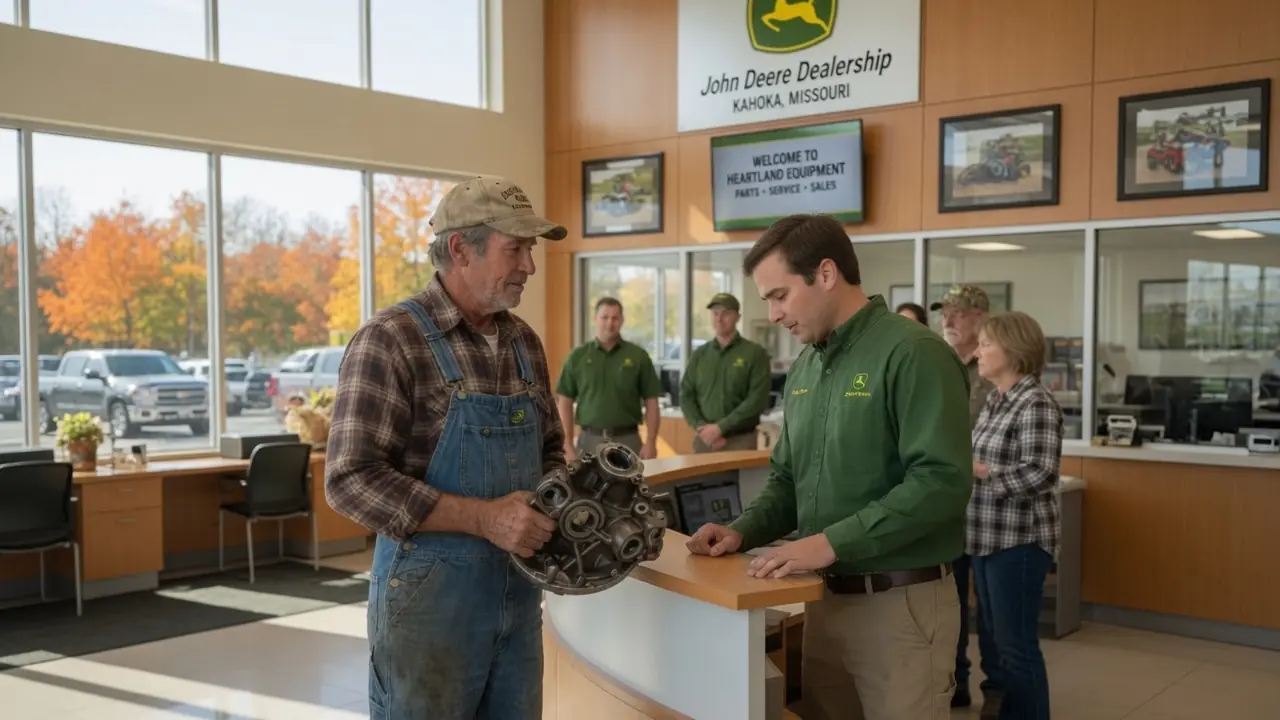
Behind the service counter, Brad Keller looked up from his computer with the kind of smile men used when they already knew they had power. He wore a clean green dealership shirt, khaki pants, and a name badge that said Service Manager. Behind him, three employees stood near the parts shelves, pretending not to listen. In the showroom beyond the counter, a brand-new John Deere tractor gleamed under the lights, bright and untouched, while Nolan stood there holding the piece that had stopped his whole farm.
“I need this repaired or replaced today,” Nolan said. “The tractor’s down, and I can’t wait.”
Brad took the housing, turned it once, and set it on the counter like it was dirty laundry. “What model?”
“8430.”
“Bought here?”
Nolan’s jaw tightened. “No. Bought it used out of Iowa.”
Brad’s eyes went back to the computer. He clicked a few times, then leaned back. “You don’t have a priority service account with us.”
“I have bought parts here for twenty years.”
“Parts, yes. Equipment, no.” Brad’s tone stayed polite, which made it worse. “Our shop is backed up. Earliest we can look at it is four weeks.”
Nolan stared at him. “Four weeks?”
Brad nodded. “Maybe three if something opens.”
“My crop rots because I bought elsewhere?”
A farmer standing near the oil filters looked up sharply. Brad’s face hardened, but the little smile stayed. “That’s not what I said.”
“That’s exactly what you said.”
Brad tapped the counter with two fingers. “Our real customers come first, Nolan. That’s how service works. The people who buy equipment from us expect support, and we take care of them.”
Nolan looked at the broken housing, then at the polished showroom, then back at Brad. He thought about his father walking into this dealership when it had still been small enough for the owner to know every farmer’s name. Back then, a man with a broken tractor did not need to prove loyalty with a purchase history. He needed help, and if the dealership could help, it helped.
“I have seven hundred and twenty acres sitting unfinished,” Nolan said. “Rain comes Thursday. If I’m down four weeks, that field might as well be firewood.”
Brad shrugged slightly. “Should’ve thought about that when you bought the tractor somewhere else.”
The words did not come out loud, but they cut through the room anyway. One of the employees behind Brad looked away. The farmer by the filters slowly put the box back on the shelf. Nolan felt heat rise in his chest, but he kept his voice low.
“Say that again.”
Brad’s smile faded. “I’m saying business has consequences.”
Nolan leaned closer over the counter. “So does forgetting who keeps this building alive.”
Brad crossed his arms. “You threatening me?”
“No.” Nolan picked up the broken housing. “I’m remembering something.”
He turned and walked out before Brad could answer. The glass doors opened to a gray afternoon, and the cold wind hit his face hard enough to make his eyes water. He loaded the cracked housing back into the bed of his pickup and stood there for a moment, both hands on the tailgate. In the dealership window, he could see Brad talking to one of the employees, shaking his head like Nolan had made a fool of himself.
Nolan climbed into the truck and sat behind the wheel without starting it. His phone lay in the cup holder. He had one more number he could call, though he had not used it in years.
The contact was saved as Eddie Miles - Shop.
Eddie Miles had once been the best mechanic Heartland Equipment ever had. He could diagnose a hydraulic issue by sound, rebuild a transmission with half the tools other men needed, and remember serial numbers like Scripture. Then the dealership changed ownership, management got younger, and Eddie got tired of being told to sell replacements instead of repairs. He left and opened a small independent shop inside a Morton building outside town.
Nolan pressed call.
Eddie answered on the fourth ring. “Miles Repair.”
“Eddie, it’s Nolan Kirchner.”
There was a pause, then warmth. “Nolan. Been a long time.”
“I’ve got an 8430 down. Cracked housing. Heartland told me four weeks.”
Eddie made a sound that was not quite a laugh. “Let me guess. You didn’t buy it from them.”
“No.”
“Bring it here.”
“Can you look at it today?”
“I said bring it here.”
Nolan started the truck.
Eddie’s place sat five miles outside Kahoka, down a gravel road behind a line of cedar trees. There was no polished showroom, no giant sign, no coffee station with branded cups. Just a tan Morton building, three service bays, a gravel lot full of farm trucks, and a hand-painted sign that read Miles Farm Repair - If It Can Work, We’ll Make It Work.
Eddie met Nolan outside before he even shut the truck off. He was sixty-two, broad through the shoulders, with white hair under a grease-stained cap and hands that looked like they had been built from old wrenches. He walked to the truck bed, looked at the cracked housing, and whistled softly.
“That’s ugly.”
“Can it be fixed?”
“Everything can be fixed. Question is whether it should be welded, sleeved, replaced, or cursed at first.”
Despite himself, Nolan almost smiled. “I’m short on time.”
“Farmers always are.” Eddie looked toward the sky. “Rain Thursday?”
“That’s what they’re saying.”
Eddie nodded. “Then we don’t have until Thursday.”
Inside the shop, Eddie laid the broken part on a steel bench under clean lights. His young assistant, Marcy, came over with a notebook and camera. She was maybe twenty-five, hair tucked under a cap, hands already black with grease. Eddie had trained her himself, and everyone knew she was good.
“What did Heartland say?” she asked.
“Four weeks,” Nolan said.
Marcy snorted. “Luxury.”
Eddie studied the crack. “I’ve got two options. I might have a salvage housing from a parted-out machine. If it matches, we’re moving by tonight. If not, we weld and reinforce, and you run it careful until winter.”
Nolan stared at him. “Tonight?”
Eddie looked up. “You got somewhere better to be?”
For the first time that day, Nolan felt air return to his lungs.
By dusk, Eddie found the salvage housing in a back storage room, wrapped in an old tarp and labeled in black marker. It was not perfect, but it was sound. By nine that night, Nolan’s tractor was pulled into Eddie’s shop, the bad housing off, the replacement cleaned, checked, and ready. Nolan tried to help, but Eddie pointed him toward a folding chair near the wall.
“You want to be useful?” Eddie said. “Call your wife and tell her you’re not losing the farm tonight.”
Nolan looked away quickly.
His wife, Ellen, answered on the second ring. “What happened?”
“Eddie thinks he can have me running before morning.”
Silence.
Then Ellen exhaled. “Thank God.”
Nolan rubbed his eyes. “Heartland wouldn’t touch it.”
“I figured.”
“They said real customers come first.”
Ellen was quiet a moment. “Then maybe real farmers should remember that.”
Those words followed Nolan the rest of the night.
At 2:14 in the morning, the tractor started. The engine rolled alive in the shop, deep and steady, vibrating through the concrete floor. Eddie stood beside the open bay door, listening. Marcy watched the gauges, one hand resting on the fender.
“Run it slow for twenty minutes,” Eddie said. “Then we check for leaks.”
Nolan climbed into the cab. He put his hand on the wheel and looked down at Eddie. “What do I owe you?”
“We’ll settle after you finish your acres.”
“No. Tell me now.”
Eddie wiped his hands on a rag. “Less than Heartland would’ve charged you to wait.”
By sunrise, Nolan was back in the field.
The first rows were slow because he did not trust the repair yet. Then the tractor held. Hour after hour, the housing stayed dry, the pressure stayed right, and the machine pulled like nothing had happened. Nolan worked until dark, went home long enough to eat and sleep four hours, then started again.
By Wednesday afternoon, the last of the field was finished.
Rain came Thursday morning.
Nolan stood on his porch with coffee in his hand, watching the water fall over ground that was no longer waiting on a broken tractor. He thought about Brad Keller behind that counter. Then he thought about Eddie Miles working under lights in a cold shop while the dealership’s service bays sat behind a schedule that had forgotten urgency.
At six that evening, Nolan called the first neighbor.
“Tom,” he said, “you still running that 7810?”
“Barely.”
“Next time it breaks, call Eddie Miles.”
By the end of the week, the story had spread without Nolan having to try very hard. Farmers loved a good repair story almost as much as they loved a grievance with a name attached. Heartland had refused Nolan because he was not a “real customer.” Eddie Miles had fixed him in one night. Rain had come the next morning.
By Monday, three trucks were parked outside Eddie’s shop.
By Friday, there were eight.
Eddie did not celebrate. He did not have time. He and Marcy worked twelve-hour days, then fourteen. They hired a retired mechanic named Glen to handle simple repairs and paperwork. Ellen Kirchner started bringing sandwiches once a week because she said men who saved farms deserved lunch, even if they were too stubborn to stop for it.
Heartland Equipment noticed in the second month.
The first sign was parts sales. Farmers who used to buy filters, belts, hydraulic fittings, and oil from Heartland began ordering through Eddie. The second sign was shop cancellations. Men who had been waiting two or three weeks suddenly called and said they had made other arrangements. The third sign was the quietest and most dangerous: nobody was gathering around the coffee counter anymore.
Farmers still came in, but they did not linger.
They bought what they had to buy and left.
Brad Keller noticed the silence before he understood the numbers. For years, Heartland’s service counter had been a gathering place. Men came in for a belt and stayed twenty minutes talking about rain, yields, seed prices, and gossip. That winter, they came in with closed faces and short answers.
One morning, Brad saw Nolan walk in.
For a second, he thought things might be returning to normal. Nolan came to the counter carrying a folded sheet of paper. Brad straightened and tried to look friendly.
“Nolan,” he said. “Haven’t seen you in a while.”
“No,” Nolan said. “You haven’t.”
“What can I do for you?”
Nolan unfolded the paper and laid it on the counter. It was a list of twenty-three farm names.
Brad looked down. “What’s this?”
“Accounts that won’t be renewing service contracts.”
Brad’s face tightened. “Is this supposed to mean something?”
“It means twenty-three farms got tired of being told loyalty only counts when it flows toward this counter.”
Brad pushed the paper back. “You don’t speak for twenty-three farms.”
“No,” Nolan said. “They signed for themselves.”
Brad looked again. The names were there in different handwriting. Tom Rusk. Henry Lawson. Dale Pritchard. Miller Brothers. Fulton Dairy. Kirchner Farms. And eighteen more, each one a farm Heartland had assumed would never leave because they had nowhere else to go.
Brad’s mouth went dry. “Eddie Miles can’t handle all this work.”
Nolan leaned closer. “He already is.”
The general manager came out from the office after Brad called him. His name was Patrick Sloan, and he had transferred from a dealership group in Illinois with spreadsheets, polished shoes, and no memory of the old way business worked in farm country. He read the list once, then again.
“This is over one repair?” Patrick asked.
Nolan shook his head. “No. One repair just gave us proof.”
Patrick frowned. “Proof of what?”
“That this dealership forgot farmers are not account numbers.”
Brad laughed sharply. “Come on, Nolan. You bought a used tractor somewhere else, then acted shocked when customers who invested here got priority.”
Nolan’s face hardened. “I invested here for twenty years. Parts, filters, oil, repairs, service calls, emergency fees, after-hours charges. My father bought here. My neighbors bought here. But the first time I needed help fast, you looked at a screen and told me I was not real.”
Patrick glanced at Brad.
Brad looked away.
Nolan picked up his cap from the counter. “Eddie didn’t ask where I bought the tractor. He asked how fast I needed to get back in the field.”
He walked out.
The paper stayed on the counter.
After that, Heartland tried to respond the way corporations respond when they finally realize a community has turned. They sent postcards offering discounted inspections. They called long-time customers with “winter maintenance specials.” Patrick Sloan hosted a customer appreciation breakfast with free biscuits, sausage gravy, and a raffle for John Deere jackets.
Twelve people came.
Eight were retired.
One was Eddie Miles, who showed up with Marcy just to eat.
Brad did not find it funny.
The real damage came in March, when planting season approached and twenty-three farms scheduled pre-season inspections with Miles Farm Repair instead of Heartland. Eddie’s gravel lot filled with tractors, planters, combines, and trucks. He added two bays, hired another mechanic, and put Marcy in charge of diagnostics because she could find electrical problems faster than men twice her age.
Farmers trusted Eddie because he did not talk like he owned their choices.
He told them what was wrong, what could wait, what could not, and what he would do if the machine were his. Sometimes he told them not to spend money yet. That was the thing that made the rebellion permanent.
One afternoon, Brad drove out to Eddie’s shop.
Nolan happened to be there, drinking coffee near the open bay while Marcy worked on a hydraulic issue. Eddie looked up when Brad walked in. The whole shop seemed to quiet without stopping.
Brad forced a smile. “Eddie.”
“Brad.”
“You’ve been busy.”
“Farmers keep breaking things.”
Brad looked around the shop, at the tractors lined up, the mechanics working, the parts shelves, the handwritten schedule board. “You know, we could work together. Heartland could send overflow your way officially. Maybe make you an authorized service partner.”
Eddie wiped his hands slowly. “Authorized by who?”
Brad’s smile stiffened. “By Heartland.”
Eddie looked at Nolan, then back at Brad. “I was fixing tractors before your service software learned to reject appointments.”
Brad’s face flushed. “This isn’t personal.”
Nolan set down his coffee. “It became personal when you told me my crop could wait.”
Brad turned to him. “I never said that.”
“You said real customers come first.”
The words hung in the shop.
Marcy looked up from the tractor. “That sounds worse.”
A few farmers laughed under their breath.
Brad’s jaw tightened. “You people act like we’re villains because we have a schedule.”
Eddie’s voice stayed calm. “No. We act like you’re replaceable because you made farmers feel replaceable.”
Brad looked around the shop and saw no sympathy there. He left without another word.
By summer, Heartland’s service revenue had dropped hard enough that corporate sent a regional director. She spent two days interviewing customers, employees, and farmers who had left. What she heard was not just about Nolan.
She heard about the dairy farmer told to wait six days for a service call while cows stood in heat because his skid steer was not bought through Heartland. She heard about the young widow who was charged an emergency fee for a ten-minute diagnostic visit. She heard about the employee who had been told to prioritize high-value accounts and “let small operators learn how service works.”
At the end of the second day, Brad Keller was fired.
Patrick Sloan lasted three more weeks.
Heartland called Nolan after both were gone. The new manager, a woman named Rebecca Hart, asked if she could visit the farm. Nolan nearly said no, but Ellen told him refusing a conversation was how bad managers behaved. So he said yes.
Rebecca came on a Tuesday morning in August. She wore boots, not dress shoes, and she did not park near the house like she was afraid of dust. Nolan met her beside the machine shed. The repaired tractor sat nearby, still running strong.
“I read the file,” Rebecca said. “But I’d rather hear it from you.”
Nolan told her everything.
He did not dramatize it. He did not need to. He told her about the broken housing, the 720 acres, the four-week wait, and the phrase real customers. Rebecca listened without interrupting.
When he finished, she looked toward the field. “I can apologize, but I know apologies don’t harvest crops.”
“No,” Nolan said. “They don’t.”
“I want Heartland to earn business back.”
“That’ll take years.”
“I know.”
Nolan studied her. “Then start with this: don’t ask farmers where they bought the machine before asking how bad they need it running.”
Rebecca nodded. “Fair.”
“And don’t try to kill Eddie’s shop.”
“I wasn’t planning to.”
“Corporate might.”
Rebecca looked at him. “Then corporate can come talk to me.”
That was the first thing she said that made Nolan think she might survive.
Heartland did not win back the twenty-three farms quickly. Some never returned. But Rebecca changed the service policy. Emergency repairs were ranked by field urgency, not purchase origin. Small farms got equal access to seasonal breakdown slots. Employees were told never to use the phrase real customers again.
Eddie Miles kept growing anyway.
By the next year, his shop was not just a backup option. It was the first call for half the county. Marcy became part owner after Eddie had a mild heart scare and finally admitted he could not work forever. The sign outside changed to Miles & Marcy Farm Repair.
Nolan liked that.
Five years later, Heartland Equipment and Miles & Marcy worked together more often than anyone expected. Rebecca sent work to Marcy when the dealership was full. Marcy bought certain factory parts from Heartland when it made sense. Eddie, older now and mostly retired, sat in a chair near the shop door and complained that cooperation was less entertaining than a good feud.
But the lesson remained.
At the annual county farm meeting, Nolan was asked to speak about equipment planning and harvest risk. He stood at the front of the Grange Hall, older, grayer, still wearing the same faded cap. Brad Keller was long gone. Patrick Sloan was a name nobody mentioned. Rebecca Hart sat in the third row, listening.
Nolan told the story plainly.
“One repair taught us something,” he said. “A dealership is not built by tractors under showroom lights. It is built by the farmer standing at the counter with a broken part and rain coming.”
The room was quiet.
“If you tell that farmer he is not real because his invoice came from somewhere else, he will believe you. Then he will go find someone who knows he is real before the computer says so.”
In the back of the room, Marcy Miles smiled.
Nolan looked down at his hands, remembering the cracked housing, the polished counter, and Brad’s smirk. Then he looked up again.
“Loyalty cuts both ways,” he said. “The day one side forgets that, the other side learns the road to a different shop.”