“Rip off that filthy jacket, or I’ll have you dragged out in cuffs.”
Judge Everett Sloan’s voice cracked through Courtroom 7B, silencing every whisper beneath the high oak ceiling. At the witness rail stood Clare Donnelly, a striking thirty-four-year-old trauma nurse wearing navy-blue scrubs beneath a faded olive military jacket. Dried blood marked one sleeve, an old burn scar darkened the left shoulder, and a worn black patch reading PHANTOM 4 remained fixed above her right arm.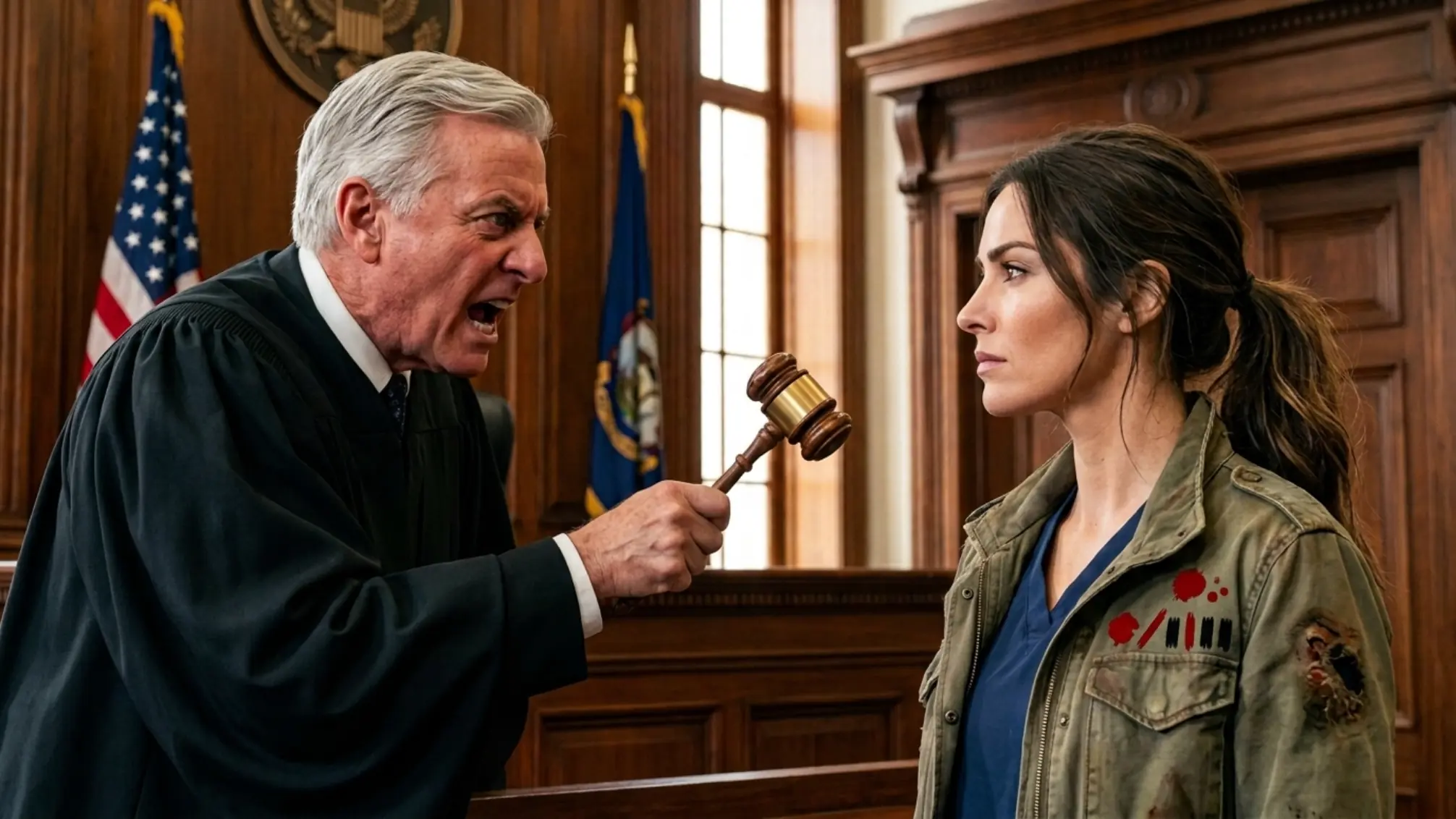
Clare did not flinch.
“Touch me,” she said, stepping toward the bench, “and this courtroom learns exactly what those scars cost.”
Sloan’s expression hardened. He pointed his gavel at her as though it were a weapon. “You are a bloodstained nurse playing soldier. Sit down before I bury your testimony.”
The courtroom doors opened behind her.
A tall four-star Navy admiral entered in a dark formal uniform, his steel-blue eyes locked on the patch across Clare’s shoulder. He moved between her and the approaching court officers without waiting for permission.
“Stand down, Your Honor,” Admiral Conrad Barrett said. “Phantom Four saved my SEALs, and every threat you just made is now on record.”
Less than one hour earlier, Clare had still been inside the emergency department at Pacific Mercy Medical Center. She had worked thirty-six hours through a massive Interstate 5 collision involving seventeen patients, four critical injuries, and two emergency surgeries. By the time the final ambulance cleared, blood had dried across her scrubs and exhaustion had settled so deeply into her body that she could barely feel where the pain in her arms ended and fatigue began.
She had fifty-three minutes to reach the courthouse.
There was no time to drive home, shower, or change into something that would satisfy a judge accustomed to pressed suits and polished shoes. Clare went directly to her locker and removed the olive jacket she almost never wore in public. The fabric was faded, the cuffs had been repaired twice, and the burned shoulder carried a story she had never explained to anyone outside a sealed military debriefing.
The jacket covered what remained of both arms.
She slipped it over her scrubs, zipped it halfway, and left the hospital without telling her coworkers where she was going. Her supervisor believed she had finally gone home to sleep. Instead, Clare drove downtown because Mason Keen had been waiting three weeks for someone willing to tell the truth.
She had met Mason eight months earlier at a trauma-recovery program for veterans. Clare volunteered there because volunteering allowed her to help without being expected to speak about herself. Mason attended because a court counselor had recommended it after he began withdrawing from friends, work, and almost every part of ordinary life.
They did not become friends immediately.
During their first meeting, Mason sat in the back row with his arms crossed and never said a word. Clare also remained silent, listening while other veterans described sleepless nights, panic attacks, and the exhaustion of pretending to be fine for people who wanted simple answers.
After the session, Mason noticed her slowly rotating her left wrist.
The movement was small, but he recognized pain when he saw it. Without asking what happened, he placed a cold water bottle beside her and walked away.
Clare remembered that gesture.
He had offered help without demanding access to the wound.
Three weeks before the hearing, Mason was returning to his car through San Diego’s Gaslamp Quarter when he heard a frightened woman speaking inside an alley. He found three men surrounding a waitress named Paige Moreno. One of them, Trevor Langston, held a folding knife against the outside of her jacket.
Mason intervened.
The confrontation lasted less than a minute. Two attackers hit the ground, one suffered a dislocated shoulder, and Trevor struck the wall with enough force to fracture his jaw and damage the bones around one eye. Yet the most important thing Mason did happened after the violence ended.
Trevor began choking on blood and broken tissue.
Mason knelt beside the same man who had threatened Paige, disassembled a ballpoint pen, and used the hollow tube to create an emergency airway. By the time paramedics arrived, the improvised device was the only reason Trevor remained alive.
That should have ended the question of whether Mason intended murder.
Instead, Trevor’s father transformed the case.
Harrison Langston owned construction firms, development companies, and relationships inside nearly every important institution in the city. By the time police completed their report, the knife had vanished from the official account. Paige received visits from men in expensive suits who advised her to reconsider what she remembered.
Mason was described as an unstable veteran who attacked three unarmed men.
His emergency airway procedure became a footnote.
His act of saving Trevor’s life was treated as irrelevant.
The prosecution built a case around the injuries, Mason’s combat history, and records showing he had attended trauma counseling. None of those facts proved guilt, but together they created a story that sounded convincing enough when the missing facts remained hidden.
Clare possessed one of those missing facts.
She had been working when Trevor arrived at Pacific Mercy. She reviewed his injuries, saw the improvised airway, and later discovered the folding knife inside the jacket removed by the trauma team. Following hospital protocol, she sealed it, documented its location, and transferred it into secure evidence storage.
No police officer ever collected it.
When Clare learned that the official report listed no weapon, she understood the omission was not accidental.
She agreed to testify.
Courtroom 7B was already full when Clare arrived. Police officers occupied several rows behind the prosecution, while veterans and community advocates sat near the defense table. Harrison Langston remained in the front row wearing a tailored suit and the relaxed expression of a man accustomed to watching institutions bend around his preferences.
Mason looked up when Clare entered.
Relief crossed his face first.
Then he noticed the jacket.
His expression became fear.
He knew she wore long sleeves even in summer. He had seen the way she protected her arms from casual contact. He had never asked what lay beneath the fabric because their trust depended partly on respecting the things neither of them was ready to name.
Judge Sloan stopped the proceeding immediately.
“Who are you?” he demanded.
“Clare Donnelly. I was called as a defense witness.”
Sloan looked at her blood-marked scrubs and worn jacket with open disapproval. “You will not approach my witness stand dressed like that.”
“I came directly from a mass-casualty shift.”
“That does not excuse disrespect.”
“My clothing has no effect on the accuracy of my testimony.”
Sloan leaned forward. “This court determines what affects its dignity.”
Clare explained that the jacket had personal and medical significance. She asked to keep it on. Her voice remained calm, but the request was not casual.
The judge heard defiance.
“You will remove that military costume,” he said, “or I will hold you in contempt and strike your testimony.”
Mason caught Clare’s eye and gave the smallest possible shake of his head.
Do not do this for me.
Clare understood.
She also understood that if she left, the missing knife might remain hidden, Paige might remain afraid, and Mason could be convicted under a story built to exclude the truth.
When Sloan ordered the court officers to assist her, Clare became perfectly still.
“Do not touch me.”
Both officers stopped.
Neither could later explain why her quiet warning carried more authority than the judge’s shouted command. Perhaps they recognized military posture. Perhaps they saw that her hands were open but positioned with deliberate control. Perhaps something in her face told them physical contact would be a mistake no one could reverse.
Judge Sloan noticed the patch.
“What does that nonsense mean?” he asked.
Clare did not answer.
“Phantom Four,” he read mockingly. “Do you expect this court to be impressed by imaginary war games?”
His voice traveled through the poorly sealed courtroom doors and into the marble corridor.
Admiral Conrad Barrett had been waiting there for a delayed federal meeting. For four years, he had carried a question that no classified report answered: who was Phantom Four?
During an operation in the mountains of Yemen, one of his SEAL teams became trapped under fire with four critically wounded men. Barrett listened from an operations center hundreds of miles away as the team’s medic reported catastrophic injuries and almost no remaining time.
Then a woman’s voice entered the radio channel.
“Phantom Four. I have four casualties, two critical. Give me twelve minutes and clear the channel.”
Barrett gave her twelve.
She used eleven.
All four men survived.
The classified after-action report stated only that Phantom Four had been evacuated with injuries severe enough to end further service. Her identity disappeared behind sealed records. Barrett searched privately but found nothing more.
Now he heard that call sign through a courtroom door.
He entered and saw Clare.
For a few seconds, he could not speak.
The faded jacket, burned shoulder, and patch confirmed what his memory already knew. The woman Judge Sloan was threatening to have physically stripped had carried four dying SEALs through the worst night of Barrett’s career.
“No one touches her,” he said.
Judge Sloan bristled. “This is my courtroom.”
“And she is connected to a sealed Naval Special Warfare file.”
“That gives you no authority over these proceedings.”
Barrett clasped his hands behind his back. “You may continue as you wish, Your Honor. The hallway security cameras are recording, and an interagency review can decide whether forcibly removing the clothing of a protected former operative was appropriate.”
Harrison Langston’s confidence weakened.
Sloan stared at the admiral, calculating the consequences of pushing forward. He had spent nineteen years controlling his courtroom through certainty, but Barrett offered neither argument nor threat. He simply placed the judge’s conduct inside a larger record.
The order to seize Clare never came.
Still, Sloan did not withdraw the contempt warning.
The jacket remained the price of testimony.
Clare made her choice.
She lowered the zipper and removed it.
The courtroom’s reaction was not loud. No one gasped dramatically or shouted. The silence simply changed as her arms became visible.
Burn tissue stretched from her elbows toward both shoulders. Surgical grafts covered the deepest injuries, while two small depressions marked old entry wounds. The damage was distributed in patterns that made clear how close surgeons had come to amputating both arms.
A Naval Special Warfare trident had been tattooed onto her right forearm beneath the worst scarring.
Below it was a date.
Barrett recognized the date instantly.
He crossed the courtroom and stopped in front of her. His attention remained on her face rather than the scars.
Then the admiral raised his hand in a formal salute.
“My men came home because of you,” he said. “All four of them.”
Mason lowered his face into his hands.
Judge Sloan looked toward the bench in front of him, finally recognizing the cost of the order he had issued. Yet Clare did not wait for admiration or apology. She draped the jacket across the rail and walked to the witness stand.
She had not come to tell a war story.
She had come to save an innocent man.
The defense attorney began with her credentials. Clare described her work as a trauma nurse, her previous military medical service, and her experience treating catastrophic injuries under extreme pressure. She explained that she met Mason through a veteran-recovery program but had no financial or professional interest in the case.
The prosecutor, Miles Corbett, suggested her relationship with Mason compromised her objectivity.
Clare remained composed.
“I cannot testify to what he felt,” she said. “I can testify to what he did and what those actions medically demonstrate.”
Corbett emphasized Trevor’s injuries: a fractured jaw, damaged eye socket, broken ribs, and a wrist fracture. He presented them as evidence of excessive violence.
Clare agreed that the injuries were severe.
“That is precisely why his next action matters,” she said.
She opened Trevor’s medical record.
Within approximately two minutes of the confrontation, Trevor’s airway began failing. Blood and tissue obstructed normal breathing. Without intervention, he likely would have died before paramedics reached the alley.
The airway found in place had been created using the hollow barrel of a ballpoint pen.
Paramedics did not perform it.
Mason did.
“A person acting through uncontrolled rage does not incapacitate a threat, recognize airway failure, improvise a medical device, and preserve that person’s life within the same minute,” Clare said. “Those actions demonstrate control, training, and immediate concern for survival.”
Corbett argued that emergency personnel might have inserted the device before documentation began.
Clare walked him through every timestamp.
The first paramedic report described the airway as already functioning when the team arrived. The device contained materials from Mason’s pen, and witnesses recalled seeing him kneeling beside Trevor.
Corbett changed direction.
“Saving someone afterward does not justify nearly killing them beforehand.”
“No,” Clare answered. “The weapon and circumstances justify the use of force.”
The prosecutor looked toward the police report. “No weapon was recovered.”
Clare reached for another document.
“That is the problem.”
Harrison Langston shifted in his seat.
Clare displayed Trevor’s wrist imaging. The fracture pattern showed sudden forced rotation while his hand maintained a tight grip around an object. She explained that such an injury commonly occurred during violent disarmament.
“The hand refuses to release,” she said. “The person taking the weapon continues rotating. The wrist fails first.”
Judge Sloan turned through the incident report.
There was no knife.
No mention of Paige being held at blade point.
No explanation for Trevor’s disarmament injury.
Clare lifted a signed evidence form from Pacific Mercy.
“When Trevor Langston’s jacket was cut away in the emergency department, a folding knife fell from the inner pocket. Four-inch blade, closed position. I recovered it with a gloved hand, documented the time and location, sealed it, and transferred it into secure hospital storage.”
The prosecutor stopped writing.
Sloan leaned forward. “Was the knife ever collected by law enforcement?”
“No.”
“Was it listed in any evidence material provided to the defense?”
“No.”
“Did anyone from the investigating agency contact the hospital regarding it?”
“No.”
The room became still.
Corbett stood slowly. “Your Honor, the prosecution was never informed that such evidence existed.”
His statement protected him personally, but it created a larger problem. If the prosecution did not know, the investigating officers had failed to disclose exculpatory evidence connected directly to the defense’s claim.
Sloan looked toward the officers seated in the gallery.
Several avoided his eyes.
The judge ordered the knife transferred immediately into court custody. He directed the criminal division to investigate the missing evidence, the incomplete police report, and any contact between the Langston family and responding officers.
Then he reviewed the full record.
The knife supported Mason’s account.
The wrist injury confirmed a forceful disarmament.
The emergency airway demonstrated that Mason stopped using force when the threat ended and immediately worked to save Trevor.
The prosecution’s version could no longer survive.
“All charges against Mason Keen are dismissed effective immediately,” Sloan announced.
Mason remained seated.
For three weeks, he had been told his memory was unreliable, his training made him dangerous, and his decision to intervene proved instability. Now the official story collapsed in less than an hour because one exhausted nurse had arrived carrying evidence no one else wanted examined.
His attorney touched his shoulder.
Mason finally stood and walked toward Clare.
There were no words large enough for the moment. He stopped near the witness rail as tears filled his eyes.
“You did not have to show them,” he whispered, looking toward her arms.
“Yes,” Clare replied. “I did.”
“For me?”
“For the truth.”
He nodded, unable to speak again.
Behind them, Judge Sloan ordered Harrison Langston to remain in the courtroom. The investigation would include communications between his family, police officers, and anyone who approached Paige Moreno. The wealthy businessman no longer appeared comfortable.
Within twenty minutes, a victim advocate found Paige in the back row.
She was told that the knife had been recovered, Mason was free, and the people who threatened her no longer controlled the case. Paige asked for paper and began writing her complete statement.
Before Clare left, Sloan asked her to approach the bench.
His voice no longer carried the certainty it had when she entered.
“This court owes you an apology,” he said. “I judged your credibility by your appearance and nearly excluded testimony essential to justice.”
Clare waited.
“I also threatened physical force without understanding what I was asking you to reveal.”
“Yes,” she said.
Sloan seemed surprised she did not immediately forgive him.
“I accept that you recognize the error,” Clare continued. “What matters is whether you make the same judgment about the next person who enters wearing something you do not understand.”
The judge lowered his eyes.
Clare put the jacket back on and zipped it to her throat.
Outside the courtroom, Admiral Barrett waited near a tall window overlooking the street. When she approached, he told her he had searched for Phantom Four for years.
“Phantom Four did not come home,” Clare said. “A nurse named Clare did.”
Barrett considered that. “The person who kept four men alive came home.”
He removed a worn Naval Special Warfare challenge coin from his pocket and placed it in her palm.
“There is a senior combat-trauma instructor position at Coronado,” he said. “One call from me, and it is yours.”
Clare turned the coin between her fingers.
Her phone vibrated.
The veterans’ recovery program had sent a message about a new participant who had arrived that morning and refused to speak to anyone. The coordinator believed Clare might understand how to sit beside him without demanding explanations.
Her next hospital shift began in twelve hours.
“Thank you,” she told the admiral. “But there are people here who still need me.”
Barrett nodded.
Not as an officer acknowledging a subordinate.
As one survivor recognizing another.
Clare left the courthouse beneath the bright San Diego afternoon. Traffic moved through the streets, pedestrians crossed beneath the lights, and almost no one knew what had happened inside Courtroom 7B.
That suited her.
She had never needed strangers to recognize Phantom Four.
She needed Mason free.
She needed the knife preserved, the false report exposed, and the frightened waitress given another chance to speak. She needed the judge to understand that dignity could not be measured by clean sleeves or expensive clothing.
The faded jacket had hidden scars, but it had never hidden weakness.
Judge Everett Sloan saw bloodstained scrubs and decided Clare did not belong in his courtroom. The police report saw a traumatized veteran and decided Mason must be violent. Harrison Langston saw influence and believed evidence could disappear if enough powerful people wanted it gone.
Every one of them stopped looking when the first convenient explanation appeared.
Clare did not win because an admiral recognized her.
She won because she brought records, medical evidence, chain-of-custody documentation, and the courage to reveal what she had spent four years keeping private. Barrett’s salute changed the room, but Clare’s testimony changed the case.
The judge ordered her to remove a filthy jacket.
Instead, the jacket uncovered the hero he had nearly silenced—and the truth that set an innocent man free.