Hannah Cole had proved up a homestead once with her own two hands and her husband’s hands beside hers, and lost it the year after she buried him.
So when Noah Sutton said the words, “The homestead needs a woman’s hand,” she felt them land somewhere that had not stopped aching.
She and Will Cole had filed on a quarter section out past Mason when they were young and full of the particular hope that goes with raw land.
They had broken it and built on it and made it begin, after years of killing work, to thrive. A garden that fed them, a few cows, a cabin that was theirs. A future you could stand in the doorway and see.
Then Will had taken a fever one winter and not come out of it, and Hannah had set herself to hold the place alone. Because it was theirs, and she was not a woman who let go of things she had bled for.
She had nearly managed it.
What she had not managed was Vester Slade.
Slade was a land speculator, which on the frontier was a polite word for a particular kind of carrion bird. A man who watched for homesteads in trouble, the grief-struck and the widowed and the behind, and moved in.
He had watched Hannah Cole try to prove up a claim alone.
And he had filed a contest against her, a legal challenge claiming a widow, grieving and short-handed, had failed the requirements of the law: the residence, the cultivation, and the improvements that turned a filing into a deed.
And Hannah, drowning in grief and ignorant of the fine, cruel machinery of land law, had not known how to fight it and had lost.
Slade took the quarter section she and Will had bled into for a song, the way he had taken a dozen others. Hannah Cole walked off the land that was to have been her whole life with what she could carry and a hole in her where the future used to be.
She had not understood while it was happening that she was being robbed. That was the genius of Slade’s kind. It all looked like law, like papers and clauses and a man at a land office desk shaking his head regretfully.
And a grieving woman who had never been taught the machinery had no way to see that the regret was a performance, and the law a weapon pointed at her by a man who had loaded it on purpose.
She had lain awake a hundred nights since, going over the steps, seeing too late where she could have planted her feet and had not known to. And that bitter, useless education, paid for with the only land she would ever own, was the one thing she carried out of the wreck that no one could take back.
So she took work, domestic work, hired-hand work, whatever a landless widow could get, drifting from place to place with a homesteader’s whole hard skill and no homestead to use it on. And that was how she came to the Sutton place, answering Noah Sutton’s notice for a woman to keep house.
She heard him say the homestead needed a woman’s hand, and felt the old wound open and the old knowledge stir in the same breath.
The Sutton place needed a woman’s hand the way a drowning man needs a rope.
Noah Sutton was a widower of about thirty-eight, and his wife, Ann, had been dead two years. You could read the whole story of those two years in the state of his homestead.
Ann had made the place. Hannah saw it the moment she came up the lane, in the bones of a garden gone to weeds, in the ghost of order under the neglect. And when Ann died, Noah had kept doing the man’s half of the work, the plowing and the stock and the fences, with a grim endurance.
But he had let the woman’s half, which he had never learned because Ann had always done it, simply fall to ruin.
The garden was a wilderness. The dairy had soured. The hens had gone half-wild and stopped laying. The house was clean in the way a grieving man keeps a house clean, which is to say, swept and dead.
A place he ate in and slept in and did not live in.
The whole homestead was going down, not from any failure of his labor, but from the absence of the other half. The half that had gone into the ground with Ann.
Noah Sutton, too proud to say he was drowning and too honest to pretend he wasn’t, had finally put out a notice for a woman to keep house because the homestead needed a woman’s hand, and his was empty of one.
He said it plain when Hannah came, no nonsense in it, a grieving, practical man hiring help. The homestead needed a woman’s hand. There was the garden, the dairy, the house. There were fair wages and a decent room.
There was no foolishness intended, and none would be tolerated.
Hannah Cole, who had buried her own homestead’s worth of hopes and wanted nothing less than foolishness herself, took the work and brought her hand to the Sutton place.
And the Sutton place came back to life.
It came back the way land does under someone who knows it and loves it, not all at once, but surely. Hannah brought the garden back from the wilderness, hard work and a homesteader’s knowing, and by midsummer it was feeding the place again.
She gentled the half-wild hens into laying and brought the sour dairy back to sweetness. She turned out butter that Noah had not tasted the like of since Ann. She brought order to the house that was not the dead clean of grief, but the live clean of a home.
And she did it all with a quiet competence that came of having done it once before on land of her own.
That was the bittersweet heart of it for Hannah, that every row she hoed and every crock she set was a thing she had done on the quarter section past Mason for herself before Slade took it. She was pouring her whole homesteader’s gift into another’s land because her own was gone.
She did not let it sour her.
But she felt it every day, the ache of the borrowed dirt.
Noah watched it happen with something he could not name at first and only later understood was a kind of grief easing. He would come in from the fields of an evening that first month, braced for the dead clean house and the cold, lone supper of his widowing.
Instead, he would find the windows open and the smell of bread and a meal on the table and the lamp lit warm. The wrongness of it, the rightness of it, would catch him in the chest because it was the homestead breathing again after two years of holding its breath.
He took to lingering at his own supper table, where for two years he had eaten fast and alone to be done with the silence. He took to walking the revived garden in the cool of the evening, not to inspect it but just to stand in the place that was alive again.
He said none of it to Hannah.
But Hannah, who had brought a place back to life before and knew what it did to the person who had been dying along with it, saw it and was glad and said nothing either.
The two of them shared the wordless thing that grows between people mending the same broken place.
What she was careful of, and what Noah noticed, was Ann.
Hannah Cole did not come into the Sutton place and erase the dead woman from it the way a lesser or less grieved person might have. She found Ann everywhere, in the perennials struggling under the weeds, in the way the kitchen was laid out, in a hundred small choices a careful woman had made.
And she honored them.
She brought back Ann’s garden rather than planting her own over it. She kept Ann’s things where Ann had kept them. She made the homestead bloom again in a way that was a continuation of Ann’s work and not a replacement of it.
Because Hannah Cole knew exactly what it was to love a piece of land into being and lose it, and she would not trample the ghost of a woman who had done the same.
Noah Sutton, who had braced himself for the strange grief of watching another woman take over Ann’s domain, found instead that the woman he had hired was tending Ann’s memory as carefully as Ann’s garden. And something in his grief, which had been a clenched fist for two years, began to open.
Mrs. Lassiter came round to speak of appearances. A widow and a widower alone out on a homestead, the wages, the closeness, no chaperone, and the talk, and how it looked.
Hannah, who was up to her elbows in the wash, said, “Mrs. Lassiter, that man’s wife made this place and died, and the place was dying of missing her. I was hired to bring it back, which I’m doing in plain daylight for plain wages with my plain hands. If the town wants to make something low out of a homestead being saved, that’s the town’s poverty, not mine.”
She wrung a shirt with a sharp twist and added, “Mr. Sutton has never once been anything but decent, which is more than I can say for the last man who took an interest in my situation. He took my land.”
Then she nodded toward the tub.
“Mind the lye. There, it splashes.”
Mrs. Lassiter minded the lye and left.
Hannah finished the wash.
It grew between them slow over the season, the way the garden grew, out of shared work and shared losses and a hundred suppers at a table that had got its life back.
Noah told her by and by of Ann, and Hannah listened the way only the bereaved can listen. She told him in turn of Will and the quarter section past Mason and how she had lost it, and Noah’s face went hard at the name of Slade because every honest homesteader knew that name and that bird.
They were two people who had each loved a thing into being and lost it. She had lost her land. He had lost his wife. And there is a particular understanding between such people, a thing that does not need much saying.
It deepened over the summer into something neither of them named, because naming it felt like a thing they had not yet earned. But it was there at the supper table and in the doorway of an evening, looking out at the saved garden, and they both knew it.
There was a night that autumn when she let Noah see the whole of it.
They had been talking late at the table, easy, and he had asked, gentle, whether it was hard for her keeping a homestead that was not hers after losing her own. Hannah had meant to say no, the way she said no to anything that might be a complaint, and found herself saying yes instead.
Yes, it was hard.
Every good thing she made on the Sutton place was a thing she had made once on her own and lost. Every row she hoed, she had hoed for Will once on dirt that was theirs. There were mornings when the borrowedness of it sat on her like a stone.
The knowing that she could love this place with her whole hand and it would still never be hers. That she was a hired hand on someone else’s future, the way she had once stood in her own doorway and seen a future she got to keep.
She had not meant to say it.
Noah did not try to fix it, which was the right thing. He only heard it and let it sit. Then he reached over and laid his hand over her work-roughened one on the table and left it there.
They sat in the lamplight a long while, saying nothing at all.
It was the first time either of them had touched the other on purpose.
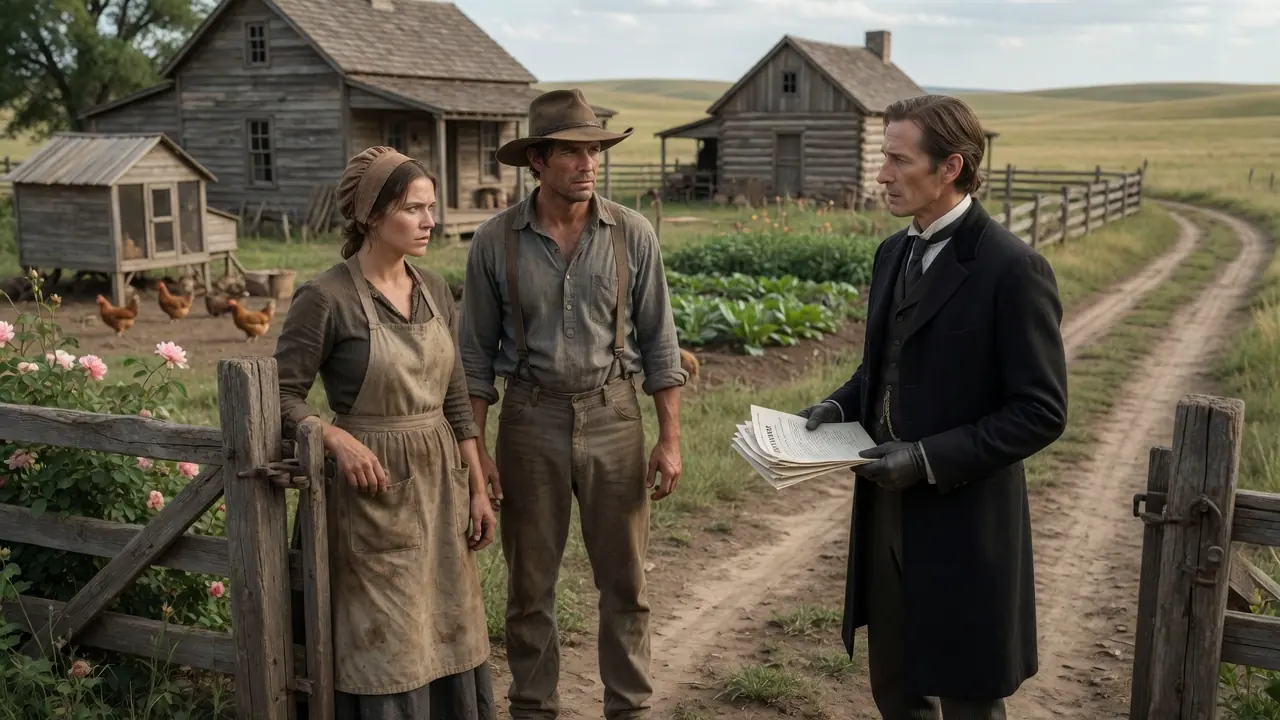
Then Vester Slade came up Sutton Lane, and Hannah Cole knew the carrion bird the instant she saw him.
He had circled the Sutton place the way he circled all of them, and he had seen what Hannah had seen the first day. A homestead that had been let go for two grieving years. A man behind on the law’s requirements. A claim not yet proved up into a deed and vulnerable to a man who knew the machinery.
Noah Sutton, drowning in grief, had let the proving up lapse. The improvements were not made. The cultivation had fallen off. The paperwork was not filed. All through the two years the place was dying.
And Slade had filed a contest exactly as he had done to Hannah, claiming Noah Sutton had failed to meet the law and the claim should be forfeit and reopened. Which meant Slade would take it.
He came up the lane to tell Noah so, smug as a man who had done this a dozen times and never lost.
He had never, in those dozen times, run into someone who had survived him.
Hannah Cole knew Vester Slade’s playbook to the letter because he had written it on her own life two years before. She had spent those two years understanding, in bitter hindsight, exactly how he had done it and exactly how she should have fought it and had not known to.
This time, she knew.
“You filed a contest on residence, improvements, and cultivation,” she said to Slade before Noah could even gather himself. “The same three you used on me. And the same three are your weakness, Mr. Slade, because they are things a body can prove. Unlike a grieving widow two years ago, this homestead has had a woman’s hand on it all season.”
She turned to Noah.
“The garden is cultivated and feeding the place. That is your cultivation, witnessed by everyone who has bought our butter and eggs all summer. The improvements are made. I made them. The fences, the dairy, the coop, the house.”
She looked back at Slade.
“And there is a town full of people who have seen the place go from ruin to thriving these past months and will swear to the date of every bit of it. You have resided here without a single day’s absence. Provable.”
Her voice did not rise. It did not need to.
“He has filed a contest against a claim that, as of this season, meets the law in every particular. And he did it on the assumption the place was still dying. It isn’t. I saw to that.”
She looked at Slade, and there were two years of cold knowledge in it.
“I didn’t know how to fight you when you took my land, Mr. Slade. I’ve had a long while to learn. Bring your contest. We’ll meet it with a witnessed record of a proved-up claim. And you’ll lose, and it will cost you the filing fee and the pleasure of being shown up by the widow you robbed two years back.”
Then she tilted her head slightly.
“Or you can withdraw it now and save yourself the trip to the land office. Your choice. I would not be quick about it. Folks are already talking about how Vester Slade tried to jump a homestead a war widow had just brought back to life.”
Vester Slade looked at Hannah Cole and recognized her. He understood that he had made the one mistake his kind cannot afford, which was to circle back to ground already defended by someone he had taught the hard way.
The contest that would have rolled over a grieving man rolled instead into a witnessed, documented, thriving, fully proved-up claim and a fury of a woman who knew his every trick.
And it died there in the lane.
He withdrew it within the week rather than face the land office with Hannah Cole’s record and Hannah Cole’s testimony, and word got around the county of how he had been routed. The grief-struck homesteaders he had been counting on for his next dozen thefts grew, all at once, a great deal more wary of him.
Because Hannah Cole made sure they knew.
The land she had not been able to save for herself, she had saved for Noah Sutton. And in the saving, she turned the worst thing that ever happened to her into the knowledge that beat the man who had done it.
Noah asked her to stay for good that autumn, in the doorway, looking out at the garden she had saved twice over now.
“I hired a woman’s hand,” he said, “because this place was dying, and so, if I’m honest, was I. I told myself it was just work, just keeping the homestead from going under. But you didn’t just keep it. You brought it back to life.”
His voice went quieter.
“And you did it tending Ann’s memory as carefully as Ann’s roses, which I’ll never have the words to thank you for. Then you stood in that lane and saved the whole of it from Slade with knowledge you paid for with your own land.”
He looked at her fully then.
“You gave this homestead a great deal more than a hired hand’s work, Hannah. And you gave me a great deal more than I hired, too.”
He made himself say the rest.
“I loved Ann, and I’ll always love Ann. I think you, of all people, understand that doesn’t leave less room, only teaches you how much room there is. I’ve fallen in love with you over a summer of saved gardens and shared suppers, and I can’t go on paying you wages and pretending it’s only the homestead that needs you.”
He drew a breath.
“Marry me. Stay for good. The place is yours as much as mine. You proved it up. You saved it. Your hand is in every row of it. Let me give you, at last, a homestead you don’t have to lose. Let me give you more than work.”
And Hannah Cole, who had loved a piece of land into being and watched it taken, who had spent two years landless and grieving and pouring her whole gift into other people’s dirt, looked at the man offering her not just a wage, but a home.
Not just work, but a place that could finally be hers to keep.
And she felt the hole where the future used to be begin, at last, to fill.
“I proved up a homestead once and lost it,” she said. “And I told myself I would never love a piece of land that hard again because loving it is what makes losing it able to break you. Then I came here and couldn’t help it.”
Her voice trembled, but it did not fail.
“I loved this place back to life because that is the only way I know how to keep one, with my whole hand and my whole heart. And somewhere in the loving of the land, I went and loved the man on it, too.”
She looked out toward the garden, then back at him.
“You hired me to save your homestead. I didn’t expect it to save me back.”
She put her work-roughened hand in his.
“Yes, Noah. I’ll stay. I’ll marry you and keep this place and love it without flinching from the loving, because you have offered me the one thing Slade can never take again: a homestead with my name beside yours on the deed, and a man who will stand in the lane and fight for it next to me.”
Her fingers tightened around his.
“Yes. More than work. I’ll take it and give it back the rest of my life.”
They married before the first frost, and Hannah Cole Sutton put her name beside Noah’s on the deed they proved up together that fall. The homestead was hers in law as it had been hers in labor all along.
She kept Ann’s roses blooming by the door every year of her life and told the truth about them to anyone who asked, that the first woman of that homestead had made it, and the second had saved it, and there was room in one good place for the memory of both.
And when Hannah heard, as she made it her business to hear, of another grieving homesteader with Vester Slade circling, she went and taught them, free of charge, exactly how to prove up a claim past the reach of a carrion bird.
Until in time, there was a whole county of homesteads Slade could not touch.
All of them schooled by the widow he had once robbed and underestimated.
And that was the story of Hannah Cole, the widow who lost her own homestead to a thief and was hired to keep another’s with the words that the homestead needed a woman’s hand.
She gave it her whole hand and her whole heart.
She saved the land she had been hired to keep from the very man who had taken hers, and was given, at the end, far more than the work she came for.
A homestead of her own again.
A man to keep it with.
And a future she did not have to lose.