The library was almost empty near closing time.
Soft lamps glowed between the long rows of books, casting warm yellow pools of light over polished wooden tables, faded green chairs, and carpets worn smooth by decades of quiet footsteps.
Outside, rain tapped gently against the tall windows of the Maple Street Public Library, turning the dark glass into a blur of streetlights and moving shadows.
Most people had already gone home.
The college students had packed their laptops. The elderly men who read newspapers by the front windows had folded their pages and left with umbrellas tucked under their arms.
A young mother had gathered three picture books, two restless children, and one missing mitten before hurrying out into the rain.
Only the quiet turning of pages and the distant roll of a book cart still echoed through the building.
Eleanor Whitaker moved slowly down the main aisle, checking each table the way she had done for nearly forty years. She was seventy-one years old, though she still wore her silver hair neatly pinned and walked with the careful dignity of a woman who believed a library deserved respect even after everyone else had gone.
She knew every corner of that building.
She knew which window leaked when the wind came from the east. She knew which chair in the reading room squeaked no matter how many times maintenance tightened it. She knew which children secretly returned to the same shelf every week because they had fallen in love with stories before they had words for it.
To Eleanor, the library was not only a building.
It was a shelter made of books.
She had seen lonely people come there for warmth. Job seekers come for computers. Teenagers come for quiet. Older people come because the house felt too silent after a spouse died. Children came because the library was the one place where no one needed money to belong.
But that evening, just as she was preparing to turn off the lamps near the children’s section, Eleanor noticed something strange between the shelves.
At first, she thought someone had dropped a coat.
Then the coat moved.
Eleanor stopped.
Between the low shelves of picture books, curled against the carpet with her backpack hugged tightly to her chest, was a little girl.
She was asleep.
Her knees were tucked close to her body. One cheek rested on the backpack. Her hair had come loose from two uneven braids, and a thin jacket was pulled tightly around her shoulders. Beside her lay a book about planets, open facedown on the carpet as if she had tried to keep reading until sleep took over.
Eleanor’s heart sank.
For a moment, she did not move.
The sight of a child sleeping in a library near closing was sad enough. But there was something about the way the girl held that backpack, the way her body curled around it like it contained everything she owned, that made Eleanor’s throat tighten.
She slowly knelt beside her.
“Sweetheart,” Eleanor whispered gently. “The library is closing.”
The little girl woke with a sharp breath.
Her eyes opened wide, startled and afraid. For one second, she looked ready to run. Then embarrassment came over her face, quick and practiced, like she already knew she had done something wrong before anyone told her.
“I’m sorry,” she whispered.
She sat up and pulled the backpack closer against her chest.
“I didn’t mean to fall asleep.”
Eleanor kept her voice soft.
“That’s all right. You must have been very tired.”
The girl looked down at her shoes.
They were worn at the toes, and one lace had been tied together with a knot so thick it looked permanent.
“I was just reading.”
Eleanor glanced at the book on the carpet.
“The one about planets?”
The girl nodded.
“I like Saturn.”
“Most children do. The rings make it look dressed up for a party.”
A tiny smile almost appeared on the girl’s face, but it disappeared before it fully arrived.
Eleanor sat back on her heels, ignoring the ache in her knees.
“What’s your name, dear?”
The girl hesitated.
“Maddie.”
“Maddie,” Eleanor repeated gently. “I’m Mrs. Whitaker. Do you know where your grown-up is?”
Maddie’s fingers tightened around the straps of her backpack.
“My mom’s working.”
Eleanor waited.
The rain tapped softly against the windows.
“Is she coming to pick you up?”
Maddie’s eyes moved toward the front doors, then away again.
“Later.”
“How much later?”
The girl’s lip trembled, though she tried to stop it.
“I don’t know.”
Eleanor felt the first cold edge of worry.
The library closed at eight.
The clock on the wall already read 7:52.
Outside, the rain was steady, the temperature dropping, the sidewalks shining under streetlights. Maple Street was safe enough in daylight, but no place felt safe enough for a small child alone after dark.
Eleanor reached for the book and closed it carefully.
“Have you been here all afternoon?”
Maddie shrugged.
“Since school got out.”
“And did you eat anything?”
The girl did not answer.
That was answer enough.
Eleanor looked at the child’s thin jacket, her damp socks, the way she kept rubbing one thumb across the seam of her backpack as if soothing herself. Something about the scene hurt in a place Eleanor had not expected.
She had spent her life loving books because stories could save children in small ways.
But books could not feed a child.
They could not keep rain off a sidewalk.
They could not tuck a frightened little girl into bed.
Eleanor lowered her voice.
“Maddie, why didn’t you go home after school?”
The little girl’s eyes filled.
For a moment, she tried to hold the tears back with the fierce determination of children who have learned crying does not always bring help.
Then she whispered, “It’s warmer here than outside.”
The words struck Eleanor so hard that she could not speak.
Because suddenly, the child did not look like someone hiding in a library.
She looked like someone trying to survive the night.
Eleanor slowly sat down on the carpet beside her. At her age, getting down was easier than getting back up, but she did not care. The child needed someone beside her, not towering over her with questions.
“Where is outside, sweetheart?” she asked.
Maddie swallowed.
“The room.”
“What room?”
“The motel room.”
Eleanor’s chest tightened.
“What motel?”
“The Green Lantern.”
Eleanor knew it.
Everyone in town knew it.
It sat near the highway behind a gas station, a tired strip of rooms with flickering lights and curtains that never seemed fully closed. People ended up there when they had nowhere else to go and not enough money to go farther.
“Is your mother at work now?” Eleanor asked.
Maddie nodded.
“She cleans offices at night. Sometimes she gets extra hours at the hospital laundry too.”
“And you stay at the motel alone?”
Maddie shook her head quickly.
“Not all night. I’m supposed to wait in the room. But the heater broke, and the man at the desk said Mom has to pay before he fixes it. And there was a man yelling outside last night. Mom said not to open the door for anybody.”
Her voice grew smaller.
“So I came here after school.”
Eleanor closed her eyes briefly.
Not out of judgment.
Out of sorrow.
She could see it now. A mother doing everything she could. A child old enough to understand fear but too young to carry it. A motel room colder than the library. A little girl choosing shelves and carpet because they felt safer than a locked door on the edge of town.
“Does your mother know you’re here?”
Maddie looked ashamed.
“She thinks I’m in the room.”
Eleanor’s heart clenched.
“Maddie.”
“I left a note.” The girl began to cry now, silently at first. “I put it by the TV. I wrote, ‘I’m at the library. I’ll come back before you get home.’ But then it rained, and I got tired, and I fell asleep.”
She wiped her face with her sleeve.
“I didn’t mean to be bad.”
“Oh, sweetheart,” Eleanor whispered. “You are not bad.”
The words broke whatever strength Maddie had been using to hold herself together.
She bent forward and cried into her backpack.
Eleanor reached out slowly, giving her time to pull away. When Maddie did not move, Eleanor placed one gentle hand on her shoulder.
“There now,” she said softly. “We’re going to figure this out.”
By then, Daniel Mercer, the evening security guard, had appeared at the end of the aisle. He was a retired school custodian with kind eyes and a habit of jingling keys whenever he was nervous. He looked from Eleanor to Maddie and immediately understood enough not to speak too loudly.
“Everything all right, Mrs. Whitaker?”
“No,” Eleanor said quietly. “But it will be.”
Daniel glanced toward the clock.
“We’re closing.”
“I know.”
Maddie stiffened.
Eleanor felt it beneath her hand.
She looked at Daniel.
“Would you bring the blanket from the staff room? The blue one.”
Daniel nodded at once.
“And the granola bars from my desk.”
He disappeared without asking questions.
Maddie lifted her head.
“You don’t have to do that.”
“I know,” Eleanor said. “That’s why it counts.”
The girl stared at her as if she did not quite understand.
Daniel returned with the blanket and two granola bars. Eleanor wrapped the blanket around Maddie’s shoulders. It was soft, faded, and smelled faintly of laundry soap and old paper. Maddie pulled it close with both hands.
“Thank you,” she whispered.
Eleanor handed her the granola bar.
“Eat slowly.”
Maddie tore the wrapper carefully, as if afraid someone might change their mind and take it back.
Eleanor stood with some effort, Daniel offering his hand without making a fuss. Her knees protested, but her mind was already moving through practical steps.
“Do you know your mother’s phone number?” Eleanor asked.
Maddie nodded and recited it.
Eleanor wrote it down, then went to the front desk and called.
It rang four times before a woman answered breathlessly over the sound of machinery in the background.
“Hello?”
“Is this Ms. Reyes?”
A pause.
“Yes. Who is this?”
“My name is Eleanor Whitaker. I’m a librarian at Maple Street Public Library. Your daughter Maddie is here with me. She is safe.”
For two seconds, there was no sound.
Then the woman’s voice cracked.
“Maddie? What? Is she okay? What happened?”
“She’s all right,” Eleanor said quickly. “She fell asleep in the children’s section. She told me she came here after school because the motel room was cold.”
On the other end, the woman drew in a sharp breath.
“Oh God.”
“She’s safe,” Eleanor repeated. “She’s warm. She has eaten something.”
“I’m at work,” the woman said, her voice shaking. “I can leave. I can try to leave. I don’t know if they’ll let me, but I’ll come right now.”
Eleanor looked across the room.
Maddie sat wrapped in the blue blanket, nibbling the granola bar while Daniel pretended to straighten books nearby so she would not feel watched.
“What time does your shift end?” Eleanor asked.
“Midnight. Sometimes one. I just started this job. If I leave, I might lose it.”
There was so much shame in the woman’s voice that Eleanor’s face tightened.
“What is your first name?”
“Sofia.”
“Sofia, listen to me. Your daughter is safe. I will not let her go back into the rain alone. Do you have anyone who can come for her?”
“No.” The answer came too quickly. “We just moved here. My sister was supposed to help, but she went back to Georgia. I don’t have anybody.”
Eleanor looked at the rain-dark windows.
For a moment, she imagined the rulebook.
She imagined forms, calls, reports, the careful machinery that moved slowly around people in crisis. Some of those systems mattered. Some protected children. But Eleanor had also lived long enough to know that panic could punish poverty before it understood love.
This did not feel like abandonment.
It felt like a mother drowning while trying to keep her child above water.
“Sofia,” Eleanor said, “I’m going to give you my home address. I live four blocks from the library. Maddie can stay with me tonight. You may come there when your shift ends, or in the morning if that is safer. I’ll text you the address from this number.”
The woman began crying.
“No, I can’t ask you to do that.”
“You didn’t ask. I offered.”
“You don’t know me.”
“No,” Eleanor said. “But I know your child is cold and tired, and you are trying to keep food on the table.”
Sofia sobbed once, then tried to steady herself.
“I’m not a bad mother.”
“I did not think you were.”
“I’m trying,” Sofia whispered. “I swear I’m trying.”
“I believe you.”
That was when Sofia broke.
Eleanor stood at the front desk, receiver pressed to her ear, listening to a young mother cry beneath the hum of industrial laundry machines. She thought of all the years she had spent inside that library, watching people come in from rain, heat, loneliness, hunger, and fear. She thought of how often help arrived too late because everyone was waiting for the situation to become official.
“I’ll keep her safe,” Eleanor said.
“Thank you,” Sofia whispered. “Please tell her I love her. Tell her I’m not mad.”
“I will.”
When Eleanor returned to the children’s section, Maddie looked up quickly.
“Was that my mom?”
“Yes.”
“Is she mad?”
“No, sweetheart. She’s worried. She loves you very much.”
Maddie’s face crumpled with relief.
“She works all night.”
“I know.”
“She’s not leaving me because she wants to.”
“I know that too.”
The girl looked down at the blanket.
“She cries in the bathroom when she thinks I’m sleeping.”
Eleanor sat beside her again.
“Grown-ups cry sometimes when life gets too heavy.”
“Do librarians cry?”
Eleanor smiled sadly.
“More than people think.”
Maddie considered this.
Then she whispered, “Are you going to make someone take me away from my mom?”
The question hurt more than Eleanor expected.
She understood the fear in it.
A child who had already lost stability knew that adults with good intentions could still change everything.
“I am going to help you both stay safe,” Eleanor said carefully. “That is my promise tonight.”
Maddie searched her face.
Children often know when adults are speaking around the truth.
Eleanor did not look away.
Finally, Maddie nodded.
After Daniel locked the front doors, Eleanor gathered her coat, purse, and the little emergency tote she kept in the staff room. She placed Maddie’s planet book inside it after checking it out properly, because rules still mattered even during mercy.
Daniel walked them to Eleanor’s car with an umbrella held wide over both of them.
The rain had softened but not stopped. Water ran along the curb. Streetlights glowed through mist. Maddie held Eleanor’s hand without seeming to notice she had done it.
Eleanor noticed.
Her old heart did too.
Her house was four blocks away, a small brick home with a narrow porch, white curtains, and a maple tree in the front yard. She had lived there with her husband, George, for forty-three years before he passed away. Since then, the house had grown too quiet. Some nights, Eleanor left the television on only to hear another voice.
The spare room had once belonged to her son, Peter.
Peter was forty-six now and lived in Oregon with a wife, two children, and a job that made visiting difficult. He called every Sunday, and Eleanor loved him, but love over a telephone did not fill a hallway.
That night, when Maddie stepped into the house, Eleanor felt the old rooms wake up.
The girl stood just inside the doorway, dripping rainwater onto the mat, looking afraid to touch anything.
“It smells like cinnamon,” Maddie said.
“I made tea this morning.”
“It smells like Christmas.”
Eleanor hung up her coat.
“I have pajamas that might fit. They belonged to my granddaughter when she visited last summer.”
Maddie looked alarmed.
“I can sleep in my clothes.”
“You can,” Eleanor said. “But dry pajamas are better.”
The girl looked toward the door.
“My mom knows where I am?”
“Yes.”
“She can come here?”
“Yes.”
“You won’t lock her out?”
Eleanor’s voice softened.
“No, Maddie. I will not lock your mother out.”
Only then did the child move farther inside.
Eleanor warmed soup, made toast, and set a mug of milk beside Maddie’s bowl. The girl ate with careful manners, though hunger made her hands quick. She stopped halfway through and looked embarrassed.
“You may eat as much as you need,” Eleanor said.
Maddie nodded, but her cheeks flushed.
After dinner, Eleanor showed her the bathroom and set clean pajamas on the counter. While Maddie changed, Eleanor stood in the hallway holding the laundry basket and listening to the rain. She could not stop thinking about Sofia working under fluorescent lights, folding sheets and towels while wondering whether her daughter was safe in a stranger’s house.
When Maddie came out in the pajamas, they were a little too big. Purple sleeves covered half her hands.
Eleanor smiled.
“Perfect fit.”
Maddie looked down.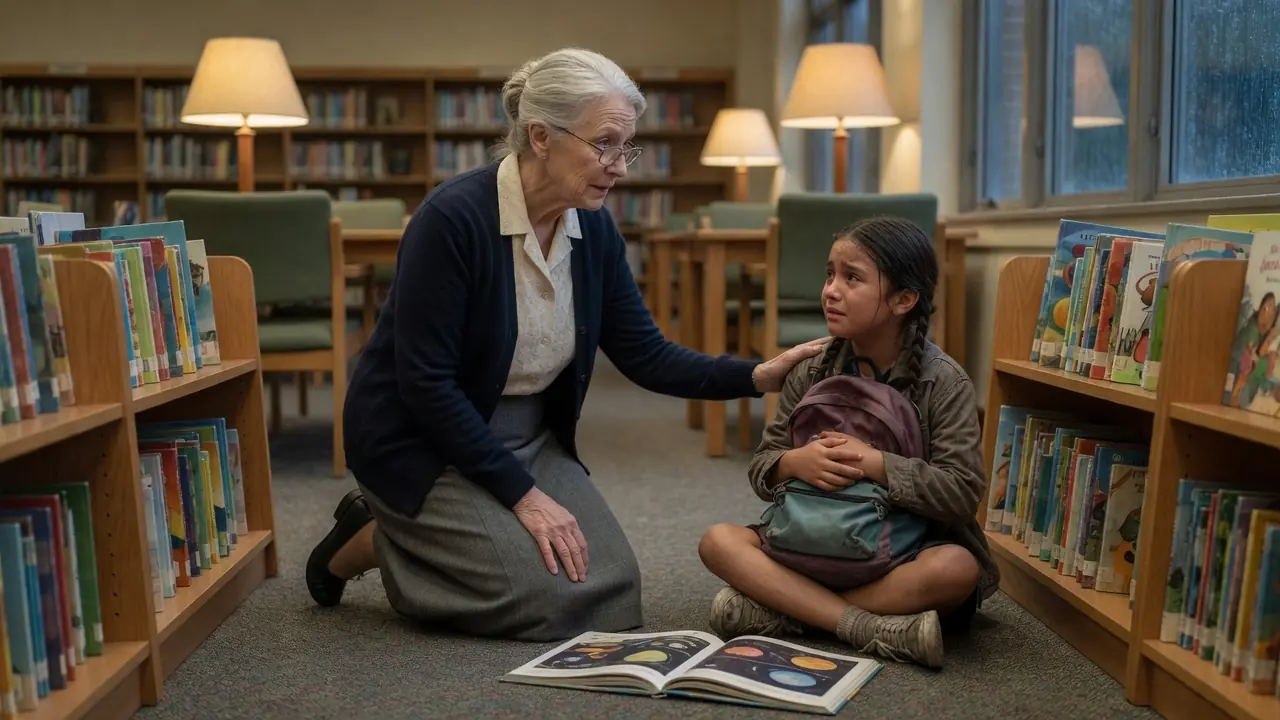
“They’re soft.”
“They’re yours now if you want them.”
The child’s eyes widened.
“For keeps?”
“For keeps.”
Maddie touched the sleeve.
“Thank you.”
In the spare room, Eleanor turned down the quilt and set the planet book on the nightstand. Maddie placed her backpack on the bed before climbing in, still keeping it close.
“You can put that on the chair,” Eleanor said.
Maddie shook her head.
“My things are in it.”
“Important things?”
The girl nodded.
“My school folder. Mom’s picture. Two granola bars from last week. My library card.”
Eleanor’s throat tightened.
“Then keep it close.”
Maddie slid under the quilt with the backpack beside her.
Eleanor sat in the chair near the bed.
“My mother used to read to me when I was frightened,” she said. “Would you like that?”
Maddie hesitated.
Then nodded.
Eleanor opened the planet book and read in her soft library voice, the one generations of children had heard during story hour. She read about Mercury, Venus, Earth, Mars, Jupiter, and Saturn with its rings made of ice and rock. Maddie’s eyelids grew heavy before they reached Uranus.
“Mrs. Whitaker?” she murmured.
“Yes?”
“If my mom comes while I’m sleeping, tell her I didn’t mean to scare her.”
“I will.”
“And tell her I saved half my toast for her.”
Eleanor looked at the plate on the nightstand, where half a piece of toast sat wrapped in a napkin.
“I’ll tell her.”
Maddie fell asleep before Neptune.
Eleanor remained in the chair for a long time after that, listening to the child breathe.
The house did not feel empty anymore.
At 12:38 a.m., there was a knock on Eleanor’s front door.
Three quick taps.
Not weak like Maddie’s had been.
Terrified.
Eleanor opened the door to find Sofia Reyes standing on the porch in a damp black work uniform, hair pulled into a messy bun, eyes red from crying and lack of sleep. She could not have been more than thirty. She held a plastic grocery bag in one hand and her phone in the other.
“I’m sorry,” Sofia whispered immediately. “I’m so sorry. I came as soon as I could. They wouldn’t let me leave early, and then the bus was late, and I—”
Eleanor stepped aside.
“Come in.”
Sofia entered but did not move far.
“Where is she?”
“Sleeping.”
Sofia covered her mouth with one hand.
“She’s really okay?”
“Yes.”
“I thought…” She stopped. Tears spilled down her face. “When I got back to the motel and saw the note, I thought something happened. I called the library number first, but it was closed, then I checked my messages and—”
“She is safe,” Eleanor said again.
Sofia nodded, but she could not stop trembling.
Eleanor guided her to the kitchen and put the kettle on.
Sofia sat at the table as if her bones had given out.
She looked around the room with shame in her eyes. The clean counters. The warm light. The small plate with Maddie’s saved toast wrapped in a napkin.
Eleanor placed the plate in front of her.
“She saved this for you.”
Sofia broke completely.
She bent over the table and sobbed into both hands.
Eleanor did not tell her not to cry.
Some tears deserved room.
When Sofia could speak again, the story came out in pieces.
She had moved to town two months earlier after leaving a bad relationship in Georgia. She had promised Maddie things would get better. She had found work quickly, but not good work. Daytime shifts paid too little. Overnight cleaning paid more, and the hospital laundry job had just started giving her extra hours. The motel was supposed to be temporary, but deposits for apartments were impossible when every paycheck disappeared into room fees, food, bus fare, and school supplies.
“The heater broke three days ago,” Sofia said. “I asked the manager. He said repairs cost money and if I complained, maybe he wouldn’t renew the weekly rate. I told Maddie to stay under blankets. I thought she would. I didn’t know she was that scared.”
“She did what children do,” Eleanor said. “She found the safest place she knew.”
“The library,” Sofia whispered.
“The library.”
Sofia looked at her.
“I don’t deserve her.”
Eleanor’s voice became firm.
“Do not say that.”
Sofia blinked.
“A bad mother would not be sitting here at nearly one in the morning after a night shift, shaking because her child was afraid.”
“I left her alone.”
“You had impossible choices.”
“That doesn’t make it right.”
“No,” Eleanor said gently. “But it makes it human.”
Sofia looked toward the hallway.
“Can I see her?”
“Of course.”
They stood outside the spare room door.
Maddie slept curled beneath the quilt, her backpack still beside her, the sleeves of the purple pajamas pulled over her hands. Sofia made a sound like pain and love mixed together. She crossed the room quietly, knelt beside the bed, and pressed her lips to Maddie’s forehead.
Maddie stirred.
“Mom?”
“I’m here, baby.”
“I’m sorry.”
“No,” Sofia whispered fiercely. “No, you don’t apologize. I’m sorry. I’m so sorry.”
Maddie opened her eyes just enough to see her mother, then wrapped both arms around her neck.
Eleanor stepped away and let them have the room.
The next morning, rain had stopped.
Sunlight came through Eleanor’s kitchen window, falling across the table where Maddie ate scrambled eggs while Sofia drank coffee and tried to look less exhausted than she was. Eleanor made pancakes because children in crisis needed more than toast, and because her kitchen had not smelled that alive in years.
Maddie talked more with her mother there.
She told Eleanor about her teacher, Ms. Greene, who let her borrow books from the classroom shelf. She explained that she liked planets because they stayed where they were supposed to stay. She said Saturn was her favorite because it had rings, but Earth was probably better because it had libraries.
Sofia smiled at that, though tears remained close.
After breakfast, Eleanor made three phone calls.
The first was to a friend from church who volunteered with a housing assistance group.
The second was to a retired teacher who ran a weekend children’s program at the community center.
The third was to Peter in Oregon.
Her son answered on the fourth ring, sounding sleepy because of the time difference.
“Mom? Everything okay?”
“Yes,” Eleanor said. “But I need to use some of the money from the house fund.”
There was a pause.
The house fund was what Peter called the savings Eleanor kept for repairs, emergencies, and the uncertain future.
“How much?”
“I don’t know yet.”
“What happened?”
Eleanor looked into the dining room where Maddie was showing Sofia the planet book.
“A child slept in the library last night because it was warmer than the motel room where she lives.”
Peter was quiet.
Then he said, “Use what you need.”
Eleanor closed her eyes.
“Thank you.”
“And Mom?”
“Yes?”
“Don’t try to do everything alone.”
She smiled faintly.
“I never do anything alone. I simply begin before everyone else arrives.”
By Monday, help had begun moving.
Not perfectly.
Not magically.
But enough.
The housing assistance group found Sofia and Maddie a temporary room in a family shelter that was clean, supervised, and warm. It was not a permanent home, but it was not the Green Lantern Motel. A caseworker helped Sofia apply for rental assistance, childcare support, and a daytime job placement program. Ms. Greene, Maddie’s teacher, arranged for Maddie to stay after school in the reading club until Sofia could pick her up safely.
Eleanor drove them to the shelter herself.
Maddie sat in the back seat holding her backpack and the blue library blanket. Eleanor had insisted she keep it.
When they arrived, Maddie looked at the building with cautious hope.
“Do they have books?”
“Not enough,” Eleanor said. “But I can fix that.”
She did.
Within two weeks, the shelter had a small bookshelf in the common room filled with donated children’s books from the library’s storage closet. Eleanor labeled it Maddie’s Shelf, though Maddie protested that it should belong to everyone.
“That is exactly why it has your name,” Eleanor told her.
At the library, people began noticing something different too.
Eleanor had always been kind, but now her kindness had taken shape. She spoke to the library board about extending children’s safe hours during bad weather. She worked with volunteers to create a small after-school corner with snacks, blankets, and emergency contact forms. Daniel helped set up a sign near the entrance.
If you need a warm place to wait, please tell a librarian.
Some people questioned it.
A man at a board meeting said, “We are a library, not a shelter.”
Eleanor stood slowly, both hands resting on the table.
“We are a public library,” she said. “Public means people. And people sometimes come in cold, hungry, frightened, or alone. We do not have to become a shelter to stop pretending we cannot see them.”
No one had much to say after that.
Maddie continued coming to the library after school.
At first, she still carried the backpack everywhere. She sat where she could see the front door. She folded snack wrappers neatly and asked permission before taking a second apple. But week by week, something in her loosened.
She joined story hour even though she was older than most of the children.
She helped Eleanor place returned books on the cart.
She made a drawing of Saturn and taped it behind the children’s desk.
She began calling Eleanor “Mrs. W,” because Whitaker took too long to say every day.
Sofia came whenever work allowed.
She looked healthier once she was sleeping in a warm room. She found a daytime position at a medical supply office after three interviews and one borrowed blazer from Eleanor’s church friend. It did not pay much at first, but it meant she could be with Maddie at night.
The day Sofia received her first paycheck from the new job, she brought Eleanor a small bouquet of grocery store flowers.
“They aren’t fancy,” Sofia said.
“They’re beautiful.”
“I want to pay you back.”
Eleanor arranged the flowers in a vase at the circulation desk.
“Then keep going,” she said.
Sofia’s eyes filled.
“That’s all?”
“That’s plenty.”
Spring came slowly.
The trees along Maple Street grew new leaves. The library windows no longer rattled with rain every evening. Maddie’s jacket was replaced by a warmer one donated by Ms. Greene, though Maddie kept the old one folded in her backpack because she said it reminded her that things could get better.
One afternoon, Eleanor found Maddie asleep again in the children’s section.
For one terrible second, fear returned.
Then Eleanor saw the difference.
Maddie was not curled tightly around her backpack.
She was stretched on a reading beanbag beneath the warm lamp, a book open on her chest, one hand loose by her side. Her backpack sat safely on a chair nearby. Her shoes were not wet. Her cheeks were full of color.
Sofia was due in twenty minutes.
Eleanor stood there quietly, smiling.
This time, the child was not hiding.
She was resting.
Nearly a year after the stormy night when Eleanor first found her between the shelves, the library held a small community evening called Warm Pages. It began as a fundraiser for after-school snacks and winter supplies, but it became something more. Parents came. Teachers came. Shelter volunteers came. Even the library board came, including the man who had once insisted they were not a shelter.
Maddie, now nine, stood at the front of the children’s section holding a paper she had written herself.
Her braids were neat, her shoes polished, and the blue blanket was folded on a chair behind her like a quiet witness.
Sofia stood near the back, crying before Maddie had even started.
Eleanor sat in the front row.
Maddie cleared her throat.
“My name is Maddie Reyes,” she read. “Last year, I fell asleep in the library because I was cold and scared. I thought I was in trouble. Mrs. Whitaker found me. She did not yell. She gave me a blanket and a granola bar. She called my mom. Then she helped us.”
Her voice wobbled, but she kept going.
“Before that night, I thought libraries were places for books. Now I know they are places for people too. Books helped me dream, but Mrs. Whitaker helped me stay.”
Eleanor pressed a hand to her mouth.
Maddie looked up from the paper.
“If you see someone who looks like they don’t belong, maybe they are just waiting for someone to tell them they do.”
The room was silent.
Then people stood and applauded.
Maddie looked startled, then smiled so brightly Eleanor felt something inside her old heart mend.
Afterward, Sofia hugged Eleanor in the aisle.
“You changed our lives,” she whispered.
Eleanor held her tightly.
“No,” she said. “You and Maddie did the hard part. I only opened a door.”
Sofia pulled back.
“Sometimes that is the hard part.”
Eleanor thought of the night she had knelt between the shelves, the rain falling outside, Maddie whispering that it was warmer there than outside. She thought of how close the world had come to letting a child disappear into the space between closing time and morning.
Then she looked around the library.
At the children eating cookies by the craft table.
At Daniel pretending not to cry near the front desk.
At Maddie showing another little girl where the planet books were kept.
At Sofia laughing softly with Ms. Greene.
The building did not feel empty anymore.
It had not felt empty for a long time.
Years later, people in Maple Street still talked about Mrs. Whitaker and the little girl who fell asleep between the bookshelves. The story changed depending on who told it. Some said Eleanor saved Maddie. Some said Maddie saved Eleanor from the loneliness of widowhood. Some said the library saved both of them.
Eleanor believed all three were true.
Maddie grew older, but she never stopped loving libraries. She became the kind of teenager who carried novels in her bag and corrected adults when they said libraries were outdated. By seventeen, she volunteered at Maple Street every Saturday. By twenty-two, she was studying social work and library science because she said people needed both stories and someone who knew how to help.
On the wall near the children’s section, the library eventually placed a small framed sign above a basket of blankets.
It read:
For anyone who needs a warm place to wait.
Under it, in smaller letters, was a sentence Maddie had written years before.
If you see someone who looks like they don’t belong, maybe they are just waiting for someone to tell them they do.
And every evening, when closing time came and the lamps glowed softly between the shelves, Eleanor still walked the aisles with slow steps and careful eyes.
Not only to count books.
Not only to turn off lights.
But to make sure no one in the quiet had been missed.
Because one rainy night, a little girl had slept between the shelves with a backpack held tightly to her chest, and an elderly librarian had realized something she would never forget.
Sometimes a library is not just a place where stories are kept.
Sometimes it is the place where a frightened child survives long enough to begin a new one.