The Blackwater marshlands lay silent beneath the dying light of autumn.
Cold wind swept across the reeds in long, mournful waves, bending them beneath a sky painted deep red by the setting sun.
Mud bubbled softly beneath stagnant water, and thin layers of mist drifted low across the swamp like wandering ghosts.
Most men avoided Blackwater after dark. Too many travelers had vanished there.
But Mason Red Elk rode straight into it.
The Apache tracker moved carefully through the marsh atop a broad-chested sorrel stallion, his sharp eyes studying the ground ahead. For two days, he had followed the trail of horse thieves moving south across the New Mexico territory.
Three men, four stolen horses, one limping mule.
The tracks led directly into Blackwater.
His horse snorted nervously as they crossed a patch of soft earth near the reeds. Mason leaned forward slightly, calming the animal with a quiet Apache word under his breath.
Then the ground suddenly gave way.
The stallion leapt sideways in panic. Mason hit the mud hard. Cold black swamp water swallowed him to the waist instantly. He tried grabbing nearby roots, but they tore loose in his hands.
The mud beneath him shifted like living hands, dragging him downward. Every movement only pulled him deeper.
Within seconds, the swamp reached his chest. His horse circled nearby with frightened cries before bolting into the fog.
Mason breathed slowly despite the freezing water crushing against his ribs. He knew enough about marshland to understand the truth. Struggling would kill him faster.
The wind howled softly through the dead reeds around him.
Then a woman’s voice broke the silence.
“Well, now,” she called lazily. “That’s a sorry sight.”
Mason turned sharply.
A girl stood balanced on the trunk of a fallen cottonwood near the edge of the swamp. She looked young, maybe twenty, with long black hair whipped around her face in the wind. Her gray eyes held the kind of sharp amusement usually found in gamblers and thieves.
She wore a weathered brown coat several sizes too large for her, with worn boots splattered in dry mud. Most white folk feared Apache men.
This girl looked entertained.
Mason studied her quietly.
“You planning to help?” he asked.
She crossed her arms.
“That depends.”
Her eyes drifted toward the silver knife at his belt and the revolver strapped against his chest.
“If you want to live,” she said, “you’ll hand over everything valuable you got.”
For a long moment, neither of them moved.
Then Mason gave a short breath that almost sounded like a laugh.
“You rob every man dying in a swamp?”
She shrugged.
“I ain’t generous enough to work for free.”
The mud shifted beneath him again.
Slowly, Mason removed the revolver first and tossed it toward her boots. Then the silver hunting knife. Finally, a small leather pouch heavy with coins.
The girl caught it neatly. A grin touched the corner of her mouth.
“Pleasure doing business with you.”
“Wrap it under your arms,” she said. “And don’t die halfway through. You look heavy.”
Pulling him free took several exhausting minutes. By the time Mason dragged himself onto solid ground, covered in black mud and breathing hard, the girl had already collected all his belongings before he could even stand.
She swung herself smoothly onto his runaway horse.
Mason stared at her.
“What’s your name?”
She tilted her head slightly.
“Linda.”
Then she smirked.
“Try staying out of swamps next time, Mr. Apache.”
And with that, she rode away into the thick evening fog.
His horse, his money, his gun.
Gone.
Mason stood alone beneath the darkening sky until something silver caught his eye atop the fallen log.
A bracelet.
Old silver. Scratched from years of wear.
Linda must have lost it while pulling him free.
For reasons he did not understand, Mason picked it up carefully and slipped it into his coat pocket before walking alone into the cold Blackwater night.
For the next two years, Mason Red Elk never saw the girl from Blackwater again. But some names stayed.
Late at night, beside dying campfires or beneath the lonely stars of the New Mexico plains, he found himself remembering the sound of her voice, sharp as broken glass, fearless, alive, and always, somehow, his hand drifted toward the silver bracelet tucked inside his saddlebag.
Meanwhile, Linda Vale kept running from town to town beside her father’s wagon, just as she had her entire life. By then, she knew every kind of frontier town in the West. Dusty cattle settlements in Texas, mining camps in Arizona, railroad towns crowded with gamblers, drifters, and men carrying revolvers low on their hips.
No matter where they went, the story remained the same.
Silas Vale would smile.
Linda would lie.
And together, they survived another week.
Her father taught her everything he knew about deceiving people. How to mark playing cards with fingernail scratches. How to cry on command. How to flatter lonely men until they trusted her enough to lose money at the poker table.
“Honest folks die poor,” Silas often told her. “The smart ones take what they can before the world takes it first.”
Linda pretended not to care anymore. She pretended she enjoyed the drifting life.
But some nights, while sitting beside their wagon beneath cold desert skies, she secretly watched ranch houses glowing in the distance. Families gathered around supper tables. Children laughed near lantern light.
Those sights left a strange ache inside her chest, an ache she never spoke aloud.
Silas would only mock it.
Then came El Paso in the summer of 1880.
The heat there clung to the streets like wet cloth. Saloon doors never stopped swinging, and the gambling halls along San Antonio Street stayed crowded deep into the night.
Silas believed he had found easy money.
For three nights, he cheated wealthy cattle buyers at poker and walked away grinning with pockets full of cash.
On the fourth night, somebody caught him.
Linda still remembered the sound of the table flipping over. Men shouting. A revolver fired into the ceiling.
By morning, Silas owed more money than he could ever repay. The men waiting for him were not patient men.
They dragged him into an alley behind the gambling hall and beat him until blood covered his shirt collar. Linda helped him back to the wagon afterward while he trembled from pain and whiskey.
“I’ll fix it,” he kept saying.
But he could not.
Three days later, the creditors came for payment.
Silas sat silent for a long time while Linda watched him from beside the wagon wheel. Then slowly, he looked at her.
“You’re smart enough to escape,” he said quietly.
Linda felt cold all over.
“Pa…”
But he would not meet her eyes.
The labor auction took place the next morning in Silver Creek beside the freight yard. Men gathered beneath the wooden awning while horses stomped through muddy streets nearby.
Linda stood on the platform with her wrists tied loosely before her, trying not to shake while strangers looked her over like cattle.
One man asked if she could cook. Another asked if she caused trouble.
Silas stood near the back of the crowd with his hat pulled low. He never once looked at her.
And in that moment, Linda finally understood something she should have learned years ago.
Some people would always choose survival over love.
Summer heat settled heavily over Silver Creek. Dust rolled through the streets beneath wagon wheels while flies buzzed around the hitching rails outside the saloons.
Somewhere near the railroad tracks, a steam whistle screamed across the dry afternoon air, scattering horses and cursing workers alike.
Mason Red Elk rode into town shortly before noon. His ranch lay north of the Apache border country, nearly fifteen miles beyond the Cedar Hills.
Over the past two years, he had built a quiet reputation across the territory. Settlers trusted his word. Traders respected his fairness. Even the rough cattle hands drinking through Silver Creek saloons knew Mason was not a man to provoke.
He came to town for supplies, nothing more.
Coffee, rifle cartridges, nails for fence repairs.
The silver bracelet Linda had lost years earlier remained forgotten inside a wooden chest beneath his bed back at the ranch.
Life moved on in the West.
It had to.
Mason tied his horse outside the general store when shouting drifted across the street near the freight yard.
A labor auction.
He barely glanced toward it at first. Such things were common along the frontier. Men drowning in debt sold work contracts. Women without family were bought into kitchens, laundries, or ranch labor.
It was ugly business, but Silver Creek had never pretended to be a decent town.
Then he heard a woman’s voice cut sharply through the crowd.
“Take your damn hands off me.”
Something about the voice made him turn.
A young woman stood atop the wooden auction platform with her wrists loosely bound by rope.
Black hair, gray eyes, a stubborn chin lifted against the crowd. Older now. Thinner, too. But the moment Mason looked at her face, memory returned all at once like lightning striking dry earth.
Blackwater marsh.
Cold fog.
A thief laughing while stealing his horse.
Linda.
The auctioneer grabbed her arm roughly.
“Healthy girl,” he announced loudly. “Can cook, clean, mend clothes.”
“I can also break your nose if you keep touching me,” Linda snapped.
A few men laughed. Others stared at her with irritation.
Linda looked exhausted beneath the bravado. Dust clung to her boots and sleeves, and bruises shadowed one wrist beneath the rope.
Mason felt something cold settle heavily inside his chest.
Not anger.
Something quieter than that.
Disgust.
No one deserved to stand on a platform like livestock. Least of all someone who once pulled another human being out of death with her bare hands.
The bidding started low.
“Thirty.”
“Forty.”
A rancher near the front spat tobacco into the dirt.
“She looks mean. She probably bites.”
Another man muttered without raising his voice.
Mason stepped forward.
“One hundred.”
The freight yard went silent. Heads turned immediately.
The auctioneer blinked in surprise.
Another buyer hesitated before raising his hand.
“One twenty.”
Mason’s expression never changed.
“Two hundred.”
Nobody bid after that.
The auctioneer slammed his ledger shut quickly. Whispers spread through the crowd at once. An Apache rancher paying two hundred dollars for a troublesome white girl made no sense to anybody there.
Linda stared at Mason as he climbed onto the platform and cut the rope from her wrists. Recognition slowly appeared in her eyes.
“You,” she said quietly.
Mason gave a small nod.
For a second, neither of them spoke.
Then Linda looked away bitterly.
“Well,” she muttered. “Guess this is the part where you collect payback.”
But Mason only handed her a canteen against the brutal summer heat.
“Come on,” he said calmly.
And without another word, he led her away from Silver Creek, beside the long burning roads of the western frontier.
The ride north from Silver Creek lasted nearly three hours.
Neither of them spoke much.
Heat shimmered above the dry plains, while grasshoppers scattered beneath the horse’s hooves. Far off, blue mountains rested against the horizon like sleeping giants beneath the western sky.
Linda rode half a length behind Mason, watching him carefully.
He still carried himself the same way she remembered from Blackwater Marsh. Quiet, steady, impossible to read. Most men talked too much when they were angry.
Mason said almost nothing at all, which somehow unsettled her worse.
By sunset, they reached the ranch.
A wide stretch of grazing land rolled beneath cedar hills and cottonwood trees beside a narrow creek. The main ranch house stood weathered but sturdy beneath the fading light, with a horse barn nearby and long wooden fences stretching across the open ranch.
It was not fancy, but it felt lived in. Warm.
Linda hated that she noticed immediately.
Two ranch hands looked up from repairing tack near the barn as Mason dismounted. One of them, an older Mexican cowboy with gray in his beard, frowned slightly when he saw Linda.
“Who’s the girl?”
Mason handed him the reins calmly.
“She’ll be staying here.”
The man raised an eyebrow, but asked nothing else.
That surprised Linda, too. In most places in the West, people asked questions first and showed kindness second.
Inside the ranch house, the air smelled faintly of coffee, leather, and cedar smoke. Mason removed his hat and pointed toward a small room near the back hallway.
“You can sleep there.”
Linda crossed her arms.
“And what exactly did two hundred dollars buy you?”
Mason glanced at her once while pouring water into a kettle.
“Work.”
“That all?”
“Yes.”
She narrowed her eyes suspiciously. Men did not spend that kind of money expecting nothing.
“You planning to make me scrub floors till I die?”
“If the floors get dirty enough.”
Linda stared at him.
Mason calmly continued preparing coffee. The answer irritated her more than anger would have.
The next morning, work began before sunrise.
Linda helped feed horses, carried water buckets from the well, repaired old saddle blankets, and gathered firewood beneath the cottonwoods near the creek. By noon, sweat clung to her neck beneath the brutal summer heat.
She was terrible at ranch work.
The horses disliked her immediately. One nearly kicked her through a fence after she fastened a saddle strap wrong.
“You laugh,” she snapped when she caught Mason watching.
“I didn’t.”
“You wanted to.”
“Maybe a little.”
That was the first time she ever saw something close to amusement in his face.
Days slowly turned into weeks. And somehow, without Linda noticing exactly when it happened, the ranch stopped feeling temporary.
Every evening, supper waited on the stove after work was done. Sometimes stew, sometimes beans and fresh biscuits from the Mexican cookhouse near the barn. Sometimes coffee strong enough to wake the dead.
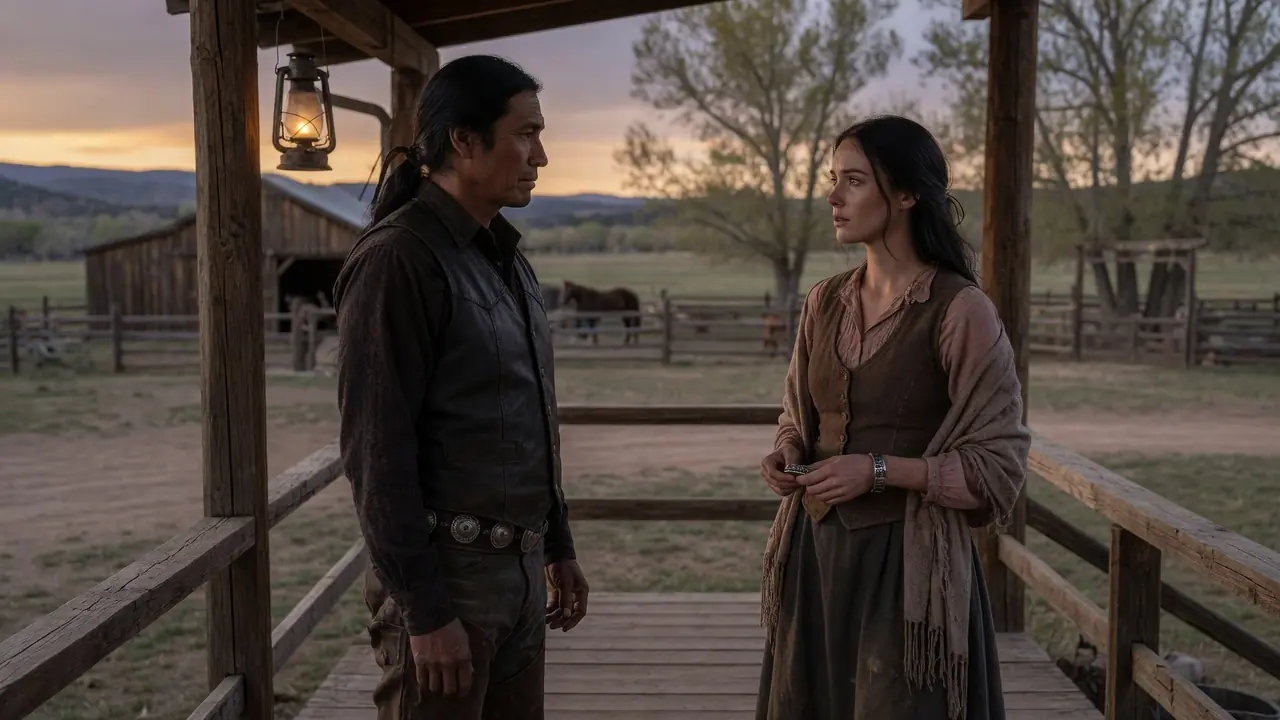
Mason rarely spoke during meals. Yet Linda slowly became aware of small things.
If she returned late from the creek, he waited before eating. If her boots tore, they somehow appeared repaired the next morning outside her bedroom door. When sudden desert storms rolled across the hills at night, Mason always checked the windows in her room first before his own.
He never mentioned any of it aloud, which made the kindness harder to defend against.
One evening, Linda sat on the porch steps, watching the sunset bleed gold across the grasslands while Mason repaired a broken bridle nearby.
“You ever going to tell me why you bought me?” she asked suddenly.
Mason kept working silently for a moment.
Then finally, he said, “You pulled me out of Blackwater.”
Linda scoffed softly.
“After robbing you.”
“You still saved me.”
The evening wind stirred gently through the cottonwoods.
Linda looked away toward the fading horizon. No one had ever spoken of her like that before.
Not evil.
Not troublesome.
Not dangerous.
Just someone who had done something good.
The feeling unsettled her more than she cared to admit.
Later that night, lying awake beneath clean blankets while crickets sang outside the ranch house windows, Linda realized something strange.
For the first time in years, she knew exactly where she would wake up tomorrow morning.
And somehow, that frightened her almost as much as it comforted her.
Winter arrived early across the northern plains. Cold winds swept down from the mountains, rattling the ranch windows through long, dark nights. Frost coated the fences every morning, and thin ice formed along the edges of the creek beside the barn.
By December, Linda had lived at Mason’s ranch nearly five months. Long enough to memorize the sound of his boots crossing the porch before sunrise. Long enough to know which horse would bite strangers and which one secretly liked apples.
Long enough that the ranch no longer felt entirely unfamiliar, which was exactly why fear began creeping back into her chest.
Nothing good ever lasted that long in her life.
The old wagon arrived during the first snowstorm of winter.
Linda spotted it from the barn while carrying feed buckets through the blowing snow. One broken wheel, one tired mule, and a man wrapped in a worn brown coat slumped at the front reins.
Her stomach dropped instantly.
Silas Vale climbed down slowly, coughing into the cold air. He looked older than she remembered, thinner, too. Gray streaks now ran through his hair, and deep lines marked the corners of his mouth.
But the moment his sharp eyes found Linda, that familiar crooked smile returned.
“There’s my girl.”
Linda stood frozen beside the barn door.
Mason walked out onto the porch behind her, calm as always, though his dark eyes studied Silas carefully.
Silas tipped his hat politely.
“You must be the Apache fellow,” he said. “Heard plenty about you.”
Mason said nothing.
Snow blew between them across the yard.
That night, Silas sat near the fireplace drinking coffee while Linda remained tense in her chair across the room. Mason stayed mostly silent beside the window, repairing a saddle strap beneath lamplight.
Silas watched the ranch house slowly, the warm stove, the clean table, the quiet peace.
Then finally, he looked at Linda.
“You really planning to stay here?”
Linda frowned slightly.
“What’s that supposed to mean?”
Silas chuckled softly.
“It means men don’t spend two hundred dollars out of kindness.”
Mason’s hands paused briefly against the leather strap.
Silas continued casually.
“World don’t work that way, sweetheart. Either he pities you, or he thinks he owns you.”
Linda’s jaw tightened.
“That ain’t true.”
“Isn’t it?”
Silas leaned closer, lowering his voice.
“You think decent men exist out here? I raised you smarter than that.”
The words settled heavily inside her chest because part of her hated how badly she wanted them to be wrong.
Later that night, after Mason stepped outside to check the horses during the storm, Silas spoke again quietly.
“We could leave before sunrise,” he murmured. “Man like him is bound to have gold hidden somewhere.”
Linda stared toward the dark window where snow swirled across the ranch yard. For months, she had slowly begun feeling safe here. Now old fears clawed their way back to life.
Not because she wanted Mason’s money, but because trusting someone still felt far more dangerous than stealing from them ever had.
The snowstorm lasted through the night. Wind rattled the ranch house windows while the fireplace burned low beside the dark hallway. Somewhere outside, horses shifted restlessly inside the barn against the cold.
Linda could not sleep.
Silas’s words kept circling through her mind like vultures over desert carrion.
Men don’t spend that kind of money without wanting something back.
She hated how deeply the words unsettled her.
For months, Mason had asked nothing from her except honest work. He never touched her without permission, never raised his voice, never reminded her what he had paid for her freedom.
And somehow, that frightened her more than cruelty ever had.
Because cruelty made sense.
Kindness did not.
Near midnight, Linda quietly slipped from her room.
The ranch house stood silent beneath the storm. Mason had not yet returned from checking the outer fences before the heavy snow reached the hills. Silas sat asleep near the fireplace with a whiskey bottle hanging loose from one hand.
Linda hesitated outside Mason’s room, then slowly stepped inside.
The room was plain and orderly, much like the man himself. A narrow bed, folded blankets, a rifle mounted beside the wall, a wooden chest resting beneath the bed frame.
She knelt beside it carefully.
For a moment, guilt tightened inside her chest.
Then Silas’s voice echoed again inside her head.
You survive first.
Linda opened the chest.
Inside lay neatly folded clothes, old documents, ammunition belts, and beneath them, wrapped carefully in cloth, rested something silver.
Her breath caught instantly.
The bracelet.
The same worn silver bracelet she had lost two years ago at Blackwater Marsh.
Linda stared at it in disbelief before slowly lifting it into her trembling hands. The old scratches along the metal remained exactly the same.
He kept it.
Beneath the bracelet rested another object, a dark wool scarf. The scarf she had knitted for Mason only weeks earlier during the first winter frost, folded carefully beside the bracelet like both things mattered equally.
Linda swallowed hard.
Then she noticed a folded paper tucked beneath them.
She opened it slowly. The handwriting was rough, steady.
I don’t know where you are now. Hope life is treating you decent somewhere. But I hope someday we might see each other again.
Linda’s vision blurred instantly.
She lowered herself onto the wooden floor beside the chest as tears finally slipped down her face.
No one had ever kept something of hers before.
Not because it was useful. Not because it held value.
But simply because it reminded them of her.
For the first time in her life, Linda understood something terrifyingly gentle.
Somewhere along the way, without her even noticing, Mason Red Elk had begun thinking of her as someone worth waiting for.
Morning came gray and bitterly cold. Snow covered the ranch yard in pale silence, while smoke drifted slowly from the chimney into the winter sky. Somewhere near the barn, cattle groaned softly against the wind.
Linda stood alone on the porch, Mason’s letter still folded tightly inside her coat pocket.
She had not slept at all.
Every word from that page remained lodged deep inside her chest.
I hope someday we might see each other again.
The front door creaked open behind her.
Silas stepped outside, wrapping his coat tighter against the cold.
“Well?” he asked quietly. “You find anything worth taking?”
Linda looked out across the frozen pasture without answering.
Silas moved closer.
“We leave before noon,” he continued. “Storm will cover our tracks good enough.”
Still silence.
Then finally, Linda spoke.
“I didn’t take anything.”
Her father frowned slightly.
“What?”
“I said, I didn’t take anything.”
The wind swept snow across the porch boards between them.
Silas studied her face carefully.
“That Apache got inside your head already.”
Linda turned toward him slowly, and for the first time in years, there was no fear in her eyes when she looked at her father.
Only exhaustion.
“I’m tired, Pa.”
Silas scoffed softly.
“Tired of what?”
“Tired of running.”
The words hung heavily in the cold morning air.
Silas looked away first.
Linda stepped closer.
“All our lives,” she said quietly. “It’s always been another town, another lie, another night sleeping scared somebody’s coming after us.”
“That’s survival.”
“No,” Linda whispered. “That’s misery.”
Silas’s jaw tightened.
“You think this place changes who you are?”
Linda glanced toward the barn where Mason worked silently beside the horses through the falling snow.
“No,” she said softly. “But maybe it changes who I got to keep pretending to be.”
For a long moment, neither of them spoke.
Then Linda reached into her coat and pulled out a small leather pouch, the last money she had hidden from months earlier. She pressed it into her father’s hand.
“Take it,” she said. “Get somewhere warm. Find honest work for once.”
Silas stared down at the pouch silently, almost ashamed. It was the first time Linda had ever seen that expression on his face.
Finally, he gave a weak laugh without humor.
“You always were too soft for this world.”
Linda shook her head gently.
“No, Pa,” she said. “I was just raised by people who forgot how to be kind.”
Silas looked at her for a long time after that.
Then, without another word, he turned and walked slowly toward the waiting wagon beneath the falling snow.
Silas Vale left before noon. The old wagon creaked slowly through the falling snow until it disappeared beyond the cedar hills north of the ranch.
He never looked back.
Linda watched from the porch in silence, Mason standing quietly beside her with his hands resting against the fence rail.
Neither of them spoke for a long time.
Winter passed slowly after that. Snow melted from the plains. The creek beside the ranch thawed beneath warmer winds, and patches of green grass slowly returned across the hills.
By early spring, wildflowers began blooming near Blackwater Marsh once more, scattering purple and yellow across the open country.
Life settled into something calm, steady.
One evening near sunset, Linda found Mason repairing a broken fence near the pasture while golden light spread across the valley below. She walked toward him slowly, the silver bracelet clutched tightly in her hand.
Mason noticed it immediately.
For a moment, neither of them moved.
Then he leaned back against the fence post slightly.
“So,” he said quietly, “you opened my chest.”
Linda lowered her eyes.
“I’m sorry.”
Mason shrugged once.
“Did you find what you were looking for?”
The question hit harder than anger ever could.
Linda looked out across the grasslands while evening wind stirred softly through the wildflowers nearby.
“I think so,” she admitted.
Mason waited patiently. That was another thing about him. He never rushed people toward truths they were afraid to say.
Linda swallowed hard.
“I don’t want to run anymore,” she whispered.
The fading sunlight painted the world gold around them.
Mason stepped closer without speaking and gently took the bracelet from her hand. His rough fingers carefully fastened it once more around her wrist.
The silver gleamed softly beneath the spring sunset.
Linda looked down at it, then back at him, and for the first time in her entire life, the future no longer felt like another road leading away from somewhere.
It felt like home.
Behind them, beyond the ranch fences and rolling hills, Blackwater Marsh swayed quietly beneath the evening wind. No longer a place of sinking and loss, but a place where wildflowers had finally learned to bloom.