The cowboy had one hand on the reins and the other on a folded paper nobody would let her read.
Yet somehow, the thing that frightened her most was the blue ribbon waiting in a room she had never seen.
A wagon wheel hit a frozen rut hard enough to jolt Savannah sideways. The wind sliced across the Montana plains, stinging her cheeks as she clutched her coat tighter.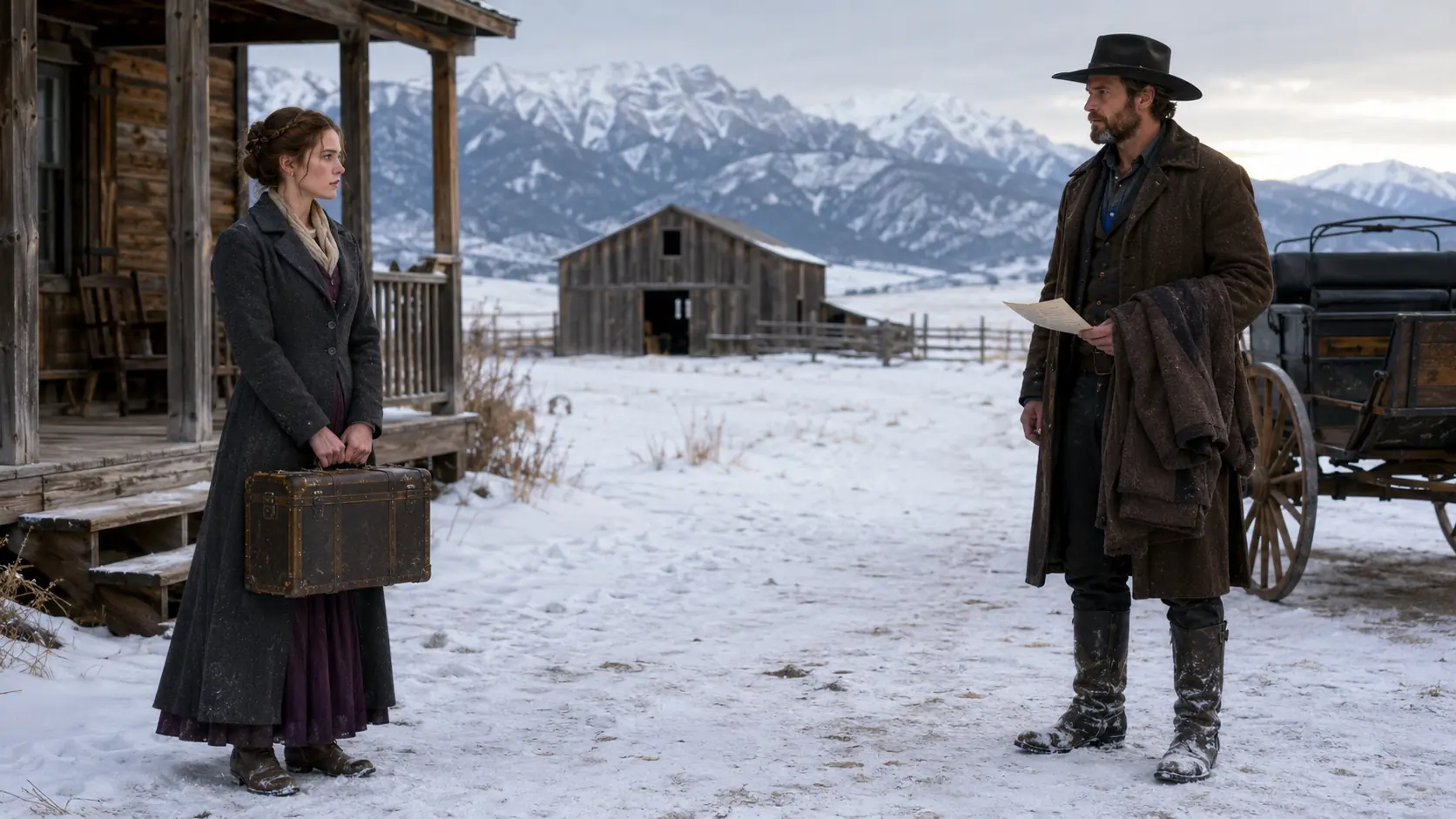
Beside her, the cowboy said nothing.
Behind them, her family’s house had already vanished into the falling snow.
Ahead, the mountain stood dark against the evening sky.
Then she noticed him glance toward the small wooden box resting beside her trunk, as if he was wondering whether she would recognize what was inside.
Winter came early to Elk Creek that year.
Snow sat in the wheel ruts along Main Street, and a hard wind rolled down from the Bitterroot Mountains, rattling shutters and pushing smoke sideways from chimney tops.
Savannah Reed had spent the morning mending a torn saddle blanket in the barn. She was threading a needle through thick wool when Laya’s voice cut through the cold air.
“Your father wants you in the house.”
Not Travis.
Your father.
Laya only used that word when something unpleasant was waiting.
Savannah set the blanket aside and brushed the hay from her skirt. Her fingers were stiff from the cold. She stepped out of the barn and crossed the frozen yard toward the house she had lived in since she was nine years old.
The front room felt too warm, too quiet.
Travis Reed sat at the pine table near the stove. Eleanor stood by the window. Laya leaned against the wall with her arms folded.
And there was a man Savannah had never seen before.
Tall.
Broad-shouldered.
A dark coat dusted with snow.
A cowboy’s hat resting on his knee.
The stranger was not looking at her.
He was looking at the paper on the table.
Savannah stopped near the door.
Nobody invited her to sit.
Nobody explained why she had been called inside.
The only sound was the ticking of the clock above the mantel.
Then Travis dipped a pen into the ink bottle and signed his name.
The scratch of the nib seemed louder than it should have.
He pushed the paper across the table.
The stranger read it once, folded it carefully, and placed it inside his coat.
Savannah looked from one face to another.
No one met her eyes.
A cold feeling settled in her stomach.
“What is this?” she asked.
Eleanor adjusted her sleeves.
Travis cleared his throat.
“The debt is settled.”
That was all.
Not an explanation.
Not an apology.
Just a sentence.
Savannah stared at him slowly.
The meaning found her.
The debt.
The paper.
The stranger.
The silence.
Her hands tightened around each other.
“You traded me.”
Nobody answered.
That answer was enough.
Outside, the wind struck the side of the house.
Laya looked away first.
The stranger rose from his chair.
He was younger than Savannah expected, perhaps thirty-eight. His face was weathered by mountain winters and long days in the saddle.
His eyes met hers for the first time.
There was no triumph in them.
No satisfaction.
If anything, he looked uncomfortable standing in that room.
“The road to Cedar Ridge gets cold,” he said quietly.
Savannah did not move.
Nobody stopped him.
Nobody stopped her.
The transaction had already happened.
An hour later, Elk Creek disappeared behind them.
The wagon rolled north through frozen grasslands. Snow drifted against fence posts. A hawk circled high above the valley.
Savannah sat rigid on the wooden seat.
Her small trunk rattled behind them.
Wyatt Carter guided the horses without speaking.
She watched him from the corner of her eye.
He never once looked at her the way men looked at livestock at auction.
That should have comforted her.
Instead, it made her uneasy.
She knew cruelty.
Cruelty was simple.
Kindness from a stranger was harder to understand.
Dusk had settled over the mountains by the time Cedar Ridge Ranch appeared.
The ranch house stood against the foothills with lantern light glowing in the windows.
Wyatt carried her trunk inside.
No orders.
No demands.
Just silence.
He led her down a hallway and opened a door.
“This room is yours.”
Savannah stepped inside.
A small iron stove.
A clean quilt.
A washstand.
A window facing the mountains.
Then she noticed the wooden box resting on the table.
She crossed the room and lifted the lid.
Inside lay a faded blue ribbon.
Her breath caught.
Years ago, at the Elk Creek Harvest Fair, she had spent weeks sewing ribbons exactly like this one.
She picked it up carefully.
The stitching along the edge was unmistakable.
It was hers.
Savannah slowly turned toward the doorway.
Wyatt was already gone.
She stood alone in the quiet room, the blue ribbon resting in her palm.
For the first time since leaving Elk Creek, a different question entered her mind.
Not why she had been given away.
But why Wyatt Carter had been waiting for her long before she arrived.
The question followed Savannah into sleep and greeted her again before dawn.
She opened her eyes to the pale gray light of a Montana winter morning. Frost had gathered along the corners of the windowpane.
Outside, the mountains stood silent beneath fresh snow.
For a moment, she forgot where she was.
Then she saw the blue ribbon resting on the table.
The memory returned all at once.
Cedar Ridge.
Wyatt Carter.
The paper her father had signed.
The room that somehow seemed prepared for her before she ever arrived.
Savannah dressed slowly and stepped into the hallway. The house was quiet except for the faint crackle of wood in the stove downstairs.
She followed the smell of coffee.
Wyatt sat alone at the kitchen table. A ledger book lay open beside him. His reading glasses rested low on his nose as he studied a column of numbers.
A second mug sat near the stove, already filled, steam still rising from it.
Savannah stopped.
Wyatt looked up briefly.
“Morning.”
That was all.
No questions.
No expectation.
He returned to the ledger.
Savannah approached the stove and picked up the mug.
The coffee was not strong.
Not bitter.
Exactly the way she preferred it.
Her eyes moved toward him.
He was still reading.
The realization sat strangely inside her.
She had never told him how she liked her coffee.
The morning passed quietly.
After breakfast, Wyatt showed her the smokehouse, the root cellar, and the small shed where tack and harnesses were kept.
He never assigned her work.
Never told her what she must do.
Instead, he simply explained how things ran at Cedar Ridge.
“If you see something that needs doing, do it. If not, don’t.”
Savannah frowned.
That was not how life worked.
Not in her experience.
At the Reed house, every task came with criticism waiting behind it. Every mistake had a witness. Every success belonged to someone else.
Yet here, Wyatt handed her information and walked away.
The absence of control felt almost suspicious.
Three days later, she learned another thing.
The bay mare in the north paddock disliked strangers.
Otis, one of the neighboring ranch hands helping repair fencing nearby, mentioned it while dropping off supplies.
“Funny thing,” he said while unloading feed sacks. “That mare usually won’t let anybody near her.”
Savannah glanced toward the paddock.
The horse stood quietly while she brushed snow from its mane.
Otis chuckled.
“Guess she likes you.”
That evening, Savannah mentioned it while Wyatt repaired a lantern wick.
He did not look surprised.
“She always liked calm people.”
Savannah paused.
“How did you know I’d get along with her?”
The question slipped out before she could stop it.
For the first time, Wyatt hesitated.
Only a second.
Then he adjusted the lantern.
“Lucky guess.”
The answer sounded thin.
Savannah noticed.
Days passed.
The ranch settled into a rhythm.
Snow.
Coffee.
Fence lines disappearing into white hills.
The distant sound of cattle.
Sometimes she caught Wyatt watching the weather before storms arrived, reading clouds the way other men read newspapers.
And somehow, he kept knowing things.
Small things.
The kind strangers should not know.
One afternoon, she found a novel on a shelf near the fireplace.
A book she had borrowed repeatedly from the church reading room in Elk Creek.
The exact title.
The exact edition.
When she opened it, she discovered pages carefully repaired with old tape.
Someone had read it many times.
That night, Martha Boon arrived with a pie wrapped in cloth.
The widow lived on a neighboring homestead less than a mile away. She talked easily enough for three people. By comparison, Wyatt hardly spoke at all.
Martha smiled while pouring tea.
“You know, Wyatt used to ride into Elk Creek every harvest fair.”
Savannah looked up.
“He did?”
“Oh, yes. Nearly every year.”
Martha laughed softly.
“Never stayed long. Just wandered around town like he was looking for something.”
Across the room, Wyatt focused very hard on his coffee cup.
Savannah noticed that, too.
Later that evening, she could not stop thinking about it.
The ribbon.
The coffee.
The books.
The harvest fairs.
Pieces that refused to fit together.
The answer waited somewhere just beyond reach.
Several days later, while carrying feed to the barn after sunset, Savannah noticed a loose board near one of the stalls.
Curiosity got the better of her.
She knelt and pulled it aside.
Behind it sat a weathered wooden box.
Dust covered the lid.
Not much, as if someone opened it from time to time.
She hesitated.
Then she lifted it.
Inside were old fair tickets, faded ribbons, receipts from Elk Creek merchants, and a dried flower pressed between pages of folded paper.
Beneath everything else rested a small scrap of paper.
A date.
Eight years earlier.
Savannah stared at it.
The year she had first entered the Elk Creek Harvest Fair.
The year she had sold handmade ribbons from a table near the church booth.
The same year she had made the blue ribbon now sitting upstairs in her room.
Cold crept slowly up her spine.
The barn stood silent around her.
Snow tapped softly against the roof.
For the first time, Savannah wondered if meeting Wyatt Carter had not been an accident at all.
The thought followed her for weeks.
Winter slowly loosened its grip on the valley. Snow still lingered beneath the pines, but patches of brown earth began showing through along the fence lines.
The creek behind the ranch ran louder each day as the ice broke apart and drifted downstream.
Life at Cedar Ridge settled into a rhythm.
Savannah mended tack in the evenings.
She helped sort supplies in the storeroom.
Some mornings, she rode the bay across the lower pasture while Wyatt checked cattle farther up the ridge.
Nothing was demanded of her.
That was what made it difficult.
The longer she stayed, the harder it became to hold on to her anger.
One afternoon, she was repairing a torn work shirt near the kitchen window when Wyatt came inside carrying a sack of flour from town.
He set it on the counter.
“General store finally got fresh coffee beans.”
Savannah looked up.
“That’s good.”
He nodded, then added quietly, “The lighter roast you like.”
The room went still.
He seemed to realize what he had said.
A brief shadow crossed his face.
Then he turned toward the pantry.
Savannah watched him disappear through the doorway.
The question returned again.
How did he know?
A few days later, Martha Boon stopped by with preserves packed in glass jars wrapped in newspaper.
While helping stack them in the pantry, Martha smiled.
“You’re good for him.”
Savannah nearly dropped a jar.
Martha noticed and laughed softly.
“That man spent years riding into Elk Creek for reasons he never could explain.”
Savannah stared.
“What reasons?”
Martha opened her mouth, then stopped.
The smile faded.
“That’s a story he ought to tell himself.”
That answer only made things worse.
By early spring, the hills had turned green.
The first real warmth arrived with a southern wind.
For the first time in years, Savannah found herself waking without dread waiting beside her bed.
Then the wagon appeared.
She saw it from the front porch.
A familiar wagon.
A familiar horse.
A familiar knot formed in her stomach.
Laya Reed stepped down first.
Behind her came a narrow man in a black coat carrying a leather case.
A lawyer.
Wyatt came out of the barn at the same moment.
Their eyes met briefly.
Neither smiled.
Neither spoke.
The lawyer introduced himself inside the house and unfolded several documents across Wyatt’s table.
According to the papers, there had been irregularities in the debt agreement.
Questions regarding ownership.
Questions regarding authority.
Questions requiring Savannah’s return until the matter could be reviewed.
Savannah sat silently through most of it.
She recognized the game.
The papers were not the point.
Pressure was.
Control was.
Laya crossed one leg over the other and smiled as though they were discussing weather.
“You belong with family.”
Savannah almost laughed at that.
Family.
The word felt strange coming from Laya.
Wyatt remained calm.
When the lawyer finished speaking, Wyatt read every page.
Then he folded the papers neatly.
“No.”
The lawyer blinked.
“No?”
“No,” Wyatt said again.
Nothing louder.
Nothing sharper.
Just certainty.
The meeting ended soon after.
The lawyer gathered his papers.
Laya lingered.
She waited until Wyatt stepped outside to speak with the horses.
Then she moved closer to Savannah.
Too close.
The old familiar smell of expensive perfume and calculation followed her.
Laya lowered her voice.
“He never told you, did he?”
Savannah did not answer.
Laya smiled.
“Why he wanted you instead of any other girl?”
The words landed harder than they should have.
Laya saw it happen.
That was the point.
Her smile widened.
“Ask him.”
Then she left.
The wagon rolled down the road and disappeared toward Elk Creek.
Silence settled over the ranch again.
But it was not the same silence.
That evening, Savannah barely touched her supper.
Wyatt noticed.
He did not ask why.
The next morning, she avoided him.
The morning after that, she avoided him again.
Short answers.
No eye contact.
Distance.
For the first time since arriving at Cedar Ridge, a wall stood between them.
Wyatt saw it.
Savannah knew he saw it.
Neither seemed willing to speak first.
Three days later, dark clouds gathered over the Bitterroot Mountains.
The wind shifted sharply from the north.
Even the horses seemed restless.
Near sunset, Wyatt stood on the porch, studying the horizon.
The sky had turned the color of steel.
“A storm’s coming,” he said quietly.
Savannah looked toward the mountains.
The clouds were moving faster than they should have.
Far too fast.
Somewhere beyond the ridge, thunder rolled through the valley.
The distance between them remained.
But something else was approaching now.
Something neither of them could stop.
The first snowflakes began to fall before night fully arrived.
By full dark, the wind was driving snow sideways across the valley. The lantern hanging outside the barn swayed on its hook. Fence posts disappeared behind sheets of white.
The Bitterroot Mountains vanished completely, swallowed by the storm.
Savannah sat near the stove with a book open in her lap.
She had not turned a page in nearly twenty minutes.
The silence between her and Wyatt still lingered.
Not angry.
Not peaceful.
Just unfinished.
A sudden pounding rattled the front door.
Wyatt was already on his feet.
When he opened it, a blast of snow rushed inside.
Martha Boon stood on the porch wrapped in a heavy wool coat.
“The north fence is down,” she shouted over the wind. “Your horses are heading toward the ravine.”
Wyatt did not hesitate.
He grabbed his coat and gloves.
Savannah was already standing.
“I’m coming.”
“You don’t have to.”
“I know.”
That was the end of the discussion.
The storm hit them like a wall.
Snow stung their faces. Wind tore at their coats. The lantern light from the house vanished behind them within minutes.
They found the broken section of fence by sound more than sight.
The frightened horses were moving toward the narrow cut between two rocky ridges.
One wrong step in the dark could mean disaster.
For nearly an hour, they worked without speaking, pulling wire, driving temporary stakes, turning the horses back toward safer ground.
Their gloves soaked through.
Their hands went numb.
Their breaths came in clouds.
Then one of the younger horses bolted.
Wyatt moved after it too quickly.
The animal slipped against icy ground and lurched sideways.
Savannah saw Wyatt lose his footing near the edge of the ravine.
For one terrible second, he disappeared into the blowing snow.
She reached him before he could slide farther.
Her gloved hand caught his coat sleeve.
Wyatt grabbed a fence post.
Together, they fought the wind, slowly, carefully, until solid ground was beneath them again.
Neither spoke.
Neither needed to.
The ride back to the ranch happened in silence.
The storm still raged outside while the fire crackled inside. Snow melted from their coats and formed small puddles on the floorboards.
Savannah sat near the stove, holding a tin cup of coffee.
Wyatt stared into the flames.
Finally, he spoke.
“I should have told you sooner.”
She looked up.
The room felt very still.
“Eight years ago,” he said quietly, “there was a harvest fair in Elk Creek.”
Savannah’s fingers tightened around the cup.
Wyatt continued.
“There was a little boy crying near the livestock pens. Folks walked past him all afternoon.”
His gaze remained on the fire.
“You were the only person who stopped.”
Savannah barely remembered.
A frightened child.
A lost mother.
A crowded fairground.
Nothing remarkable.
At least, not to her.
“I watched you help him.”
The fire popped softly.
“You missed your own customers, lost money, and didn’t seem to care.”
Savannah said nothing.
Wyatt smiled faintly.
“Most people remember the loud moments in life. I remembered that one.”
Outside, the storm beat against the windows.
Inside, another kind of silence settled between them.
Not distance.
Not suspicion.
Something gentler.
Wyatt stood and crossed the room.
From a shelf near the stairs, he retrieved a worn leather notebook.
He placed it carefully on the table.
Savannah opened it.
The first page held a date from eight years earlier.
Then another.
And another.
Short entries.
A woman selling blue ribbons at the harvest fair.
A young woman singing quietly after church.
A woman helping an elderly rancher load supplies at the livestock market.
Page after page.
Year after year.
Nothing romantic.
Nothing dramatic.
Just moments.
Small things.
Things most people would have forgotten.
Wyatt remembered them all.
Savannah slowly turned the final page.
The room blurred for a moment.
Not because of tears.
Because an old belief she had carried her entire life was beginning to break apart.
All this time, she thought she had been traded.
Bought.
Given away.
But sitting beside the fire with the notebook open in her hands, she began to understand something else.
Wyatt Carter had not come to claim her.
He had come to save her before someone worse could.
The thought stayed with Savannah long after the fire burned low that night.
She sat awake in the quiet house with Wyatt’s notebook resting in her lap.
Outside, the last of the blizzard drifted through the darkness.
Inside, eight years of memories filled page after page.
Not grand declarations.
Not poems.
Not promises.
Just moments.
A blue ribbon at a harvest fair.
A church social on a rainy Sunday.
A cattle auction in Elk Creek.
A young woman helping people when nobody was watching.
Savannah closed the notebook gently.
For the first time in many years, she felt no need to defend herself from the future.
Spring arrived quickly after the storm.
Snow retreated into the higher elevations. Water ran through the creek behind the ranch. Meadowlarks returned to the valley.
Life should have settled.
Instead, trouble arrived one final time.
The wagon came just after noon.
Savannah saw it from the porch.
Ned Holloway sat beside the driver.
Laya Reed sat across from him.
Neither looked happy.
Neither looked willing to leave empty-handed.
By the time the wagon stopped, Wyatt was already walking toward the yard gate.
Savannah stepped beside him.
Not behind him.
Beside him.
That small difference mattered.
Ned climbed down first, his expensive coat strained across his broad frame.
Laya followed, carrying a folder of papers.
“We’re settling this today,” Ned announced.
Sheriff Amos Walker arrived moments later on horseback.
The timing surprised Savannah.
Then she remembered Wyatt always prepared for storms before they arrived.
Even the human kind.
The sheriff removed his gloves and accepted the documents from Laya.
He read them carefully.
Then he read another set of papers Wyatt handed him.
The valley seemed unusually quiet.
Only the creek could be heard.
After several long minutes, Amos folded everything together.
“The agreement stands,” he said.
Laya’s face tightened.
“The girl belongs—”
“No,” Amos interrupted.
His voice remained calm.
“She doesn’t belong to anybody.”
The words hung in the air.
Simple.
Final.
Ned argued.
Laya protested.
The sheriff listened.
Then he shook his head.
“Miss Reed is free to decide where she lives.”
Savannah felt something shift inside her.
A door opening.
A chain falling away.
Not because somebody had rescued her.
Because for the first time in her life, someone had acknowledged what should have been true all along.
The decision belonged to her.
Laya turned toward her.
“Come home.”
Savannah looked at the woman she had spent years trying to please.
Years trying not to upset.
Years shrinking herself around.
Then she looked at Cedar Ridge.
The barn.
The fences.
The mountains beyond.
The man standing quietly beside her.
She drew a slow breath.
“I’m not going back.”
Laya stared.
Savannah continued.
“I don’t belong at Reed Ranch.”
Ned stepped forward.
“You could have a better life.”
“No.”
Her voice remained steady.
“I don’t belong to you either.”
Silence followed.
The kind that arrives when a truth finally reaches daylight.
Neither Laya nor Ned had an answer for it.
Eventually, they climbed back into the wagon.
The wheels turned.
The road carried them away.
This time, they did not come back.
The valley seemed brighter after they left.
Weeks passed.
Grass returned to the hillsides.
The cottonwood tree above Cedar Ridge filled with fresh leaves.
One evening, Savannah asked Wyatt to ride with her.
They followed a trail overlooking the ranch.
The sun hung low above the Bitterroots. Golden light spread across the valley floor.
At the top of the hill stood an old cottonwood tree. Its branches stretched wide over the slope.
Savannah dismounted first.
Wyatt followed.
Neither spoke for a while.
The ranch lay below them.
Every fence.
Every pasture.
Every mile of ground where her life had quietly changed.
Finally, Savannah turned toward him.
The wind moved gently through the leaves overhead.
“If you’re still willing to have me here…”
Wyatt looked at her.
She saw uncertainty in his eyes for the first time.
Not fear.
Hope.
Careful hope.
Savannah smiled softly.
“I’d like to stay for the rest of my life.”
For a moment, he said nothing.
The words seemed to reach him slowly, as though he had imagined hearing them many times but never truly expected them.
His eyes dropped briefly toward the valley, then back to her.
A small smile appeared, the kind she had never seen before.
“You would?”
Savannah nodded.
“Yes.”
Wyatt laughed quietly under his breath.
Not because anything was funny.
Because relief had finally found somewhere to go.
Several months later, the leaves turned gold again.
The wedding took place at the small church in Elk Creek.
Nothing fancy.
No grand celebration.
Martha Boon sat in the front row.
Sheriff Amos Walker stood beside her.
Reverend Cole waited near the altar.
The church smelled faintly of pine boards and candle wax.
Savannah stood at the doorway for a moment before entering.
Years earlier, she had walked into rooms because someone else had decided her future.
This time was different.
This time, nobody pushed.
Nobody traded.
Nobody arranged.
She walked forward because she wanted to.
Because she chose it.
Because she chose him.
When she reached Wyatt’s side, he looked at her exactly the way he always had.
Steady.
Patient.
Certain.
The mountains watched through the church windows. Autumn sunlight spilled across the floorboards.
For the first time in her life, Savannah Reed stepped into a new chapter that belonged entirely to her.
Not given.
Not borrowed.
Not earned through suffering.
Chosen.
And that made all the difference.
As the sun slipped behind the Bitterroot Mountains and the lights inside that little church began to glow against the evening sky, it was not really the wedding that stayed in the heart of the story.
It was the choice.
For years, Savannah had lived a life shaped by other people’s decisions, other people’s fears, other people’s plans.
Yet in the end, the moment that mattered most was the quiet one.
The moment she stepped forward on her own.
Healing did not arrive with grand speeches.
It looked like a warm cup of coffee left on a stove before sunrise.
A door that was never opened without permission.
A promise spoken through years of patient actions.
Maybe the lesson was not about finding someone who rescues you.
Maybe it was about finding the courage to believe you are worth choosing, and then choosing for yourself.