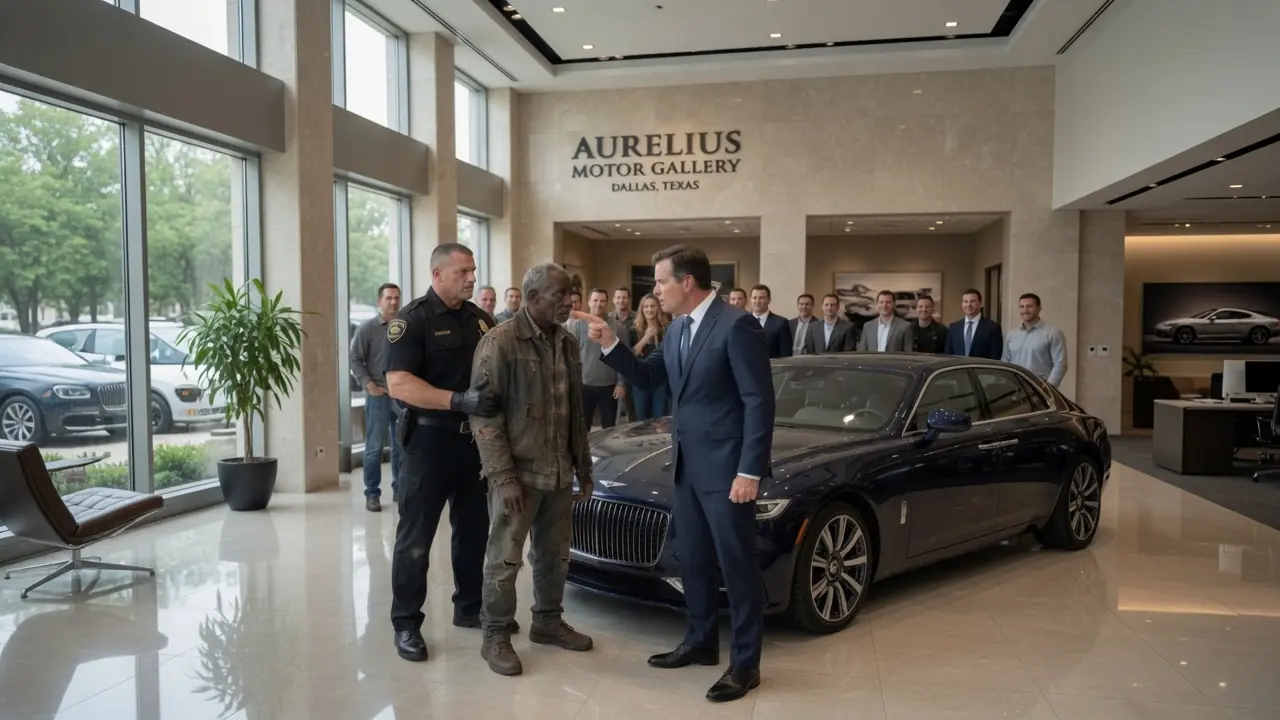
Isaiah Cole stepped into Aurelius Motor Gallery in Dallas on a bright Monday afternoon, wearing stained work clothes, scuffed boots, and a torn brown jacket that made the polished showroom feel colder the moment he entered.
The floor beneath him shone like black glass, reflecting luxury sedans, chrome wheels, and bright ceiling lights arranged above cars worth more than most homes.
Salesmen in tailored suits turned their heads, then looked away with the practiced disinterest of men who had already decided he was not worth their time.
Isaiah did not seem offended.
He only removed his worn cap, held it in both hands, and walked slowly toward the most expensive car in the room.
The car was a midnight-blue Aurelius Phantom LX, displayed on a raised platform with velvet ropes around it.
Its windows were tinted, its leather seats were cream-colored, and a silver plaque near the front bumper announced a price that made two wealthy customers whisper.
Isaiah stood near the rope and studied the vehicle quietly, not with hunger or envy, but with the careful eyes of a man who knew machines.
He looked at the hood line, the tire clearance, the hand-stitched interior, and the way the headlights curved like a predator’s eyes.
For a moment, he almost smiled.
Preston Vale noticed him from the manager’s office.
Preston was the sales manager of Aurelius Motor Gallery, thirty-eight years old, handsome in a hard way, with slick dark hair and a silver watch he checked whenever poor people spoke too long.
He had built his reputation by flattering wealthy clients and cutting down anyone who could not help his commission.
To him, the showroom was not a place for people; it was a stage where money proved who deserved respect.
When he saw Isaiah standing near the Phantom LX, his smile turned sharp.
Preston crossed the showroom with two junior salesmen following at a distance.
He stopped beside Isaiah and looked him up and down, from the torn jacket to the dusty boots.
Isaiah turned calmly toward him, still holding his cap.
Before the old man could speak, Preston pointed at the car and let out a short laugh.
“You… buy one of these? Don’t make everybody laugh, old man.”
A few customers turned.
One woman in pearl earrings covered her smile with her hand.
A young salesman near the reception desk lowered his eyes, embarrassed but silent.
Isaiah looked at Preston for a long second, then said quietly, “I would like to ask a few questions about this vehicle.”
Preston leaned closer, as if the request itself insulted him.
“You can ask about a used pickup lot down the street,” Preston said.
“This is Aurelius Motor Gallery.”
Isaiah’s face stayed still.
“I can read the sign.”
Preston’s mouth tightened because the old man had answered without fear.
Behind them, the showroom became quieter.
Isaiah turned slightly back toward the car.
“I asked to see the car, Preston, not to hear a cheap man judge my boots.”
The words landed cleanly, not shouted, not dramatic, but heavy enough to make one of the junior salesmen stiffen.
Preston’s face darkened.
He was used to poor people apologizing, not correcting him.
He stepped closer until his polished shoes nearly touched Isaiah’s scuffed boots.
“What did you just call me?” Preston asked.
Isaiah looked at him with calm eyes.
“I called you by what you showed me.”
For a moment, Preston seemed almost stunned.
Then he smiled because humiliation was easier for him than self-control.
“Security,” Preston snapped, lifting two fingers.
A large guard near the front entrance straightened immediately.
Another guard by the finance hallway stepped forward, uncertain but obedient.
Preston pointed at Isaiah’s torn jacket as if presenting evidence to a courtroom.
“Throw him out now before his stink and torn clothes ruin the showroom.”
The words moved through the air like a slap.
Isaiah’s jaw tightened, but he did not shout.
The first guard touched his arm, not roughly at first, but firmly enough to show that the order had become real.
Isaiah looked down at the hand on his sleeve, then lifted his eyes back to Preston.
“You are making a mistake you will remember longer than this suit.”
Preston laughed loudly.
The wealthy customers near the coffee bar laughed with him, though some looked uncomfortable.
The guard pushed Isaiah toward the entrance, and the old man allowed himself to be moved without struggling.
His boots slid slightly across the polished floor, leaving faint dust marks that Preston stared at with disgust.
“Clean that up,” he barked at the receptionist.
At the glass doors, Isaiah stopped and turned.
The guard’s hand was still on his arm.
Preston stood in the middle of the showroom with his arms folded, enjoying every second of the public scene.
Isaiah looked through the glass walls, memorizing the faces: Preston, the laughing customers, the silent salesmen, the receptionist with pity in her eyes, and the young mechanic visible through the service window.
Then his voice came low and cold.
“Remember every laugh in this room,” Isaiah said, “because tomorrow I will make this whole place answer for it.”
Preston walked closer, still smiling.
“Tomorrow?” he said, leaning near Isaiah’s face.
“You’ll still be begging outside, and I’ll still decide who belongs here.”
Isaiah put his cap back on slowly.
“No, Preston,” Isaiah said.
“Tomorrow I return in a suit, and you learn whose name is on the deed.”
The guard shoved him through the door before anyone could answer.
Isaiah stepped onto the sidewalk, straightened his torn jacket, and stood in the sunlight for several seconds.
Inside, Preston shook his head and laughed as if the old man’s final words were the funniest part of the day.
But one person inside did not laugh.
Her name was Maya Ellison, a twenty-six-year-old receptionist who had worked at Aurelius for only seven months.
She had watched Preston humiliate customers before, especially people who came in looking uncertain, elderly, foreign, or poor.
He called it protecting the brand.
Maya called it cruelty, though never out loud because she needed the job.
She had also seen something in Isaiah’s eyes that did not match the clothes.
The old man had not looked confused, desperate, or ashamed.
He had looked disappointed.
That frightened her more than anger would have.
As Preston walked back toward his office, Maya glanced through the glass and saw Isaiah standing beside the curb, looking at the building like a man saying goodbye to its old life.
That night, Preston told the story at a private dinner with two high-end clients.
He made Isaiah sound like a beggar who had wandered in from a construction site.
He repeated the line about the deed, laughing so hard that one client spilled wine on his cuff.
“People are unbelievable,” Preston said.
“They see one rich man buy a car on television and think anybody can walk into my showroom.”
Across town, Isaiah Cole sat alone in a quiet hotel suite, wearing clean pajamas, reading through a stack of legal documents.
His torn jacket hung over a chair.
His stained clothes had not been a costume exactly, though they had served a purpose.
He owned a ranch outside Weatherford, still repaired his own fences, and still believed a man should know how to work with his hands even if he could afford not to.
But he had worn the old clothes that day because he wanted to see the truth.
Isaiah had grown up poor in East Texas, the son of a mechanic who fixed tractors, trucks, and church buses behind a wooden shed.
His father taught him that engines did not care about a man’s clothes, only whether his hands understood the problem.
Isaiah carried that lesson into every business he built.
He started with one repair garage, expanded into fleet maintenance, bought land, invested early in transport companies, and later became a silent partner in dealerships across the Southwest.
By seventy-four, he was wealthier than most people who wore wealth loudly.
Aurelius Motor Gallery had been struggling before Isaiah’s investment group moved to acquire it.
The cars were expensive, but the management was rotten.
Sales had dropped, staff turnover was high, and customer complaints had been buried beneath polished marketing reports.
Isaiah had agreed to finalize the purchase only after visiting the flagship showroom himself.
He wanted to know whether the problem was financial, cultural, or human.
By 9:00 the next morning, he had his answer.
At 9:45, a black sedan pulled up outside Aurelius Motor Gallery.
This time, Isaiah Cole stepped out wearing a charcoal suit, a crisp white shirt, a dark tie, and polished shoes.
His silver hair was neatly combed, and the old cap was gone.
In his right hand, he carried a slim leather folder.
Behind him came two attorneys, a regional finance officer, and a woman named Denise Harrow, the new operations director appointed by Isaiah’s investment group.
Inside the showroom, Preston was drinking coffee near the Phantom LX, telling a junior salesman to remove all fingerprints from the driver’s door.
The bell above the entrance chimed softly.
Preston looked up with the irritation of a man expecting another interruption.
Then he saw Isaiah.
The coffee cup froze halfway to his mouth.
For a moment, nobody spoke.
Maya stood behind the reception desk, staring at the old man she had watched being thrown out the day before.
The security guard near the entrance recognized him too, and his face went pale.
Isaiah walked across the showroom with measured steps, no dust on his shoes now, no torn jacket to mock.
The silence grew with every footstep.
Preston forced a smile that failed before it fully formed.
“Sir,” he said carefully, “welcome to Aurelius Motor Gallery.”
Isaiah stopped in front of him.
“Yesterday, I was told I did not belong here.”
Preston swallowed.
“I believe there may have been a misunderstanding.”
Isaiah opened the leather folder.
“There was no misunderstanding,” he said.
“You understood exactly what you were doing.”
Denise Harrow stepped beside him and placed a document on the hood of a nearby desk.
“As of 8:00 this morning,” she said, “Cole Meridian Holdings has completed acquisition of Aurelius Motor Gallery and its related assets.”
Preston stared at the document.
His eyes moved to Isaiah’s signature at the bottom.
The junior salesman whispered, “Oh no.”
Maya covered her mouth.
The security guard took one step backward.
Preston looked from the papers to Isaiah, and the color drained from his face.
“You’re Isaiah Cole,” he said.
Isaiah nodded once.
“And you are Preston Vale, the man who ordered security to throw me out of my own dealership.”
The words carried across the showroom.
A couple near the service desk stopped signing paperwork.
A mechanic opened the service door and stood frozen with a wrench in his hand.
Every employee seemed to understand that something larger than a sale was happening.
Preston lifted both hands slightly.
“Mr. Cole, I did not recognize you.”
“That is not an excuse,” Isaiah said.
“It is the reason I came.”
Preston tried to smile again, but his lips trembled.
“I was protecting the showroom environment.”
Isaiah’s eyes hardened.
“No,” he said.
“You were protecting your pride.”
Preston’s mouth closed.
Isaiah turned slowly, looking at the cars, the glass walls, the employees, and the wealthy customers pretending not to listen.
“My father taught me that a good business is judged by how it treats a person who has nothing to offer.”
Then he looked back at Preston.
“Yesterday, you thought I had nothing to offer, and you showed everyone exactly who you are.”
Preston’s face flushed red.
“Sir, I have been the top sales manager in this region for six years.”
“I know,” Isaiah said.
“I have read your numbers.”
Preston seemed relieved for half a second.
Then Isaiah continued, “I have also read the complaints your numbers buried.”
Denise opened a second folder.
“Thirty-two staff complaints in eighteen months,” she said.
“Four customer discrimination complaints, two wrongful termination warnings from legal, and repeated reports of verbal abuse.”
Preston turned sharply toward her.
“That is internal information.”
Isaiah’s voice became colder.
“Not anymore.”
Maya lowered her eyes, and Isaiah noticed.
He turned toward her.
“You were here yesterday.”
Maya nodded nervously.
“Yes, sir.”
“Did Mr. Vale treat me differently from the way he treats others he looks down on?”
The whole showroom went still.
Maya’s hands trembled on the desk.
Preston glared at her.
“Maya, be careful.”
Isaiah did not raise his voice, but it cut through the room.
“Do not threaten her in front of me.”
Maya took a breath, then looked at Isaiah.
“No, sir,” she said.
“He treats people that way often.”
Preston turned white with anger.
“That is a lie.”
Another voice came from the service doorway.
“It isn’t.”
Everyone turned.
The young mechanic holding the wrench stepped forward.
His name was Luis Grant, and he had been written up twice for “attitude” after defending elderly customers from Preston’s insults.
Luis wiped his hands on a rag.
“He talks like that whenever he thinks someone can’t afford to fight back.”
A second salesman spoke from near the coffee bar.
“He made me refuse a test drive to a retired teacher last month because her purse looked cheap.”
The security guard near the door added quietly, “He told me to remove a veteran in a wheelchair because he was taking too long near the entrance.”
The showroom seemed to shrink around Preston.
Isaiah listened to each statement without interruption.
His face showed no pleasure.
This was not revenge to him.
It was confirmation of something rotten.
When the voices stopped, he closed the folder and placed it under his arm.
“Preston Vale,” Isaiah said, “you are terminated effective immediately.”
Preston stepped back as if struck.
“You can’t do that in front of everyone.”
Isaiah’s voice remained steady.
“You humiliated people in front of everyone.”
Then he pointed toward the glass doors.
“Now you may leave through the door you had me thrown through yesterday.”
A heavy silence followed.
Preston looked toward the employees, expecting at least one person to defend him.
No one did.
He removed his manager badge and placed it on the reception desk with shaking fingers.
Then he walked across the polished floor, past the Phantom LX, past the security guard, and out into the morning sun.
The glass doors closed behind him without a sound.
Isaiah stood still for a moment.
Then he turned to the security guard.
“What is your name?”
“Marcus, sir.”
“Marcus, yesterday you pushed me out.”
Marcus lowered his head.
“Yes, sir.”
“Did you enjoy it?”
“No, sir.”
“Did you think it was right?” Isaiah asked.
Marcus hesitated, shame visible on his face.
“No, sir.”
“Then remember this,” Isaiah said.
“A paycheck can buy your time. It should not buy your conscience.”
Marcus nodded, eyes wet.
“I understand, sir.”
Isaiah then turned to Maya.
“You are interim front-of-house lead until Denise completes staffing review.”
Maya’s eyes widened.
“Me?”
“Yes,” Isaiah said.
“You saw cruelty and did not join it. That matters.”
Maya looked like she might cry, but she straightened her shoulders.
“Thank you, Mr. Cole.”
Luis was promoted to service supervisor two weeks later.
The dealership changed its policies within the month.
Sales staff would no longer qualify customers by appearance before offering service.
Security could not remove anyone unless a clear rule had been broken.
Every employee received training, but Isaiah made clear that training was not magic; the real test would be what they did when no one important seemed to be watching.
The video from the day before went viral because one customer had filmed Preston’s insults.
Millions watched the ragged old man being pushed through the glass doors.
Then millions watched the next morning’s security footage after Isaiah released it with faces blurred except his own.
The internet loved the reversal.
But Isaiah did not release it to become famous.
He released it because he wanted other businesses to feel the cost of contempt.
He gave one interview and refused the rest.
When a reporter asked whether he enjoyed firing Preston, Isaiah shook his head.
“No,” he said.
“I would rather have found a manager worth keeping.”
Six months later, Aurelius Motor Gallery had its best quarter in five years.
Not because the cars changed, but because the feeling inside the building changed.
Customers who had once felt invisible were greeted at the door.
Employees stopped flinching when managers walked behind them.
Maya became permanent showroom director, and under her leadership, the dealership earned more repeat clients than it had under Preston’s fear.
Isaiah visited again that winter.
He came in his ranch jacket and boots, not stained this time, but still plain.
A young salesman greeted him warmly without recognizing him.
“Good afternoon, sir. Welcome to Aurelius. What can I show you today?”
Isaiah smiled.
“That is a fine start.”
Maya heard his voice and came out of her office.
She smiled when she saw him.
“Mr. Cole.”
The young salesman’s eyes widened, but Isaiah put a hand on his shoulder.
“Don’t worry,” he said.
“You treated me right before you knew my name.”
That afternoon, Isaiah finally bought the Phantom LX.
Not because he needed it.
He preferred his old truck and probably always would.
He bought it because he wanted the first sale under Maya’s full leadership to be one nobody could forget.
He signed the papers at the same desk where Preston had mocked him.
Before leaving, Isaiah stood near the glass doors and looked back into the showroom.
He remembered being pushed through them while people laughed.
He remembered Preston’s voice, sharp and cruel, saying he would still decide who belonged there.
Now the dealership belonged to better hands.
And that, to Isaiah, was worth more than the car.
Years later, employees still told the story to new hires.
They spoke of the ragged old man in stained clothes, the manager who laughed, the security guard who pushed, and the next morning when the old man returned in a suit with the deed in his folder.
But Maya always corrected the ending.
“He did not come back to prove he was rich,” she would say.
“He came back to prove we were wrong.”
And that was the lesson Isaiah Cole left behind at Aurelius Motor Gallery.
Never measure a person by their boots, their jacket, their age, or the silence they carry into a room.
The quietest man in the showroom may be the one who owns the keys.
And the person you throw out today may return tomorrow with the power to change everything.