The instant Samuel Hale saw his new bride clutch the bedsheet, every instinct sharpened across years on the Kansas frontier warned him to stop.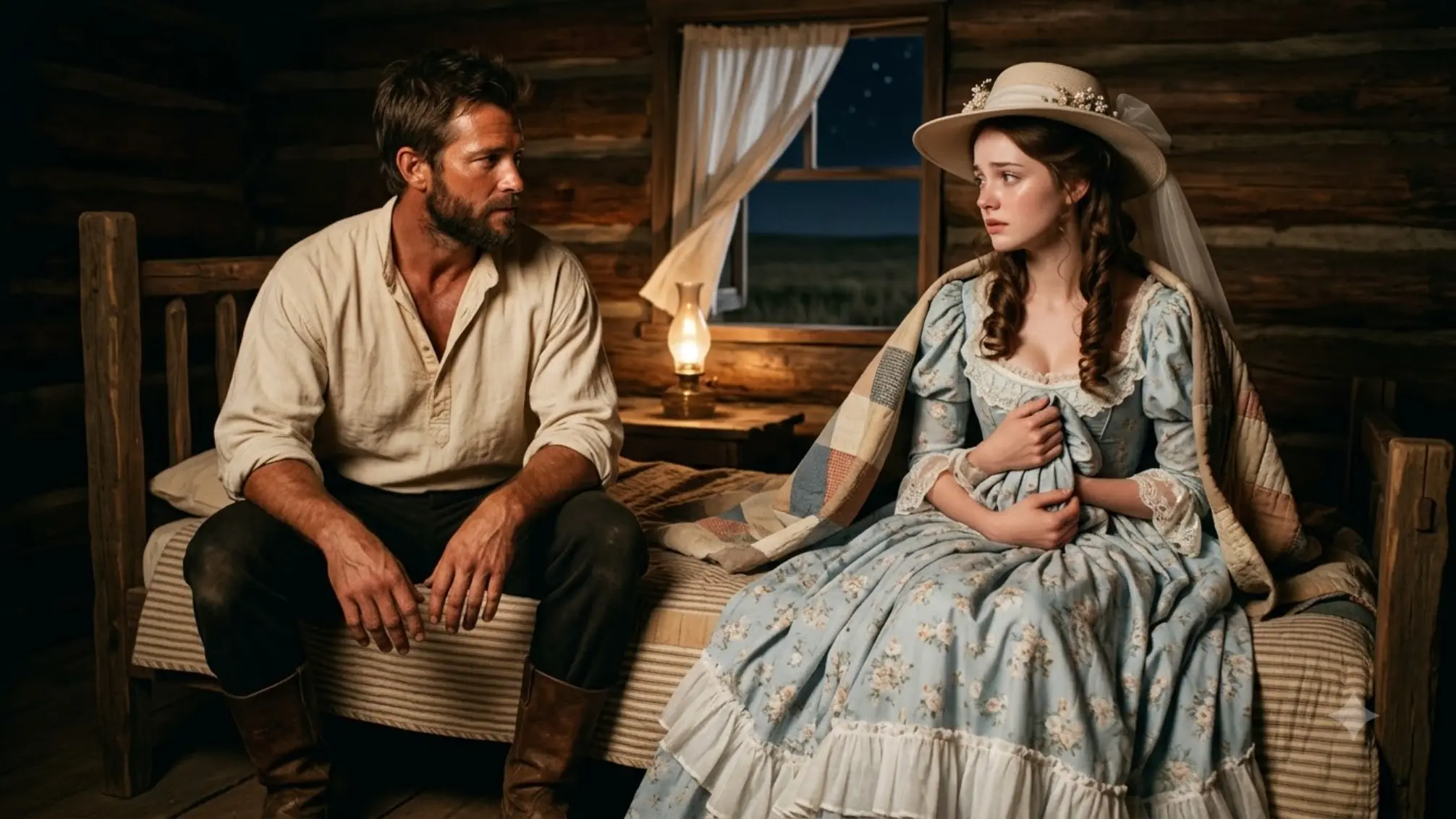
This was not ordinary nervousness.
It was fear.
Raw, silent, bone-deep fear—the kind carried by someone who had survived something too terrible to speak aloud.
Outside the lonely cabin near Abilene, the summer wind swept dust across the walls and pulled at the white curtain beside the open window. An oil lamp hissed on the bedside table, filling the room with weak golden light. Eleanor sat stiffly on the mattress, still wearing the pale-blue wedding gown she had stepped from the stagecoach in that morning.
The dress was far finer than anything Samuel expected a mail-order bride to own.
Tiny flowers covered the blue fabric. White lace framed the low neckline and puffed sleeves, while the enormous layered skirt flowed across the plain bed like water from another world. Her wide-brimmed hat, decorated with flowers and a trailing veil, rested on the wooden chair.
Eleanor was twenty-one and so beautiful that Samuel had barely known where to look when she first arrived.
Now her porcelain face had gone pale.
Her blue-gray eyes remained fixed on the closed bedroom door, and both hands twisted the front of her dress against her chest.
“I’m sorry,” she whispered. “I can’t be the wife you wanted.”
Samuel moved backward immediately.
“You owe me nothing, Eleanor.”
Her eyes filled with tears. “What if the truth makes you leave?”
He offered one hand without touching her.
“Then I’ll blame the man who hurt you—not you.”
Her sleeve slipped toward her elbow.
Bruises covered her arm.
Some were yellow at the edges, old enough to be fading. Others remained deep purple. Finger-shaped marks circled her wrist, and one long cut had healed badly beneath the lace.
Samuel’s hands curled into fists before he forced them open again.
He had branded cattle, broken wild horses, and fought men twice his size during ten hard years on the frontier. But nothing had ever demanded more strength than remaining calm while his new bride waited for him to become another man she needed to survive.
Samuel took the quilt from the foot of the bed.
“I’m going to put this around your shoulders,” he said. “I won’t touch you.”
Eleanor gave the smallest nod.
He moved slowly enough that she could follow every motion. The quilt settled around her without his fingers brushing her skin, yet she still flinched.
The movement was quick and practiced.
It chilled him more than the bruises.
Samuel sat on the edge of the bed with both boots planted firmly on the floor. He kept several feet between them and rested his hands where she could see them.
“You don’t have to tell me anything tonight.”
Eleanor pressed the quilt beneath her chin.
“You’ll want an explanation.”
“I want you to know you’re safe.”
“No man says that without wanting something.”
“Then I’ll prove it without saying it again.”
He started to rise.
Panic flashed across her face.
“Where are you going?”
“To the kitchen.”
“Are you angry?”
“No.”
“You’re leaving me?”
Samuel looked toward the wooden rocking chair beside the window.
“I’ll sleep there if you want someone nearby. Or I’ll sleep in the barn if you want the cabin to yourself.”
Eleanor stared at him as though he had spoken in a language she did not understand.
“You would give me the house?”
“For tonight.”
“But this is your home.”
“It became ours when we signed the marriage paper.”
Her lower lip trembled.
Samuel sat down again.
“Who hurt you?”
She looked toward the small locked trunk near the wall. It was the only possession she had brought from Missouri besides the wedding dress, a repaired traveling cloak, and a pair of shoes too delicate for ranch work.
Samuel followed her gaze.
“Is the answer inside that trunk?”
Eleanor covered her mouth as a sob escaped.
He waited.
She struggled for breath, then whispered a name Samuel never expected to hear.
“Reverend Asa Whitcomb.”
The lamp flame bent beneath a sudden draft.
Samuel remained completely still.
Whitcomb was the respected preacher who had answered Samuel’s newspaper advertisement. He had described Eleanor as a quiet, educated young woman raised in a charitable household outside St. Louis.
He supplied references.
He arranged the correspondence.
He even traveled west to officiate the wedding that morning before continuing toward Colorado on what he called church business.
Samuel remembered the reverend standing beside Eleanor beneath the cottonwood tree.
Whitcomb had placed her hand inside Samuel’s and spoken warmly about sacred duty, obedience, and the responsibility of a wife to honor her husband.
Eleanor had trembled throughout the ceremony.
Samuel assumed she was overwhelmed by the journey.
Now he understood she had been standing within arm’s reach of the man she feared most.
“He did this?” Samuel asked.
She nodded.
“For how long?”
“Three years.”
Samuel looked away before the anger in his face frightened her.
Whitcomb operated the St. Agnes House for Women, a religious residence supposedly offering work and shelter to widows, orphans, and young women abandoned by their families. Newspapers praised him for finding respectable homes and husbands for women who might otherwise become destitute.
Samuel had believed every word.
Eleanor pulled the quilt tighter.
“My parents died during a fever outbreak when I was seventeen. Reverend Whitcomb told the county magistrate he would become my guardian. At first, he was kind.”
Her voice cracked.
“He gave me books. He let me help with the accounts. Then I found numbers that didn’t match.”
“What numbers?”
“Marriage payments.”
Samuel frowned.
Eleanor explained that Whitcomb charged lonely farmers and businessmen a modest fee for introductions. But the ledgers contained far larger payments made privately by men seeking wives who could not easily refuse them.
Some women were threatened with prison for fabricated debts.
Others were told their younger siblings would lose shelter unless they accepted the marriages arranged for them.
A few disappeared.
Whitcomb claimed they had gone willingly.
Eleanor discovered letters hidden beneath his office floorboards—letters written by women begging to return, describing beatings and imprisonment. Whitcomb never mailed their replies to families.
“When I confronted him, he locked me in the cellar.”
Samuel’s jaw tightened.
“He said no one would believe an ungrateful orphan over a minister. After that, he began reminding me what happened to women who caused trouble.”
She looked down at her bruised wrist.
Samuel’s voice became dangerously quiet.
“Why did he send you here?”
“I stole something.”
Her eyes returned to the trunk.
“The original ledger. The private one.”
Samuel stood, but stopped when she recoiled.
“I won’t open it,” he said. “Not without permission.”
Eleanor stared at him.
“The key is sewn inside my hem.”
“You keep it.”
“If Whitcomb realizes I brought the ledger—”
“He already knows.”
“No. He thinks I burned it.”
Samuel looked toward the dark window.
The open prairie beyond the glass suddenly felt less empty. Every shadow near the barn appeared capable of hiding a rider.
“Why choose me?” he asked.
Eleanor’s shame returned.
“I read your letters before he approved them.”
“And?”
“You never demanded beauty. You never asked whether I could give you children. You wrote about the ranch, your first wife, and the quiet.”
Samuel lowered his eyes.
His first wife, Clara, had died ten years earlier during a winter illness. He buried her beneath the cottonwood tree overlooking the eastern pasture. Afterward, he spent a decade eating alone, mending his own clothes, and convincing himself solitude hurt less than losing someone again.
“I thought you might be gentle,” Eleanor said. “Or at least far enough away.”
Samuel’s chest tightened.
She had not crossed six hundred miles because she trusted him.
She had crossed them because Kansas seemed farther from danger than Missouri.
He walked toward the door.
Eleanor’s breathing quickened.
“I’m getting a chair.”
Samuel carried the kitchen chair into the bedroom and placed it against the outside of the door.
“What are you doing?”
“Sleeping in the hallway.”
“You don’t have to.”
“I know.”
He removed the revolver from his belt and set it on the floor beside the chair.
“If anyone comes through that front door, they reach me before they reach you.”
Eleanor stared at him.
“You believe me?”
“I believe the bruises.”
“What about the ledger?”
“We’ll look tomorrow, if you choose.”
“And if I never become a real wife?”
Samuel rested one hand on the doorframe.
“You became my wife when you trusted me enough to say his name.”
He closed the door gently, leaving it unlocked.
Samuel slept poorly.
Every creak of the cabin awakened him. Once, sometime after midnight, he heard Eleanor crying behind the door. He did not enter.
Instead, he sat awake in the hallway and spoke quietly through the wood.
“You’re still safe.”
The crying stopped.
At dawn, Samuel cooked coffee, bacon, and biscuits. The biscuits were hard enough to threaten teeth, but he placed them on the table anyway.
Eleanor entered wearing a plain cream blouse and dark skirt. Her chestnut hair had been braided over one shoulder, and the bruises were hidden beneath long sleeves.
She paused when she saw two plates.
“You cooked for me?”
“I attempted to.”
She touched one biscuit.
“It could stop a bullet.”
“I made them thick for safety.”
A faint smile appeared.
It was the first Samuel had seen.
He turned away to hide how deeply it affected him.
After breakfast, Eleanor brought the trunk into the kitchen. She removed the key from her hem, unlocked the brass clasp, and lifted several folded dresses.
Beneath them lay a thick black ledger wrapped in linen.
Samuel opened it only after she nodded.
Pages of names, dates, locations, and payments filled the book. Some entries listed a woman’s age, appearance, and skills as though she were livestock.
Beside several names appeared notes.
Disobedient.
No family.
Suitable for correction.
Samuel shut the book before anger made him tear the pages.
“This can hang him.”
“It can hang many men.”
“Then we take it to the law.”
Eleanor shook her head.
“Whitcomb owns the law where he came from. The magistrate received payments. So did a deputy.”
“Kansas has a territorial judge in Abilene.”
“What if he knows Whitcomb?”
“What if he doesn’t?”
Fear moved across her face.
Samuel reached halfway across the table, then stopped.
“May I hold your hand?”
The question startled her.
After several seconds, Eleanor placed her fingers inside his.
Samuel closed his hand carefully around them.
Nothing more.
“We won’t give the ledger to anyone until copies are made,” he said. “And you won’t face Whitcomb alone.”
“You barely know me.”
“I know enough.”
For the next week, Samuel taught Eleanor the rhythm of the ranch.
He showed her where the hens hid their eggs, how to test the well rope, and which mare disliked sudden movement. He never approached Eleanor from behind. Before entering a room, he knocked against the wall.
At first, she apologized for everything.
A dropped cup.
A burned pot.
A torn stocking.
Each time, Samuel answered the same way.
“Nothing in this house matters more than you.”
Slowly, her shoulders began to loosen.
She helped with the ranch accounts and discovered mistakes Samuel had ignored for years. A cattle buyer had underpaid him twice, and the general store had charged interest incorrectly.
“You may have saved me sixty dollars,” Samuel said.
Eleanor looked pleased. “Perhaps you didn’t marry entirely foolishly.”
“I was beginning to suspect that.”
Their marriage remained unconsummated.
Samuel never mentioned it.
Some nights, they sat on the porch watching heat lightning flicker beyond the prairie. Eleanor told him about books she loved. Samuel described Clara without making Eleanor feel compared to a ghost.
One evening, Eleanor asked whether he still loved his first wife.
“Yes.”
She looked down.
Samuel continued, “Love for someone gone doesn’t take food from the living.”
Eleanor looked at him.
“Is there room for another?”
“There could be.”
“For me?”
Samuel answered honestly.
“There already is.”
She leaned toward him, then stopped.
He waited.
Eleanor kissed his cheek.
It lasted only a heartbeat, but Samuel remained motionless until she withdrew.
“Was that all right?” she asked.
He smiled.
“It was more than all right.”
The following morning, three riders appeared on the eastern road.
Samuel recognized Whitcomb first.
The reverend wore a black coat despite the heat, his pale hair combed neatly beneath a flat-brimmed hat. Beside him rode a county deputy from Missouri and a broad man carrying a shotgun across his saddle.
Eleanor saw them from the window.
The cup slipped from her hand and shattered.
Samuel stepped between her and the glass.
“Bedroom. Take the ledger.”
“No.”
“Eleanor—”
“I’m done hiding alone.”
Her voice trembled, but she remained standing.
Samuel nodded.
“Then stand behind me until you decide otherwise.”
Whitcomb dismounted near the porch.
His smile held the same warmth Samuel remembered from the wedding.
“Mr. Hale. I fear there has been a grave misunderstanding.”
Samuel rested one hand near his revolver.
“You entered my land armed. Explain carefully.”
Whitcomb looked toward Eleanor.
“My child, you have caused tremendous concern.”
She went pale.
Samuel stepped down from the porch.
“She is not your child.”
The deputy unfolded a paper.
“Eleanor Ward is accused of stealing church funds and confidential records. We have authority to return her to Missouri.”
Samuel did not take the document.
“Authority signed by whom?”
“A county magistrate.”
“The same magistrate named in Whitcomb’s ledger?”
The deputy’s eyes shifted.
Whitcomb’s smile vanished.
“So she did bring it.”
Eleanor came onto the porch holding the black book against her chest.
Samuel glanced back.
She looked terrified.
She also looked determined.
Whitcomb raised one hand toward her.
“Give me the ledger, Eleanor. We can still forgive this confusion.”
“You locked me underground.”
“You were ill.”
“You beat me.”
“You were hysterical.”
“You sold women.”
The hired man moved toward the porch.
Samuel drew his revolver.
“Take another step.”
The man stopped.
Whitcomb looked at Samuel with disgust.
“She deceived you. She cannot fulfill the duties of marriage. She is unstable, dishonest, and corrupted by vanity.”
Samuel’s voice became cold.
“She warned me you would say that.”
“She belongs under my guardianship.”
“No person belongs to you.”
The deputy reached for his weapon.
A rifle clicked behind them.
Samuel’s neighbor, Thomas Bell, stood near the barn. Two more ranchers emerged from the tree line, weapons lowered but ready.
Samuel had sent messages after reading the ledger.
He had also sent copied pages to Judge Edwin Carter in Abilene.
A wagon approached along the road.
Judge Carter sat beside the territorial marshal.
Whitcomb turned toward his horse.
The marshal raised his rifle.
“Stay where you are.”
Within minutes, the ledger rested in the judge’s hands.
Eleanor stood beside Samuel while Carter read several pages. The silence became heavier with every name.
Whitcomb attempted to speak.
The judge stopped him.
“I have three sworn statements from women whose names appear here.”
Eleanor looked at Samuel.
He had used the previous week not only to protect the ranch, but to locate former residents of St. Agnes House living across Kansas.
One woman had married a decent blacksmith and kept Whitcomb’s threatening letters.
Another escaped a violent husband selected through his arrangement.
Their statements matched the ledger.
The Missouri deputy removed his badge voluntarily.
“I was told she stole money.”
The judge pointed toward an entry carrying the deputy’s name.
“You received forty dollars last winter.”
The man’s face collapsed.
Whitcomb lunged toward Eleanor.
Samuel moved first, but Eleanor did not retreat.
She pulled Samuel’s spare revolver from the folds of her skirt and aimed it directly at Whitcomb’s chest.
“Don’t touch me again.”
The preacher froze.
Her hands shook violently, yet the barrel remained steady.
Samuel stood beside her.
Not in front.
Beside.
The marshal placed Whitcomb in chains.
As he was led toward the wagon, his gaze remained fixed on Eleanor.
“No man will want you once he knows what you are.”
Samuel took her free hand.
“I know what she is.”
Whitcomb sneered.
Samuel looked at Eleanor with quiet tenderness.
“She’s my wife.”
The wagon carried Whitcomb toward Abilene.
The investigation spread across three states. The ledger exposed magistrates, businessmen, and several men who had paid for vulnerable women through false marriage arrangements.
St. Agnes House closed.
The women still living there were released from Whitcomb’s control. Funds seized from his accounts helped several return to their families or begin new lives.
Eleanor testified before the territorial court.
Samuel sat behind her every day.
He never spoke unless she turned and asked him a question. When memories overwhelmed her, she found him exactly where he promised to be.
Whitcomb received a long prison sentence.
The magistrate who protected him was removed and charged. Several marriages obtained through coercion were annulled.
Months passed before Eleanor stopped checking every doorway.
Healing did not arrive like rain after drought. It came slowly, through ordinary moments.
Samuel asking permission before brushing hair from her face.
Eleanor waking from a nightmare and discovering him sleeping outside her door.
Shared meals.
Small laughter.
The first time she rode alone across the eastern pasture and returned because she wanted to, not because she had nowhere else to go.
One winter evening, snow pressed against the cabin windows while a fire burned low in the hearth.
Eleanor entered the bedroom wearing a simple white nightdress. Samuel sat in the chair reading an old newspaper.
She stopped before him.
“You still sleep there sometimes.”
“Only when you have difficult nights.”
She offered her hand.
“Not tonight.”
Samuel looked toward the bed, then back at her.
“Are you certain?”
“Yes.”
He rose slowly.
Eleanor placed his hand against her cheek.
She flinched slightly from habit, but did not pull away.
Samuel began to remove it.
She held him there.
“I’m frightened,” she admitted.
“We can stop.”
“I know.”
That answer made her smile through tears.
“I think that is why I don’t want to.”
Samuel kissed her forehead first.
Then her cheek.
He waited until she lifted her face before kissing her lips.
There was no demand in it.
No debt.
No promise she had to repay.
Only tenderness freely offered and freely returned.
Years later, travelers passing the Hale ranch often saw Eleanor working beside Samuel beneath the Kansas sun. She wore practical dresses now, though she kept the pale-blue wedding gown folded inside the cedar trunk.
Not because it reminded her of fear.
Because it reminded her of the night a man could have claimed power and chose kindness instead.
They eventually had two children.
Samuel never described them as proof their marriage had succeeded. Their life had become real long before that—in the hallway outside a locked bedroom, beside an untouched breakfast, and at the kitchen table where Eleanor first placed her hand inside his.
On every anniversary, Samuel asked the same question.
“Would you still choose me?”
Eleanor always pretended to consider it.
Then she would touch the scar near his eyebrow, smile, and answer:
“Yes. But only because you let me choose the first time.”