Henry Walker had cleaned the same marble showroom for three weeks without anyone in Beverly Hills Auto Gallery asking where he came from. To most of the staff, he was simply the old janitor with gray work clothes, rubber-soled shoes, and a silver mop bucket that squeaked whenever it rolled across the floor. He arrived before sunrise, wiped fingerprints from glass doors, emptied trash from private offices, and polished the floors beneath cars worth more than entire neighborhoods. Nobody knew that every security report, sales sheet, and staff complaint he quietly studied at night went directly into a file under his real title: majority owner.
The dealership had been his late son’s dream before it became a monument to arrogance. Henry’s son, David Walker, had built Walker Prestige Holdings from a small repair garage into one of the most respected luxury vehicle groups in California. But after David died suddenly, the company grew colder, flashier, and more careless under executives who believed wealth mattered more than character. Henry had stayed away at first because grief made every showroom feel like an empty hospital room.
Then the complaints began arriving. A retired teacher said she had been ignored because she drove an old sedan. A nurse said a salesman laughed when she asked about financing. A disabled veteran wrote that a manager told him not to touch a vehicle unless he was serious, even though he had come with cash. The worst complaints all came from the Beverly Hills branch, and every one of them mentioned the same name: Blake Morrison.
So Henry did what he had done his whole life. He stopped listening to polished reports and went to see the truth with his own eyes. He asked his corporate attorney to arrange a temporary janitorial position under an outside contractor, then walked into the showroom wearing a name tag that said HENRY. For three weeks, he watched people reveal themselves when they believed he had no power. Some employees were kind, a few were decent, and Blake Morrison was exactly what the complaints had warned.
Blake was thirty-eight, handsome, sharp-suited, and proud in the way men become when they mistake expensive surroundings for personal greatness. He moved through Beverly Hills Auto Gallery like a prince among machines, smiling at celebrities, flattering investors, and humiliating staff whenever customers could not hear. He called detail workers “background people,” told receptionists to stand prettier, and referred to cleaning staff as “floor shadows.” Henry wrote it all down.
Only one salesman ever bothered to speak to Henry like a person. His name was Ethan Price, twenty-seven years old, still new enough to feel uncomfortable when cruelty entered the room. He often helped Henry move buckets away from high-traffic areas, asked if he had eaten lunch, and once apologized after another salesman stepped over a spill Henry was cleaning. Henry remembered that because decency shown to invisible people was never small.
The day everything broke open began with a pearl-white hypercar parked beneath the center lights. The car had arrived inside a covered trailer before dawn, guarded by two transport specialists and handled like a priceless painting. Its value was nine million dollars, and Blake had repeated that number at least twelve times before noon. A private buyer was flying in the next morning, and Blake treated the car less like inventory than like a throne waiting for royalty.
Henry had just finished mopping near the velvet rope when a customer named Preston Calloway stepped too close to the display. Preston wore sunglasses indoors, a linen shirt, and the lazy smile of a man accustomed to staff pretending not to see his bad manners. He held an iced coffee in one hand and a phone in the other, laughing loudly while telling someone that the car looked “almost worthy” of his garage. Then his elbow bumped the rope post, his cup tilted, and coffee splashed down the passenger-side door.
Blake crossed the showroom before Henry could speak. His polished shoes squeaked once against the marble, and his face tightened with fury as he stared at the coffee on the car. “Sir, step away from the vehicle,” he snapped. Henry still held the mop handle, standing exactly where he had been cleaning moments earlier. “I didn’t do that,” he said quietly.
Blake turned on him so fast that several customers stopped talking. “What did you just say?” Henry straightened as much as his eighty-two-year-old back allowed. “I said it wasn’t me. He dropped the cup.” Preston lifted his eyebrows behind the sunglasses and gave a small laugh. “Are you calling me a liar, old man?”
Henry looked directly at him. “No. I’m saying what happened.” The showroom went quiet in that strange way expensive rooms go quiet, where people do not gasp but still make space for cruelty. Blake stepped closer, his face hardening as phones began to rise around the room. He did not check the cameras, did not ask another witness, did not even look at the angle of the spill.
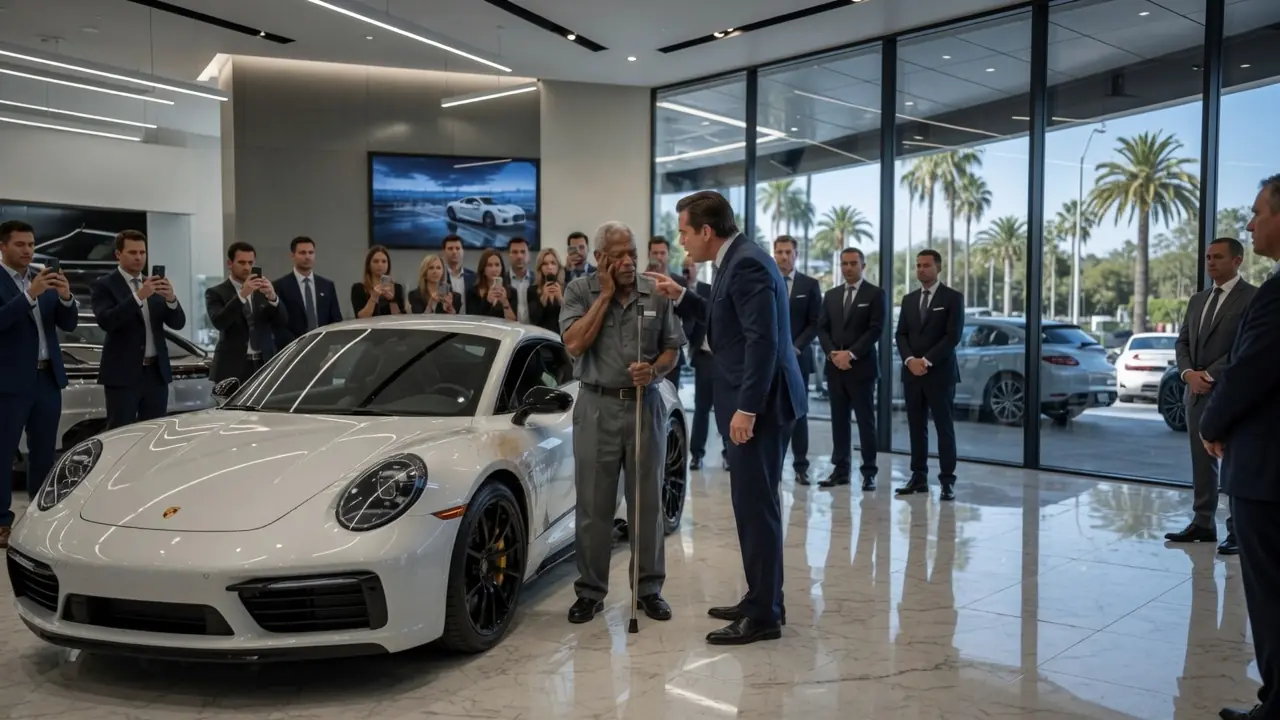
“At your age,” Blake said, pointing at Henry’s face, “you should be hidden in the back, not embarrassing my showroom.” Henry’s hand tightened around the mop, but his voice stayed calm. “Why did you blame me before checking your own cameras?” Blake’s mouth curled. “Because janitors don’t accuse million-dollar clients in my showroom.” Henry’s eyes sharpened. “Your showroom? That is a dangerous lie to say out loud.”
Blake heard only defiance. He stepped in close enough that Henry could smell expensive cologne and anger. “You clean floors, old man. Don’t pretend you belong near power.” Ethan, standing near the reception desk, shifted uneasily and looked up at the ceiling camera positioned above the hypercar. “Blake,” he said carefully, “maybe we should pull the footage first.”
Blake turned his head slowly. “Are you managing the floor today, Ethan?” Ethan swallowed. “No, but the camera is right there.” Blake’s smile vanished. “Then stop talking before you join him in the service hallway.” Ethan looked down, jaw tight, hands curling and uncurling at his sides.
Henry saw the young man’s shame and did not blame him. The world trains people to protect their paychecks before their courage. Blake pointed toward Preston and said, “Apologize to Mr. Calloway.” Henry looked at the customer, then back at Blake. “I can apologize for the mess,” he said, “but I will not apologize for something I did not do.”
The slap came so suddenly that the sound cracked against the glass walls. Henry staggered half a step, his mop clattering onto the marble. His shoulder struck the velvet rope, and for one terrible second, the whole showroom watched an old man fight to stay upright. Someone whispered, “Oh my God,” and then phones rose higher.
Henry touched his cheek. Heat spread beneath his fingers where Blake’s hand had landed. He had been struck before in his life, in poorer rooms by meaner men, but the pain was not what froze him. It was the silence of wealthy people who knew something wrong had happened and still waited to see whether power would allow them to care.
Blake stood over him, breathing hard. “You think I’m going to believe you over a client?” Henry lifted his eyes slowly. “I think,” he said, “you just made a mistake.” Blake laughed once, sharp and ugly. “No, Henry. The mistake was letting you work the main floor.”
He turned toward the security guards near the entrance. “Drag him out before his cheap shoes touch another car.” Henry bent carefully to pick up the mop. The simple movement took longer than it should have, and that made the scene crueler. Preston shook his head and muttered, “This place used to have standards.”
Henry looked at him, calm now in a way that made the customer’s smile fade. “Standards show up when no powerful man is watching,” he said. Blake stepped closer again, face dark with anger. “Enough. Clock out. You have nothing left here.”
Henry did not answer. He walked toward the service hallway with the mop in one hand and his cheek burning. Every step sounded louder than it should have. He passed champagne leather couches, framed racing photographs, and salesmen who suddenly found the floor fascinating. Behind him, Blake’s voice brightened into performance as he apologized to the guests for “a disruption involving cleaning staff.”
The hallway door closed behind Henry, cutting the showroom’s shine in half. Back there, the walls were plain beige, the light was harsher, and the air smelled of lemon cleaner and cardboard. Henry set the mop against the wall and stood beside the janitor’s closet. He took one slow breath, then reached into his pocket and pulled out an old scratched flip phone.
His thumb hovered over one contact. He had promised himself he would finish the inspection quietly and let the board handle the changes later. But promises made before a public slap sometimes needed to be buried where pride had fallen. He opened the phone and pressed call.
Maria Santos, the detail supervisor, stepped out of the break room with towels in her arms and stopped cold when she saw his face. “Henry,” she whispered. “I’m fine,” he said. Maria’s eyes filled with anger. “No, you’re not.”
Henry held up one hand gently as the call connected. “This is Walker,” he said into the phone. Maria’s expression changed. She had never heard his voice sound like that before, low and final, the voice of a man used to being obeyed. “Send Angela and corporate security to the showroom. Now. Pull camera four, camera six, and the ceiling feed over the center display. Lock every exit file and suspend no footage.”
Maria stared at him. Henry closed the phone, then looked at her with tired eyes. “I’m sorry you had to see this.” She lowered the towels slowly. “Who are you?” Henry touched his reddened cheek once. “The man who should have come here sooner.”
Back in the showroom, Blake was still trying to restore the illusion of control. He offered Preston a private espresso, ordered a junior staff member to bring a detailing kit, and told guests that the situation had been handled. But Ethan kept staring at the security camera. He had seen the slap, heard the insult, and watched Henry walk away with dignity Blake did not deserve.
Ten minutes later, the front doors opened. Angela Hart, the chief operating officer of Walker Prestige Holdings, entered with two corporate security officers and a legal associate carrying a tablet. The conversation in the showroom died almost instantly. Blake’s expression shifted from annoyance to confusion, then to concern. “Angela,” he said, forcing a smile. “We were not expecting corporate today.”
Angela did not smile back. “Where is Henry Walker?” The name meant nothing to several people, but Blake’s face twitched. “The janitor?” Angela’s eyes turned colder. “The owner.” The word dropped into the showroom like a stone through glass.
Preston lowered his espresso cup. Ethan looked up sharply. The receptionist covered her mouth. Blake stared at Angela, waiting for a laugh that never came. “What did you say?” he asked. Angela stepped closer. “Henry Walker is the majority owner of Walker Prestige Holdings, which owns Beverly Hills Auto Gallery and every vehicle in this room.”
For the first time all day, Blake had no prepared expression. His lips parted, but his face emptied. The service hallway door opened, and Henry walked back into the showroom beside Maria. He still wore the gray work shirt. His name tag still read HENRY. The red mark across his cheek was brighter now.
Every phone turned toward him. Blake’s eyes dropped to Henry’s cheap shoes, then lifted to the old man’s face. The power in the room changed so completely that even the cars seemed silent. Henry did not look grand or theatrical. He looked tired, disappointed, and harder to face than any angry executive.
Angela held up the tablet. “We reviewed the footage.” She turned the screen toward the showroom. The video showed Preston dropping the coffee clearly. It showed Henry stepping back. It showed Blake ignoring him, ordering him to apologize, and slapping him across the face. No angle left room for misunderstanding.
Preston’s face went pale behind his sunglasses. He removed them slowly, as if that might make him look more honest. “This is being blown out of proportion,” he said. Henry turned toward him. “You spilled coffee on a car and watched an old man get struck for it.” Preston swallowed. “I was embarrassed.”
Henry’s eyes did not move. “So you rented my pain to cover your embarrassment.” Preston looked away first. Blake tried to speak, but Henry lifted one finger. The small gesture silenced him more completely than shouting would have.
Henry stepped toward the hypercar, where the stain had already been cleaned but the memory remained. “My son built this company because he loved machines and respected people,” he said. “He used to tell me a showroom should never make a poor man feel small or a rich man feel larger than he is.” His voice remained calm, but several staff members looked down as if the words had weight.
Blake finally found his voice. “Mr. Walker, I didn’t know.” Henry turned to him. “That is not an excuse. That is the evidence.” Blake blinked. Henry stepped closer, and Blake took one involuntary step back. “You did not know who I was, so you showed me who you are.”
The sentence broke through the showroom harder than the slap had. Blake’s face reddened, then paled. “I made a terrible mistake,” he said. Henry nodded slowly. “Yes. You believed power belonged to the man in the suit, not the man with the truth.” He looked toward Angela. “Terminate his employment immediately.”
Blake’s mouth fell open. “Please. I have been loyal to this company for seven years.” Henry’s cheek tightened with pain as he answered. “No, Blake. You have been loyal to wealthy customers, expensive cars, and your own reflection. The company was only the building you used to practice cruelty.” Angela turned to the security officers. “Mr. Morrison, please surrender your badge and keys.”
Blake looked around for help, but every person he had intimidated was suddenly fascinated by his fall. Ethan stood near reception, breathing hard, eyes full of the courage he had not fully used earlier. Maria watched with her arms folded, face cold. Preston quietly tried to step backward, but Henry saw him.
“Mr. Calloway,” Henry said. Preston froze. “Your allocation is canceled.” Preston’s face twisted. “You can’t do that.” Henry’s eyes stayed steady. “I can. And I did.” Angela added, “You will also receive an invoice for inspection and detailing, and our legal department will contact you regarding your false statement.”
Preston opened his mouth, then closed it. For once, his money had no useful words. He left through the glass doors with his head low, followed by the eyes of people who had laughed at Henry ten minutes earlier and now wanted to pretend they had always been horrified.
Henry turned toward Ethan. The young salesman stiffened. “You spoke up,” Henry said. Ethan’s face flushed with shame. “Not enough.” Henry studied him for a long moment. “No. Not enough.” Ethan looked down, accepting it. Henry continued, “But enough to show me there is still something in you worth building.”
Ethan’s eyes lifted. Henry looked toward Angela. “Promote Mr. Price to interim floor lead under Maria’s service culture review.” Ethan stared at him. Maria raised an eyebrow. Angela nodded. “Understood.” Henry turned back to Ethan. “Your first job is to apologize to every employee you watched Blake mistreat and ask what needs to change. Not tell. Ask.”
Ethan nodded quickly, emotion visible in his face. “Yes, sir.” Henry looked around the showroom. “Everyone here will attend dignity and conduct training. Not the kind you click through while drinking coffee. Real training. If you cannot sell luxury without humiliating people, you do not belong in luxury.”
No one argued.
The video spread before sunset. Someone had recorded the slap, another had recorded Angela’s arrival, and within hours the story was everywhere. “Elderly Janitor Slapped in Beverly Hills Showroom, Revealed as Owner.” News vans appeared outside the next morning. Henry refused interviews for two days because he did not want his humiliation turned into entertainment.
When he finally spoke, he did it from the showroom floor beside Maria and Ethan. The red mark on his cheek had faded, but his voice had not softened. “This story is not important because I owned the building,” he told the cameras. “It is important because if I had not owned it, many people would have accepted what happened to me as normal.” He paused, letting that sentence settle. “Respect should never require a title.”
In the weeks that followed, Beverly Hills Auto Gallery changed in ways that were impossible to fake. Maria became director of client and staff experience, with authority equal to sales leadership. Every complaint from the past three years was reopened. Employees who had been silenced were interviewed privately, and several managers who had protected Blake’s behavior quietly left before they could be removed.
Ethan changed too. He worked longer hours, not chasing commissions, but listening to the people who kept the dealership alive. He learned from detailers how often clients blamed them for scratches they did not cause. He learned from receptionists how many insults were hidden behind smiles. He learned from Maria that dignity was not a slogan; it was a system, and systems needed consequences.
Henry returned to the showroom often after that, sometimes in a suit, sometimes in the same gray work shirt. He wanted the staff to remember both versions of him and understand they were never different men. One afternoon, he stood beside the pearl-white hypercar, now sold to a different buyer, and watched Ethan help an elderly mechanic in faded clothes sit inside a vintage Porsche. Ethan treated the man with patience and care, as if he had all the money in the world or none at all.
Maria stepped beside Henry. “You see that?” she asked. Henry nodded. “I see a young man learning before life has to slap him harder.” Maria smiled faintly. “Blake never learned.” Henry looked toward the front doors, thinking of the man who had mistaken cruelty for authority. “Some people only recognize power when it can fire them,” he said. “That is why they should never have it.”
Months later, Henry visited David’s grave with a folded copy of the new company conduct policy in his pocket. He placed one hand on the stone and stood quietly for a long time. “I let it drift, son,” he whispered. “I thought grief gave me permission to look away.” The wind moved softly through the cemetery trees. Henry swallowed hard. “I’m looking now.”
He did not know whether David could hear him, but saying it mattered. The dealership had not become perfect, because no place run by people ever does. But it had become accountable. The people who once worked in the background had names now, voices now, and a path to report mistreatment without begging the powerful to care.
On the anniversary of the incident, Henry entered Beverly Hills Auto Gallery through the service hallway instead of the front doors. He passed the janitor’s closet where he had made the phone call, then stopped at the cracked mirror still taped inside. The old man staring back at him had the same white hair, the same lines, the same tired eyes. But now that face was no longer easy for anyone in the building to dismiss.
Ethan found him there a few minutes later. “Mr. Walker,” he said softly, “the new staff is ready.” Henry nodded and followed him into the showroom, where every employee stood waiting beside the cars. Maria handed Henry a mop, not as a joke, but as a reminder. Henry took it and rested both hands on the handle.
“This,” he said, “is not a symbol of low status.” The room stayed silent. “It is a tool. Like a wrench, a pen, a contract, or a key. The shame was never in holding it. The shame was in thinking the person holding it mattered less.”
Several employees lowered their eyes. Ethan did not. He looked straight at Henry, absorbing every word. Henry glanced toward the place where Blake had slapped him, then back at the staff. “Remember this showroom is not judged by how you treat billionaires,” he said. “It is judged by how you treat the person you think cannot hurt you.”
That became the first lesson every new employee heard.
Years later, people still talked about the old janitor who turned out to own the Beverly Hills showroom. Some told it as a revenge story, some as a business lesson, some as a warning to arrogant managers. Henry never liked any of those versions completely. To him, the story was simpler and heavier than that.
A man spilled coffee. Another man lied. A manager chose power over truth and struck someone he believed was powerless.
Then the truth walked back into the room wearing a janitor’s uniform and reminded everyone that human worth had never been tied to a name tag, a suit, a bank account, or a showroom floor.
Henry Walker did not need to own the dealership to deserve respect.
Owning it only made the people who forgot that truth finally listen.