Marcus Bell had learned long ago that expensive suits changed how people opened doors. A tailored jacket made hotel clerks smile faster, bankers stand straighter, and restaurant managers suddenly remember the word sir. But that Tuesday afternoon, Marcus did not wear a suit. He walked into Hawthorne Grill in a faded black jacket, a worn baseball cap, plain jeans, and work boots dusted from the sidewalk.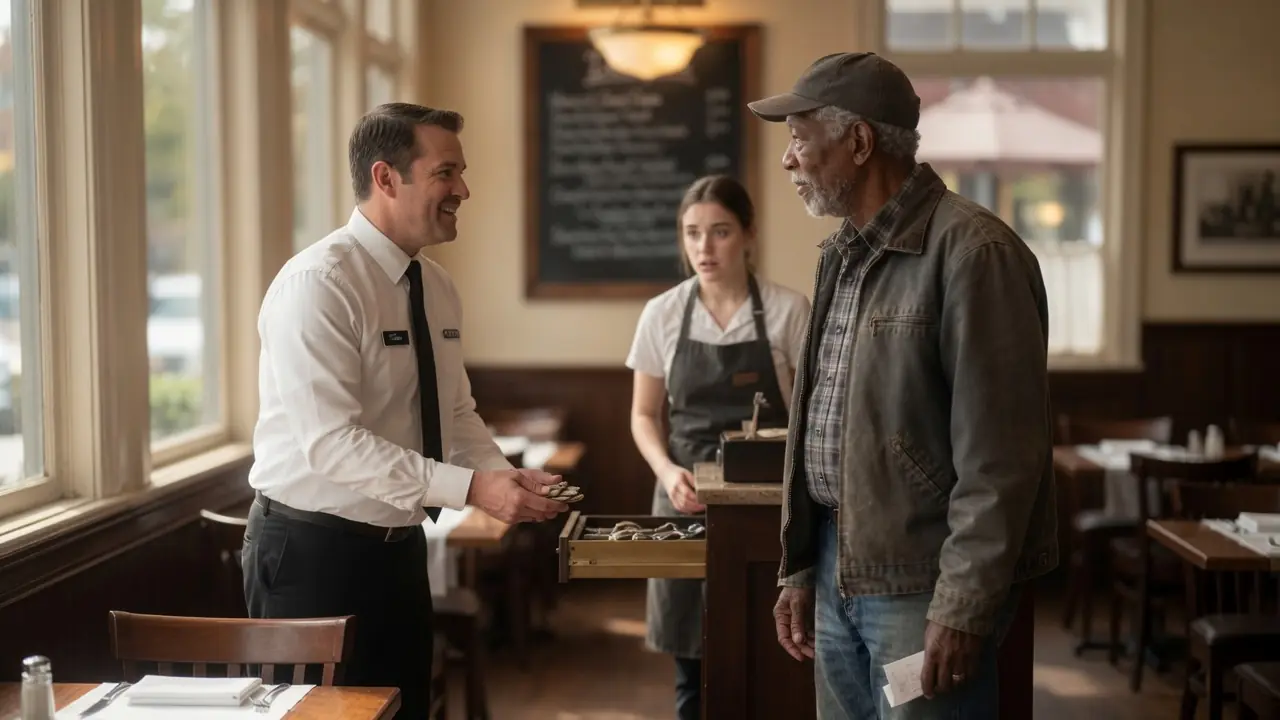
To most people, he looked like a tired man stopping in for lunch after a long shift. That was exactly how he wanted to look. For six months, anonymous complaints had reached the corporate office of Bell & Harbor Hospitality, the restaurant group Marcus had built from one small diner into fourteen respected locations across the Midwest. The complaints all pointed to the same place: Hawthorne Grill on Dearborn Street, and the same manager: Victor Hale.
Customers had written that Victor treated certain people like they were stains on his dining room. Former employees said he mocked workers, cut hours as punishment, and ignored guests he thought looked poor. Two Black customers had complained that he made them wait while serving others who arrived later. Victor always denied everything, and on paper, his numbers looked good enough for regional supervisors to give him the benefit of the doubt.
Marcus did not believe paper when people were hurting. His mother had worked thirty-two years as a waitress in restaurants where managers smiled at wealthy customers and snapped their fingers at women like her. She used to come home with swollen feet and still remind Marcus that food tasted different when served with dignity. When Marcus opened his first restaurant, he promised her no one under his roof would be treated like furniture.
Hawthorne Grill had once been one of his proudest locations. It sat in a renovated brick building with tall windows, polished wood floors, and a chalkboard menu that made simple food feel elegant. Families came after church, office workers came during lunch, and tourists wandered in after seeing the old theater across the street. But lately, the warmth had disappeared from the reviews.
Marcus paused outside the front door and looked through the window. He saw linen napkins, brass lamps, and customers eating quietly at well-spaced tables. He also saw Victor Hale standing near the host stand in a white shirt and black tie, smiling at a couple in designer coats. Victor’s smile was wide, practiced, and empty.
Marcus stepped inside.
A young waitress behind the register looked up first. She was maybe twenty-four, with dark hair tied back and a gray apron over a white shirt. Her name tag read Lena. She gave Marcus a tired but sincere smile.
“Welcome to Hawthorne Grill,” she said. “Just one today?”
“Yes, please.”
“Counter or table?”
“Counter is fine.”
Before Lena could lead him, Victor turned. His eyes moved over Marcus’s jacket, cap, jeans, and boots. The smile he had given the wealthy couple vanished so quickly it might never have existed.
“Counter is full,” Victor said.
Marcus looked toward the counter. Three stools were empty.
Lena opened her mouth, then closed it.
Marcus kept his voice easy. “Looks like there’s space.”
Victor’s jaw tightened. “Those seats are reserved.”
“For whom?”
“For customers.”
The word landed softly, but the meaning behind it was not soft at all. Marcus looked at Lena, whose face had gone pale with embarrassment. She gestured toward a small table near the back, half-hidden beside the kitchen doors.
“I can seat you there,” she said quietly.
Marcus nodded. “Thank you.”
He followed her past the counter. Victor watched them with irritation, as if Lena had broken some rule by treating Marcus like a person. The back table smelled faintly of cleaning solution and fryer oil from the kitchen swing door. Marcus sat down and removed his cap, keeping his expression neutral.
Lena handed him a menu. “I’m sorry about that.”
Marcus looked up. “About what?”
She hesitated. “The counter confusion.”
He gave her a small, sad smile. “Is that what we’re calling it?”
Her eyes flickered toward Victor. “I need this job.”
“I understand.”
She swallowed. “Can I get you coffee?”
“Yes. Black, please.”
As Lena walked away, Marcus studied the room. Victor greeted some guests by name, laughed too loudly at jokes from well-dressed men, and checked on a table of businessmen twice within five minutes. But when an older Latino couple raised a hand for water, he looked through them as if they were part of the wall. When a delivery driver stepped in asking to use the restroom, Victor pointed sharply toward the public gas station down the block.
Marcus felt anger settle in his chest, slow and controlled.
Lena returned with coffee. “Do you know what you’d like?”
“The lunch special.”
“Roast chicken, mashed potatoes, and greens?”
“That’s right.”
She wrote it down. “Good choice.”
“Lena,” Marcus said gently.
She paused.
“Does he always talk to people like that?”
Her fingers tightened around the order pad. “Only when he thinks nobody important is listening.”
Marcus held her gaze. “That’s usually when people show who they are.”
She looked like she wanted to say something more, but the kitchen bell rang. She hurried away. Marcus sipped his coffee and watched Victor berate a busboy for setting glasses too close to the edge of a table. The busboy lowered his head and apologized twice.
The meal came hot and well-prepared. Whoever worked in the kitchen still cared. Marcus ate slowly, taking mental notes. The chicken was excellent, the greens slightly underseasoned, and the service from Lena careful but strained. Every time Victor passed his table, he glanced down with open annoyance, as though Marcus’s presence reduced the value of the room.
When Marcus finished, Lena brought the bill. “Take your time.”
He paid in cash.
Not because he had to. His wallet carried black cards that could have bought the building twice over. But cash revealed habits. It showed how people handled small power, loose change, and customers they thought could not complain upward.
The bill was twenty-two dollars and forty cents. Marcus placed thirty on the tray. Lena returned with change and a receipt, but Victor intercepted her near the register.
“I’ll handle it,” Victor said.
Lena stiffened. “I can take it to him.”
“I said I’ll handle it.”
Marcus watched as Victor took the small tray and walked over with a smirk. He stopped beside the table and looked down at the bills and coins. The whole room did not notice yet, but Lena did. So did the busboy near the water station.
Victor placed the receipt on the table but held the change in his hand. “You sure you meant to eat here?”
Marcus looked up slowly. “I ordered, ate, and paid.”
“That wasn’t my question.”
“No,” Marcus said. “It wasn’t.”
Victor’s mouth twisted. “We run a certain kind of establishment. People get confused when they see certain… appearances.”
The phrase was polished enough for plausible denial and ugly enough for truth. Marcus leaned back slightly. “What appearance is that?”
Victor laughed under his breath. “Don’t make this difficult.”
“I’m not.”
Victor opened his hand. The coins and bills dropped toward the table, but at the last second, he flicked his wrist. The change scattered across the wooden floor.
Coins bounced once, twice, then rolled under the table.
The dining room went quiet.
Lena froze near the register. The busboy stared at the floor. A woman at a nearby table gasped softly, and a man beside her looked away like discomfort could excuse silence.
Victor looked down at the scattered money and smiled. “There,” he said. “Pick it up. People like you should learn where you belong.”
For a moment, Marcus heard only the soft ticking of the wall clock and the distant clatter from the kitchen. He thought of his mother counting tips at midnight. He thought of her telling him that dignity was not something anyone could give him, but people would try to steal it if he bent too quickly. So he did not bend.
Marcus looked at the coins on the floor, then at Victor.
“Do you speak to every customer this way,” he asked calmly, “or only the ones you think can’t fire you?”
Victor laughed loudly, relieved by his own arrogance. “Fire me? You can barely afford lunch in my restaurant.”
Lena stepped forward. “Mr. Hale, please.”
Victor turned on her. “Back to work.”
“That wasn’t right.”
His eyes narrowed. “Do you want to lose your job over him?”
Lena’s face flushed, but she did not move back. “He didn’t do anything.”
Marcus stood slowly. The room seemed to shrink around him. Victor was still smiling, but confusion flickered in his eyes now. Men like Victor understood shouting, pleading, and shame. Calm made them uncertain.
Marcus removed his cap and placed it on the table.
“Your restaurant?” he asked.
Victor folded his arms. “That’s right.”
Marcus reached into his jacket and took out a slim leather card holder. He removed a black business card and placed it on the table beside the receipt. Victor glanced down, still smirking.
Then he read the name.
Marcus Bell. Founder and Owner. Bell & Harbor Hospitality Group.
Victor’s smile collapsed.
Lena’s hand flew to her mouth.
The woman at the nearby table whispered, “Oh my God.”
Marcus reached into his pocket again, removed his phone, and tapped one number. He put it on speaker. A woman answered on the second ring.
“Mr. Bell?”
Victor went pale.
“Angela,” Marcus said, his eyes still on Victor. “I’m at Hawthorne Grill. Please come in through the front with HR and legal.”
“Yes, sir,” Angela said. “We’re outside.”
Victor swallowed. “Mr. Bell, I didn’t—”
Marcus lifted one hand. “Do not finish that sentence unless you are prepared to tell the truth.”
The front door opened less than ten seconds later. A woman in a navy suit entered with two others behind her. Angela Pierce, the regional director, looked from Marcus to Victor to the coins still scattered beneath the table. Her expression hardened.
“Mr. Hale,” she said.
Victor’s voice shook. “Angela, there’s been a misunderstanding.”
Marcus looked down at the floor. “Lena, would you please leave the change where it is?”
Lena nodded, eyes wet.
Marcus turned back to Victor. “A misunderstanding is when someone misreads a reservation. You threw a customer’s change on the floor and told him to pick it up because you thought he had no power here.”
Victor’s face reddened. “I was enforcing standards.”
“No,” Marcus said. “You were performing cruelty.”
The words silenced the entire dining room.
Victor glanced around at the watching customers and staff. “This is being blown out of proportion.”
The busboy, a thin teenager named Miguel, suddenly spoke from near the water station. “He does this all the time.”
Victor turned sharply. “Quiet.”
Marcus looked at Miguel. “Keep talking.”
Miguel’s voice trembled, but he did. “Not always like that. But he seats people he doesn’t like near the kitchen. He tells us not to waste time on customers who look like they won’t tip. He made Mrs. Johnson wait forty minutes last week even though tables were open.”
An elderly woman near the window raised her hand slightly. “That was me.”
Victor’s mouth opened.
Lena stepped forward too. “He told me to stop being so friendly to delivery drivers because it made the place look cheap.”
Another server from the back added, “He cuts shifts when people complain.”
Angela’s face became colder with each sentence.
Marcus did not interrupt. He let the truth gather weight. For months, complaints had come to corporate in separate pieces. Now the pieces stood in one room, speaking at last because the person they feared had finally lost his shield.
Victor looked at Marcus desperately. “I can fix this.”
Marcus’s voice stayed low. “You thought the problem was that you insulted me. It isn’t.”
Victor blinked.
“The problem is that you would have done it to anyone you thought didn’t matter.”
Angela stepped beside Marcus. “Mr. Hale, you are suspended immediately pending termination review. Hand over your keys, access card, and company phone.”
Victor stared at her. “You can’t be serious.”
Marcus looked at him. “I have never been more serious in this building.”
Victor’s hands shook as he removed his keys from his belt. The metal clinked loudly when he placed them on the table. He looked around, perhaps expecting sympathy from the customers he had tried to impress. None came.
As Angela’s team escorted Victor toward the office, he muttered, “All this over some change.”
Marcus heard him.
“No,” he said.
Victor stopped.
Marcus pointed toward the coins under the table. “All this over what you thought that change proved.”
Victor had no answer.
After he disappeared into the back, the restaurant remained silent. Marcus looked around at the customers and staff, many of whom seemed unsure whether they were allowed to breathe again. He bent down then, not because Victor had ordered him to, but because no amount of money made him too proud to gather what belonged to him.
Before his fingers touched the first coin, Lena crouched beside him.
“Please,” she said softly. “Let me help.”
Marcus looked at her. “You don’t have to.”
“I know.” Her voice trembled. “But I want to.”
Miguel joined them next. Then the older woman by the window came over and picked up a dime near the chair leg. One by one, the scattered coins were gathered, not in shame, but in witness. The room changed as they did it. What Victor meant as humiliation became evidence of who refused to look away.
Marcus placed the change on the table and stood.
“Lunch is on the house for everyone here,” he said. “Not as a publicity stunt. As an apology from the owner of a restaurant that failed you today.”
A murmur moved through the room.
He turned toward the staff. “And every employee here will be paid for the full day, including time spent giving statements. Nobody loses hours for telling the truth.”
Lena wiped her eyes quickly. Miguel looked stunned. In restaurants, justice often stopped at speeches. Paid time meant Marcus understood the fear beneath their silence.
Angela returned from the office twenty minutes later. “Victor has been removed from the premises.”
“Good.”
“There are files you need to see.”
“I expected that.”
“And complaints.”
“I expected those too.”
Marcus looked toward Lena, who was quietly refilling coffee for the elderly woman by the window. Her hands still shook, but she kept working because servers rarely knew how to stop moving. He walked over.
“Lena.”
She turned quickly. “Yes, sir?”
“Please don’t call me sir like you’re in trouble.”
A nervous laugh escaped her. “Sorry.”
“You stood up when it could have cost you.”
She looked down. “I should’ve done it sooner.”
“Fear is expensive,” Marcus said. “People with power count on that.”
Her eyes lifted.
He continued, “Would you be willing to speak with Angela about what’s been happening here?”
“Yes.”
“And after that, I’d like to talk to you about interim floor leadership.”
Lena stared at him. “Me?”
“Yes.”
“I’m just a waitress.”
Marcus looked around the restaurant. “You were the only leader in the room before I said my name.”
Her eyes filled again, but this time she smiled.
The investigation lasted two weeks. It uncovered more than Marcus expected and exactly as much as he feared. Victor had manipulated seating, ignored discrimination complaints, punished workers who challenged him, and falsified notes about customer disputes. He had written “low value” beside names on private reservation notes. He had denied job applicants interviews based on appearance before they ever reached HR.
Marcus terminated him officially before the second week ended. But firing Victor was only the beginning. Marcus closed Hawthorne Grill for three days, paid the staff anyway, and brought in trainers, mediators, and new leadership. Some people online said he was overreacting. Marcus did not care. A restaurant was not saved by protecting its image. It was saved by repairing what the image had hidden.
He held a staff meeting in the dining room on the first morning of closure. Everyone sat at the tables instead of standing in lines. Marcus stood near the counter where Victor had thrown the change.
“My mother used to tell me a restaurant has two menus,” he said. “One is printed. The other is how people feel when they leave.”
The staff listened quietly.
“The food here is good,” Marcus continued. “But lately, too many people have left feeling smaller than when they came in. That is not hospitality. That is failure.”
Miguel looked down at his hands. Lena sat near the front, holding a notebook.
Marcus softened his voice. “Some of you were hurt. Some of you were afraid. Some of you stayed silent because rent is real, childcare is real, and managers can make life difficult. I understand that. But from today forward, silence will not be the price of employment here.”
Angela introduced new reporting systems. Scheduling protections. Anonymous complaint lines handled outside the location. Clear rules on seating, service, and guest treatment. Every employee received back pay for stolen break time Victor had quietly erased from schedules.
Then Marcus named Lena interim general manager.
She stood frozen for a moment, hand pressed to her chest. “I don’t know if I’m ready.”
Marcus smiled. “Good. The dangerous ones always think they are.”
The reopening drew attention because the story had traveled. Someone had posted part of the incident online, and by the next morning, millions had watched Victor throw the change. Reporters wanted interviews. Marcus declined most of them. He released one statement: Hawthorne Grill failed a guest and failed its staff. We are correcting both.
On reopening day, Marcus returned in a suit. Not because he needed one now, but because he wanted the staff to see both versions of him and understand neither had deserved different treatment. He stood near the entrance as the first customers came in. Lena greeted them with a calm confidence that still looked new on her but fit well.
Mrs. Johnson, the elderly woman who had spoken up, came for lunch and was seated by the window, her favorite spot. Miguel brought her water before she asked. She smiled at him like he had restored something small but important.
Halfway through lunch, a man in construction clothes entered hesitantly, looking at the polished floors as if unsure he belonged. Lena stepped forward at once.
“Welcome to Hawthorne Grill,” she said warmly. “Table or counter?”
The man relaxed. “Counter, if that’s okay.”
“Of course it is.”
Marcus watched from the host stand. That moment mattered more than any press release.
A month later, Hawthorne Grill’s reviews changed. Not instantly, not magically, but steadily. Customers wrote about being welcomed. Former employees asked if positions were open. Regulars returned cautiously, then more often. The food had always been good, but now the room began to feel warm again.
One evening, after closing, Lena found Marcus sitting at the same back table where she had first seated him. He was looking at the polished floor beneath it, the place where the coins had scattered.
“Do you think about it a lot?” she asked.
“Yes.”
“Me too.”
Marcus looked up. “What do you think about?”
She sat across from him. “How close I came to saying nothing.”
“You did say something.”
“After he did it to you. Not before, not all the other times.”
Marcus leaned back. “Lena, courage is not always early. Sometimes it arrives late and still saves the room.”
She looked away, blinking.
He continued, “The important thing is what you do now that it has arrived.”
She nodded slowly. “I want this place to be different.”
“It already is.”
“Not enough.”
Marcus smiled. “That is the correct answer.”
Six months later, Hawthorne Grill hosted a community dinner for neighborhood workers, delivery drivers, teachers, bus operators, and hospital staff. Marcus paid for it personally, though Lena planned every detail. No velvet ropes, no hidden tables by the kitchen, no quiet judgment at the door. People came in uniforms, scrubs, work boots, church clothes, hoodies, and suits.
Near the end of the evening, Marcus stood beside the counter and watched Lena move through the room. She laughed with Miguel, checked on Mrs. Johnson, and adjusted a chair for a father holding a sleeping toddler. She was still learning numbers, inventory, and supplier contracts. But she already understood the thing Victor never had.
Restaurants did not belong to managers who stood behind counters. They belonged to everyone hungry enough to walk through the door.
Marcus reached into his pocket and felt a coin there. One of the coins Victor had thrown. He had kept it, not as a wound, but as a warning. Money on the floor could become humiliation in the wrong hands, or a reminder in the right ones.
After the dinner, Lena locked the front door and turned to him. “Good night, Mr. Bell.”
“Good night, Lena.”
She paused. “Do you think your mother would like this place now?”
Marcus looked around the dining room. Clean tables. Warm lights. Staff laughing softly in the back. No one hidden, no one dismissed, no one treated as if dignity had a dress code.
“Yes,” he said. “I think she would.”
Outside, the city moved past the windows, full of people who had been judged too quickly in too many rooms. Inside Hawthorne Grill, the lights stayed on a little longer while the staff finished closing. Marcus stood for a moment by the counter where Victor had tried to make him bend.
He had not bent.
Not because he was rich.
Not because he was powerful.
But because his mother had taught him that dignity did not fall to the floor just because someone threw coins there.
And from that day forward, anyone who walked into Hawthorne Grill, no matter their clothes, skin, job, age, or accent, was greeted before they were judged.
That was the rule Marcus Bell wrote into the heart of the restaurant.
And this time, everyone knew the owner meant it.