The cruelest kind of humiliation does not always arrive with shouting. Sometimes it comes dressed in a tailored black suit, wearing a polite smile, standing beneath chandeliers while a room full of elegant strangers pretends not to hear. That was how Samuel Whitaker learned that grief could still be insulted, even after a man had spent years carrying it quietly. And that was how eight-year-old Emily Whitaker learned, far too young, that some people judge a person’s worth before they ever ask their name.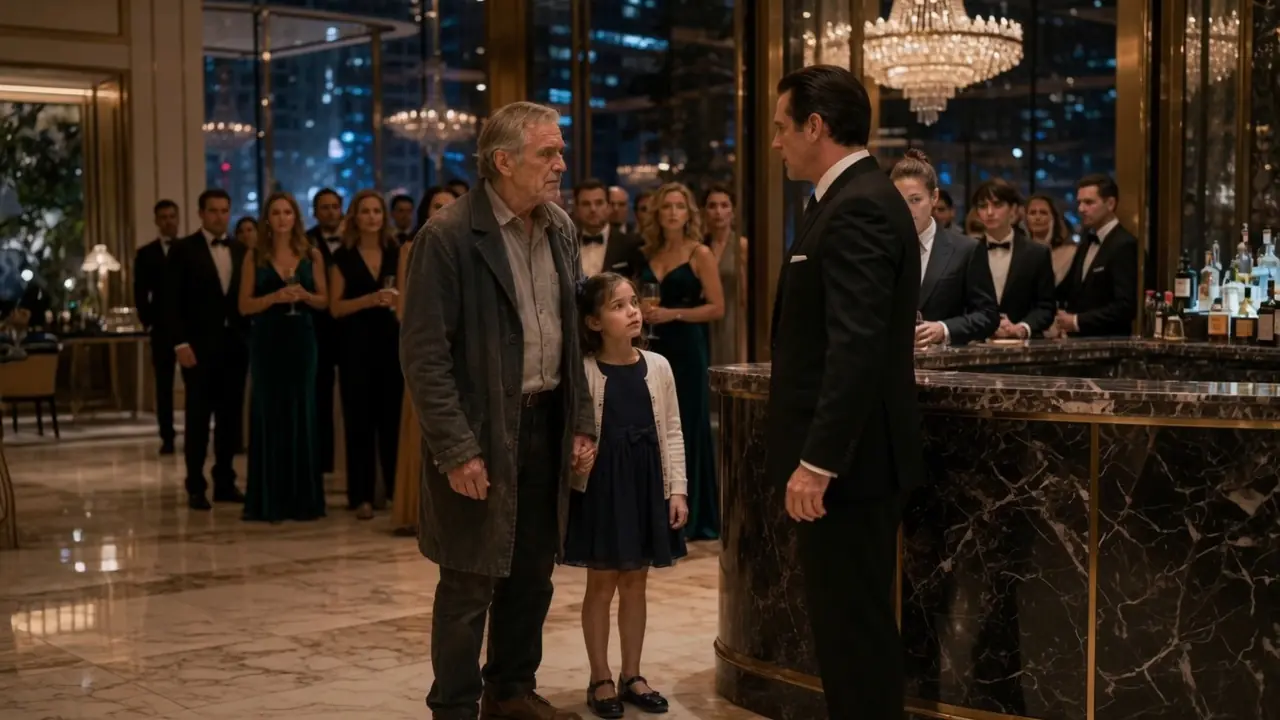
It was a bitter winter evening in Manhattan, the kind of night when rain became needles against the skin and taxi headlights smeared across the shining streets. Samuel stood at the entrance of Le Céleste, one of the most exclusive restaurants in New York, holding his granddaughter’s small hand inside his weathered palm. Emily wore a navy-blue dress, a white cardigan, and black shoes polished so carefully that the old cracks in the leather almost disappeared. She had spent twenty minutes fixing the ribbon in her hair because her grandfather had told her this dinner was important.
Samuel had not dressed like the men inside. His gray coat had been mended at both cuffs, his shirt collar was faded from years of washing, and his shoes did not match because the left sole of his proper pair had split that morning. He had tried to polish them anyway. Not because he cared about impressing wealthy strangers, but because Emily cared, and he wanted this night to feel beautiful for her.
Inside the restaurant, golden light spilled from enormous chandeliers onto marble floors and polished brass. Men in tuxedos leaned over wine lists, women in glittering gowns laughed softly beneath diamonds, and waiters moved like shadows carrying silver trays. The dining room smelled of truffle butter, fresh herbs, expensive perfume, and old money. Emily stared through the entrance with wide eyes, trying to hide her excitement.
“Grandpa,” she whispered, squeezing his hand. “Is this really the place?”
Samuel looked down at her and smiled softly. “Yes, sweetheart. This is the place.”
He did not say the rest aloud. He did not tell her that her grandmother, Eleanor Whitaker, had once stood in this very building before the chandeliers, before the marble, before the name became famous. He did not tell her that Eleanor had scrubbed floors, saved tips, borrowed money, and built the first version of Le Céleste from a narrow dining room with eight tables and a kitchen barely large enough for two cooks. He only held Emily’s hand and stepped toward the reception podium.
The manager noticed them before the hostess did. Adrian Vale was tall, polished, and sharp-faced, with slick dark hair and a tuxedo jacket that fit like armor. He had the expression of a man who had spent years confusing authority with importance. His eyes moved over Samuel’s coat, shoes, and worn leather wallet, then landed on Emily’s hopeful face.
“Good evening,” Samuel said politely. “We have a reservation.”
Adrian’s smile appeared, but it did not reach his eyes. “Sir, this is a private dining establishment.”
“I know.”
“Reservations are required.”
Samuel nodded. “That is why we made one.”
Behind the podium, the young hostess looked at Adrian before touching the keyboard. She seemed nervous, as if she already knew what he wanted her to find. Adrian did not step aside. He stood between Samuel and the dining room like a gate deciding whether dignity could enter.
“Reservation name?” the hostess asked.
Samuel carefully reached into his coat and unfolded a confirmation paper. He had kept it pressed inside an old book for three days so it would not crease more than necessary. Emily watched the paper with pride, as if it were a ticket to a dream. Samuel placed it gently on the podium.
“It should be under Emily,” he said.
Emily smiled at hearing her name in that room.
The hostess typed. She paused, frowned, and typed again. Adrian glanced at the screen, then at Samuel, and his smile grew colder.
“I’m sorry, sir,” the hostess said, avoiding Emily’s eyes. “We don’t have any reservation under that name.”
Emily’s smile vanished.
Samuel did not move. “I called three days ago. Someone confirmed the table.”
“Who?” Adrian asked.
“I don’t remember the name.”
“How convenient.”
The words were quiet, but the contempt behind them carried. A woman in an emerald dress turned slightly, champagne glass frozen near her lips. A businessman by the bar pretended to read a message while watching over the top of his phone. No one spoke up, but the room began to listen.
Samuel’s jaw tightened. “Perhaps there was an error.”
Adrian chuckled under his breath. “Perhaps.”
Emily leaned closer to Samuel’s side. She could feel people looking at them now, and her small fingers tightened around his. Samuel felt the tremble in her hand and hated the room for noticing. He had brought her here to honor her grandmother, not to let strangers turn her into a spectacle.
Adrian adjusted his jacket. “I’ll ask one last time. Do you actually have business here?”
Samuel looked at him for a long moment. “Yes.”
“And what business would that be?”
“A table for my granddaughter.”
The manager’s eyes flicked toward Emily, then back to Samuel. “Sir, this simply isn’t a place for people like you.”
The piano music seemed to fade beneath the sentence. Emily looked up at her grandfather, confused at first, then wounded as she understood enough. Her shoulders drew inward. Her polished shoes shifted against the marble floor.
Samuel kept his voice calm. “People like me?”
Adrian’s smile hardened. “People who wander into places they cannot afford and expect us to embarrass ourselves pretending otherwise.”
A few guests gasped softly. Others lowered their eyes, not from shame, but from the discomfort of being near cruelty they did not intend to stop. The hostess stared at the keyboard as if the screen had become the most important thing in the world. Adrian mistook the silence for support.
Emily whispered, “Grandpa, maybe we should just leave.”
Those words cut Samuel deeper than Adrian’s insult. Emily had practiced saying please and thank you all afternoon. She had asked if her grandmother would have liked her dress. She had believed, with the honest heart of a child, that special nights were allowed to belong to her too.
Samuel bent slightly toward her. “No, sweetheart.”
Adrian sighed loudly. “Do not make this more difficult.”
Samuel straightened. “You are the one making it difficult.”
“I am protecting the atmosphere of this establishment.”
“You are humiliating a child.”
For the first time, Adrian’s face twitched. Not with guilt, but irritation at being named accurately.
A man near the bar whispered, “You can’t throw them out tonight.” But the warning came too late, and it came too softly to matter. Adrian heard only the audience, the wealth, the chandeliers, and his own certainty. He stepped closer.
“If you do not leave,” Adrian said, “I will call security.”
Emily’s eyes filled with tears, though she fought bravely not to let them fall. Samuel looked at her, and something old moved inside him. He thought of Eleanor standing in their first tiny restaurant forty years earlier, refusing to turn away a hungry young mother who could only pay with coins. He thought of Eleanor saying, “A fine dining room that cannot recognize hunger is just a rich room with plates.”
Samuel slowly reached inside his coat.
Adrian’s hand moved slightly, as if expecting trouble. “Sir, keep your hands visible.”
Samuel ignored the insult. From the inside pocket of his old coat, he pulled out a small black envelope, sealed with a faded gold crest. The paper was thick, aged, and carefully preserved. The crest showed a crescent moon above a single star, the original mark of Le Céleste before investors, expansions, and magazine awards had turned it into a temple for the wealthy.
Adrian’s eyes narrowed. Then his confident smile faded.
“Where did you get that?” he asked.
Samuel held the envelope between them. “From the woman whose name is still on the deed you never bothered to read.”
The room shifted. The woman in the emerald dress set down her champagne. The businessman lowered his phone completely. Behind the podium, the hostess finally looked up.
Adrian stared at the seal. “That is not possible.”
Samuel opened the envelope with steady hands. Inside was a folded legal document, old but protected in a clear sleeve. He placed it on the marble podium. The hostess leaned in first, then froze when she saw the name.
Eleanor Rose Whitaker.
Founder.
Original majority owner.
Lifetime family dining rights reserved for descendants and named heirs.
Adrian’s face drained of color, but he tried to recover quickly. “This must be some outdated ceremonial document.”
“No,” Samuel said. “It is attached to the founding agreement. Eleanor kept it because she never trusted men who loved a restaurant more after it became profitable than when it was kind.”
The words landed heavily.
Adrian looked toward the hostess. “Call Mr. Bellamy.”
The hostess picked up the phone with shaking hands. Bellamy Holdings was the investment group that currently managed Le Céleste, though Samuel knew very well they did not own all of it. Eleanor had sold operational control years ago when illness made the work too hard, but she had kept one protected share, one founder’s clause, and one table right. A promise written into the restaurant’s bones.
Emily looked up at Samuel. “Grandpa?”
He squeezed her hand. “Your grandmother built this place.”
Her mouth opened slightly. “Grandma Eleanor?”
“Yes.”
Emily looked around the glittering room differently now, not as a child begging to belong, but as a child realizing part of the story had always belonged to her.
Adrian heard that and stiffened. “This is highly irregular.”
Samuel looked at him. “No. What is irregular is a manager denying a child a table reserved in her name because her grandfather’s shoes do not match.”
A few people murmured. This time, the sound was not amusement. It was discomfort turning into shame.
The hostess spoke into the phone in a low, urgent voice. She gave the name Eleanor Whitaker, then Samuel Whitaker, then listened. Her face changed quickly. “Yes, sir,” she said. “Yes. He is here now.”
She held the phone toward Adrian, but her eyes had gone wide.
Adrian snatched it. “Mr. Bellamy, I apologize for the interruption, but there appears to be—”
He stopped.
Whatever was said on the other end stripped the last arrogance from his face.
“I understand,” Adrian whispered.
He listened again.
“Yes, sir.”
His hand trembled slightly as he lowered the phone.
The lobby was silent.
Samuel waited.
Adrian swallowed. “Mr. Bellamy is coming down.”
Samuel nodded. “Then we will wait.”
Emily whispered, “Are we in trouble?”
Samuel knelt carefully so he could meet her eyes. “No, sweetheart. We are standing where your grandmother told us we could stand.”
That made the first tear fall down her cheek. Samuel wiped it gently with his thumb. He hated that any part of this night had hurt her, but he also knew she was learning something important. Not every insult had to be swallowed. Not every door stayed closed when truth still had a key.
A private door near the back of the dining room opened. Several staff members straightened as Thomas Bellamy entered, a silver-haired man in a tailored suit with fear hidden poorly behind professional control. He was followed by two executives and an older woman Samuel recognized as the restaurant’s legal counsel. Bellamy moved quickly, eyes fixed on Samuel.
“Mr. Whitaker,” he said, extending a hand. “I am deeply sorry.”
Samuel looked at the hand before shaking it once. “You should be.”
Bellamy flinched. “Yes.”
Adrian tried to speak. “Mr. Bellamy, I was only trying to—”
“Stop,” Bellamy said sharply.
Adrian stopped.
Bellamy turned toward the lobby and dining room, aware that dozens of guests were now watching. “Eleanor Whitaker’s founder clause remains active. Her family has permanent dining rights at Le Céleste, including the private family table when requested. The reservation should have been honored immediately.”
The hostess covered her mouth.
Adrian looked like he might be sick.
Samuel asked, “Was the reservation entered?”
Bellamy turned to the hostess. She checked the screen again, then whispered, “It was moved.”
“Moved by whom?” Bellamy asked.
No one answered.
The legal counsel stepped behind the podium, typed quickly, and looked up. Her face hardened. “The reservation under Emily Whitaker was marked inactive at 5:12 p.m. by Manager Adrian Vale.”
Every face turned toward Adrian.
Emily pressed closer to Samuel.
Adrian lifted both hands slightly. “I did not recognize the name.”
Samuel’s voice went low. “So you erased it?”
“I assumed it was a mistake.”
“No,” Samuel said. “You assumed we were.”
That sentence silenced him completely.
Bellamy’s face reddened with anger. “Mr. Vale, go to my office. Now.”
Adrian’s pride struggled for one last breath. “Sir, with respect, I was protecting the restaurant’s image.”
Bellamy looked around at the guests, phones, staff, and frightened child. “You damaged it more in five minutes than any bad review could in five years.”
Adrian had no answer. He walked away stiffly, no longer the gatekeeper, only a man being removed from the door he had guarded too cruelly.
Bellamy turned back to Samuel. “Mr. Whitaker, Miss Emily, your table will be prepared at once.”
Samuel did not move. “Which table?”
Bellamy swallowed. “The founder’s table.”
A murmur passed through the room. The founder’s table was famous among regulars, tucked beneath a small painted ceiling panel showing a moon and one star. It was rarely used, often reserved symbolically for special anniversaries. Samuel had not eaten there since Eleanor was alive.
Emily looked up. “Grandpa, is that Grandma’s table?”
“Yes,” he said softly. “It was.”
Bellamy gestured toward the dining room. “Please allow us to escort you.”
Samuel looked at Emily. “Do you still want to stay?”
She looked toward the doorway where Adrian had disappeared, then at the beautiful room, then at her grandfather. Her small chin lifted. “Grandma would want us to, right?”
Samuel smiled through the ache in his chest. “Yes. She would.”
They walked into the dining room together. This time, no one laughed. No one smirked. Guests turned in their seats, some ashamed, some curious, some suddenly eager to appear respectful. Samuel did not look at them for long. His attention stayed on Emily, who held his hand tightly but walked with growing confidence.
The founder’s table sat beside the tall windows overlooking the winter streets. Above it, painted softly into the ceiling, was Eleanor’s original crest: a crescent moon and a single star. The table had two chairs and a small brass plaque at the edge. Emily leaned close to read it.
In honor of Eleanor Rose Whitaker, who believed no guest should leave colder than they arrived.
Emily touched the plaque with one finger. “She wrote that?”
Samuel’s voice thickened. “She lived it.”
A waiter arrived with water and menus, visibly nervous. Samuel recognized fear in the young man’s face and softened his tone. “What is your name?”
“Julian, sir.”
“Julian, my granddaughter would like whatever dessert has the most chocolate.”
Emily turned pink. “Grandpa.”
Julian smiled for the first time. “That would be the chocolate soufflé.”
“Then we will begin with that,” Samuel said.
Emily’s eyes widened. “Before dinner?”
“Your grandmother believed important nights should not wait for dessert.”
Julian laughed quietly. “I’ll bring two spoons.”
As the meal began, Bellamy returned with Eleanor’s old guest book. He placed it beside Samuel with the careful manner of someone returning a sacred object. “We keep this in the archive,” he said. “I thought Miss Emily might like to see it.”
Samuel opened the book slowly. The first pages were in Eleanor’s handwriting. Names, dates, notes about birthdays, anniversaries, and regular customers who had become friends. Emily leaned over the pages, fascinated.
Samuel turned to one entry near the beginning.
Samuel Whitaker, late as always. Eleanor forgave him because he brought flowers.
Emily giggled. “Grandpa, you were late?”
“Once.”
Bellamy raised an eyebrow.
Samuel sighed. “More than once.”
For the first time that evening, Emily laughed freely. The sound reached nearby tables, and Samuel saw several guests look down with shame. They had watched a child nearly be thrown into the cold. Now they watched her laugh at the founder’s table, and the difference was almost too much for them to hold.
Halfway through dinner, the woman in the emerald dress approached slowly. She held her champagne glass by the stem, but her hand trembled.
“Mr. Whitaker,” she said. “Miss Emily. I owe you an apology.”
Samuel looked at her. “For what?”
She swallowed. “For watching.”
That answer surprised him because it was honest.
Emily looked at her grandfather, unsure what to say. Samuel nodded once. “Thank you.”
The woman’s eyes filled. “I should have spoken.”
“Yes,” Samuel said.
She accepted the sentence without defense, then returned to her table. After that, others did not approach, but the mood in the dining room changed. Conversations lowered. People became more aware of the staff, more careful with their words, as if one exposed cruelty had made the room examine itself.
Near the end of the meal, Bellamy returned again. “Mr. Whitaker, I want you to know Mr. Vale has been suspended pending investigation.”
Samuel set down his fork. “Investigation into what we all saw?”
Bellamy looked down. “Into whether this has happened before.”
Samuel studied him. “Has it?”
Bellamy did not answer quickly enough.
Samuel nodded sadly. “Then Eleanor’s restaurant has been sick longer than tonight.”
Bellamy’s face tightened. “We will correct it.”
“No,” Samuel said. “You will begin correcting it. Those are different things.”
Bellamy bowed his head. “Yes.”
Emily listened quietly. She did not understand every adult word, but she understood enough to know her grandfather was not being mean. He was making sure the next person in a worn coat would not need an old envelope to be allowed inside.
After dinner, Samuel asked for one more thing. Not free food. Not special treatment. Not a public speech.
He asked for the staff to gather.
Bellamy hesitated, then agreed. Within ten minutes, servers, hosts, cooks, and managers stood quietly near the dining room entrance. Some looked scared. Some looked exhausted. Some looked relieved that Adrian was gone.
Samuel stood with Emily beside him. “My wife built this restaurant because she loved feeding people,” he said. “Not important people. Not polished people. People.”
No one moved.
“She believed a dining room was judged by how it treated the guest with the least power. Not the guest with the most money.” He looked around the staff. “Tonight, my granddaughter was made to feel small in the place her grandmother built. That must never happen to another child here.”
A young dishwasher wiped his eyes with the back of his wrist. The hostess who had denied the reservation began crying quietly.
Samuel looked at her. “What is your name?”
“Claire,” she whispered.
“Claire, did you erase our reservation?”
“No, sir.”
“Did you speak up when you saw wrong?”
Her face crumpled. “No, sir.”
“Then learn from tonight. Silence can be a small kind of cruelty when someone needs your voice.”
She nodded through tears.
Emily suddenly stepped forward. Samuel looked down in surprise.
“My grandma Eleanor wanted people to be warm,” Emily said, her voice small but clear. “So maybe when someone comes in cold, you should not ask if their shoes match first.”
The staff stood frozen.
Then Julian, the waiter, began to clap. Slowly, others joined. It was not loud applause. It was ashamed applause, gentle applause, the kind that admitted a child had said what adults should have known.
Samuel put one hand on Emily’s shoulder, overwhelmed with pride.
That night, after they left through the front door, Bellamy himself held Emily’s coat while Samuel helped her into it. The winter air outside was still cold, but Emily stepped into it differently. She looked back at the glowing restaurant windows.
“Grandpa,” she said, “do we own it?”
Samuel thought about the question. “Part of it.”
“Which part?”
He looked through the glass at the founder’s table, at the crest above it, at the staff still gathered near the podium. Then he looked down at her.
“The part that remembers Grandma.”
Emily nodded seriously. “That’s the best part.”
Samuel laughed softly. “Yes, sweetheart. It is.”
In the weeks that followed, Le Céleste changed. Adrian Vale was terminated after the investigation revealed a pattern of canceled reservations, hidden seating notes, and quiet discrimination disguised as “atmosphere management.” Bellamy Holdings issued a public apology, but Samuel insisted the apology include actual changes, not polished language. Staff were retrained, reservation oversight was tightened, and the founder’s clause was displayed in the employee room beside Eleanor’s photograph.
Under Eleanor’s picture, Bellamy added her words: No guest should leave colder than they arrived.
Samuel visited once a month after that, always with Emily. Sometimes they wore their best clothes. Sometimes Samuel wore the same old coat. No one ever looked at his shoes again, and if they did, they were wise enough to keep shame out of their eyes.
Emily grew to love the founder’s table. She brought drawings for the staff, asked Julian about desserts, and once corrected Bellamy when he called the restaurant “exclusive.”
“Grandma didn’t build it to exclude people,” she said.
Bellamy smiled sadly. “You’re right, Miss Emily.”
Years later, guests would still tell the story of the night an old man in mismatched shoes was nearly thrown out of Manhattan’s finest restaurant. Some told it as a scandal, some as a lesson, some as gossip polished by time. But Emily remembered it differently.
She remembered her grandfather’s hand never letting go.
She remembered the manager’s cruel smile fading when the black envelope appeared.
She remembered reading her grandmother’s name on the plaque.
Most of all, she remembered that belonging did not begin when the room finally accepted her. It had begun before she ever walked in, in the courage of a grandmother who built a table, and a grandfather who refused to let anyone erase it.
And from that night on, whenever someone arrived at Le Céleste in a worn coat, tired shoes, or trembling hope, the staff opened the door a little wider.
Because Eleanor Whitaker’s restaurant had remembered itself.
And no one needed a black envelope to prove they deserved warmth.