Theodore Grant was still looking at the empty glass when the restaurant went quiet.
A moment earlier, water had struck him across the cheeks and eyes. Now it dripped from the tangled gray hair beside his face, ran through his thick beard, and darkened the torn blue shirt beneath his filthy canvas jacket.
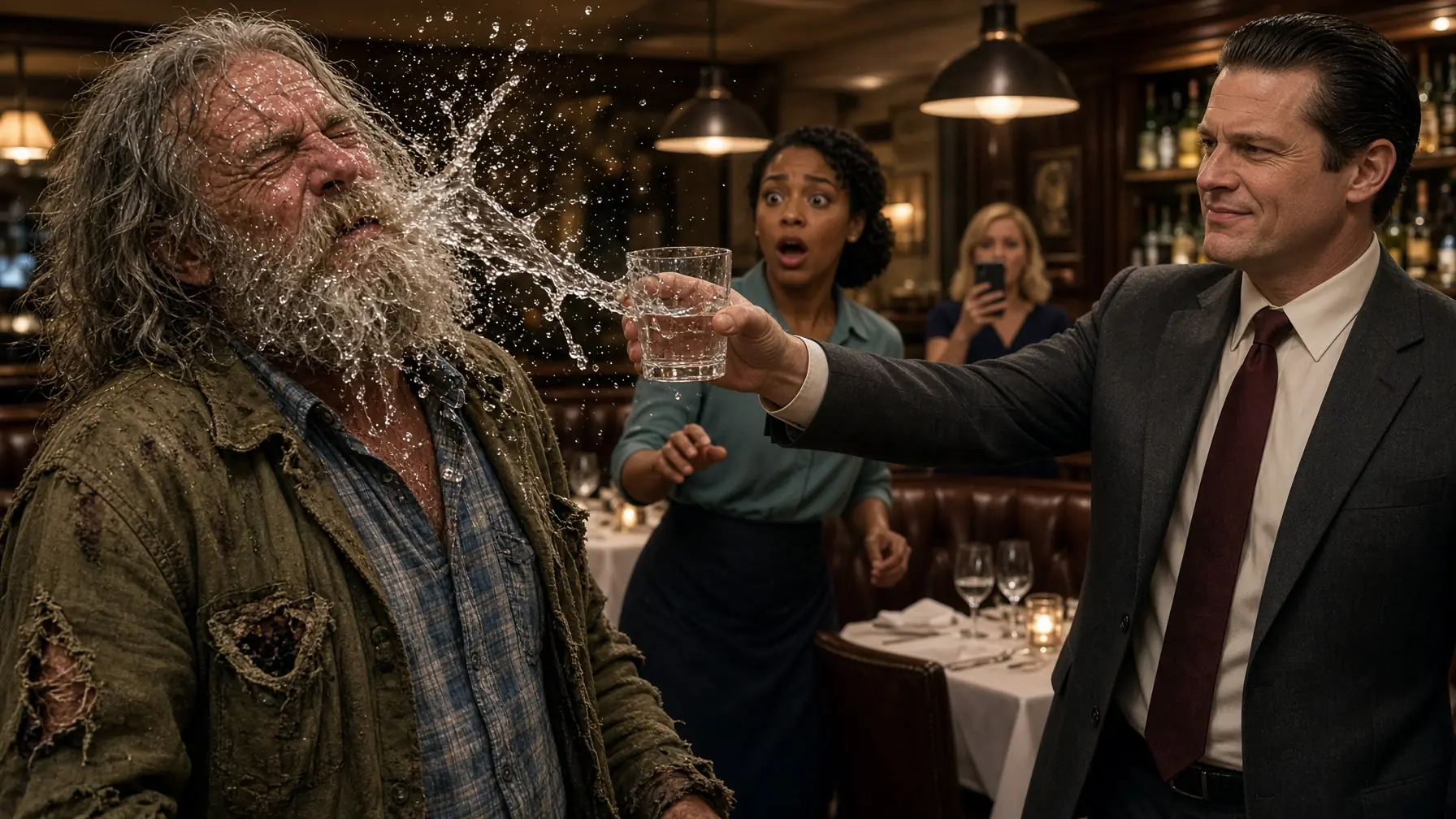
Blake Carter held the glass at his side.
It had not broken.
Theodore noticed that because his mind had seized on the smallest, simplest fact available. The glass was intact; the water was gone; and the man who threw it stood close enough that Theodore could see a tiny crease beside his smug mouth.
Behind Blake, the restaurant remained beautiful.
Warm pendant lights above leather booths. Neatly arranged tables. The polished bar reflecting rows of glassware.
Theodore had entered believing he could sit somewhere quiet.
Instead, he stood beside the host counter with water running down his neck, trying to remember how to breathe without showing the people watching how badly the moment hurt.
He had not raised a hand.
He had not threatened anyone.
He offered to clean his boots.
That morning, those boots had already been wet before the sun cleared the tree line.
Theodore was outside when the ground still held the night’s chill, following a stretch of fence that needed attention before another ordinary problem became an afternoon he could not afford to lose. He had meant to finish early.
Most days began with that intention.
A task took longer. Something else needed doing. The route back to the house became a series of stops that seemed too small to postpone.
By midday, his olive canvas jacket had gathered another layer of dirt.
The torn elbows caught on things if he forgot about them. One frayed cuff had become loose enough that he kept pushing it above his wrist, and the ripped pocket no longer held anything he could bear to lose.
He wore it anyway.
It fit over the checked shirt.
It took the abuse.
And when he put it on, he did not have to think about whether the work would leave a mark.
The jacket already carried the answer.
His jeans were no better.
The knees were torn, the hems unraveling above boots whose leather had cracked and whose soles had begun to peel at the edges. He had intended to deal with the boots.
Then he intended to deal with something else.
Theodore knew how that looked.
He did not need Blake Carter to explain it.
At around sixty-two, he was old enough to recognize the difference between not caring how he looked and not having the energy to make appearance the next priority. Lately, he had been living on the wrong side of that difference.
His hair had grown past his shoulders.
He kept meaning to cut it.
Instead, he tied it back when he remembered and pushed it away from his face when he did not. By the afternoon, the tie was gone and the wind had worked through it until the strands tangled around his collar.
His beard had gone unattended too.
In a mirror, it made him look older than he felt on good mornings and exactly as old as he felt on bad ones.
That day was neither especially good nor dramatically bad.
It was simply long.
There had been work.
Then more work.
Then the slow recognition that the evening appointment he had agreed to keep would arrive whether he finished everything or not.
He checked the time while standing beside a gate.
For a moment, he considered calling to say he could not come.
It would have been easy.
He was tired.
He looked like a man who had spent the day outside because he had.
He could go home, wash properly, find something less worn, and arrange another evening.
But he had already postponed once.
The other person had made room to meet him.
Theodore did not like treating somebody else’s time as less important than his own just because his day became inconvenient.
So he finished the immediate job, put away what could not be left exposed, and went to the truck.
He did not make the trip to the house first.
That would have required pretending he could go inside, clean up, and leave again without becoming too late.
He knew himself better than that.
He would sit for a minute.
A minute would become ten.
He would see something else that needed doing.
Then the evening would be gone.
Theodore wiped his hands with a cloth he kept in the truck and looked at his reflection in the side mirror.
Dust along his forehead.
Hair tangled beside his face.
The checked shirt visible beneath the jacket, with missing buttons and small holes near its hem.
He looked exhausted.
He looked worse than exhausted.
He looked like someone people might prefer not to see.
The thought irritated him.
Not because it was entirely unfair.
Because he could already feel himself preparing to apologize for arriving somewhere.
He was meeting someone.
He was not asking a restaurant to adopt him.
He could clean his boots, wash his hands, sit down, and order.
That should have been enough.
The drive gave him time to reconsider.
As the ranch fell behind him and the road became smoother, he noticed every stiff place in his body. His shoulders hurt when he adjusted his grip on the steering wheel.
His back objected when he shifted.
He was hungry enough that the thought of food made him impatient with distances he usually ignored.
He had eaten something earlier.
Not enough.
At the time, stopping to make a proper meal felt like a luxury of time.