The tractor sat in the center of Cedar Ridge Ag Service like a sleeping giant that refused to wake. It was brand new, enormous, and expensive enough to make every man in the workshop speak more softly around it. Its green body still shone under the clean shop lights, its cab held three digital screens, and its side panels hid more sensors, wires, and control modules than the older mechanics wanted to admit they understood. Yet for all that power and technology, the machine would not start.
Ethan Ward, the owner, stood near the concrete service bay with his arms crossed and his jaw locked. He had paid more for that tractor than his father had paid for the first eighty acres of their farm. The spring ground was ready, the weather window was tight, and every hour the tractor sat dead on the shop floor cost him time he could not get back. He looked at the three mechanics standing around it and asked the question none of them wanted to hear again.
“What else is left?”
Ryan Hale, the youngest mechanic, held a tablet in one hand and a diagnostic cable in the other. He had sharp hair, clean boots, and the confidence of a man who trusted software more than sound. Beside him, Connor Pike wiped his hands on a rag, though there was hardly any grease on them. Lucas Reed stood near the engine compartment, staring at the tractor like the machine might confess if he looked disappointed enough.
“We reset the control system twice,” Ryan said. “No active fault codes.”
“Fuel lines are clear,” Connor added.
“Battery voltage is perfect,” Lucas muttered. “Starter’s strong. It cranks clean.”
Ethan looked at the tractor. “Then why won’t it run?”
No one answered.
The silence filled the workshop until the ticking of cooling metal and the distant hum of fluorescent lights seemed loud. Ethan had built his entire season around this machine. It was supposed to pull heavy equipment through the north field, the hardest ground on his farm, without slowing down. The dealer had promised power, precision, and control, but right now the only thing it controlled was everyone’s patience.
Ryan tapped the tablet again. “We may need a factory specialist.”
Ethan turned sharply. “I don’t have three days.”
“Then I don’t know what else to tell you.”
From the back corner of the workshop, an older parts runner named Owen Bell cleared his throat. He had been quiet all morning, carrying filters, checking shelves, and watching the mechanics circle the tractor. Owen was almost sixty, old enough to remember when machines were simpler but young enough to know pride could make a man blind in every generation. He looked at Ethan and said, “There’s someone else.”
Ryan looked up from his tablet. “Who?”
Owen hesitated. “Silas Mercer.”
Connor actually laughed. “The old farmer out by Mill Creek?”
Owen did not smile. “That old farmer has forgotten more about machines than most men here have learned.”
Ryan lowered the tablet. “This isn’t a two-cylinder relic. This tractor has electronic load management, hydraulic safety interlocks, and encrypted calibration systems.”
Owen shrugged. “And it still won’t start.”
Ethan stared at him for a moment. Desperation made strange suggestions sound reasonable. He had known Silas Mercer’s name since childhood. Every county had one man people called when a baler made a sound no manual described, when a combine ran wrong even though every gauge said fine, when an old engine had one more season left if someone knew how to listen.
“Call him,” Ethan said.
Ryan shook his head under his breath. “Unbelievable.”
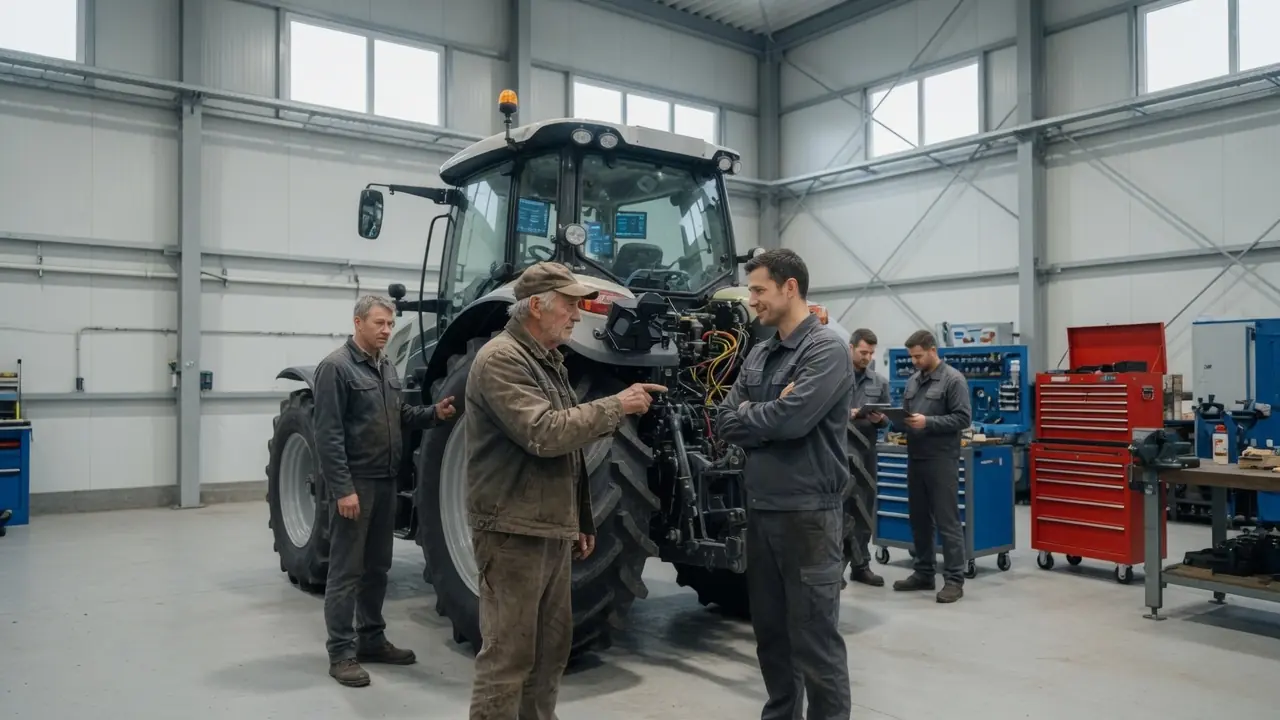
He was seventy-four, with white skin weathered by sun and cold, a gray beard stubble along his jaw, and a faded cap pulled low over his brow. He wore a worn brown jacket, dusty work pants, and boots that had clearly walked through real soil before stepping onto concrete. He did not hurry. He did not look impressed by the dealership sign, the polished tractor, or the mechanics watching him like a joke had just entered the room.
Silas walked through the open service door and stopped a few feet from the tractor.
Ryan crossed his arms. “Old man, this isn’t some rusty field tractor you can guess your way through.”
Silas looked at him once, then looked back at the machine. “I’m not here to guess.”
That quiet answer did not sound defensive. It sounded settled. Ethan noticed that first. Silas did not need the room to respect him before he began working. He simply walked around the tractor slowly, one hand hanging at his side, eyes moving from the tires to the rear assembly, from the cab steps to the side panel, from the wiring harness to the load sensor housing.
Ryan watched him with a smirk. “You want the tablet?”
“No.”
Connor gave a short laugh. “You going to ask it nicely?”
Silas ignored him.
He completed one full circle, then another half circle, stopping near the exposed side panel. He did not touch anything yet. He leaned slightly, studied the sensor connections, then looked toward the cab as if remembering how the machine behaved before he ever sat in it.
Ethan stepped closer. “What do you think?”
Silas did not answer immediately. “Who worked on it last?”
The workshop went still.
Ryan frowned. “What does that mean?”
“It means who changed something.”
“No one changed anything,” Ryan said.
Silas turned his head. “Then show me what you checked.”
Ryan looked irritated, but Ethan nodded for him to continue. The young mechanic walked to the tractor, opened the service panel fully, and pointed inside. He explained the diagnostics, the fuel system check, the safety interlocks, the electronic control module reset, and the clean voltage readings. He spoke quickly, as if speed could prove competence.
Silas listened to every word.
When Ryan finished, Silas nodded once. “That’s the problem.”
Ryan blinked. “What is?”
“You keep saying the system says everything is fine.”
“It does.”
Silas pointed lightly toward the sensor housing. “If something’s wrong and the system says everything is fine, then you’re asking the wrong thing.”
Ryan scoffed. “That doesn’t tell us anything.”
“It tells me enough.”
Ethan’s attention sharpened. He had heard men talk around problems all morning. Silas was the first man who sounded like he had found the edge of one. The old farmer climbed carefully into the cab, settled into the seat, and looked at the digital dash without touching anything.
Ryan muttered, “Now he’s going to do exactly what we already did.”
Silas turned the key.
The engine cranked strong and clean, but it did not start. He waited, tried once more, then shut everything down. For a few seconds, he sat completely still.
Then he said, “It wants to start.”
Connor rolled his eyes. “That’s obvious.”
Silas looked down from the cab. “No. It’s being stopped.”
That changed the air.
Ethan stepped toward the tractor. “Stopped by what?”
Silas climbed down and tapped the side panel near the safety sensor. “This.”
Ryan frowned. “That’s just a safety sensor.”
“Exactly.”
The word landed quietly but heavily. Silas bent closer, not touching the sensor yet, only studying the connection angle and the mounting bracket. He looked toward the rear linkage, then back at the sensor. His face did not brighten with discovery. It darkened with concern.
Ethan saw it. “Can you fix it?”
Silas looked at him. “I can make it start.”
Ryan spread his hands. “Then do it.”
Silas kept his eyes on Ethan. “You might not want me to.”
The whole shop went silent.
Ethan’s impatience faded into caution. “Explain that.”
Silas tapped the sensor housing once. “This sensor is misreading load. It thinks the tractor is already under pressure, so it blocks the start.”
Ryan stepped forward. “Then override it.”
“That’s the easy part.”
“What’s the hard part?” Ethan asked.
Silas looked toward the rear assembly, where the heavy linkage system waited for work it had not yet done. “It was calibrated wrong. Not just in the shop. For the field.”
Ryan frowned. “That makes no sense.”
Silas turned to Ethan. “Where are you using it first?”
“The north field. Heavy ground. Tight pull.”
Silas nodded slowly, as if that confirmed what he already feared. “That’s your danger.”
Ethan looked back at the tractor. “What happens if we run it?”
“It’ll start if I reset this,” Silas said. “It’ll move. It’ll pull. It’ll feel strong.”
“That sounds like what I paid for.”
“Until it stops regulating power under resistance.”
Ryan shook his head. “You’re guessing.”
Silas met his eyes. “I’ve seen it before.”
The answer carried no bragging, only experience. It sounded like weather remembered in the bones. Ethan felt the irritation in the room shift into something closer to fear, because Silas was no longer talking about a dead tractor. He was talking about a working tractor that could fail in a far more expensive way.
“What gives first?” Ethan asked.
Silas looked at him steadily. “Not the tractor.”
Ethan waited.
“Whatever it’s pulling.”
Lucas, who had been quiet until then, finally spoke. “You mean the implement?”
Silas nodded. “Or the linkage. Or the driveline under load. The machine is trying to protect itself, but it doesn’t know the work it’s about to do. If you force it awake without finishing the setup, you won’t fix the problem. You’ll move the problem into the field.”
The words settled across the workshop.
Ethan imagined the north field, the heavy ground, the expensive equipment attached behind the tractor, and a failure happening miles from the shop with rain on the way. Suddenly, the tractor refusing to start felt less like a defect and more like a warning. He looked at Ryan, whose confidence had thinned.
“Is he right?” Ethan asked.
Ryan’s jaw tightened. “The system didn’t show that.”
“That isn’t what I asked.”
Ryan looked at the sensor, then the rear assembly. “It’s possible.”
Silas gave no reaction to being confirmed. He only stepped closer to the panel. “Do you want it started or do you want it right?”
Ethan answered faster than before. “Right.”
Silas nodded. “Then no one rushes me.”
No one did.
For the first time all morning, the workshop gave the old farmer space. Silas removed his cap and set it on the tractor step. He opened the panel wider, adjusted one connection, checked the mounting angle, then asked for a wrench without looking back. Lucas handed it to him immediately.
Ryan watched closely, his tablet hanging at his side now. The old farmer did not tear things apart. He made small, precise changes that looked almost too simple to matter. He loosened one bracket, reset the sensor position, checked the harness tension, then climbed into the cab and entered a calibration sequence the mechanics had skipped because the machine had arrived “factory ready.”
“That screen isn’t in the quick-start guide,” Connor said quietly.
“No,” Silas said. “Because quick starts are for easy ground.”
Ryan’s face flushed, but he said nothing.
Silas worked for nearly forty minutes. He started inside the cab, moved to the panel, returned to the cab, then stood outside and asked Ethan to describe the north field in detail. Soil type. Slope. Implement weight. Pull depth. Turning space. Ethan answered every question, slowly at first, then with growing respect.
Silas listened the way real mechanics listened—not only for information, but for behavior hidden inside it.
Finally, he closed the side panel and climbed into the cab. The entire workshop held its breath. Silas rested one hand on the control, waited one second, and turned the key.
The engine cranked.
Then it started.
Smooth, clean, controlled.
No one cheered. The sound was too serious for that. It filled the workshop like proof, steady and undeniable. Silas let it idle, listening with his head slightly tilted. Then he increased the throttle gently, watched the readings, lowered it again, and shut the machine down.
“There’s your start,” he said.
Ethan exhaled, relief crossing his face.
Silas stepped down. “But not your answer.”
Ethan nodded. “We test it.”
For once, Ryan did not object.
They rolled the tractor out of the service bay into the open yard behind the dealership. The ground there was uneven enough to imitate real work without risking the north field. Silas climbed back into the cab and restarted it. He moved slowly at first, letting the machine respond, then gradually applied controlled load through the test rig Lucas connected behind it.
The tractor pulled.
Silas watched the readings, but he also watched the movement—the way the frame settled, the way the engine note changed, the way the rear assembly responded under pressure. He adjusted once, then again, small corrections that made the machine seem to breathe easier. Ryan stood nearby with the tablet and, for the first time that day, used it to learn instead of prove.
“That wasn’t happening before,” Lucas said.
Silas nodded. “Because before, it wasn’t ready.”
After the third pass, the tractor responded exactly as it should. Power came on smoothly. The load system regulated correctly. The engine did not fight itself. Ethan watched the machine move across the yard and felt the knot inside his chest finally loosen.
Silas brought the tractor to a stop and shut it down. He climbed out slowly, put his faded cap back on, and brushed dust from his jacket. Ethan approached him, no frustration left in his face.
“How much do I owe you?”
Silas shook his head. “Nothing.”
Ethan frowned. “You came out here and fixed what nobody else could.”
Silas looked at the tractor. “You already paid.”
“For what?”
“For almost learning the hard way.”
That line stayed in the air.
Ryan looked down at the concrete. Connor folded his arms, but not with arrogance now. Lucas stared at the tractor like he was seeing it for the first time. Ethan understood exactly what Silas meant. The most expensive mistake is not always the thing that breaks in the shop. Sometimes it is the thing that almost works long enough to destroy something else.
Ryan finally stepped forward. “How did you know?”
Silas looked at him. “I didn’t know all of it.”
Ryan seemed surprised by the honesty.
Silas continued, “I watched what the machine refused to do. Then I asked why a working machine would protect itself from starting.”
“We trusted the diagnostics,” Ryan said.
“Diagnostics tell you what the system sees,” Silas replied. “They don’t always tell you what the machine feels.”
Connor muttered, “Machines don’t feel.”
Silas looked at him, not harshly. “No. But they behave.”
The young mechanics had no answer.
Ethan extended his hand. Silas shook it firmly. There was dirt under the old farmer’s nails and strength still in his grip. “I owe you more than nothing,” Ethan said.
“Then use it right,” Silas replied. “And make them finish the job before they call it ready.”
He started walking toward his old pickup, the same quiet way he had entered. This time, no one laughed. No one smirked. The mechanics watched him go with the uncomfortable look of men who had been corrected without being humiliated.
At the workshop door, Silas paused and looked back at Ryan.
“You know plenty,” he said. “But don’t let the tablet make you deaf.”
Ryan swallowed. “Yes, sir.”
Silas nodded once and walked out.
The old pickup rattled to life and rolled away from the dealership, leaving the new tractor standing ready in the yard. Ethan watched until the truck disappeared down the road. Then he turned back to the machine and to the mechanics who had spent the morning trying to force an answer from screens.
Ryan picked up the tablet again, but he held it differently now. Not like a judge. More like a tool.
Lucas looked at Ethan. “You still taking it to the north field?”
Ethan looked at the tractor, then toward the road Silas had taken. “Yes. But we test it properly first.”
Connor nodded. “I’ll check the implement.”
Ryan added quietly, “I’ll run the load calibration again with field settings.”
Ethan noticed the change and said nothing. Sometimes men did not need speeches after being humbled. They needed a chance to do the next thing right.
The next morning, Ethan took the tractor to the north field. Ryan came with him, along with Lucas and the full test equipment. They did not rush. They connected the implement, checked the ground resistance, ran the tractor at low load, then gradually increased pressure. The tractor held. It adjusted. It pulled clean.
By noon, Ethan was working the field.
The machine did what the brochure had promised, but now Ethan understood that the promise meant nothing without judgment behind it. Power was dangerous when men trusted it blindly. Technology was useful only when experience taught it where to stand.
A week later, Ethan drove out to Mill Creek with a box of parts Silas had refused to charge him for and a fresh peach pie his wife, Nora, insisted he bring. He found Silas in an open shed, repairing an old hay rake with a wrench that looked older than Ryan Hale. The old farmer glanced up as Ethan stepped out of the truck.
“Tractor holding?” Silas asked.
“Perfectly.”
“Good.”
Ethan placed the box and pie on a workbench. “Payment.”
Silas looked at the pie. “That from Nora?”
“Yes.”
“Then I’ll accept the pie.”
“And the parts?”
Silas shrugged. “Leave them if it makes you feel better.”
Ethan smiled. “It does.”
For a while, he stood in the shed while Silas worked. The place was nothing like Cedar Ridge’s polished workshop. It smelled like hay, oil, dust, and old wood. Tools hung on pegboards, some modern, some ancient. There were no giant screens, no polished floor, no corporate signs. Yet Ethan felt more knowledge in that little shed than he had felt in the dealership all morning.
“Can I ask you something?” Ethan said.
Silas kept working. “You can ask.”
“Why didn’t you take the money?”
Silas tightened a bolt before answering. “Because then they’d think I came for money.”
“Why did you come?”
“Owen asked.”
“That’s it?”
Silas looked up. “And because a machine that expensive shouldn’t be ruined by men too proud to listen.”
Ethan nodded slowly. “Ryan’s different now.”
“He should be. He got embarrassed.”
“He needed it.”
“We all do, sooner or later.”
Ethan looked toward the fields beyond the shed. “You ever get tired of being underestimated?”
Silas gave a quiet laugh. “At my age, being underestimated is useful. Lets people show you who they are before they know they should hide it.”
The words stayed with Ethan long after he left.
Back at Cedar Ridge, the story spread quickly. Not as a loud legend, but as a shop lesson. A flagship tractor came in dead. Three trained mechanics could not start it. An old farmer in dusty boots found the problem by watching behavior instead of trusting a clean diagnostic screen. The first versions made Ryan look foolish, but over time, Ryan himself began telling the story.
He told it differently.
He would stand beside a machine with a new apprentice and say, “The tablet matters. Use it. But don’t stop there. Listen to the engine. Watch the system. Ask what the machine is trying not to do.”
Then he would pause and add, “An old farmer taught me that after I laughed at him.”
By harvest season, Ethan’s tractor had become the strongest machine on his farm, not because it was new, but because it had been set up correctly before being pushed. It pulled through the north field without damaging the implement, without power surges, without the dangerous overconfidence that had nearly followed it out of the workshop. Every time Ethan climbed into the cab, he thought of Silas tapping that sensor and saying he could make it start, but maybe they would not want him to.
The warning had saved him.
Months later, Cedar Ridge held a small training session for its mechanics. Owen suggested inviting Silas. Ryan supported the idea before anyone else could joke. Silas arrived in the same faded cap and brown jacket, looking uncomfortable in front of a room full of younger men with notebooks and tablets.
He did not give a fancy speech.
He pointed at a tractor diagram and said, “A machine has three stories. What the screen says, what the operator says, and what the machine does. If those three stories don’t match, don’t pick the easiest one. Find the truth.”
No one laughed.
Afterward, Ryan approached him privately. “I owe you an apology.”
Silas nodded. “Yes, you do.”
Ryan took that without flinching. “I thought you were just an old man guessing.”
“I know.”
“You weren’t.”
“I know that too.”
Ryan almost smiled, then grew serious. “I’m sorry.”
Silas studied him for a moment. “Good. Now be better.”
“I’m trying.”
“That counts if you keep doing it.”
The two men shook hands. The young mechanic’s hand was clean, the old farmer’s rough. For once, neither seemed to think that difference proved anything except where each man had learned.
Years later, people still remembered the day the modern tractor would not start. The story changed depending on who told it. Some made the machine bigger, the room more crowded, the mechanics more arrogant, the farmer almost mythical. But Ethan remembered it plainly: a silent tractor, a desperate morning, a room full of men who had tried everything except humility.
Silas Mercer never bragged about it. He went back to his farm, back to his old pickup, back to fixing things without audience or applause. If someone asked whether he really solved a problem the computers missed, he would shrug and say, “The tractor said enough.”
Most people laughed at that.
But not Ryan.
Not Ethan.
Not anyone who had stood in that workshop and watched a man everyone underestimated point to one small sensor and reveal the difference between making something start and making it safe to use.
The tractor had been modern.
The lesson was older than any machine in the room.
Never mistake new technology for complete understanding.
Never mistake a quiet man for an empty one.
And never laugh at dusty boots until you know how many fields they have crossed.