The laughter began before the farm girl ever raised her bidding card.
It was the kind of laughter grown men used when they believed the answer to a question was so obvious that only a child could miss it.
The auction yard in western Kansas was already crowded by eight that morning.
It was the summer of 1978, and the heat had arrived early.
Dust hung above the hard-packed ground in a pale brown haze.
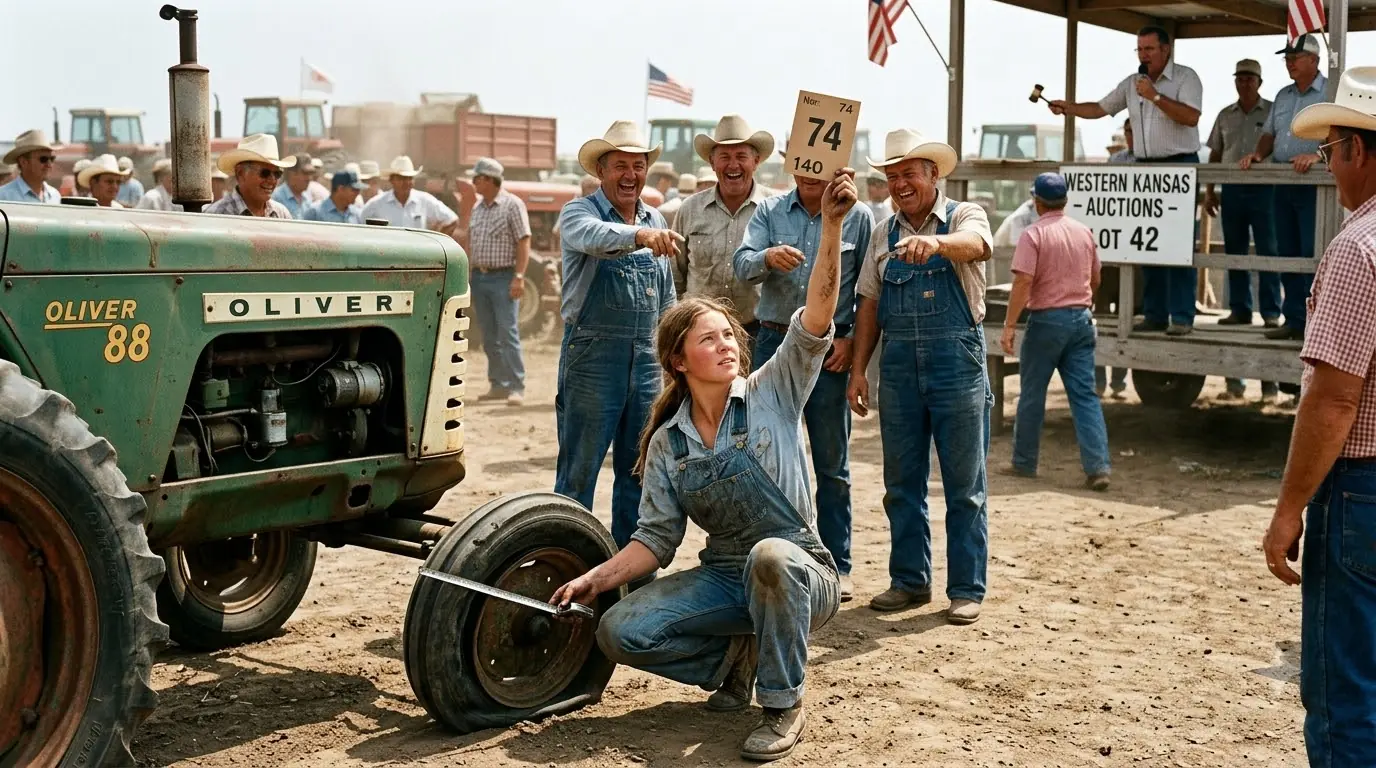
Pickup trucks filled the roadside.
Farmers stood in small groups beside equipment arranged in long rows beneath the sun.
There were plows with polished moldboards, combines with faded paint, grain drills, cultivators, wagons, trucks, engines, toolboxes, and tractors in every condition from nearly new to barely recognizable.
Some machinery had been carefully washed for sale.
Other pieces still carried enough dirt to show exactly where they had last worked.
The farm girl moved through the crowd with a dented metal coffee can held against her side.
Inside it was almost every dollar she owned.
She had earned that money slowly.
Not through an allowance.
Not from birthday cards.
She had earned it before school, after school, on weekends, and during the long hours of summer when other teenagers disappeared toward the swimming pool in town.
She fed calves for one neighbor.
Collected eggs for another.
Cleaned pens.
Stacked hay.
Pulled weeds.
Helped repair fence.
Washed equipment.
Carried lunch to harvest crews.
During wheat harvest, she rode beside her father until midnight and sometimes later.
Every small payment went into the coffee can.
Coins first.
Then single-dollar bills.
Eventually fives.
A few tens.
She counted the money often enough to know the total without opening the lid.
Two hundred eighty-seven dollars.
That was everything.
Her father knew she had brought it.
He had asked only one question before they left the farm that morning.
“Planning to spend it?”
The girl had shrugged.
“Maybe.”
“On what?”
“I’ll know when I see it.”
Her father had smiled.
Not because he believed she would buy anything serious.
He thought she might come home with an old toolbox, a hand drill, perhaps a small engine to rebuild.
He did not expect her to buy a tractor.
Nobody did.
Especially not that tractor.
It sat near the back of the auction yard behind two wagons and beside a badly rusted cultivator.
An old Oliver 88.
Once, the tractor had probably been a handsome machine.
Now its green paint had faded almost gray in places.
Rust marked the edges of the hood.
The seat was cracked.
One headlight was missing.
The exhaust pipe leaned slightly backward.
Grease darkened the front assembly.
The rear tires were worn but usable.
None of those things mattered much.
The front wheel did.
It leaned inward at such an ugly angle that the tractor looked as though someone had dropped it from a building.
Anyone approaching from twenty feet away could see the problem.
The auction sheet tied near the steering column made it worse.
POSSIBLE FRONT AXLE DAMAGE.
That phrase was enough to kill most interest.
Farmers knew what axle work could mean.
Parts.
Labor.
Time.
Possibly a complete front-end replacement.
Maybe damage deeper than anyone could see.
A cheap tractor could become an expensive mistake.
That was why nobody surrounded the Oliver.
People stopped.
Looked.
Shook their heads.
Then moved on.
The farm girl did not.
She stopped about ten feet away.
Her father continued walking for several steps before realizing she was no longer beside him.
He turned.
“You coming?”
The girl stared at the tractor.
Her father followed her eyes.
“Oh, no.”
She glanced at him.
“What?”
“I know that look.”
“What look?”
“The one you had before you brought home that broken hay elevator.”
“I fixed that.”
“After three weeks.”
“It worked.”
Her father pointed toward the Oliver.
“That isn’t a hay elevator.”
The girl walked closer.
She crouched beside the crooked wheel.
Her father sighed.
Around them, several farmers noticed.
One was a middle-aged man wearing a sweat-darkened cap.
He had been examining a nearby grain drill.
Now he smiled.
“Careful, sweetheart.”
The girl ignored him.
“That thing’s more likely to fall apart than start.”
Another farmer laughed.
“Maybe she wants a lawn ornament.”
A third man looked at the coffee can near her boot.
“You buying it with egg money?”
The group laughed.
The farm girl remained crouched.
She looked at the wheel.
Then at the steering linkage.
Then underneath.
Dust covered nearly everything.
Old grease had hardened around several points.
She wiped one area with her thumb.
The first farmer leaned closer.
“What are you looking for?”
She did not answer.
Instead, the girl reached into the pocket of her work shirt and removed a small measuring tape.
The men behind her laughed louder.
“Oh, this is getting serious.”
“What are you measuring?”
“Maybe she wants curtains for it.”
The girl pulled the tape across part of the front assembly.
She measured.
Stopped.
Then measured again.
Her expression changed.
Not dramatically.
Just enough that her father noticed.
He stepped closer.
“What?”
She shook her head.
“Nothing yet.”
One farmer pointed toward the wheel.
“You don’t need a tape measure to see that axle is bent.”
The girl looked up.
“Maybe.”
The farmer laughed.
“Maybe?”
He slapped the side of his jeans.
“I’ve worked on tractors since before you were born.”
Another man nodded toward the wheel.
“That front end’s finished.”
The girl looked back down.
She did not argue.
That irritated them more than an argument would have.
A person who argued could be corrected.
A silent teenager crouched in dust with a measuring tape seemed to suggest she knew something.
The first farmer stepped closer.
“You hearing us?”
“Yes.”
“And?”
The girl rewound the tape.
“I’m looking.”
He shook his head.
“Waste of time.”
Maybe.
But the girl remembered something.
It had been six years earlier.
She had been nine.
Her grandfather still lived then.
He kept an old shed behind the farmhouse, a low building that smelled of grease, dirt, oil, and metal warmed by afternoon sun.
Nothing in that shed was thrown away quickly.
Broken machinery was studied.
Bent pieces were saved.
Bolts were sorted into coffee cans.
Washers lived in glass jars.
Old bearings sat in wooden boxes because, according to her grandfather, a person never knew when something useless would become exactly the thing needed.
The girl spent hours in that shed.
At first, her grandfather gave her simple jobs.
Hold the flashlight.
Bring a wrench.
Clean a part.
Sort bolts.
Then he began asking questions.
“Why did that bearing fail?”
“Why did this shaft wear here instead of there?”
“What does that sound tell you?”
He never accepted “I don’t know” as the end of an answer.
“I don’t know” meant look again.
One afternoon, a neighbor had brought over an old tractor with one front wheel sitting at a terrible angle.
The girl remembered staring at it.
“Bent axle?”
she had asked.
Her grandfather had smiled.
“Looks like it.”
Then he had pointed.
“Which is why people spend money replacing things that aren’t broken.”
She had followed him underneath.
He had shown her a small piece of the front assembly.
Nothing impressive.
Nothing expensive.
But when it wore, bent, shifted, or failed in a certain way, the geometry of the wheel changed.
From a distance, the tractor looked ruined.
Her grandfather had tapped the part with a wrench.
“Always look at the cheap failure before you believe in the expensive one.”
The girl had never forgotten that sentence.
Always look at the cheap failure before you believe in the expensive one.
Now, at fifteen, kneeling beside the old Oliver 88, she saw something familiar.
Not proof.
Not yet.
But familiar.
The axle itself did not appear to sit the way a badly bent axle should.
One measurement was wrong.
Another was surprisingly close.
The wheel angle was terrible.
The surrounding structure did not fully agree with it.
That contradiction made her curious.
Her father crouched beside her.
“You thinking what I think you’re thinking?”
She whispered:
“Grandpa’s tractor.”
Her father looked again.
Then his expression changed slightly.
“You sure?”
“No.”
“That’s an expensive no.”
“I know.”
The farmer behind them laughed.
“Her dad finally talking sense into her?”
The father stood.
He looked at the man.
“No.”
The farmer grinned.
“Then somebody better.”
The auctioneer’s voice carried from another row.
They were approaching the tractors.
People began moving.
The girl stood.
Her father touched her shoulder.
“How much?”
“All of it if I have to.”
His eyebrows rose.
“No.”