The first dump truck arrived before sunrise.
Ethan Carter heard its air brakes from his upstairs bedroom and sat up, confused by the heavy mechanical hiss rolling through the frozen darkness outside the farmhouse.
Then came another.
And another.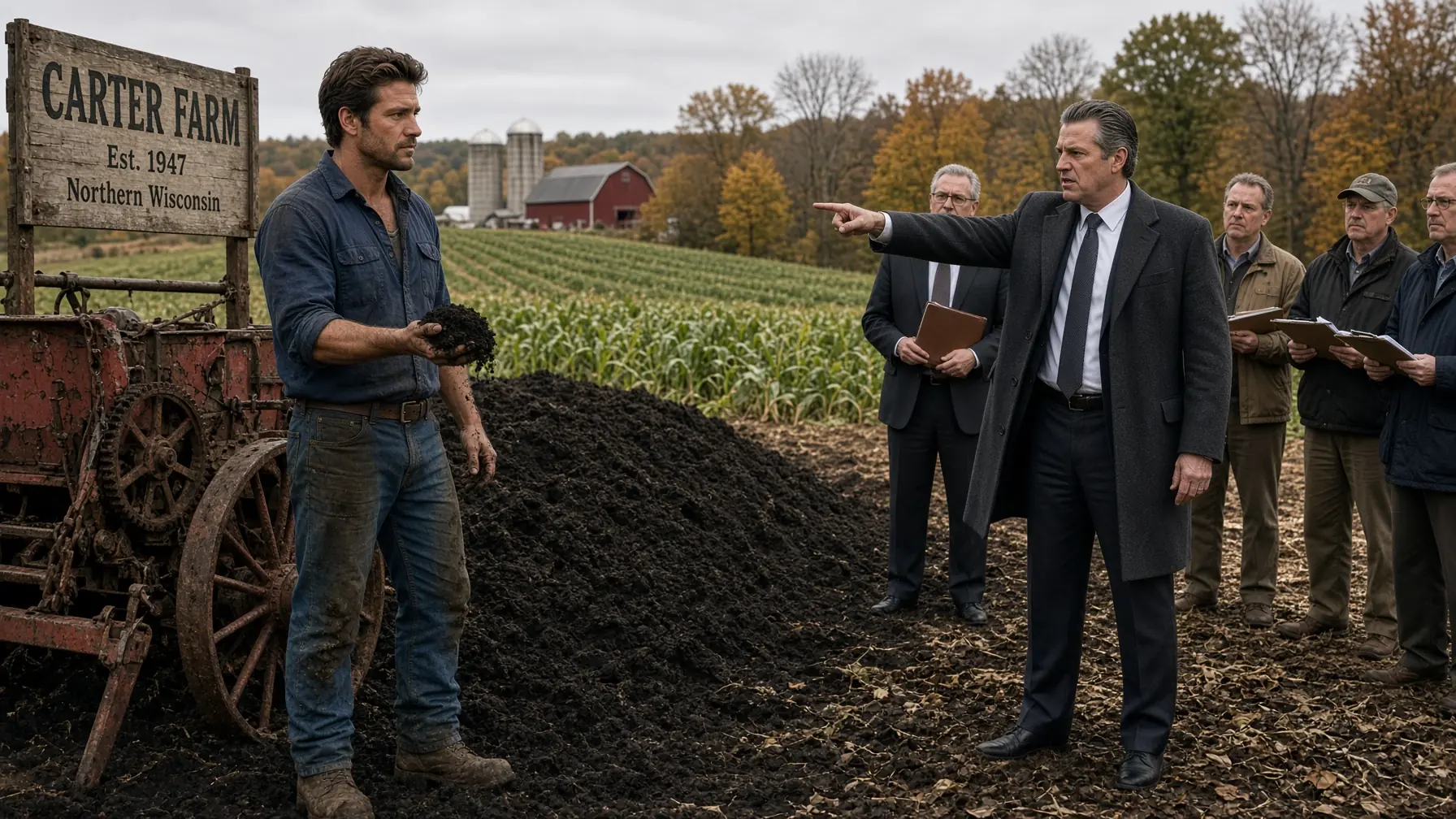
By the time Ethan pulled on his jeans, work shirt, and boots and stepped onto the porch, headlights stretched down the gravel lane behind the Carter property like a convoy.
It was the winter of 1979 in northern Wisconsin, and twenty-five-year-old Ethan Carter had already spent enough years working beside his father to know that machinery appearing before daylight usually meant either trouble or money.
Sometimes both.
Ethan was tall and naturally athletic from farm work, with thick dark-brown hair, hazel eyes, a strong jaw, and the kind of sun-browned face that looked older during planting season and younger again after winter. He had recently begun taking over more responsibility on the Carter farm, although his father, Walter, still made most major decisions.
That morning Walter was already standing beside the back fence.
The older farmer wore brown coveralls beneath an old coat, one hand wrapped around a steaming mug of coffee.
A dump truck reversed toward the low pasture.
Its bed began to rise.
A pale avalanche spilled onto the frozen ground.
Sawdust.
Wood shavings.
Chips.
Steam rolled from the pile into the bitter air.
Ethan stared.
“What the hell is this?”
Walter drank his coffee.
“The mill’s waste.”
“I can see that.”
Another truck backed toward the field.
Ethan looked at his father.
“Why is the mill’s waste on our farm?”
Walter finally glanced toward him.
“They’re paying for somewhere to put it.”
Ethan looked across the pasture.
“How much?”
Walter told him.
Ethan’s expression changed slightly.
The previous year’s drought had cut deeply into their hay production. A tractor transmission needed work. Their baler was becoming unreliable.
Cash mattered.
Still, Ethan looked at the enormous pile growing behind the fence.
“How temporary is this?”
Walter returned his attention to the truck.
“Depends how long they keep paying.”
By the end of winter, the back section of the Carter property looked as though it had disappeared beneath pale yellow snow.
Except this snow smelled like pine.
The nearby lumber mill was one of the largest employers in the area. Almost every family knew somebody working there.
Production had increased.
So had waste.
Sawdust, bark, planer shavings, chips, and other wood residue accumulated faster than the mill could conveniently handle.
The company needed disposal space.
Most farmers wanted nothing to do with it.
People believed heavy applications of raw sawdust would lock up nitrogen, create acidic conditions, smother vegetation, and generally make a mess that might take years to fix.
Walter understood those concerns.
He simply also understood that the mill was paying.
The unused ground behind the Carter pasture had never produced particularly well.
So he accepted the arrangement.
The neighbors thought he had lost his mind.
Dale Harper was the first to say it directly.
Dale farmed nearby and had known Walter for decades. One afternoon he parked beside the county road while another truck unloaded.
Ethan was repairing a gate.
Walter was checking fence wire.
Dale leaned against his pickup and watched the sawdust pour.
“Congratulations, Walter.”
Walter kept working.
Dale grinned.
“You’re officially farming hamster bedding.”
Two men with him laughed.
Ethan straightened.
At twenty-five, he had less patience for insults than his father did.
Walter simply continued tightening the wire.
Dale called again.
“That field’s ruined forever.”
Walter finally looked toward him.
“Good thing it isn’t yours.”
Ethan smiled.
Dale’s grin disappeared.
The dumping continued.
Month after month.
Year after year.
Spring trucks.
Summer trucks.
Winter trucks.
The piles became hills.
By 1982, some stood higher than Ethan.
Children riding past on bicycles called the area the Wooden Desert.
People slowed their cars just to stare.
At the feed store, strangers asked Walter whether he planned to open the world’s largest horse stable.
Walter rarely defended himself.
One afternoon, Ethan asked why.
“You know they think we’re idiots.”
Walter loaded feed bags into the pickup.
“Let them.”
“That doesn’t bother you?”
“No.”
“Why not?”
Walter shut the tailgate.
“People argue harder with an idea than they do with a result.”
Ethan remembered that.
Because Walter had already started experimenting.
He did not simply let the sawdust sit.
He watched it.
Studied it.
Mixed selected piles with manure.
Added spoiled hay.
Used poultry litter when he could acquire it cheaply.
Applied lime in measured amounts.
He tracked heat with a long metal thermometer.
At night, Walter sat at the kitchen table recording dates, temperatures, rainfall, mixture ratios, smell, color, and moisture.
Ethan once found him writing after ten o’clock.
“You’re keeping notes on garbage?”
Walter looked up.
“Soil’s hungry.”
Ethan laughed.
“That doesn’t mean anything.”
“It will.”
“What’s dirt supposed to be hungry for?”
“Carbon. Life. Water. Structure.”
Ethan stared at him.
“You sound like a preacher.”
Walter returned to his notebook.
“You’ll understand eventually.”
For the first years, Walter’s experiment caused as many problems as benefits.
Wind lifted fine sawdust and carried it across nearby ground.
Some piles became wet, dense mats.
Other sections smelled sour.
Once, during a warm wet summer, decomposition inside a pile became hot enough that smoke-like vapor began rising heavily.
Dale Harper drove over specifically to enjoy the spectacle.
He found Ethan and Walter standing beside the mound.
Dale pointed.
“Your dirt’s on fire now.”
Walter looked at the steam.
“No.”
Dale frowned.
“What do you call that?”
“Compost.”
“That’s smoke.”
“Heat.”
“You buried your field under sawdust and now it’s cooking.”
Walter pushed the temperature probe deeper into the pile.
“That’s the idea.”
Dale looked genuinely annoyed.
“You wanted this?”
Walter read the thermometer.
“Pretty much.”
Ethan turned away so Dale would not see him laughing.
By 1985, something began changing.
The oldest piles were no longer pale.
They had darkened.
Raw shavings softened and broke apart.
The smell changed from fresh wood to something deeper and earthier.
When Ethan pushed his hand into one pile, the material was dark brown, warm, crumbly, and moist.
Walter began spreading small amounts on exhausted sections of the farm.
One test area was the South Field.
For years, the soil there had crusted badly and dried faster than Walter wanted.
Corn struggled during hot summers.
He spread compost across several strips.
Nothing miraculous happened.
But small changes appeared.
The treated ground stayed moist longer.
Surface crusting decreased.
After rainfall, Ethan began seeing more earthworms.
Plants developed more evenly.
Walter recorded everything.
Then came 1986.
Rain disappeared by midsummer.
Pastures turned brown.
Corn leaves curled under the heat.
Across the county, topsoil hardened into cracked plates.
Farmers began calculating losses.
The South Field suffered too.
But not as badly.
The compost-treated sections stayed green longer.
The plants did not look perfect.
They simply looked alive while neighboring ground was fading.
One August evening Dale Harper stopped beside the road.
He looked toward Carter corn.
Then toward his own.
Then back again.
“That section yours?”
Ethan was repairing part of a spreader wagon.
Walter nodded.
Dale narrowed his eyes.
“Why’s it greener?”
“Better soil.”
“Because of that wood garbage?”
Walter smiled slightly.
“Because of carbon.”
Dale stared.
“That supposed to mean something?”
“It does to the corn.”
Dale drove away without another joke.
By 1988, almost nobody called the Carter property ruined anymore.
The old waste field had transformed into acres of dark organic material.
Walter purchased an old spreader wagon specifically to handle it.
Ethan became the one who ran it most often.
By then he was in his mid-thirties, and farming had carved more definition into his face and shoulders.
He had thick dark hair, sharp hazel eyes, a lean muscular build, and the calm physical confidence of someone who had spent most of his adult life lifting, repairing, planting, and harvesting.
He was also beginning to understand what his father had seen years earlier.
Soil was not dead material.
It behaved.
It changed.
It held memory.