“Ladies, I just had the most brilliant idea.”
Catherine Prescott stood beneath the crystal chandelier in the center of her marble-floored sitting room, champagne raised loosely between two fingers.
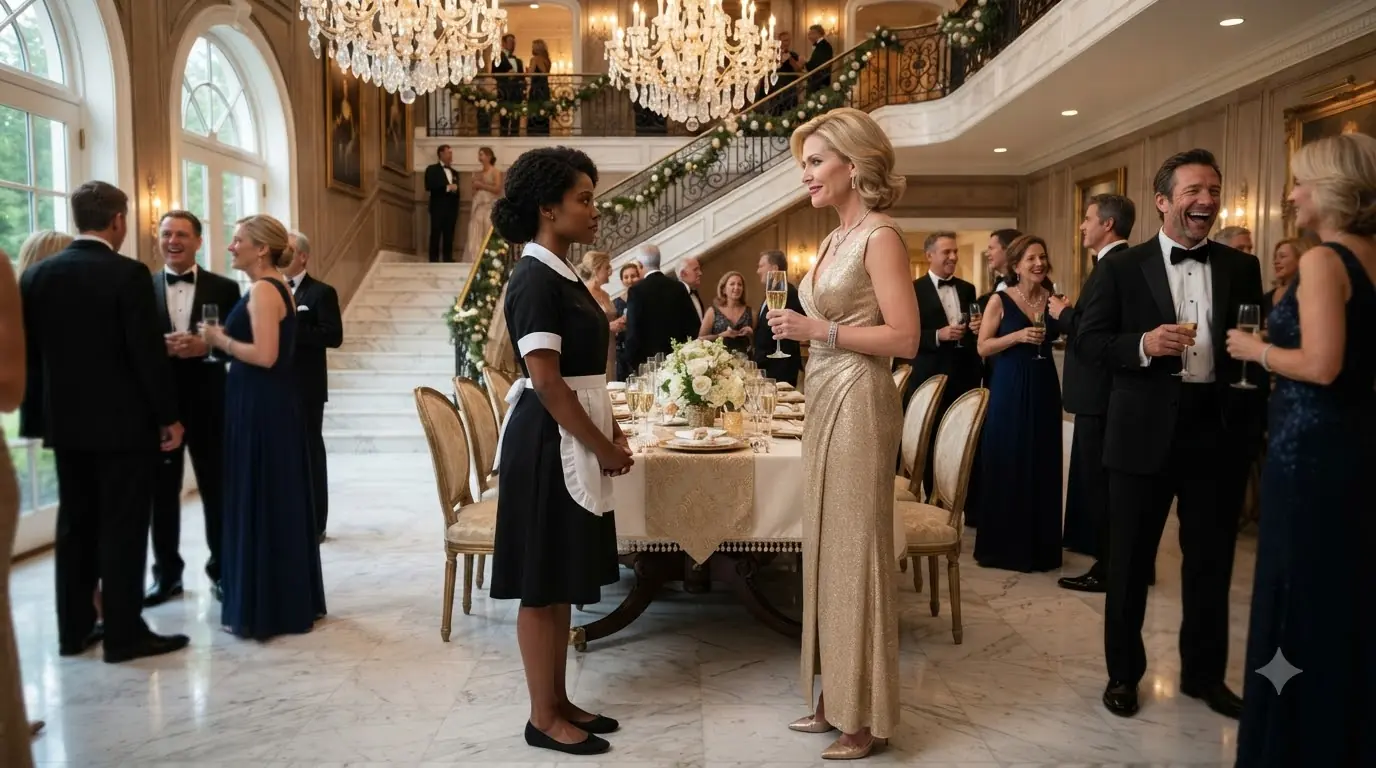
Around her, six women in silk dresses and diamonds leaned closer.
Near the doorway, Monica Adams held a tray of polished glasses against her hip.
Catherine glanced toward her.
Then smiled.
“I’m inviting my maid to my birthday gala.”
For half a second, nobody understood.
Then Catherine’s closest friend laughed.
The others followed.
Monica lowered her eyes.
Not because she was ashamed.
Because she had worked for Catherine Prescott long enough to understand that cruelty was less satisfying when its target refused to perform pain.
“Two hundred guests,” Catherine continued.
“Investors.”
“Executives.”
“Politicians.”
“People who actually matter.”
She slowly looked Monica up and down.
“And then this.”
The laughter became louder.
Monica remained still.
Catherine stepped closer.
“Did you hear me?”
“Yes, ma’am.”
“You're coming Saturday.”
Monica looked up.
“As staff?”
Catherine smiled.
“No.”
That surprised her.
“As my guest.”
The women laughed again.
Catherine enjoyed the confusion on Monica’s face.
Then she delivered the rest.
“I thought the evening needed entertainment.”
One woman covered her mouth to hide a laugh.
Another whispered:
“Catherine…”
But she was smiling too.
Catherine turned toward a cabinet beside the fireplace.
She opened one drawer.
Pulled out an old stained kitchen cloth.
It had once been white.
Years of cleaning had turned it gray.
Catherine held it between two fingers.
“Wear something nice.”
She paused theatrically.
“Oh.”
“Right.”
Then she tossed the cloth at Monica.
Monica caught it.
“That’s your gown.”
The women erupted.
Catherine lifted her champagne.
“Let my guests see what a real charity case looks like.”
Monica stared at the cloth.
Her fingers tightened around it.
“Of course, ma’am.”
Catherine leaned closer.
“What's wrong?”
“Nothing.”
“You don't think it’s funny?”
Monica met her eyes.
“I think I'll remember it.”
Something about the answer made Catherine’s smile falter.
Only for a second.
Then she laughed again.
“Good.”
“You should.”
Monica folded the cloth neatly.
Placed it over her arm.
Then picked up the tray.
She walked away without another word.
Nobody saw her hands shaking once she reached the service hallway.
Nobody saw her stop beside the pantry door and close her eyes.
Nobody saw the tear she wiped away before it reached her cheek.
And nobody in that room understood that Monica Adams had spent the last three years being underestimated on purpose.
Seven years earlier, Monica had occupied a glass office forty floors above downtown Chicago.
She had been twenty-six.
Young enough that senior executives often assumed she was an assistant.
Good enough that they stopped making that mistake after she opened a spreadsheet.
Monica had grown up in a family where money was counted carefully.
Her mother cleaned hotel rooms.
Her father repaired industrial machinery.
Neither had finished college.
Both made sure she did.
Monica studied accounting.
Then finance.
Then forensic analysis.
Her first job paid more money than either of her parents had ever earned.
She sent half her first bonus home.
Within four years, she became one of the youngest senior analysts in her division.
Her specialty was simple to describe.
Difficult to do.
She found the places where financial stories stopped matching financial facts.
Then came the Hartwell acquisition.
Her company planned to purchase a smaller logistics firm for hundreds of millions.
Everyone loved the deal.
Executives called it transformational.
Bankers called it strategic.
Investors were told it would immediately increase earnings.
Monica called it impossible.
Not publicly.
At first.
She noticed that several operating expenses had been moved into categories that made them appear temporary.
Customer losses were being treated as one-time events.
Debt obligations were buried inside subsidiaries.
On paper, Hartwell looked profitable.