The wooden wash paddle stopped inches above Abigail Hale’s head when a low voice cut through the alley behind the Black Pine Boarding House. Abigail remained on her knees in the mud, both arms raised over her bruised face, too frightened to look toward the stranger. Her mother, Martha Hale, stood above her with rainwater dripping from the paddle and fury twisting her hard features. The miners passing at the mouth of the alley slowed, but none of them stepped closer.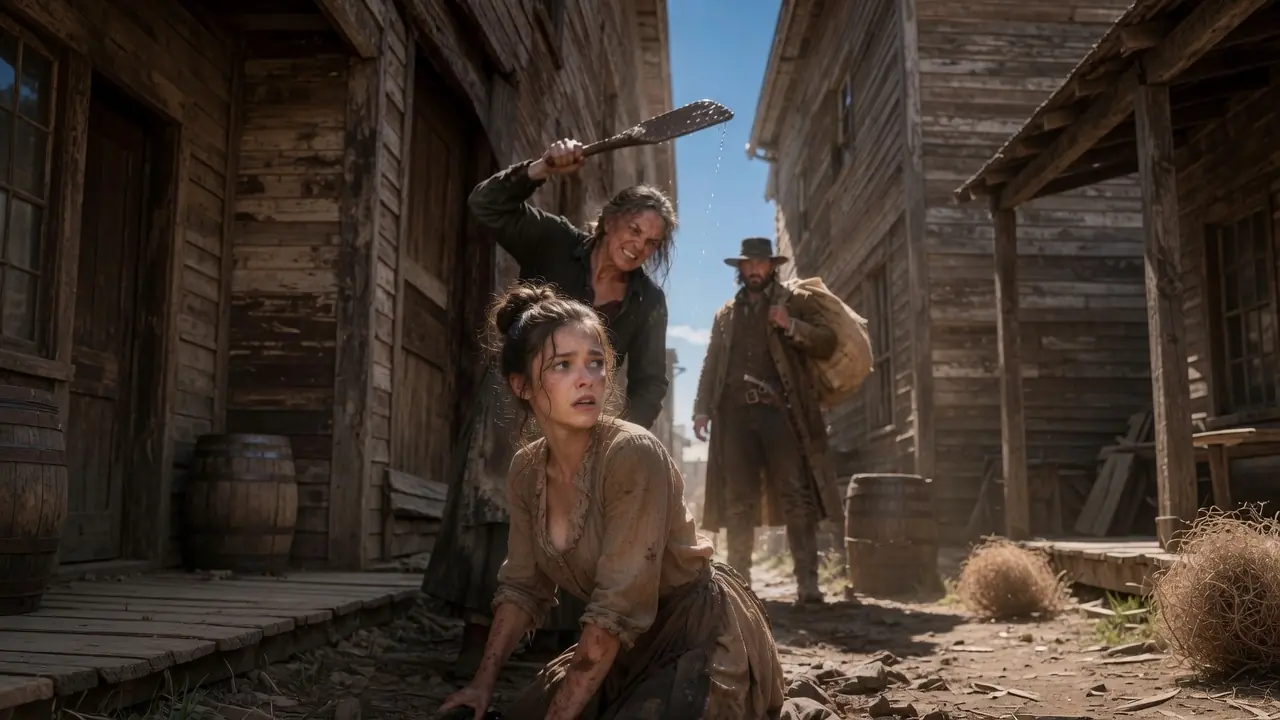
“Please don’t hit me,” Abigail whispered.
“You hid my money and tried to run,” Martha snarled. “You belong to me, and I’ll break you before I let you leave.”
Boots moved across the wet ground behind them. The newcomer stopped only a few paces away, carrying a heavy canvas pack over one shoulder and wearing a long brown coat darkened by mountain rain. He was broad through the chest, with a weathered face, thick dark hair, and a full beard that made his expression difficult to read. A rifle rested against his hip, but his hands remained calm at his sides.
“Put the paddle down,” he said.
Martha turned sharply. “This is family business.”
The man reached into his coat and removed three gold coins. He held them between two rough fingers, allowing the pale afternoon light to catch their edges. Several miners near the alley entrance murmured, because three gold coins represented more money than most of them earned in months. Martha’s eyes moved from the money to the stranger’s face.
“Take these and release her now,” he said.
Abigail finally looked up. The man’s gray eyes were not soft, but neither were they hungry, mocking, or impatient. He looked at the raised paddle as though it were an object he intended to remove from the world. Then his gaze dropped to the carved silver pendant hanging from Abigail’s neck.
Something changed in his face.
The pendant was shaped like a small pine tree beneath a crescent moon. Abigail’s father had carved the design into the metal before she was born, and it was the only possession Martha had never managed to take from her. Abigail usually hid it beneath her blouse, but the chain had been pulled free during the struggle. The mountain man stared at it as though he had just seen a ghost.
“Where did you get that?” he asked.
“My father gave it to me.”
“What was his name?”
Abigail hesitated. Martha gripped the paddle more tightly.
“Do not answer him,” she ordered.
“Samuel Hale,” Abigail said.
The stranger’s expression hardened. He stepped between Abigail and the raised paddle, forcing Martha to lower it or strike him instead. “Take the coins,” he said without looking away from her. “Then write that Abigail owes you nothing.”
Martha laughed. “You cannot purchase another person.”
“You have spent twelve years claiming her labor pays some imaginary debt,” he replied. “I’m paying the debt you invented.”
“I fed her. Clothed her. Kept a roof over her head.”
“You beat her beneath that roof.”
Martha’s eyes moved toward the witnesses gathering nearby. She knew the town tolerated cruelty when it remained hidden behind walls, but public cruelty made respectable people nervous. The stranger placed the coins on an overturned barrel and removed a folded paper from his coat. He had already written the terms in a steady, careful hand.
Martha read the paper twice. It stated that three gold coins settled every debt she claimed Abigail owed for food, clothing, lodging, medicine, and household expenses. It also declared that Abigail was free to leave the Black Pine Boarding House without further obligation. Two miners offered to sign as witnesses before Martha could object.
“Why would you spend that much on her?” Martha asked.
The mountain man looked at the pendant again. “Because her father once paid a greater price for me.”
Abigail did not understand, but Martha did. Her face went pale beneath the anger. She signed the document quickly, snatched the coins, and stepped away as though the stranger carried a disease.
“You will regret this,” she told Abigail. “Men do not give away gold without expecting repayment.”
The warning struck exactly where Martha intended. Abigail had learned that every kindness contained a hidden demand, and that every gift became a weapon once she accepted it. She looked toward the mountain man with sudden terror. He saw it immediately.
“My name is Cole Mercer,” he said. “You do not have to come with me.”
Martha gave a contemptuous laugh. “Then she can sleep in the street.”
Cole picked up Abigail’s small cloth bundle from the mud. “I have a cabin two days north. You may stay until you decide where you wish to go.”
“You expect me to believe that?” Abigail asked.
“No.”
His answer surprised her.
Cole held out the signed paper instead of his hand. “Keep this. Whatever happens next, she cannot claim you owe her anything.”
Abigail took the document and folded it against her chest. Her fingers trembled so badly that the paper rattled. Behind Cole, Martha watched with narrowed eyes, already calculating how she might recover the coins and regain control. Abigail understood that remaining in town would allow her mother to drag her back before nightfall.
She followed Cole.
They left Black Pine before sunset with one packhorse and a chestnut mare named Willow. Cole gave Abigail the mare and walked beside her instead of riding, though the muddy road rose steadily toward the mountains. He did not ask about the bruises on her face or the years she had spent working without wages. He spoke only when the trail became dangerous or when he needed to point out a low branch.
At dusk, they stopped beneath a rocky overhang. Cole built a small fire, heated beans in a blackened pot, and placed the food near Abigail before moving to the opposite side of the flames. He kept his rifle beside him but turned the barrel away from her. Abigail ate slowly, waiting for him to name the price of the meal.
“You knew my father,” she finally said.
Cole nodded. “Eleven years ago.”
“He died eleven years ago.”
“I know.”
Martha had always claimed Samuel Hale abandoned them after gambling away the boarding house. According to her story, he fled into the mountains with stolen money and froze during an early winter storm. His body had never been returned, and Martha used that absence as proof of his cowardice. Abigail had been eight years old when he disappeared.
“What did he do for you?” she asked.
“He saved my life.”
Cole explained that he had once trapped for a mining company farther north. During a spring flood, his horse fell into a swollen river and dragged him beneath the current. Samuel Hale, traveling with a freight wagon, cut the harness and pulled Cole onto the bank. He stayed three nights while Cole recovered from a broken leg and fever.
“He wore that pendant,” Cole said. “Not one like it. That exact pendant.”
Abigail touched the metal. “He gave it to me before he left.”
“He told me he carved it for his daughter.”
Her throat tightened. “Did he say why he was traveling?”
Cole stared into the fire. “He said he had found proof that someone was stealing from him. He planned to take it to the territorial judge.”
Abigail stopped breathing for a moment. Martha had never mentioned a judge, stolen money, or proof. She had described Samuel’s final journey as a drunken escape from debt.
“Did he say who stole from him?”
“No. But he feared the person would follow.”
The mountain wind moved through the pines above them. Abigail heard Martha’s voice in her memory, insisting that Samuel had abandoned her because she was weak, troublesome, and expensive. For years, Abigail had believed her father chose freedom over his family. Now a stranger described a man carrying evidence toward a judge.
“What happened after he helped you?” she asked.
“I woke one morning and he was gone. He left food, a walking stick, and half his money beside me.”
“Why?”
“He said a man should not survive one danger only to starve beside the road.”
Cole reached inside his coat and removed a small leather pouch. From it he took a second pendant, made of dark wood and carved with the same pine tree beneath a crescent moon. “He made this while I healed.”
Abigail held both pendants side by side. The carving marks matched exactly, including the small cut along the moon where Samuel’s knife had slipped. No lie could have created such a detail. Tears filled her eyes before she could turn away.
Cole pretended not to notice. He added wood to the fire and spread his blanket near the edge of the overhang, leaving the warmer place for her. That night Abigail slept with the signed paper beneath her blouse and both pendants held inside her fist.
Cole’s cabin stood in a high valley surrounded by dark pines and snow-streaked ridges. It was built from thick logs, with a stone chimney, two small rooms, and a narrow loft reached by a ladder. Abigail expected him to tell her which chores would repay the three gold coins. Instead, he showed her a bed behind a wooden door that locked from the inside.
“The key stays with you,” he said.
She stared at the iron key in her palm. “Where will you sleep?”
“In the loft.”
“What must I do?”
“Nothing today.”
“And tomorrow?”
“Whatever you choose.”
Abigail almost became angry. Choice sounded like another trick, one designed to expose her ignorance and make her punishment feel deserved. “You paid three gold coins,” she said. “No one pays that much for nothing.”
“I paid to stop the paddle.”
“That does not explain why.”
Cole looked at the pendant resting against her throat. “Your father pulled me from a river when I was a stranger. He did not ask what I could give him afterward.”
Abigail lowered her eyes. “Martha said men only help women when they want something.”
“Martha said whatever kept you afraid.”
For the first three days, Abigail remained inside the small bedroom except to eat. Cole left food outside the door, knocked once, and walked away. He spent the daylight hours checking traps, splitting wood, and repairing a section of roof damaged by wind. At night she heard him moving carefully in the loft, never approaching her locked door.
On the fourth morning, Abigail found him cleaning a cut on his hand near the stove. He had sliced his palm while repairing a broken axe handle. She fetched a clean strip of cloth without being asked and wrapped the wound with the skill of someone who had treated many injuries in secret.
“You have done this before,” he said.
“Martha became angry if customers saw blood on the linens.”
Cole’s jaw tightened, but he did not ask for more details. “Thank you.”
Abigail waited for him to remind her that gratitude required obedience. Instead, he tested the bandage, nodded approvingly, and returned to work. Something unfamiliar loosened inside her chest.
Over the following weeks, she began choosing small responsibilities. She swept the cabin, cooked venison stew, and repaired Cole’s torn shirts because sewing made her hands feel useful rather than trapped. Cole taught her to set rabbit snares, read weather from the movement of clouds, and fire a rifle without letting the recoil bruise her shoulder.
He never stood too close behind her. He never took an object from her hand without asking. When a nightmare woke her one night, she found him sitting outside her door on the floor, speaking softly through the wood until she recognized the cabin.
“You may come in,” she whispered.
“Are you certain?”
“Yes.”
Cole entered and sat beside the cold fireplace rather than the bed. Abigail told him about the boarding house, the years of unpaid work, and the punishments Martha called discipline. She also described Samuel’s disappearance and the strange locked room Martha had kept sealed ever since.
“My father stored his account books there,” Abigail said. “After he vanished, she burned most of them.”
“Most?”
“I saved one page.”
From the lining of her carpetbag, Abigail removed a folded scrap of paper covered in faded numbers. She had stolen it from the ashes as a child because Samuel’s handwriting appeared at the bottom. The page recorded repeated payments from a man named Edwin Pike.
Cole recognized the name. Pike was now a deputy in Black Pine, known for collecting debts that did not legally exist. Eleven years earlier, he had worked as a freight guard on the northern road Samuel traveled.
“If Pike was paying your father,” Cole said, “why would Samuel hide the record?”
“The payments move backward.”
Cole examined the columns again. Abigail was right. The amounts were written as money entering the boarding house accounts, but Samuel’s notes indicated the coins had actually been removed. Pike had been taking money while Martha altered the books to make the theft appear legitimate.
At the bottom of the page, Samuel had written one sentence.
Martha and Pike meet after midnight. The land deed is missing.
The Black Pine Boarding House stood on valuable ground beside a road the railroad planned to expand. If Samuel owned the deed, Martha could not sell the property without him. Abigail began to understand why her father had carried evidence toward a judge and why he never returned.
“We need the rest of the records,” Cole said.
“Martha destroyed them.”
“Perhaps she destroyed what she wanted you to see burning.”
Before they could decide what to do, hoofprints appeared near the cabin.
Cole discovered them at dawn after fresh snow. Three riders had approached from the south, circled the property, and left without dismounting. One horse wore a distinctive split shoe, the same kind used by Deputy Pike’s gray gelding.
“They found us,” Abigail said.
Cole checked the rifle above the door. “Finding the cabin and entering it are different matters.”
“They will say you kidnapped me.”
“You have the signed release.”
“Pike is the law in Black Pine.”
“Not in this valley.”
Cole sent a message with a passing timber crew to Marshal Thomas Reed in Laramie. Then he moved the original release, Samuel’s wooden pendant, and the burned ledger page into a metal box buried beneath the woodshed floor. Abigail kept the silver pendant around her neck.
Martha arrived the following afternoon with Deputy Pike and two armed men. Snow fell across their shoulders as they stopped outside the cabin. Pike wore a badge and carried a folded warrant, though the paper lacked a territorial seal.
Cole stepped onto the porch with his rifle lowered but ready. Abigail remained behind the doorway, where she could see without being easily reached.
“You stole my daughter,” Martha shouted.
Cole held up the release. “You signed away every claim of debt and allowed her to leave.”
“I signed because you threatened me.”
“Twenty witnesses saw me offer gold while you held a paddle over her.”
Pike unfolded the false warrant. “Abigail Hale is a minor under her mother’s authority.”
“I am nineteen,” Abigail called from the doorway.
Martha’s expression sharpened. “You have no birth record.”
“I found it before I left.”
That was not true, but the sudden fear in Martha’s eyes told Abigail a record existed. Cole noticed it too.
Pike climbed the porch steps. “Hand the girl over, Mercer.”
Cole did not move. “Show me the judge’s signature.”
“You questioning my badge?”
“I’m questioning the paper shaking in your hand.”
Pike reached for his revolver. Cole raised the rifle before the weapon cleared leather. The two hired men shifted nervously, unwilling to die over a boarding-house dispute.
Then Martha pointed at Abigail’s pendant.
“That belongs to my husband,” she said. “She stole it after he abandoned us.”
Cole’s voice became dangerously quiet. “Samuel Hale wore it the night he saved my life.”
Martha froze.
“He was traveling toward Laramie with evidence of theft,” Cole continued. “He feared someone followed him.”
Pike’s hand moved away from his revolver. “A dead man’s story proves nothing.”
“He was alive when I last saw him,” Cole replied. “And he named the place he intended to stop next.”
Cole had withheld one detail from Abigail because he was not certain it mattered. Samuel planned to visit an abandoned survey cabin near Eagle Pass, where territorial engineers stored duplicate land maps. The cabin stood less than ten miles from Cole’s valley.
Martha’s eyes moved toward the northern ridge before she could stop herself.
Abigail saw it. “You know the place.”
“I know nothing.”
“You followed him there.”
Pike stepped toward Abigail. “Enough.”
She did not retreat. For the first time, the corrupt deputy looked less like the law and more like a frightened man wearing its clothes.
Hoofbeats sounded from the valley road. Marshal Thomas Reed arrived with four territorial officers and the timber workers who had carried Cole’s message. Pike attempted to hide the false warrant, but Reed took it from his hand and immediately recognized the missing seal.
The marshal listened to Cole’s account, examined Martha’s release, and read Samuel’s ledger page. He then ordered Pike’s weapons removed until the kidnapping claim could be investigated. Martha protested loudly, insisting Abigail was unstable and Cole had confused her with stories.
Abigail touched her pendant. “Search the survey cabin at Eagle Pass.”
Martha’s face revealed the truth before she spoke. “There is nothing there.”
Marshal Reed turned toward her. “You seem certain.”
The search began the next morning. Inside the abandoned cabin, beneath a loose stone near the fireplace, officers found a rusted metal document tube. It contained the original deed to the Black Pine property, copies of Samuel’s ledgers, and a letter addressed to the territorial judge.
The letter named Martha and Edwin Pike.
Samuel described discovering that his wife and Pike had diverted boarding-house earnings for years. They planned to forge his signature, sell the property when the railroad expanded, and claim he had fled with the money. Samuel wrote that he feared for Abigail and intended to remove her from Martha’s care once the court secured the deed.
A second discovery lay behind the cabin.
Beneath a collapsed slope, investigators found the remains of a wagon and several personal items identified as Samuel’s. The damage initially appeared consistent with an accident, but one broken wheel had been deliberately cut through. Pike eventually confessed that he and Martha followed Samuel, forced his wagon from the mountain road, and left him injured in the storm.
Martha had returned to Black Pine and told Abigail her father abandoned her.
The confession did not come easily. Pike surrendered it only after investigators found Samuel’s missing pocket watch among Martha’s private belongings and discovered payments she had made to him for years. Both were arrested for conspiracy, fraud, and Samuel’s death.
Before officers took her away, Martha demanded to speak with Abigail.
“You owe me,” she said through clenched teeth. “I kept you alive.”
Abigail stood beside Cole outside the marshal’s office. Her hands trembled, but her voice did not.
“You kept me afraid.”
“I am your mother.”
“A mother should not need a paddle to make her daughter stay.”
Martha’s face twisted with rage. “You think that mountain animal cares about you? He bought you.”
Cole remained silent because the answer belonged to Abigail.
“He paid for a piece of paper you used to cage me,” she said. “Then he gave me every choice you stole.”
Martha was taken east to stand trial. Pike lost his badge and named two other officials who had accepted bribes connected to the planned railroad sale. The Black Pine Boarding House and surrounding land were returned to Abigail as Samuel’s legal heir.
The property was worth far more than three gold coins.
Abigail did not return to live there. She sold the boarding house to a widow who promised fair wages and converted part of the building into safe rooms for women traveling alone. The money allowed Abigail to repay Cole’s three coins, though he refused them twice.
“The debt was Martha’s invention,” he said. “You never owed me.”
“I know.”
“Then why are you insisting?”
“Because this is not repayment.”
Abigail placed the coins on his cabin table. “It is my first choice as a free woman.”
Cole accepted one coin and pushed the other two back. He used his share to place a stone marker at Samuel’s grave near Eagle Pass. The marker carried the pine tree and crescent moon from the two pendants.
Winter eventually softened into spring. Abigail remained in the mountain cabin, not because she had nowhere else to go but because she wanted to stay. She planted herbs near the south wall, acquired three goats, and began keeping careful accounts that no one could alter without her knowledge.
One evening, Cole found her sitting outside with Samuel’s silver pendant in her hand. The sunset spread copper light across the valley, and the first wildflowers had begun appearing beside the melting snow.
“You could build a different life in town,” Cole said.
“I know.”
“You could travel east.”
“I know.”
“You do not have to remain because I helped you.”
Abigail looked up at him. “You still think I cannot tell the difference between staying and being trapped.”
Cole removed his hat. “I think freedom should be spoken aloud occasionally, so no one forgets it.”
She smiled. “Then hear me clearly. I choose this valley.”
“And the cabin?”
“Yes.”
“And me?”
Abigail stood and closed the distance between them. Cole did not touch her until she placed his hands around hers.
“Yes,” she whispered. “But not because you paid for me.”
“I know.”
“Because you never acted as though you owned me.”
Cole bowed his forehead against hers. The mountain wind moved gently through the pines, carrying the clean scent of earth uncovered after winter. Abigail no longer heard Martha’s voice in every silence or expected punishment after every kindness.
Months earlier, she had knelt in a muddy alley beneath a raised paddle and begged not to be struck. Cole Mercer had offered three gold coins because he recognized a pendant and remembered the man who once saved his life. Yet Samuel’s final gift had not been the property, the evidence, or even the silver pendant.
It was the truth.
The truth revealed that Abigail had never been abandoned. Her father had died trying to protect her, and the stranger he once rescued had returned that kindness when she needed it most. Cole did not give Abigail freedom as though it were another possession a man could place into her hands.
He simply stood beside her while she claimed it for herself.