She had been polishing the brass railing at the base of the lobby stairs, where the morning light came through the Heritage's tall windows at the angle that revealed every fingerprint, every smudge, and every sign of neglect.
She had set the cloth on the marble floor beside her spray bottle while she worked, the way she had set it there every morning for twelve years. Now Derek's shoe was on it. Martha looked at the shoe, then looked up. Derek was thirty-two years old and wore the kind of suit that announced itself before the man inside it had said a word. He had an expensive watch, a sharp haircut, polished confidence, and the expression of a man constantly deciding which old things no longer deserved to stay. He had arrived at the Heritage three weeks earlier with a new title and a new efficiency plan. Looking down at Martha, he said, "This lobby is not a storage room for people who don't know when to leave."
The lobby went quiet. Leo stood at the doorman's station near the entrance, one hand resting on the brass stand that had been there since 1974, his jaw tight but his voice silent. Sophie looked up from the reception desk. She was twenty-two, new enough to be frightened of Derek but kind enough to understand that something about this moment was wrong.
Derek glanced at Martha's faded cardigan, the spray bottle, and the cloth beneath his shoe. "The tenants pay a great deal to live here," he said. "They shouldn't have to walk past this every morning. Clear out your locker by noon." Martha bent down slowly and picked up the cleaning cloth from beneath his shoe. Then she straightened and looked at the brass railing she had just finished polishing.
he metal caught the morning light with the warm glow of something that had been cared for properly over many decades. Her husband, Arthur, had chosen those railings himself in 1974. He had stood in the lobby when the building was new and watched them being installed with the attention of a man who believed small details were never small when they belonged to a home.
Martha looked at the railing for one more second, then turned toward the elevator. Leo watched her from the doorman's station, his expression unchanged, the expression of a man who knew the full picture and was waiting for the correct moment. Martha reached into the pocket of her faded cardigan and took out a key. It was brass, old, and tarnished from use, the kind of master key made for a building that had been built to last. Derek saw it and smiled faintly, as if it proved his point. To him, it looked like a janitor's key. He did not know it opened every door in the Heritage. He did not know it opened the penthouse. He did not know it opened the ownership office at the top of the building, where a meeting had been scheduled for one o'clock that afternoon, a meeting Derek had been chasing since his first week. It was the meeting with the building's owner. Martha pressed the elevator button with the brass key still in her hand. The doors opened, and she stepped inside without looking back. Derek remained in the lobby with his polished shoes and his perfect suit, having no idea that he had just fired the woman who owned the building. Martha had arrived at the Heritage at six o'clock that morning, which was when she always arrived, before the building knew it was awake. The lobby held the particular quality of a large space in the early morning.
The marble floor caught the first light through the tall windows and threw it back in long, pale rectangles. The air was still and cool, and the brass railings were waiting. She set her small bag by the cabinet behind the front desk and took out the spray bottle and polishing cloth. Then she went to the railings the way she went to them every morning, as if approaching something she had been speaking to for so long that the routine had become its own form of conversation. She worked from the bottom of the stairs upward, moving the cloth in the small circular pattern Arthur had shown her when the railings were new. "You have to work with the grain of the metal, Martha, not against it," he had said in 1974. "The metal remembers how it wants to be treated." She had worked with the grain ever since.
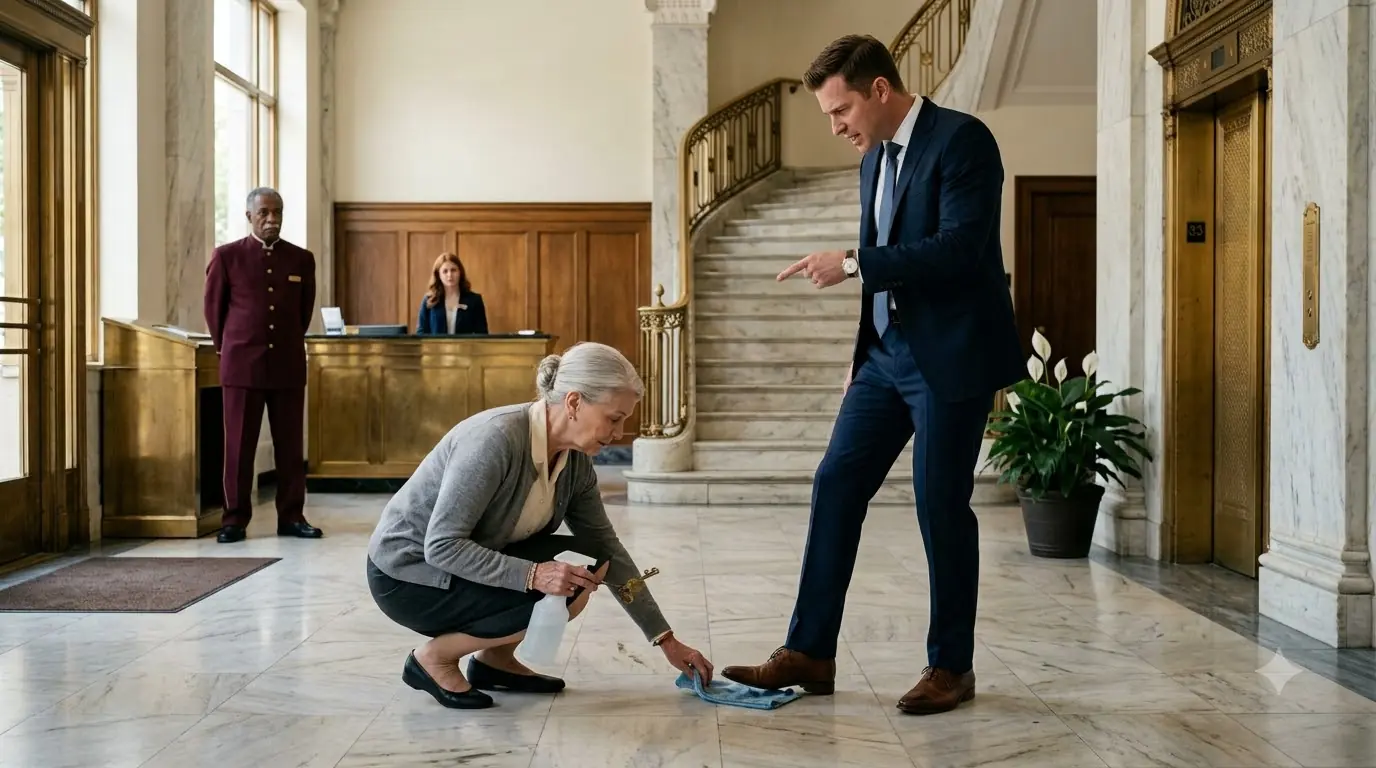
The brass under her hands had the particular warmth of something well kept, the warmth of metal attended to over many decades with the kind of care that prevented deterioration before anyone else could see it beginning. Leo arrived at six forty-five. He came through the service entrance the way he had come in for twenty-two years, hung his coat on the hook inside the doorman's station, and settled into the morning. He was sixty-eight years old and had the unhurried quality of someone who understood that his job was to be present rather than to perform presence. He was very good at it. He came to the railing and reached for the second cloth in Martha's bag. "I have it, Leo," she said. He answered, "You don't have to do the whole length yourself." Martha kept working. "It keeps my hands busy. Keeps me close to Arthur." Leo set the cloth down and looked at her for a moment with the expression he kept for things he understood completely and did not need to say anything about. Then he returned to the doorman's station, and the morning continued. At seven fifteen, a young mother came through with the controlled urgency of someone managing a stroller, a toddler, a slipping shoulder bag, and a timeline already being renegotiated. Martha set down her spray bottle and held the stroller's front wheel clear of the threshold while the mother navigated through. The toddler looked at Martha with the frank assessment of a young child and said something that was mostly vowels. "Good morning to you, too," Martha said. The mother smiled and said, "Thank you, Mrs. Martha. You're a lifesaver." After they left, Martha went to the peace lily. It stood in the corner of the lobby near the east window, in the large ceramic pot that had been there since 1989. It was a plant of considerable age and presence, one Martha tended the way she tended everything in the Heritage, with attention and without announcement. She crouched beside it and studied the leaves in the morning light. One was withered, not dead yet, but turning the particular yellow-green of a leaf that had decided it was finished. Martha touched it gently. "We'll sort it out," she said quietly, speaking to the plant and perhaps to no one at all. She took the small pruning scissors from her cardigan pocket, removed the leaf cleanly, and placed it in her bag. Then she misted the soil and straightened. Derek came through the main entrance at seven forty-seven. He entered the way he did every morning, with the forward momentum of a man who had assessed his environment, found it slow, and decided to compensate. He did not look at Leo. He checked his expensive watch, not because he needed the time, but because checking it was a statement about time and its value. Then he saw Martha near the peace lily with her spray bottle. He stopped and looked at her faded gray cardigan, the small bag on the floor, and the plant beside her with the expression of a man who had identified an inefficiency and was preparing to address it. He walked over. "What's your employee ID number?" he asked. Martha looked at him with the expression she had used since his arrival, the expression of a woman conducting a quiet and thorough assessment of something that had been placed in her building and had not yet proved whether it belonged there. "I don't have one," she said. Derek frowned. "Then you shouldn't be in this lobby at seven forty-seven in the morning with a spray bottle." "I've been in this lobby at six every morning for twelve years," Martha replied. Derek said, "That ends today." He looked across the lobby at Leo. "Efficiency starts with the staff, Leo. Why is this woman still here?" "She's been here longer than all of us, sir," Leo said. Derek looked at him the way he looked at things that offered responses he had not requested. "Have her ID processed by noon or have her out." Then he turned toward the elevator. He had not asked Martha's name. He had seen the cardigan, the spray bottle, and the plant, and he had completed his assessment in the time it took to cross the lobby. He had not asked a single question. It was the first mistake of many. Martha watched him go and picked up the spray bottle. She was not offended. Offense required surprise, and Martha had not been surprised by anything in a very long time. She was evaluating him as she had been evaluating him since he arrived, noting how he moved through the space, what he touched, and how he touched it. So far, the results were not encouraging. She returned to the railing. The brass caught the morning light the way it always did, warm and patient, the metal Arthur had sourced and installed and said would outlast both of them. It had, and Martha intended to see it continue outlasting everyone who underestimated what they were standing in. Derek held a staff meeting at eight in the small conference room off the lobby. The room had been used for staff meetings since the Heritage opened, and Derek had already described it within Martha's hearing as undersized and in need of repurposing. Sophie and Leo sat across the table from him while Derek stood at the head with his tablet. "The Heritage is a luxury brand," he said. "We are here to operate it like one. That means cutting dead weight." He swiped through the first section of his plan. "Current rents are eighteen percent below comparable buildings in this corridor. We are adjusting by twenty percent across the board next quarter, with appropriate notice to current tenants." Sophie shifted in her chair. "Some of these tenants have been here for twenty years. A twenty percent increase is going to be difficult for some of them." Derek did not hesitate. "Renters are customers, not family. Customers who cannot afford the product find a different product. That is not our concern." Sophie looked at the table. Leo looked at Derek with the same patient expression he had worn since the new manager arrived, the expression of a man who had seen many things pass through the Heritage over twenty-two years and was currently watching one of them. Derek swiped again. "Amenities," he said. "The community garden on the roof, the lending library in the second-floor common room, and the monthly tenant gatherings in the lobby are consuming staff time and building resources for no measurable return. They are being discontinued." "The tenants use those things every day," Sophie said. Derek answered, "They use them because we offer them. If we stop offering them, they adjust." He looked up from the tablet. "This is not a community center. It is a residential property investment." He walked to the conference room window overlooking the lobby. "And that woman?" he asked. "Martha. Leo tells me she helps around the building. She doesn't have an employee ID, she doesn't appear on payroll, and she is present in the lobby before eight in the morning talking to houseplants." He said it with the specific disdain of someone identifying something that offended his sense of order. "Starting today, I want her out of the lobby before the business day begins." The meeting ended without further objection because Sophie did not yet have the standing to offer an objection that would hold, and Leo had never been a man who used words when waiting served better. Martha was in the lobby when Derek came out. She sat in the armchair near the peace lily, the one that had been there since the Heritage opened, reading a small book with her cardigan around her shoulders and her spray bottle on the table beside her. She had been there for the last twenty minutes. The conference room window faced the lobby, and the door had not been fully closed. Derek stopped when he saw her. "I thought I made myself clear about the lobby hours." Martha closed the book. "You were speaking to Sophie and Leo. I'm not on the staff." Derek folded his arms. "You are also not a tenant in good standing, which means you have no reason to occupy lobby furniture during business hours." "The plants need water twice a day," Martha said. "Morning and late afternoon. The peace lily particularly, in the dry season." Derek looked at the peace lily the way he looked at the rooftop garden, the lending library, and the tenant gatherings, measuring square footage against return. "The plants are going to the landfill," he said. "We're putting in digital displays. Plants require maintenance. Digital displays require a service contract once a year." Martha studied him. "The future looks very cold from where you're standing." "Digital displays don't need water and they don't talk back. That's the future of hospitality design." He said it with the confidence of a man who had read something in a trade publication and converted it into conviction. Then he walked toward the elevator. "Have your things out of the lobby by eight tomorrow morning." Martha watched him go. After the elevator doors closed, she stood and returned to the peace lily. She gave it the rest of the water in her spray bottle, working slowly around the base, checking the soil with one finger, assessing what it needed and making the kind of mental note she had made about everything in the Heritage for decades. Then she went to unit 2B. Her apartment was what she had made it during twelve years of living close to the ground floor, exactly what she needed and nothing more. The kitchen was small, the furniture old, and the windows faced the interior courtyard rather than the street because the courtyard held the oak tree Arthur had insisted on planting in 1979. She went to the shelf above the kitchen table and took down the 1974 maintenance ledger. It was a large book with a cover worn soft by age and a spine reinforced with tape that had long since turned the color of old honey. She set it on the table and opened it to the first page. There was the original tenant list in Arthur's handwriting, the names of the people who had come to the Heritage when it was new. Many were gone, and some were still there. Their names remained in the ledger the way names stayed in a place that cared for them, permanent and attended to. Martha ran her hand across the page. Then she looked at the photograph on the wall above the table, a black-and-white picture from 1974 of a young couple standing at a construction site. The woman wore a light coat, the man a hard hat, and both looked at the camera with the expression of people who understood that what was being built was not merely a building. It was Martha and Arthur at the Heritage groundbreaking. She looked at the photograph for a long moment, then reached for the telephone. Elias answered on the second ring. "Elias, it's time for the quarterly review," she said. She paused, still looking at Arthur in the photograph. "Tell the board I'll be there in person." Arthur had stood on that ground fifty years earlier and promised they would build something that lasted. Martha had been tending it ever since. Derek had called the plants trash. He did not realize he had just described his own career. The next morning, Derek arrived at eight fifteen with an investor beside him. The investor's name was Mr. Calloway, and he was the kind of man whose shoes announced his net worth before he said anything. Derek was giving him the tour he had been planning since his first week, the tour intended to show that the Heritage was in transformation. Derek spoke of moving the building from what he called comfortable underperformance toward its full market potential. The lobby was the first stop. It was at its best hour, with the morning light fully established, the marble catching it, and the brass making the entire space feel warm and considered because it had been properly maintained. This was what Derek had planned to show Mr. Calloway, the bones of the building, the potential of the space, and the argument for investment. Then he saw Martha at the peace lily, her back to the entrance, her spray bottle in hand, checking the leaves one by one with the attention of someone who understood that checking was part of caring. Derek's jaw tightened. He crossed the lobby without adjusting his pace for Calloway, who had to shorten his stride to keep up. Derek reached Martha, snatched the spray bottle from her hand, and threw it down in the quick, decisive motion of a man removing something he believed should not be there. The bottle struck the marble and cracked cleanly along one side. Water spread in a slow, irregular shape across the stone, reaching toward the grout lines and finding its level. Martha looked at the water, then at Derek. "I told you to stay in your unit," he said. His voice was not quite a shout, but it had entered the territory of a man who had decided not to manage himself. "You're making this place look like a nursing home. Go back to 2B before I have you evicted for loitering." The lobby absorbed the words. Calloway stood several feet behind Derek with the expression of a man who had walked into a situation he had not been briefed on and was recalibrating. Sophie had both hands flat on the reception desk, her eyes bright with something she was containing with visible effort. Leo moved. He stepped out from the doorman's station and came forward, not quickly, but with the deliberate pace of a man who had decided to be present in a specific way. "That's enough, sir," he said. Derek turned. "Stay back, Leo, or you're next." Leo stopped where he was, his hands at his sides, his face composed. The most present thing in his expression was not anger but the long patience of a man arriving at its end. Martha bent down and picked up the broken spray bottle. She held the two pieces together for a moment, then set them on the small table beside the peace lily. She took a cloth from her pocket and wiped the water from her shoe with the same precision she applied to everything. Then she looked up at Derek. "Eviction is a very serious process, Derek. You should be careful how you use that word." Derek looked at the cardigan, the broken bottle, the spreading water, and Calloway behind him. He made the calculation men make when they are performing confidence for an audience and have committed too far to stop. "You're just a tenant, Martha," he said. "One of many. You're replaceable. I'm not." Martha held his gaze. "Everyone is replaceable, Derek. Some people just haven't met their replacement yet." Derek laughed, the laugh of a man who had decided the exchange was beneath him. "I'm the manager. I use whatever words I want. Get out." Martha watched him for another moment, still not angry in the way people are angry when surprised. She had seen this moment coming. She turned toward the elevator rather than the hallway to 2B. The doors opened, she stepped inside, and they closed behind her. Derek turned back to Calloway as though the matter had been resolved. "Apologies for that," he said. "Part of the transition process. We're bringing the Heritage up to the standard its address demands. Some of the older elements are being phased out." Calloway looked at the water still spreading across the marble, the peace lily, the broken bottle, and Leo standing in the middle of the lobby. "Of course," Calloway said. He spoke in the tone of a man who had revised his assessment and was filing the revision carefully. Behind the reception desk, Sophie found a cloth and came out to wipe the water from the marble without comment. When she straightened, she looked at the elevator doors with the expression of someone who had understood something she did not yet have complete words for. The lobby settled back into its morning. Derek had thought he was showing the investor how he handled problems. He was showing the owner why he had to go. At nine o'clock, Derek had his presentation open on his laptop and was working through it with the satisfaction of a man confident in his preparation. The title was Project Modernization: Heritage Efficiency Initiative, Phase One. It contained forty-seven slides. The typography communicated seriousness, and the data visualizations showed the gap between the Heritage's current performance and its projected performance after Derek's proposed changes. Those changes included removing the community garden, clearing the lending library, discontinuing tenant gatherings, and restructuring twelve of the current twenty-three staff positions. Restructuring was the word Derek used for eliminating. He fixed his tie in the small mirror he kept in his desk drawer and called Patricia. She answered on the second ring. "The chairwoman is coming today," Derek said. "The actual owner. Apparently, she's been largely absent from operations, and today she's doing a quarterly review in person. I've been explicitly told this is the meeting." "Are you nervous?" Patricia asked. Derek leaned back. "I'm prepared. There's a difference." "I've built a case that any serious business person will recognize as exactly right for this building at this moment. If I land this today, regional vice president is not out of the question by the end of the year." Patricia asked, "What about that woman from this morning, the one you told me about?" Derek answered, "Handled." He used the brevity of someone filing a resolved matter. "You have to show these people who's the boss, Patricia. If you let them think the lines are negotiable, you lose the operation." He straightened his tie again. "I'll call you after." Then he returned to slide fourteen, Staff Restructuring and Cost Efficiency. He had spent considerable time on that slide. In the penthouse at the same hour, morning light came through tall windows and reduced the streets below to patterns. Martha stood at the glass for a moment, looking at a city built over many decades by many people with many intentions, some of which had lasted and some of which had not. Then she went to the bedroom. The gray cardigan was on the chair where she had left it, with the replacement spray bottle and polishing cloth on the small table beside it. She looked at them for a moment, then opened the wardrobe. The black suit had been there for several years. She took it out and laid it on the bed with the care of someone who had been keeping it for the right occasion and had arrived at that occasion. It was well made, the kind of suit produced when clothing was expected to last, with quality that did not announce itself but was visible to anyone who knew what to look for. Martha dressed carefully and went to the jewelry box. The pearls rested in a small velvet pouch. The last time she had worn them was three years earlier at the previous board meeting she attended in person. Arthur had given them to her on their fiftieth anniversary while they sat at the table in the small restaurant where they had eaten on their first date. "You have been the best partner a man could ask for, Marty," he had said. "I'm only sorry I didn't say it more often." "You say it every time you come home," she had answered. Arthur had looked at her and said, "I hope that's true." Martha put on the pearls. Then she went to the safe behind the panel in the study. The panel looked like part of the wall and was part of the wall until it wasn't. Martha opened it with the combination she had kept in her memory since 1974. Inside was the original deed, signed by Martha and Arthur at the closing in December of that year. It was the paper that had begun everything the Heritage became. She took it out and held it for a moment, then put it back. She did not need to bring it to the meeting because she knew what it said. Elias was waiting in the sitting room. He was sixty-five and had handled Martha's legal affairs for twenty-two years, since the attorney before him retired and recommended Elias with the particular care of someone passing something important to a worthy successor. He was reading Derek's efficiency report, which Martha had forwarded from the management company's internal system. His expression had the quality of a man encountering something that confirmed a concern he had already formed. When Martha entered, he set the report on the table. "The staff restructuring alone would breach three of the Heritage's founding operational covenants," he said. "The community amenity removals would breach two more. The rent increase structure, applied to tenants with existing long-term agreements, would expose the building to significant legal challenge." Martha looked toward the window. "He wants to take the soul out of the building, Elias. Arthur wouldn't have allowed it." Elias nodded. "You have the authority to stop all of it, but you have to reveal yourself. The chairwoman of the board cannot remain anonymous in this situation." Martha looked at the city below and thought of Arthur at the groundbreaking in his hard hat. "We're going to build something that lasts, Marty," he had said. "Something that takes care of people the way buildings used to take care of people." "I've been watching this building for twelve years in a gray cardigan because I believed the best way to protect it was to be invisible," Martha said. "I wanted to see it as it really was. I was hoping I'd never have to be visible." "Are you ready?" Elias asked. Martha looked at her reflection in the window, the black suit, the pearls, and the woman she had always been beneath the cardigan she had chosen to wear. "I've been ready for forty years, Elias. I was just hoping I'd never have to be." She picked up the brass master key and put it in the pocket of the black suit. Downstairs, Derek was on slide twenty-two, Staff Morale and the Cost of Sentiment. He was very pleased with it. Outside the penthouse door, a small placard caught the light. Elias's assistant had placed it there that morning. It read: Heritage Holdings Board Quarterly Review, Chairwoman M. Holloway Presiding. The gray cardigan had been a choice. The black suit was a consequence. Derek was about to meet the consequence. At one o'clock exactly, Elias opened the penthouse door. Derek stood in the hallway with his tablet under one arm, his presentation cued, his tie straight, and the controlled anticipation of a man who had spent the morning rehearsing key points. He had decided which slides to linger on and which to move through quickly. He also had an opening story about the Heritage's untapped potential, one he had already told twice to people who responded well. "The board is ready for you, Derek," Elias said. Derek straightened his jacket. "Excellent." The boardroom was large in the way of rooms designed for a specific purpose and used for that purpose over many years. A long mahogany table ran through the center, dark and solid, the kind of furniture built when permanence was considered a value rather than a liability. Eight chairs along the sides were empty. At the far end of the table, facing the window, one chair had its back to the room. Derek looked around. "Am I early?" "The chairwoman prefers a direct conversation for the initial review," Elias said. "Please present as you would to the full board. She'll have questions." Derek nodded. "Of course." He set his tablet on the table, pulled up the first slide, and addressed the back of the chair. "Thank you for making time today. I've been looking forward to this conversation since I arrived at the Heritage. What I've found is a building with extraordinary bones and a management approach that has, with respect, left significant value on the table." The chair did not move. Derek took this as attentiveness and continued. He moved through the revenue analysis, the market comparison, and the gap between current and projected performance with the practiced confidence of rehearsal. Soon he had the rhythm of it. The points landed in their order, and he warmed to the material the way he always warmed to it in rooms where he was the one standing. "The Heritage has been operated, with full respect for its history, on a model that prioritizes sentiment over performance," he said. "It supports community amenities that consume resources without generating measurable return, staff ratios that reflect a different era of service expectations, and a tenant profile that has not been actively managed toward the premium demographic this address commands." He clicked to the next slide. "I've begun addressing some of these inefficiencies immediately. The community garden on the roof is being cleared this week. The lending library materials are being donated. The monthly tenant events are suspended pending review." He paused for a response, but none came. "I also want to address something that illustrates the broader challenge. The lobby." He pulled up a slide displaying what he called lobby utilization metrics, assembled from his own observations and formatted to appear more comprehensive than they were. "I've been dealing with what I would call a lobby problem," he said. "A woman, a current tenant in 2B, has been occupying the space as if it were her personal area. Talking to plants, polishing railings, and generally creating the impression that the Heritage is managed by a resident who doesn't understand the building's positioning." He laughed briefly, inviting the listener to recognize the mild absurdity of it. "I dealt with her firmly this morning. She's been informed that the lobby is not her personal garden and that the building has moved on from the kind of management by sentiment that allowed this situation to develop." He paused again. "Between us, she seemed to believe she had some kind of claim on the place. These long-term tenants develop an attachment that can become a real operational problem." Derek clicked to Staff Restructuring and began moving through the projected reductions, the positions he had identified as redundant, and the savings the reductions would generate. "The 2B situation points to a broader tenant profile issue," he continued. "The Heritage has long-term tenants at below-market rates whose presence is inconsistent with the premium rebrand. These are good people, but frankly, they are legacy occupants from a different era. We need a managed transition toward a tenant base that reflects where the building is going rather than where it has been." He looked toward the back of the chair. "I know that sounds direct, but I think the chairwoman will appreciate directness. These decisions are never easy, but they are necessary for the building to reach its potential." He clicked to the next slide. The chair began turning slowly. Derek continued talking, already several sentences into his commentary on revenue optimization when some peripheral awareness registered the movement. His words began to slow as his attention divided. "The projected revenue increase over the first eighteen months would represent a significant return on the investment in rebranding and the costs associated with the transition of both staff and tenants." The chair completed its turn. Martha sat at the head of the table. She wore the black suit and pearl earrings. The 1974 maintenance ledger rested before her, its leather cover worn, its spine reinforced, and its pages holding decades of careful records in Arthur's handwriting and her own. Her hands were folded on top of it. Her posture was completely straight, the posture of a woman who had been in the Heritage since before anyone in the room had heard of it. She looked at Derek with the same expression she had worn when he took the spray bottle from her hand and ordered her back to 2B. The expression had not changed. It had simply been given the correct room. Derek's tablet slipped from his hand. It struck the mahogany table and skidded several inches before stopping. The sound was the only sound in the boardroom. "I believe you were telling us about the lobby problem, Derek," Martha said. Her voice carried no theatrical edge. "Please continue. I'm very interested in your solution for 2B." Derek stood at the opposite end of the table from the woman he had told to clear out her locker by noon. The woman he had called an embarrassment. The woman he had threatened with eviction and whose spray bottle he had broken in front of an investor. He understood, in the specific and total way that certain understandings arrive all at once, that he was standing in her building. He had treated her like a squatter while standing in her home. He had no slide for this. "Martha," he said, his voice emerging in a register he had not intended. "I didn't know. I was following the guidelines. The efficiency protocols are standard practice for a building in this position, and I was implementing them in good faith." Martha opened the 1974 maintenance ledger to a page marked with a thin strip of paper. "Mrs. Higgins in 4C," she read. "She moved in with her husband in 1976. He died in 1982, a Tuesday morning in March, and by Wednesday afternoon Arthur had reduced her rent by half." She looked up. "Do you know why he did that, Derek?" Derek searched for an answer. "Because it was bad business practice that eroded the building's revenue position?" Martha held his gaze. "Because in 1974, when Arthur was building this place, construction was behind schedule, financing was uncertain, and he was working eighteen-hour days and coming home too tired to eat. Mrs. Higgins used to bring him soup every Tuesday." She closed the ledger gently. "This building is made of soup and kindness, Derek, not marble and spreadsheets. The marble came later. The soup was here first." Derek opened his mouth, but Elias placed a document on the table with the quiet precision of a man who had been waiting for the correct moment. He opened it to a page tabbed with a yellow marker, turned it toward Derek, and pointed to a highlighted section. "Page seven of your management contract," Elias said. "Section four, paragraph three, the character clause." Derek looked at the document. "The Heritage was established with a founding management covenant incorporated by reference into every management contract this building has issued. The covenant specifies that the manager serves not only as an operational director, but as a steward of the building's character and community." Elias read from the highlighted section. "Any conduct by the manager that publicly humiliates, threatens, or diminishes the dignity of a tenant, staff member, or regular visitor constitutes a material breach of the stewardship covenant and grounds for immediate termination of the management agreement." "That clause is forty years old," Derek said. Elias did not react. "It has been renewed in every management contract since 1974, including yours, which you signed eleven weeks ago. We have the signed copy." Derek looked from the contract to Martha and back to Elias. "The investor. I was managing a situation in front of an important investor. I needed to present the building as professionally run. She was in the lobby with a spray bottle talking to a houseplant." Martha said nothing. Derek pressed on. "The market demands a certain image. I was protecting the Heritage's brand positioning. If the board understood the competitive landscape we're operating in, it would recognize that my actions were necessary." "The investor you were with this morning?" Martha asked. Derek nodded. "Yes." "Mr. Calloway has been a tenant on the eighth floor for nine years. He knew exactly who I was when he walked in this morning. He called me two hours ago to make sure I was all right. He also mentioned that he is reconsidering his tenancy given the current management direction." Derek sat down. His legs seemed to make the decision before his mind caught up. He stared at the table and the contract. Martha reached into the credenza beside her chair and removed the cracked spray bottle. She placed it on the mahogany between them. The Heritage's most expensive table and its most humble object created a contrast that required no commentary. "You broke more than a plastic bottle this morning, Derek," Martha said. "You broke a forty-year promise." Derek looked at the bottle. "I can replace it," he said. "I can apologize to the tenant. I can restructure the communication approach and revisit the staff interaction protocols." "I can make this right. The efficiency work is sound. The financial case is real. I can do this job differently." He was finding his language again, the language of management, issues, solutions, and frameworks. Martha listened without interrupting. "You said I was replaceable," she said when he finished. Derek swallowed. "That was said in the heat of the moment. I recognize it was inappropriate. I'm willing to address it directly with you and with the building." "I've spent all morning thinking about that," Martha said. "And I've decided you were right about yourself." Derek stared at her. Martha stood. She had never been tall, and Derek had the height and build of someone physically confident his whole life. Yet she stood at the head of the table in Arthur's anniversary pearls, with the ledger, contract, and broken bottle before her, entirely without uncertainty. That certainty gave her its own kind of size. "This building was built on the understanding that the people inside it mattered more than the numbers around them," she said. "Arthur understood that. Every manager before you understood that." She walked toward Derek. "You understood the numbers and mistook them for the whole picture." She stopped beside the table, picked up his management contract, and held it for a moment. "You thought you were being efficient, Derek," she said, setting it down again. "You were actually being a vandal. I don't tolerate vandals in Arthur's building." Derek picked up his briefcase with the forward motion of a man who had decided the situation was concluded and was implementing the conclusion. "I understand. I'll have my office cleared by the end of the day. You'll have my resignation on Monday." "I'm not firing you," Martha said. Derek stopped. "I'm sorry?" "You have a three-year management contract with the Heritage, ironclad, as your attorney was kind enough to note when we negotiated the terms. I don't break contracts. Arthur didn't believe in breaking contracts, and neither do I." Derek set the briefcase down slowly. "Then what exactly is happening?" "You wanted to understand the lobby. You wanted to know why I was there with a spray bottle every morning. You told Leo it was inefficient, you told the investor it was embarrassing, and you told me to clear out my locker. Now you'll understand it from the inside." "I don't follow," Derek said. Elias placed a single sheet of paper on the table. "Effective immediately, the Heritage is restructuring the management position under the operational covenant," Elias said. "The covenant allows the board to reassign managerial duties in cases of breach without terminating the underlying contract. Your compensation remains unchanged. Your title and responsibilities do not." Derek looked at the paper. Elias continued. "Your new title is Junior Maintenance Associate. Your reporting structure changes accordingly." "Junior maintenance?" Derek asked. Martha nodded. "You wanted efficiency. This is efficient." "Your contract is honored, the covenant is enforced, and the Heritage gets the education it needs from its management team. Everyone learns something." "I have a business degree," Derek said. "I have seven years of property management experience. You're asking me to polish railings?" "I'm asking you to learn what the railings are for." Martha opened the boardroom door. Leo stood in the hallway with the particular stillness he had maintained all morning. "Leo," Martha said, "this is Derek, the new Junior Maintenance Associate. He'll be working under your supervision effective this afternoon." Leo looked at Derek. His expression did not shift toward satisfaction or triumph because Leo did not express himself in those registers. He simply looked at Derek with the complete, neutral assessment of someone who had been doing a job with full attention for a long time and was now being asked to teach it. "I'll show you where we keep the supplies," Leo said. Derek stared at him. "I have to work under the doorman?" Derek asked. Martha answered, "You have to work under the man who has kept this building's entrance welcoming for twenty-two years, who knows every tenant by name, and who has never once made a single one of them feel unwelcome. You could learn a great deal from him." Leo held out a simple dark maintenance vest with the Heritage's small logo on the left chest. Derek looked at the vest, then at Martha and Elias, and finally took it. He put it on over his business suit. "Leo, show the new associate where we keep the polish," Martha said. She paused. "And make sure he doesn't miss the spots under the handrails. Arthur was very particular about those." "Yes, Mrs. Holloway," Leo said with the ease of twenty-two years of mutual respect. Then he turned toward the elevator. Derek followed in a maintenance vest over his expensive suit. Martha watched them go, then turned to Sophie. Sophie had been standing in the doorway since Elias asked her to come upstairs twenty minutes earlier, wearing the expression of someone who had watched a situation resolve itself in a way she hoped for but had not expected. "Sophie," Martha said. "Yes, Mrs. Holloway?" Martha took a folded navy blazer from the credenza drawer and held it out. It was well made, with a small pin on the lapel bearing the Heritage's logo, the architectural drawing of the facade Arthur had designed in 1974. "The assistant manager position has been vacant since the previous occupant moved away eight months ago," Martha said. "The role involves tenant relations, lobby oversight, and staff coordination. I've been watching you since you arrived six weeks ago." Sophie took the blazer with both hands. Martha continued, "You offered me a chair when no one else did. You learned the tenants' names in your first week. You noticed the peace lily." "I don't know what to say," Sophie whispered. Martha answered, "Say you'll take care of the building." "I will," Sophie said with the simplicity of someone who meant it completely. Martha nodded. Derek had come seeking a vice president's seat. He left the penthouse carrying a bottle of brass polish, wearing a maintenance vest over his business suit, and following Leo into the daily company of everyone he had dismissed. Martha called it education. Derek, descending in the elevator toward the railings and the long afternoon ahead, would have used a different word. One month later, the lobby of the Heritage was exactly what it had always been, warm, attended to, and lit in the morning by light that found the brass, the marble, and the peace lily in the corner. The whole space felt like something that had been thought about rather than simply built. Derek was on his knees at the base of the stairs. He was working the lower section of the railing, the part that required crouching, the part easy to miss if polished while standing and visible from the lobby floor to anyone who looked at the right angle. Leo had pointed this out on Derek's third day without emphasis, simply as information. Derek had been doing the lower section properly since the fourth day. His tie was gone. He had stopped wearing it during the second week, not as a defeat but as a practical decision because the work required bending and the tie got in the way. His jacket hung on a hook in the maintenance closet. He wore the vest, good trousers, and expensive shoes that now carried the marks of actual work. Mr. Patterson from the sixth floor crossed the lobby. He was a retired professor who had lived in the Heritage for fourteen years and nodded to the staff with the specific courtesy of someone taught that acknowledging people was a form of respect. Derek looked up from the railing and nodded back. "Good morning," Mr. Patterson said. "Good morning, Mr. Patterson," Derek replied. Mr. Patterson went to the elevator. Derek returned to the railing. Leo did not change his expression at the doorman's station, but there was a slight difference in his posture, a very small reduction in the vigilance of a man watching someone he was not yet sure about. Martha came through the lobby at eight fifteen wearing her gray cardigan. She carried a spray bottle in her left hand and a small bag over her shoulder. She moved in the unhurried way she always had, the way of someone for whom the lobby was not a place to cross but a place to be in. The lobby received her the way a place receives someone who belongs in it. She stopped at the peace lily and stood still for a moment. The plant had been struggling for weeks. The leaf she removed the morning Derek arrived had been the first visible sign of a deeper stress caused by inconsistent watering, altered light, and the disturbance of the previous month. Martha had tended it carefully twice a day, checking the moisture and adjusting the pot to catch more morning light. Now the peace lily was blooming. A single white flower had opened overnight, the spathe carrying the warmth of something alive. It was the flower the plant produced when it was healthy and content. Martha stood in front of it for a long moment. Then she heard the soft movement of polishing cloth on the lower railing and turned. Derek had stopped working and was looking at the flower. His expression held something that had not been there when he arrived, not quite recognition, but the beginning of an understanding that certain things in a building were not decorative. He looked at Martha. "It's doing well," he said. Martha smiled slightly. "It's a good flower, isn't it, Derek?" "It is," he said. He paused. "It's doing well." He said it plainly, without management language, efficiency frameworks, or the positioning of a man who had an agenda for every sentence. He said it because it was true, and true things deserved to be said plainly. Martha looked at the flower, then at Derek. "I saw from the elevator yesterday that you got the lower section of the third railing. The spot Arthur liked." "I found it," Derek said. "It's at an angle. You have to come at it from below." "Yes. He used to say you had to earn that spot every morning." Derek looked at the railing. "I got it." "I know you did, son," Martha said. She said it plainly, and the word son entered the sentence in the way certain words sometimes arrive before the speaker has entirely decided to include them. It told both of them something about where the month had brought them. Martha picked up the spray bottle and gave the peace lily its morning water. She checked the soil with one finger and tilted the pot slightly to ensure the drainage, doing what she had done every morning for twelve years with the same care. Derek returned to the railing. The lobby moved around both of them, tenants coming and going, Sophie at the reception desk with the confidence of someone who had grown into the assistant manager role and learned every name and rhythm, and Leo holding the entrance the way he had held it for twenty-two years. The brass, marble, and morning light did what they did when the building was properly looked after. Martha finished tending the peace lily, picked up her bag, and walked toward the entrance. Leo opened the door. Martha passed through, and he let it close behind her. They looked at one another through the glass for a moment, two people who had been in the same place for a long time and shared the same understanding of what the place was for and why it mattered. Then Martha turned and walked into the city. She was simply a quiet old woman in a gray cardigan with a spray bottle and a small bag, moving along the sidewalk at the pace of someone who had nowhere urgent to be and understood that unhurried was its own form of intention. The people she passed did not know who she was. They saw the cardigan and the slight stoop of a woman in her mid-seventies and moved around her the way people move around things they have assessed as unremarkable. Behind her, the Heritage stood in the morning light. The brass caught it the way it always did when properly tended, warm, patient, and precise. The peace lily's white flower was visible through the tall lobby window in the corner where Arthur said it should be, where Martha placed it in 1989, and where it had been tended every morning since. Derek had thought power meant shouting from the top. He was learning, one brass rail at a time and on his knees in the morning light, that real power lived near the bottom, in the hands that held foundations together, in the people who arrived before sunrise, and in those who stayed after the building had finished asking anything of them. It lived in soup, kindness, remembered names, and withered leaves removed before they became something worse. Martha disappeared into the crowd. The building behind her stood exactly as Arthur had intended it to stand, tended, warm, and alive. Silence was not weakness. It was only a long and patient breath before the truth. At the Heritage, the truth was polished to a shine every morning before the business day began.A designer leather shoe came down on the cleaning cloth. The sound was small, only the soft compression of microfiber beneath an expensive sole, but Martha heard it. She had been polishing the brass railing at the base of the lobby stairs, where the morning light came through the Heritage's tall windows at the angle that revealed every fingerprint, every smudge, and every sign of neglect. She had set the cloth on the marble floor beside her spray bottle while she worked, the way she had set it there every morning for twelve years.
Now Derek's shoe was on it. Martha looked at the shoe, then looked up. Derek was thirty-two years old and wore the kind of suit that announced itself before the man inside it had said a word. He had an expensive watch, a sharp haircut, polished confidence, and the expression of a man constantly deciding which old things no longer deserved to stay.
He had arrived at the Heritage three weeks earlier with a new title and a new efficiency plan. Looking down at Martha, he said, "This lobby is not a storage room for people who don't know when to leave." The lobby went quiet. Leo stood at the doorman's station near the entrance, one hand resting on the brass stand that had been there since 1974, his jaw tight but his voice silent.
Sophie looked up from the reception desk. She was twenty-two, new enough to be frightened of Derek but kind enough to understand that something about this moment was wrong. Derek glanced at Martha's faded cardigan, the spray bottle, and the cloth beneath his shoe. "The tenants pay a great deal to live here," he said. "They shouldn't have to walk past this every morning. Clear out your locker by noon."
Martha bent down slowly and picked up the cleaning cloth from beneath his shoe. Then she straightened and looked at the brass railing she had just finished polishing. The metal caught the morning light with the warm glow of something that had been cared for properly over many decades. Her husband, Arthur, had chosen those railings himself in 1974.
He had stood in the lobby when the building was new and watched them being installed with the attention of a man who believed small details were never small when they belonged to a home. Martha looked at the railing for one more second, then turned toward the elevator. Leo watched her from the doorman's station, his expression unchanged, the expression of a man who knew the full picture and was waiting for the correct moment.
Martha reached into the pocket of her faded cardigan and took out a key. It was brass, old, and tarnished from use, the kind of master key made for a building that had been built to last. Derek saw it and smiled faintly, as if it proved his point. To him, it looked like a janitor's key.
He did not know it opened every door in the Heritage. He did not know it opened the penthouse. He did not know it opened the ownership office at the top of the building, where a meeting had been scheduled for one o'clock that afternoon, a meeting Derek had been chasing since his first week. It was the meeting with the building's owner.
Martha pressed the elevator button with the brass key still in her hand. The doors opened, and she stepped inside without looking back. Derek remained in the lobby with his polished shoes and his perfect suit, having no idea that he had just fired the woman who owned the building.
Martha had arrived at the Heritage at six o'clock that morning, which was when she always arrived, before the building knew it was awake. The lobby held the particular quality of a large space in the early morning. The marble floor caught the first light through the tall windows and threw it back in long, pale rectangles. The air was still and cool, and the brass railings were waiting.
She set her small bag by the cabinet behind the front desk and took out the spray bottle and polishing cloth. Then she went to the railings the way she went to them every morning, as if approaching something she had been speaking to for so long that the routine had become its own form of conversation. She worked from the bottom of the stairs upward, moving the cloth in the small circular pattern Arthur had shown her when the railings were new.
"You have to work with the grain of the metal, Martha, not against it," he had said in 1974. "The metal remembers how it wants to be treated." She had worked with the grain ever since. The brass under her hands had the particular warmth of something well kept, the warmth of metal attended to over many decades with the kind of care that prevented deterioration before anyone else could see it beginning.
Leo arrived at six forty-five. He came through the service entrance the way he had come in for twenty-two years, hung his coat on the hook inside the doorman's station, and settled into the morning. He was sixty-eight years old and had the unhurried quality of someone who understood that his job was to be present rather than to perform presence. He was very good at it.
He came to the railing and reached for the second cloth in Martha's bag. "I have it, Leo," she said. He answered, "You don't have to do the whole length yourself." Martha kept working. "It keeps my hands busy. Keeps me close to Arthur."
Leo set the cloth down and looked at her for a moment with the expression he kept for things he understood completely and did not need to say anything about. Then he returned to the doorman's station, and the morning continued. At seven fifteen, a young mother came through with the controlled urgency of someone managing a stroller, a toddler, a slipping shoulder bag, and a timeline already being renegotiated.
Martha set down her spray bottle and held the stroller's front wheel clear of the threshold while the mother navigated through. The toddler looked at Martha with the frank assessment of a young child and said something that was mostly vowels. "Good morning to you, too," Martha said. The mother smiled and said, "Thank you, Mrs. Martha. You're a lifesaver."
After they left, Martha went to the peace lily. It stood in the corner of the lobby near the east window, in the large ceramic pot that had been there since 1989. It was a plant of considerable age and presence, one Martha tended the way she tended everything in the Heritage, with attention and without announcement.
She crouched beside it and studied the leaves in the morning light. One was withered, not dead yet, but turning the particular yellow-green of a leaf that had decided it was finished. Martha touched it gently. "We'll sort it out," she said quietly, speaking to the plant and perhaps to no one at all.
She took the small pruning scissors from her cardigan pocket, removed the leaf cleanly, and placed it in her bag. Then she misted the soil and straightened. Derek came through the main entrance at seven forty-seven.
He entered the way he did every morning, with the forward momentum of a man who had assessed his environment, found it slow, and decided to compensate. He did not look at Leo. He checked his expensive watch, not because he needed the time, but because checking it was a statement about time and its value.
Then he saw Martha near the peace lily with her spray bottle. He stopped and looked at her faded gray cardigan, the small bag on the floor, and the plant beside her with the expression of a man who had identified an inefficiency and was preparing to address it. He walked over. "What's your employee ID number?" he asked.
Martha looked at him with the expression she had used since his arrival, the expression of a woman conducting a quiet and thorough assessment of something that had been placed in her building and had not yet proved whether it belonged there. "I don't have one," she said. Derek frowned. "Then you shouldn't be in this lobby at seven forty-seven in the morning with a spray bottle."
"I've been in this lobby at six every morning for twelve years," Martha replied. Derek said, "That ends today." He looked across the lobby at Leo. "Efficiency starts with the staff, Leo. Why is this woman still here?"
"She's been here longer than all of us, sir," Leo said. Derek looked at him the way he looked at things that offered responses he had not requested. "Have her ID processed by noon or have her out." Then he turned toward the elevator.
He had not asked Martha's name. He had seen the cardigan, the spray bottle, and the plant, and he had completed his assessment in the time it took to cross the lobby. He had not asked a single question. It was the first mistake of many.
Martha watched him go and picked up the spray bottle. She was not offended. Offense required surprise, and Martha had not been surprised by anything in a very long time. She was evaluating him as she had been evaluating him since he arrived, noting how he moved through the space, what he touched, and how he touched it.
So far, the results were not encouraging. She returned to the railing. The brass caught the morning light the way it always did, warm and patient, the metal Arthur had sourced and installed and said would outlast both of them. It had, and Martha intended to see it continue outlasting everyone who underestimated what they were standing in.
Derek held a staff meeting at eight in the small conference room off the lobby. The room had been used for staff meetings since the Heritage opened, and Derek had already described it within Martha's hearing as undersized and in need of repurposing. Sophie and Leo sat across the table from him while Derek stood at the head with his tablet.
"The Heritage is a luxury brand," he said. "We are here to operate it like one. That means cutting dead weight." He swiped through the first section of his plan. "Current rents are eighteen percent below comparable buildings in this corridor. We are adjusting by twenty percent across the board next quarter, with appropriate notice to current tenants."
Sophie shifted in her chair. "Some of these tenants have been here for twenty years. A twenty percent increase is going to be difficult for some of them."
Derek did not hesitate. "Renters are customers, not family. Customers who cannot afford the product find a different product. That is not our concern."
Sophie looked at the table. Leo looked at Derek with the same patient expression he had worn since the new manager arrived, the expression of a man who had seen many things pass through the Heritage over twenty-two years and was currently watching one of them. Derek swiped again.
"Amenities," he said. "The community garden on the roof, the lending library in the second-floor common room, and the monthly tenant gatherings in the lobby are consuming staff time and building resources for no measurable return. They are being discontinued."
"The tenants use those things every day," Sophie said. Derek answered, "They use them because we offer them. If we stop offering them, they adjust." He looked up from the tablet. "This is not a community center. It is a residential property investment."
He walked to the conference room window overlooking the lobby. "And that woman?" he asked. "Martha. Leo tells me she helps around the building. She doesn't have an employee ID, she doesn't appear on payroll, and she is present in the lobby before eight in the morning talking to houseplants."
He said it with the specific disdain of someone identifying something that offended his sense of order. "Starting today, I want her out of the lobby before the business day begins." The meeting ended without further objection because Sophie did not yet have the standing to offer an objection that would hold, and Leo had never been a man who used words when waiting served better.
Martha was in the lobby when Derek came out. She sat in the armchair near the peace lily, the one that had been there since the Heritage opened, reading a small book with her cardigan around her shoulders and her spray bottle on the table beside her. She had been there for the last twenty minutes. The conference room window faced the lobby, and the door had not been fully closed.
Derek stopped when he saw her. "I thought I made myself clear about the lobby hours." Martha closed the book. "You were speaking to Sophie and Leo. I'm not on the staff."
Derek folded his arms. "You are also not a tenant in good standing, which means you have no reason to occupy lobby furniture during business hours."
"The plants need water twice a day," Martha said. "Morning and late afternoon. The peace lily particularly, in the dry season." Derek looked at the peace lily the way he looked at the rooftop garden, the lending library, and the tenant gatherings, measuring square footage against return.
"The plants are going to the landfill," he said. "We're putting in digital displays. Plants require maintenance. Digital displays require a service contract once a year." Martha studied him. "The future looks very cold from where you're standing."
"Digital displays don't need water and they don't talk back. That's the future of hospitality design." He said it with the confidence of a man who had read something in a trade publication and converted it into conviction. Then he walked toward the elevator. "Have your things out of the lobby by eight tomorrow morning."
Martha watched him go. After the elevator doors closed, she stood and returned to the peace lily. She gave it the rest of the water in her spray bottle, working slowly around the base, checking the soil with one finger, assessing what it needed and making the kind of mental note she had made about everything in the Heritage for decades.
Then she went to unit 2B. Her apartment was what she had made it during twelve years of living close to the ground floor, exactly what she needed and nothing more. The kitchen was small, the furniture old, and the windows faced the interior courtyard rather than the street because the courtyard held the oak tree Arthur had insisted on planting in 1979.
She went to the shelf above the kitchen table and took down the 1974 maintenance ledger. It was a large book with a cover worn soft by age and a spine reinforced with tape that had long since turned the color of old honey. She set it on the table and opened it to the first page.
There was the original tenant list in Arthur's handwriting, the names of the people who had come to the Heritage when it was new. Many were gone, and some were still there. Their names remained in the ledger the way names stayed in a place that cared for them, permanent and attended to.
Martha ran her hand across the page. Then she looked at the photograph on the wall above the table, a black-and-white picture from 1974 of a young couple standing at a construction site. The woman wore a light coat, the man a hard hat, and both looked at the camera with the expression of people who understood that what was being built was not merely a building.
It was Martha and Arthur at the Heritage groundbreaking. She looked at the photograph for a long moment, then reached for the telephone. Elias answered on the second ring.
"Elias, it's time for the quarterly review," she said. She paused, still looking at Arthur in the photograph. "Tell the board I'll be there in person."
Arthur had stood on that ground fifty years earlier and promised they would build something that lasted. Martha had been tending it ever since. Derek had called the plants trash. He did not realize he had just described his own career.
The next morning, Derek arrived at eight fifteen with an investor beside him. The investor's name was Mr. Calloway, and he was the kind of man whose shoes announced his net worth before he said anything. Derek was giving him the tour he had been planning since his first week, the tour intended to show that the Heritage was in transformation.
Derek spoke of moving the building from what he called comfortable underperformance toward its full market potential. The lobby was the first stop. It was at its best hour, with the morning light fully established, the marble catching it, and the brass making the entire space feel warm and considered because it had been properly maintained.
This was what Derek had planned to show Mr. Calloway, the bones of the building, the potential of the space, and the argument for investment. Then he saw Martha at the peace lily, her back to the entrance, her spray bottle in hand, checking the leaves one by one with the attention of someone who understood that checking was part of caring.
Derek's jaw tightened. He crossed the lobby without adjusting his pace for Calloway, who had to shorten his stride to keep up. Derek reached Martha, snatched the spray bottle from her hand, and threw it down in the quick, decisive motion of a man removing something he believed should not be there.
The bottle struck the marble and cracked cleanly along one side. Water spread in a slow, irregular shape across the stone, reaching toward the grout lines and finding its level. Martha looked at the water, then at Derek.
"I told you to stay in your unit," he said. His voice was not quite a shout, but it had entered the territory of a man who had decided not to manage himself. "You're making this place look like a nursing home. Go back to 2B before I have you evicted for loitering."
The lobby absorbed the words. Calloway stood several feet behind Derek with the expression of a man who had walked into a situation he had not been briefed on and was recalibrating. Sophie had both hands flat on the reception desk, her eyes bright with something she was containing with visible effort.
Leo moved. He stepped out from the doorman's station and came forward, not quickly, but with the deliberate pace of a man who had decided to be present in a specific way. "That's enough, sir," he said.
Derek turned. "Stay back, Leo, or you're next." Leo stopped where he was, his hands at his sides, his face composed. The most present thing in his expression was not anger but the long patience of a man arriving at its end.
Martha bent down and picked up the broken spray bottle. She held the two pieces together for a moment, then set them on the small table beside the peace lily. She took a cloth from her pocket and wiped the water from her shoe with the same precision she applied to everything.
Then she looked up at Derek. "Eviction is a very serious process, Derek. You should be careful how you use that word." Derek looked at the cardigan, the broken bottle, the spreading water, and Calloway behind him. He made the calculation men make when they are performing confidence for an audience and have committed too far to stop.
"You're just a tenant, Martha," he said. "One of many. You're replaceable. I'm not."
Martha held his gaze. "Everyone is replaceable, Derek. Some people just haven't met their replacement yet."
Derek laughed, the laugh of a man who had decided the exchange was beneath him. "I'm the manager. I use whatever words I want. Get out." Martha watched him for another moment, still not angry in the way people are angry when surprised. She had seen this moment coming.
She turned toward the elevator rather than the hallway to 2B. The doors opened, she stepped inside, and they closed behind her. Derek turned back to Calloway as though the matter had been resolved.
"Apologies for that," he said. "Part of the transition process. We're bringing the Heritage up to the standard its address demands. Some of the older elements are being phased out." Calloway looked at the water still spreading across the marble, the peace lily, the broken bottle, and Leo standing in the middle of the lobby.
"Of course," Calloway said. He spoke in the tone of a man who had revised his assessment and was filing the revision carefully. Behind the reception desk, Sophie found a cloth and came out to wipe the water from the marble without comment.
When she straightened, she looked at the elevator doors with the expression of someone who had understood something she did not yet have complete words for. The lobby settled back into its morning. Derek had thought he was showing the investor how he handled problems. He was showing the owner why he had to go.
At nine o'clock, Derek had his presentation open on his laptop and was working through it with the satisfaction of a man confident in his preparation. The title was Project Modernization: Heritage Efficiency Initiative, Phase One. It contained forty-seven slides.
The typography communicated seriousness, and the data visualizations showed the gap between the Heritage's current performance and its projected performance after Derek's proposed changes. Those changes included removing the community garden, clearing the lending library, discontinuing tenant gatherings, and restructuring twelve of the current twenty-three staff positions.
Restructuring was the word Derek used for eliminating. He fixed his tie in the small mirror he kept in his desk drawer and called Patricia. She answered on the second ring.
"The chairwoman is coming today," Derek said. "The actual owner. Apparently, she's been largely absent from operations, and today she's doing a quarterly review in person. I've been explicitly told this is the meeting."
"Are you nervous?" Patricia asked. Derek leaned back. "I'm prepared. There's a difference."
"I've built a case that any serious business person will recognize as exactly right for this building at this moment. If I land this today, regional vice president is not out of the question by the end of the year."
Patricia asked, "What about that woman from this morning, the one you told me about?" Derek answered, "Handled." He used the brevity of someone filing a resolved matter.
"You have to show these people who's the boss, Patricia. If you let them think the lines are negotiable, you lose the operation." He straightened his tie again. "I'll call you after."
Then he returned to slide fourteen, Staff Restructuring and Cost Efficiency. He had spent considerable time on that slide.
In the penthouse at the same hour, morning light came through tall windows and reduced the streets below to patterns. Martha stood at the glass for a moment, looking at a city built over many decades by many people with many intentions, some of which had lasted and some of which had not.
Then she went to the bedroom. The gray cardigan was on the chair where she had left it, with the replacement spray bottle and polishing cloth on the small table beside it. She looked at them for a moment, then opened the wardrobe.
The black suit had been there for several years. She took it out and laid it on the bed with the care of someone who had been keeping it for the right occasion and had arrived at that occasion. It was well made, the kind of suit produced when clothing was expected to last, with quality that did not announce itself but was visible to anyone who knew what to look for.
Martha dressed carefully and went to the jewelry box. The pearls rested in a small velvet pouch. The last time she had worn them was three years earlier at the previous board meeting she attended in person.
Arthur had given them to her on their fiftieth anniversary while they sat at the table in the small restaurant where they had eaten on their first date. "You have been the best partner a man could ask for, Marty," he had said. "I'm only sorry I didn't say it more often."
"You say it every time you come home," she had answered. Arthur had looked at her and said, "I hope that's true." Martha put on the pearls.
Then she went to the safe behind the panel in the study. The panel looked like part of the wall and was part of the wall until it wasn't. Martha opened it with the combination she had kept in her memory since 1974.
Inside was the original deed, signed by Martha and Arthur at the closing in December of that year. It was the paper that had begun everything the Heritage became. She took it out and held it for a moment, then put it back. She did not need to bring it to the meeting because she knew what it said.
Elias was waiting in the sitting room. He was sixty-five and had handled Martha's legal affairs for twenty-two years, since the attorney before him retired and recommended Elias with the particular care of someone passing something important to a worthy successor.
He was reading Derek's efficiency report, which Martha had forwarded from the management company's internal system. His expression had the quality of a man encountering something that confirmed a concern he had already formed. When Martha entered, he set the report on the table.
"The staff restructuring alone would breach three of the Heritage's founding operational covenants," he said. "The community amenity removals would breach two more. The rent increase structure, applied to tenants with existing long-term agreements, would expose the building to significant legal challenge."
Martha looked toward the window. "He wants to take the soul out of the building, Elias. Arthur wouldn't have allowed it." Elias nodded. "You have the authority to stop all of it, but you have to reveal yourself. The chairwoman of the board cannot remain anonymous in this situation."
Martha looked at the city below and thought of Arthur at the groundbreaking in his hard hat. "We're going to build something that lasts, Marty," he had said. "Something that takes care of people the way buildings used to take care of people."
"I've been watching this building for twelve years in a gray cardigan because I believed the best way to protect it was to be invisible," Martha said. "I wanted to see it as it really was. I was hoping I'd never have to be visible."
"Are you ready?" Elias asked. Martha looked at her reflection in the window, the black suit, the pearls, and the woman she had always been beneath the cardigan she had chosen to wear. "I've been ready for forty years, Elias. I was just hoping I'd never have to be."
She picked up the brass master key and put it in the pocket of the black suit. Downstairs, Derek was on slide twenty-two, Staff Morale and the Cost of Sentiment. He was very pleased with it.
Outside the penthouse door, a small placard caught the light. Elias's assistant had placed it there that morning. It read: Heritage Holdings Board Quarterly Review, Chairwoman M. Holloway Presiding.
The gray cardigan had been a choice. The black suit was a consequence. Derek was about to meet the consequence.
At one o'clock exactly, Elias opened the penthouse door. Derek stood in the hallway with his tablet under one arm, his presentation cued, his tie straight, and the controlled anticipation of a man who had spent the morning rehearsing key points. He had decided which slides to linger on and which to move through quickly.
He also had an opening story about the Heritage's untapped potential, one he had already told twice to people who responded well. "The board is ready for you, Derek," Elias said. Derek straightened his jacket. "Excellent."
The boardroom was large in the way of rooms designed for a specific purpose and used for that purpose over many years. A long mahogany table ran through the center, dark and solid, the kind of furniture built when permanence was considered a value rather than a liability.
Eight chairs along the sides were empty. At the far end of the table, facing the window, one chair had its back to the room. Derek looked around. "Am I early?"
"The chairwoman prefers a direct conversation for the initial review," Elias said. "Please present as you would to the full board. She'll have questions." Derek nodded. "Of course."
He set his tablet on the table, pulled up the first slide, and addressed the back of the chair. "Thank you for making time today. I've been looking forward to this conversation since I arrived at the Heritage. What I've found is a building with extraordinary bones and a management approach that has, with respect, left significant value on the table."
The chair did not move. Derek took this as attentiveness and continued. He moved through the revenue analysis, the market comparison, and the gap between current and projected performance with the practiced confidence of rehearsal.
Soon he had the rhythm of it. The points landed in their order, and he warmed to the material the way he always warmed to it in rooms where he was the one standing. "The Heritage has been operated, with full respect for its history, on a model that prioritizes sentiment over performance," he said.
"It supports community amenities that consume resources without generating measurable return, staff ratios that reflect a different era of service expectations, and a tenant profile that has not been actively managed toward the premium demographic this address commands." He clicked to the next slide.
"I've begun addressing some of these inefficiencies immediately. The community garden on the roof is being cleared this week. The lending library materials are being donated. The monthly tenant events are suspended pending review."
He paused for a response, but none came. "I also want to address something that illustrates the broader challenge. The lobby." He pulled up a slide displaying what he called lobby utilization metrics, assembled from his own observations and formatted to appear more comprehensive than they were.
"I've been dealing with what I would call a lobby problem," he said. "A woman, a current tenant in 2B, has been occupying the space as if it were her personal area. Talking to plants, polishing railings, and generally creating the impression that the Heritage is managed by a resident who doesn't understand the building's positioning."
He laughed briefly, inviting the listener to recognize the mild absurdity of it. "I dealt with her firmly this morning. She's been informed that the lobby is not her personal garden and that the building has moved on from the kind of management by sentiment that allowed this situation to develop."
He paused again. "Between us, she seemed to believe she had some kind of claim on the place. These long-term tenants develop an attachment that can become a real operational problem."
Derek clicked to Staff Restructuring and began moving through the projected reductions, the positions he had identified as redundant, and the savings the reductions would generate. "The 2B situation points to a broader tenant profile issue," he continued.
"The Heritage has long-term tenants at below-market rates whose presence is inconsistent with the premium rebrand. These are good people, but frankly, they are legacy occupants from a different era. We need a managed transition toward a tenant base that reflects where the building is going rather than where it has been."
He looked toward the back of the chair. "I know that sounds direct, but I think the chairwoman will appreciate directness. These decisions are never easy, but they are necessary for the building to reach its potential."
He clicked to the next slide. The chair began turning slowly. Derek continued talking, already several sentences into his commentary on revenue optimization when some peripheral awareness registered the movement.
His words began to slow as his attention divided. "The projected revenue increase over the first eighteen months would represent a significant return on the investment in rebranding and the costs associated with the transition of both staff and tenants."
The chair completed its turn. Martha sat at the head of the table.
She wore the black suit and pearl earrings. The 1974 maintenance ledger rested before her, its leather cover worn, its spine reinforced, and its pages holding decades of careful records in Arthur's handwriting and her own.
Her hands were folded on top of it. Her posture was completely straight, the posture of a woman who had been in the Heritage since before anyone in the room had heard of it. She looked at Derek with the same expression she had worn when he took the spray bottle from her hand and ordered her back to 2B.
The expression had not changed. It had simply been given the correct room.
Derek's tablet slipped from his hand. It struck the mahogany table and skidded several inches before stopping. The sound was the only sound in the boardroom.
"I believe you were telling us about the lobby problem, Derek," Martha said. Her voice carried no theatrical edge. "Please continue. I'm very interested in your solution for 2B."
Derek stood at the opposite end of the table from the woman he had told to clear out her locker by noon. The woman he had called an embarrassment. The woman he had threatened with eviction and whose spray bottle he had broken in front of an investor.
He understood, in the specific and total way that certain understandings arrive all at once, that he was standing in her building. He had treated her like a squatter while standing in her home. He had no slide for this.
"Martha," he said, his voice emerging in a register he had not intended. "I didn't know. I was following the guidelines. The efficiency protocols are standard practice for a building in this position, and I was implementing them in good faith."
Martha opened the 1974 maintenance ledger to a page marked with a thin strip of paper. "Mrs. Higgins in 4C," she read. "She moved in with her husband in 1976. He died in 1982, a Tuesday morning in March, and by Wednesday afternoon Arthur had reduced her rent by half."
She looked up. "Do you know why he did that, Derek?" Derek searched for an answer. "Because it was bad business practice that eroded the building's revenue position?"
Martha held his gaze. "Because in 1974, when Arthur was building this place, construction was behind schedule, financing was uncertain, and he was working eighteen-hour days and coming home too tired to eat. Mrs. Higgins used to bring him soup every Tuesday."
She closed the ledger gently. "This building is made of soup and kindness, Derek, not marble and spreadsheets. The marble came later. The soup was here first."
Derek opened his mouth, but Elias placed a document on the table with the quiet precision of a man who had been waiting for the correct moment. He opened it to a page tabbed with a yellow marker, turned it toward Derek, and pointed to a highlighted section.
"Page seven of your management contract," Elias said. "Section four, paragraph three, the character clause." Derek looked at the document.
"The Heritage was established with a founding management covenant incorporated by reference into every management contract this building has issued. The covenant specifies that the manager serves not only as an operational director, but as a steward of the building's character and community."
Elias read from the highlighted section. "Any conduct by the manager that publicly humiliates, threatens, or diminishes the dignity of a tenant, staff member, or regular visitor constitutes a material breach of the stewardship covenant and grounds for immediate termination of the management agreement."
"That clause is forty years old," Derek said. Elias did not react. "It has been renewed in every management contract since 1974, including yours, which you signed eleven weeks ago. We have the signed copy."
Derek looked from the contract to Martha and back to Elias. "The investor. I was managing a situation in front of an important investor. I needed to present the building as professionally run. She was in the lobby with a spray bottle talking to a houseplant."
Martha said nothing. Derek pressed on. "The market demands a certain image. I was protecting the Heritage's brand positioning. If the board understood the competitive landscape we're operating in, it would recognize that my actions were necessary."
"The investor you were with this morning?" Martha asked. Derek nodded. "Yes."
"Mr. Calloway has been a tenant on the eighth floor for nine years. He knew exactly who I was when he walked in this morning. He called me two hours ago to make sure I was all right. He also mentioned that he is reconsidering his tenancy given the current management direction."
Derek sat down. His legs seemed to make the decision before his mind caught up. He stared at the table and the contract.
Martha reached into the credenza beside her chair and removed the cracked spray bottle. She placed it on the mahogany between them. The Heritage's most expensive table and its most humble object created a contrast that required no commentary.
"You broke more than a plastic bottle this morning, Derek," Martha said. "You broke a forty-year promise." Derek looked at the bottle.
"I can replace it," he said. "I can apologize to the tenant. I can restructure the communication approach and revisit the staff interaction protocols."
"I can make this right. The efficiency work is sound. The financial case is real. I can do this job differently."
He was finding his language again, the language of management, issues, solutions, and frameworks. Martha listened without interrupting.
"You said I was replaceable," she said when he finished. Derek swallowed. "That was said in the heat of the moment. I recognize it was inappropriate. I'm willing to address it directly with you and with the building."
"I've spent all morning thinking about that," Martha said. "And I've decided you were right about yourself." Derek stared at her.
Martha stood. She had never been tall, and Derek had the height and build of someone physically confident his whole life. Yet she stood at the head of the table in Arthur's anniversary pearls, with the ledger, contract, and broken bottle before her, entirely without uncertainty. That certainty gave her its own kind of size.
"This building was built on the understanding that the people inside it mattered more than the numbers around them," she said. "Arthur understood that. Every manager before you understood that."
She walked toward Derek. "You understood the numbers and mistook them for the whole picture." She stopped beside the table, picked up his management contract, and held it for a moment.
"You thought you were being efficient, Derek," she said, setting it down again. "You were actually being a vandal. I don't tolerate vandals in Arthur's building."
Derek picked up his briefcase with the forward motion of a man who had decided the situation was concluded and was implementing the conclusion. "I understand. I'll have my office cleared by the end of the day. You'll have my resignation on Monday."
"I'm not firing you," Martha said. Derek stopped. "I'm sorry?"
"You have a three-year management contract with the Heritage, ironclad, as your attorney was kind enough to note when we negotiated the terms. I don't break contracts. Arthur didn't believe in breaking contracts, and neither do I."
Derek set the briefcase down slowly. "Then what exactly is happening?"
"You wanted to understand the lobby. You wanted to know why I was there with a spray bottle every morning. You told Leo it was inefficient, you told the investor it was embarrassing, and you told me to clear out my locker. Now you'll understand it from the inside."
"I don't follow," Derek said. Elias placed a single sheet of paper on the table.
"Effective immediately, the Heritage is restructuring the management position under the operational covenant," Elias said. "The covenant allows the board to reassign managerial duties in cases of breach without terminating the underlying contract. Your compensation remains unchanged. Your title and responsibilities do not."
Derek looked at the paper. Elias continued. "Your new title is Junior Maintenance Associate. Your reporting structure changes accordingly."
"Junior maintenance?" Derek asked. Martha nodded. "You wanted efficiency. This is efficient."
"Your contract is honored, the covenant is enforced, and the Heritage gets the education it needs from its management team. Everyone learns something."
"I have a business degree," Derek said. "I have seven years of property management experience. You're asking me to polish railings?"
"I'm asking you to learn what the railings are for." Martha opened the boardroom door. Leo stood in the hallway with the particular stillness he had maintained all morning.
"Leo," Martha said, "this is Derek, the new Junior Maintenance Associate. He'll be working under your supervision effective this afternoon."
Leo looked at Derek. His expression did not shift toward satisfaction or triumph because Leo did not express himself in those registers. He simply looked at Derek with the complete, neutral assessment of someone who had been doing a job with full attention for a long time and was now being asked to teach it.
"I'll show you where we keep the supplies," Leo said. Derek stared at him.
"I have to work under the doorman?" Derek asked. Martha answered, "You have to work under the man who has kept this building's entrance welcoming for twenty-two years, who knows every tenant by name, and who has never once made a single one of them feel unwelcome. You could learn a great deal from him."
Leo held out a simple dark maintenance vest with the Heritage's small logo on the left chest. Derek looked at the vest, then at Martha and Elias, and finally took it. He put it on over his business suit.
"Leo, show the new associate where we keep the polish," Martha said. She paused. "And make sure he doesn't miss the spots under the handrails. Arthur was very particular about those."
"Yes, Mrs. Holloway," Leo said with the ease of twenty-two years of mutual respect. Then he turned toward the elevator. Derek followed in a maintenance vest over his expensive suit.
Martha watched them go, then turned to Sophie. Sophie had been standing in the doorway since Elias asked her to come upstairs twenty minutes earlier, wearing the expression of someone who had watched a situation resolve itself in a way she hoped for but had not expected.
"Sophie," Martha said. "Yes, Mrs. Holloway?"
Martha took a folded navy blazer from the credenza drawer and held it out. It was well made, with a small pin on the lapel bearing the Heritage's logo, the architectural drawing of the facade Arthur had designed in 1974.
"The assistant manager position has been vacant since the previous occupant moved away eight months ago," Martha said. "The role involves tenant relations, lobby oversight, and staff coordination. I've been watching you since you arrived six weeks ago."
Sophie took the blazer with both hands. Martha continued, "You offered me a chair when no one else did. You learned the tenants' names in your first week. You noticed the peace lily."
"I don't know what to say," Sophie whispered. Martha answered, "Say you'll take care of the building."
"I will," Sophie said with the simplicity of someone who meant it completely. Martha nodded.
Derek had come seeking a vice president's seat. He left the penthouse carrying a bottle of brass polish, wearing a maintenance vest over his business suit, and following Leo into the daily company of everyone he had dismissed. Martha called it education. Derek, descending in the elevator toward the railings and the long afternoon ahead, would have used a different word.
One month later, the lobby of the Heritage was exactly what it had always been, warm, attended to, and lit in the morning by light that found the brass, the marble, and the peace lily in the corner. The whole space felt like something that had been thought about rather than simply built.
Derek was on his knees at the base of the stairs. He was working the lower section of the railing, the part that required crouching, the part easy to miss if polished while standing and visible from the lobby floor to anyone who looked at the right angle.
Leo had pointed this out on Derek's third day without emphasis, simply as information. Derek had been doing the lower section properly since the fourth day. His tie was gone.
He had stopped wearing it during the second week, not as a defeat but as a practical decision because the work required bending and the tie got in the way. His jacket hung on a hook in the maintenance closet. He wore the vest, good trousers, and expensive shoes that now carried the marks of actual work.
Mr. Patterson from the sixth floor crossed the lobby. He was a retired professor who had lived in the Heritage for fourteen years and nodded to the staff with the specific courtesy of someone taught that acknowledging people was a form of respect.
Derek looked up from the railing and nodded back. "Good morning," Mr. Patterson said. "Good morning, Mr. Patterson," Derek replied.
Mr. Patterson went to the elevator. Derek returned to the railing. Leo did not change his expression at the doorman's station, but there was a slight difference in his posture, a very small reduction in the vigilance of a man watching someone he was not yet sure about.
Martha came through the lobby at eight fifteen wearing her gray cardigan. She carried a spray bottle in her left hand and a small bag over her shoulder. She moved in the unhurried way she always had, the way of someone for whom the lobby was not a place to cross but a place to be in.
The lobby received her the way a place receives someone who belongs in it. She stopped at the peace lily and stood still for a moment. The plant had been struggling for weeks.
The leaf she removed the morning Derek arrived had been the first visible sign of a deeper stress caused by inconsistent watering, altered light, and the disturbance of the previous month. Martha had tended it carefully twice a day, checking the moisture and adjusting the pot to catch more morning light.
Now the peace lily was blooming. A single white flower had opened overnight, the spathe carrying the warmth of something alive. It was the flower the plant produced when it was healthy and content.
Martha stood in front of it for a long moment. Then she heard the soft movement of polishing cloth on the lower railing and turned.
Derek had stopped working and was looking at the flower. His expression held something that had not been there when he arrived, not quite recognition, but the beginning of an understanding that certain things in a building were not decorative.
He looked at Martha. "It's doing well," he said. Martha smiled slightly. "It's a good flower, isn't it, Derek?"
"It is," he said. He paused. "It's doing well." He said it plainly, without management language, efficiency frameworks, or the positioning of a man who had an agenda for every sentence. He said it because it was true, and true things deserved to be said plainly.
Martha looked at the flower, then at Derek. "I saw from the elevator yesterday that you got the lower section of the third railing. The spot Arthur liked."
"I found it," Derek said. "It's at an angle. You have to come at it from below."
"Yes. He used to say you had to earn that spot every morning." Derek looked at the railing. "I got it."
"I know you did, son," Martha said. She said it plainly, and the word son entered the sentence in the way certain words sometimes arrive before the speaker has entirely decided to include them. It told both of them something about where the month had brought them.
Martha picked up the spray bottle and gave the peace lily its morning water. She checked the soil with one finger and tilted the pot slightly to ensure the drainage, doing what she had done every morning for twelve years with the same care.
Derek returned to the railing. The lobby moved around both of them, tenants coming and going, Sophie at the reception desk with the confidence of someone who had grown into the assistant manager role and learned every name and rhythm, and Leo holding the entrance the way he had held it for twenty-two years.
The brass, marble, and morning light did what they did when the building was properly looked after. Martha finished tending the peace lily, picked up her bag, and walked toward the entrance.
Leo opened the door. Martha passed through, and he let it close behind her. They looked at one another through the glass for a moment, two people who had been in the same place for a long time and shared the same understanding of what the place was for and why it mattered.
Then Martha turned and walked into the city. She was simply a quiet old woman in a gray cardigan with a spray bottle and a small bag, moving along the sidewalk at the pace of someone who had nowhere urgent to be and understood that unhurried was its own form of intention.
The people she passed did not know who she was. They saw the cardigan and the slight stoop of a woman in her mid-seventies and moved around her the way people move around things they have assessed as unremarkable.
Behind her, the Heritage stood in the morning light. The brass caught it the way it always did when properly tended, warm, patient, and precise. The peace lily's white flower was visible through the tall lobby window in the corner where Arthur said it should be, where Martha placed it in 1989, and where it had been tended every morning since.
Derek had thought power meant shouting from the top. He was learning, one brass rail at a time and on his knees in the morning light, that real power lived near the bottom, in the hands that held foundations together, in the people who arrived before sunrise, and in those who stayed after the building had finished asking anything of them.
It lived in soup, kindness, remembered names, and withered leaves removed before they became something worse. Martha disappeared into the crowd. The building behind her stood exactly as Arthur had intended it to stand, tended, warm, and alive.
Silence was not weakness. It was only a long and patient breath before the truth. At the Heritage, the truth was polished to a shine every morning before the business day began.