The towel was close enough that Maya Brooks could see a loose thread hanging from its corner.
It lay folded over the back of a white patio chair, exactly where she had left it before entering the pool. Between her and the chair stood a police officer who had decided, without asking a single question, that she did not belong there.
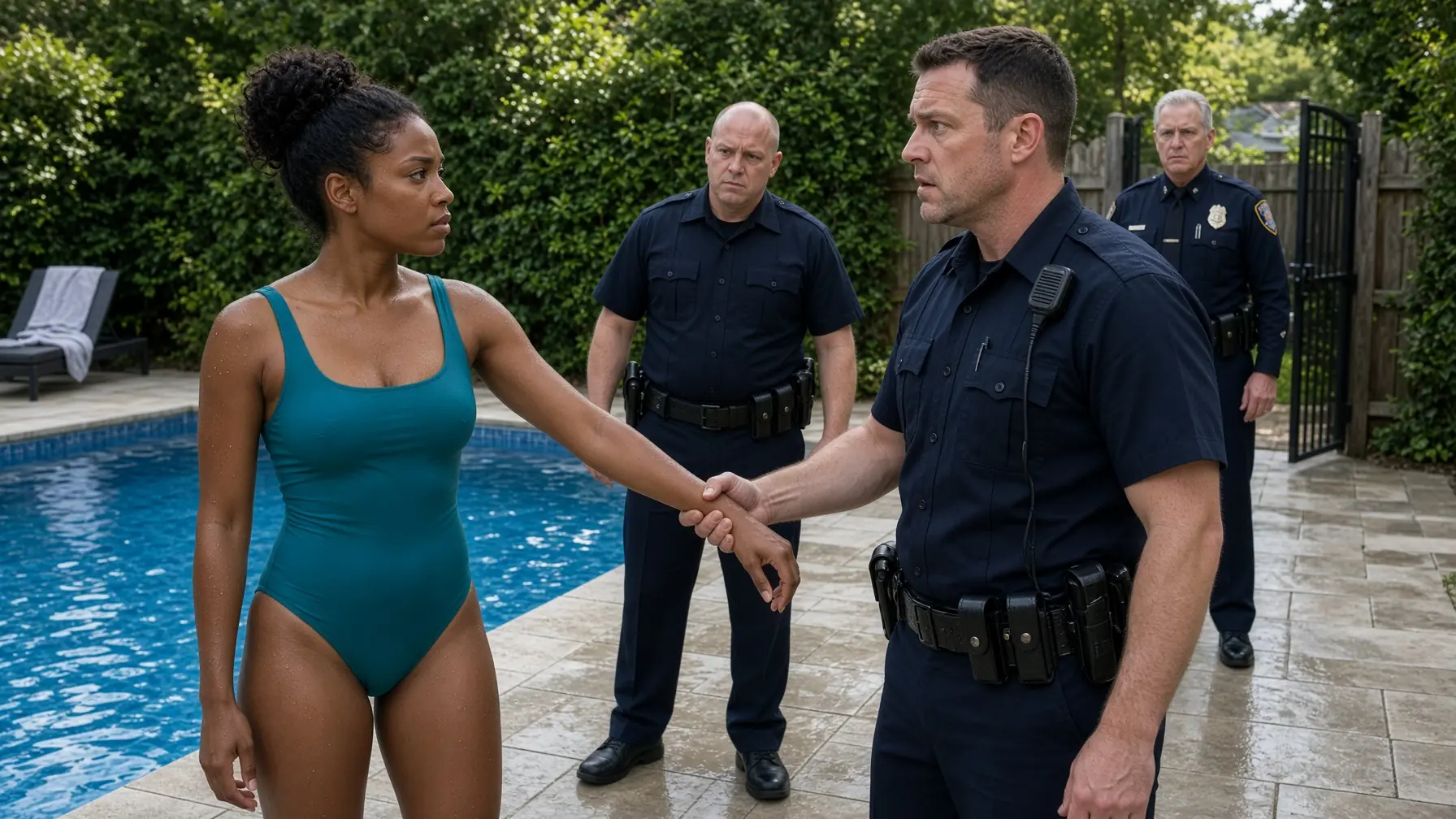
“You don’t live here,” he said. “Start talking.”
Water ran from Maya’s loose curls down the back of her neck. Her bare feet were planted on the wet paving, and the afternoon breeze had begun cooling the water on her shoulders. She looked past the officer at the towel, then back at his face.
“The owner invited me. Move.”
His expression barely changed.
A second officer approached from her left, broad enough to close the remaining space without appearing to hurry. He wore a faint smile that made the interruption feel less like a misunderstanding and more like something he intended to enjoy.
Maya had been alone in the backyard a minute earlier.
Now she could not reach a chair six feet away.
She had almost declined the invitation that morning.
Her friend had called while Maya was standing in her kitchen, deciding whether the small collection of errands on the counter could fill an entire Saturday. There was a grocery list, a package she needed to return, and a note reminding her to replace a lightbulb she had been tolerating for two weeks.
None of it was urgent. All of it offered an excuse to remain busy.
“Come over this afternoon,” her friend said. “Use the pool.”
Maya glanced toward the window. Outside, the day was clear, the kind of early autumn afternoon that made summer seem unwilling to leave the Richmond area just yet.
“Are you going to be there?”
“Most of the day. I have to run out for a little while, but that doesn’t affect your invitation.”
“I don’t want to take over your backyard.”
“You’re swimming, Maya. You’re not building an addition.”
That made her laugh.
Her friend had been offering the pool for weeks. The invitation was simple, but Maya had a habit of treating rest as something she needed to justify before accepting it. There always seemed to be one more useful thing she could accomplish first.
“You can bring lunch,” her friend continued. “There’s water in the refrigerator. Leave your bag inside if you want. Just come enjoy yourself.”
Maya looked at the list on the counter again.
A return could wait. Groceries could wait until evening. The lightbulb had already proved it was capable of waiting.
“All right,” she said.
“Good. And don’t spend the whole time on your phone.”
“I hadn’t planned to.”
“You hadn’t planned to come either.”
After the call, Maya took the teal swimsuit from a drawer and laid it on her bed. It had a square neckline and broad straps, comfortable enough that she could swim without adjusting it every few minutes.
She packed a towel, a change of clothes, sunscreen, and a water bottle. Then she added the paperback she had been trying to finish for a month, although she knew she was more likely to read three pages and fall asleep in a chair.
Her phone went into an outside pocket of the bag.
Before leaving, she checked the apartment once, found nothing that required her presence, and locked the door.
The drive took her through streets she knew and then into a quieter neighborhood outside Richmond. Houses stood behind mature trees, with hedges trimmed along property lines and driveways wide enough to make parking unremarkable.
Maya slowed near her friend’s house, checked the address, and pulled in.
The front door opened before she reached it.
“There she is,” her friend said.
“You make it sound like I’ve crossed an ocean.”
“For you to take an afternoon off? Close enough.”
They hugged in the doorway. Her friend took one look at the bag and smiled.
“You really brought a book.”
“I like having options.”
“You can have options by the pool.”
Inside, the house was bright and quiet. A ceiling fan moved slowly in the room beyond the entrance, and through the rear glass doors Maya could see green hedges enclosing a blue rectangle of water.
Her friend showed her where to leave the bag and which bathroom to use. Then they carried water and a plate of fruit outside.
The backyard was smaller than it looked from the house, but thoughtfully arranged. A hedge screened the fence, a narrow paved path led to the side gate, and two chairs stood near a low table at the shallow end of the pool.
Nothing about it asked Maya to hurry.
She sat down and took off her sandals.
Her friend settled into the other chair, and they talked for a while about ordinary things: a delayed delivery, an overgrown plant, a recipe neither of them had managed to make as easily as the instructions promised.
Maya found herself laughing more than she had expected.
The afternoon had no agenda.
That was what made it feel strange at first.
When her friend went inside to take a call, Maya remained outside with the water bottle between her hands. Somewhere beyond the hedge, a lawn mower started and then faded as its operator moved farther away.
A bird landed briefly on the fence.
Maya watched it until it flew off.
When her friend returned, she was carrying her keys.
“I have to go out sooner than I thought.”
Maya began reaching for her sandals.
“I can head back.”
“No, you can’t.”
“I’m pretty sure I can.”
“You know what I mean.” Her friend pointed toward the pool. “I invited you to use it. That invitation doesn’t expire because I need to leave the house for a while.”
Maya hesitated.
She was comfortable there with her friend. Being alone in someone else’s home carried a different feeling, even when permission was clear.
Her friend noticed.
“You have the side gate if you want it. Your bag is safe inside. Stay as long as you like.”
“How long will you be?”
“Long enough for you to stop asking and get in the water.”
Maya smiled.
“All right.”
“And if you leave before I get back, just send me a message.”
“I will.”
Her friend went through the glass doors, paused to wave from inside, and disappeared toward the front of the house. A short time later, Maya heard a car start in the driveway.
Then the backyard became quiet again.
Maya remained in the chair for another few minutes, looking at the pool.
The surface caught the clear afternoon light without hiding the bottom. She could see the shallow steps, the drain cover, and a few tiny leaves that had settled near one corner.
She folded her towel over the chair back.
The loose thread caught briefly against her finger.
She freed it, placed her water bottle on the table, and went to the steps.
The water was cool enough to make her stop at knee depth.
She breathed out, went another step, and let the water rise to her waist. By the time she pushed away from the edge, the initial chill had become something pleasant.
For the first few lengths, she thought about the errands she had left undone.
Then she thought about the book in her bag.
Then, gradually, she thought about nothing beyond reaching the far wall and turning.
Her curls had been gathered into a loose bun before she arrived, but a few strands escaped as she swam. They clung to her temples and cheeks.
She did not bother with them.
She swam steadily, rested, and floated for a while near the middle of the pool. Above her, the sky was clear and the hedge formed a green border around the yard.
It was the kind of quiet that made small sounds distinct.
Water against the pool wall.
A car passing beyond the fence.
The soft movement of leaves.
At thirty-one, Maya knew how easily an afternoon could vanish without leaving anything she remembered about it. She had not expected this one to stand out.
She had certainly not expected to remember the precise placement of a towel.
She turned onto her stomach and swam toward the shallow end.
There was movement near the side path.
At first, she assumed her friend had returned and come through the gate. She lifted her face from the water, brushed a wet curl away from one eye, and looked toward the hedge.
A man in a navy police uniform stood beside the path.
Another was coming through behind him.
Maya stopped swimming.
Her feet found the pool bottom.
The first officer looked toward the house, then across the patio. The second let the gate settle behind him and scanned the backyard.
Neither called out.
Maya waited for one of them to explain why they were there.
The first officer’s gaze reached her and stayed there.
He was muscular, with short brown hair and a uniform that looked neat despite the heat of the afternoon. His posture suggested he was not uncertain about where to go next.
The other officer had a shaved head and a broader build. He paused near the hedge, giving his colleague room to approach.
Maya stood in water just above her waist.
For a moment, she wondered whether something had happened outside the property. A traffic accident nearby. A problem at another house. Someone who needed to speak with the owner.
She glanced toward the glass doors.
Nothing had changed inside.
Her bag was where she had left it.
The officer began walking toward the shallow end.
Maya moved to the steps.
She wanted to be able to hear him without water moving around her ears, and she wanted her towel. Both seemed reasonable things to want before having a conversation with two strangers in uniform.
She came up the steps carefully.
Water streamed from the teal swimsuit and ran along her legs. She placed one hand briefly on the rail, stepped onto the paving, and turned toward the chair.
The officer moved into her path.
He did it without touching her.
One step was enough.
Maya stopped so abruptly that a small sheet of water slid from her shin onto his shoe.
His eyes traveled over her face, the swimsuit, and her bare feet. It was not the quick assessment of someone checking whether she needed help.
He seemed to be collecting reasons for a conclusion already reached.
The towel waited behind his right shoulder.
Maya looked at it.
Then he spoke.
“You don’t live here. Start talking.”
She had been prepared to answer a question.
The accusation left a different impression.
Her friend’s invitation had been unambiguous. She had entered through the front door, sat with the homeowner, and remained because she had been specifically asked to do so.
Nothing about that required her to apologize.
Still, she understood how quickly an ordinary explanation could become an argument if the person requesting it was not actually interested in hearing one.
She kept her shoulders straight.
“The owner invited me. Move.”
The first sentence answered him.
The second asked him to stop blocking something she needed.
His mouth tightened slightly.
Behind him, the other officer began approaching.
Maya could feel the breeze now. The water on her skin had turned cold, and a drop ran slowly from the end of one curl to her collarbone.
She wanted the towel.
She wanted her phone.
Most of all, she wanted to understand why two officers had entered a private backyard and treated a swimmer as someone they had caught doing something wrong.
The first officer remained where he was.
His nameplate was too low in her line of sight for her to read without making the movement obvious. She kept her eyes on his face.
He looked young enough that the contempt in his expression seemed practiced rather than earned.
Maya had seen that expression before.
Not on him.
In stores where an employee watched her hands more closely than anyone else’s. At a reception where a stranger had asked which entrance the staff used while she was holding an invitation. In situations so small that explaining them afterward made them sound easier to dismiss than they had felt at the time.
She did not bring those experiences into every new encounter.
She would have exhausted herself if she did.
But they had taught her to notice the moment when a question stopped being a question.
The officer had not asked whether she lived there.
He had told her she did not.
She could not know what he had been told before entering the yard. She could not know whether he had mistaken the property or misunderstood someone else.
What she knew was the treatment in front of her.
She gave him a chance to change it.
Her gaze moved briefly toward the chair again.
He followed it, then looked back at her.
The faint smugness remained.
Maya considered stepping around him.
There was space on the pool side, although not enough to pass comfortably without moving close to the edge. On the other side, the second officer was approaching.
She stayed where she was.
The paving was wet beneath her feet, and she did not want to turn a disagreement into a fall simply because a man refused to allow a direct route to a towel.
The second officer stopped beside her.
He placed himself close enough that Maya had to shift her attention to include him. His uniform remained fully fastened, his equipment secured at his waist.
He was not assisting his colleague in making the conversation clearer.
He was making the space smaller.
“Relax, sweetheart,” he said. “We’re checking you.”
Maya looked at him.
The word sweetheart had no warmth in it.
It reduced the situation to something she was supposed to accept with a smile, as though the officer blocking her path were a minor inconvenience and her objection were the real problem.
She could hear the pool water moving behind her.
A small wave she had created while climbing out reached the far wall and came back.
The motion continued while everything on the patio seemed to stop.
Maya had no pockets.
Her phone was inside.
Her sandals were beside the chair.
The simple distance between those objects and her body now mattered in a way it had not mattered ten minutes earlier.
She did not feel helpless.
She felt exposed.
There was a difference, but she was beginning to understand how easily other people could confuse the two.
The officer beside her smiled faintly.
Maya could see the edge of his nameplate, though she did not turn far enough to read it yet. Her attention remained on what he was doing.
He was standing too close.
She began shifting her weight away from him, intending to preserve the small amount of space she still had.
He moved his hand.
The gesture was casual enough that, from a distance, it might have looked like someone guiding another person around an obstacle. There was no obstacle.
There was no reason for his hand to reach her.
His palm touched her waist.
Maya knocked it away immediately.
The movement was fast and contained.
She did not step toward him.
She did not continue after the contact ended.
She simply removed his hand from her body.
The second officer’s smile disappeared.
At almost the same instant, the first officer caught her wrist.
His fingers closed hard enough that she felt the change before she understood the movement. Then he pulled her toward him.
Her right foot slid on the wet paving.
For one sharp second, she was off balance.
The pool was behind her, the chair beyond him, and his grip controlled the direction of her arm. She stumbled one step, caught herself, and planted both feet.
She did not pull back.
She did not push him.
She stood still because falling would have made everything worse.
The officer held her wrist between them.
Maya looked down.
His hand was pale against her wet skin.
Her fingers remained open.
Water dripped from her elbow onto the concrete.
The surprise came first.
Not because she believed officers could never behave badly. Because there was still a part of her that expected a person who had crossed a boundary to recognize the mistake when she corrected it.
Instead, one man had touched her without permission and the other had punished her for stopping it.
The whole movement had taken only a few seconds.
There had been no warning long enough to prepare for it, no conversation that explained it, no reason she could identify beyond the fact that she had refused to accept what they were doing.
Maya drew a careful breath.
The air felt cool against her teeth.
She looked at the officer holding her wrist.
His expression had changed, but not in the way she had hoped.
The smugness was still there beneath a harder set to his jaw, as though he now expected her to become the kind of person he had decided she was when he first saw her in the pool.
Angry enough to give him something useful.
Frightened enough to stop objecting.
Unsteady enough to make the grab look necessary.
Maya gave him none of those things.
She concentrated on her feet.
One had found a drier patch of paving. The other remained near the wet mark left by the stumble.
She settled her weight evenly.
Her shoulders came level.
The officer beside her stayed close, but he did not put his hand back on her waist.
She could feel him watching her.
The first officer’s grip had not loosened.
Maya had spent years learning that composure could be misread as agreement. She had also learned that losing it in front of someone determined to misread her could become a different kind of trap.
She did not need to choose between silence and panic.
There were other ways to make a moment clear.
She began with what she could observe.
The officer holding her was shorter than he had seemed when he stood between her and the chair. Up close, she could see the slight crease beside his mouth and the way he kept his chin lifted.
His nameplate was now directly in front of her.
Ryan Cole.
She read it once.
Then again.
Not because it was difficult to understand.
Because she wanted no uncertainty later.
The other officer’s position had shifted just enough that she could also see his plate when she glanced toward him.
Travis Grant.
She did not say either name aloud.
She looked back at Cole.
The pressure around her wrist made the small joint feel unfamiliar, as though it belonged to someone standing at a distance from her. She resisted the instinct to rotate it free.
He was stronger.
He was wearing shoes with traction on a surface where she was barefoot.
He had another officer beside him.
Those were facts.
They did not mean his behavior was acceptable. They meant she needed to decide what to do with care.
The gate was somewhere behind his shoulder.
The house was to her right.
Her phone remained inside the glass doors, far enough away that reaching for it was not an option while he held her.
Maya could have shouted.
She considered it.
The hedge rose high along the fence, thick enough to make the backyard feel private when privacy had been something she wanted. Now it hid the scene from anyone passing outside.
A raised voice might reach a neighbor.
It might also let Cole tell himself she had become disorderly.
She did not have to make that decision immediately.
What mattered first was that he understood she had noticed exactly what happened.
Her eyes stopped moving.
The surprise in her face settled into something colder.
She held his gaze.
“Remember what you just did,” she said. “You’re going to explain it.”
Her voice was clear.
Not loud.
Not trembling.
Grant glanced at Cole.
For the first time, the second officer seemed to be assessing the situation rather than enjoying it. Maya saw the change without turning her head.
Cole tightened his jaw.
His fingers remained closed around her wrist.
The sentence had not persuaded him to release her.
But it had altered the expression on his face.
Maya was not asking him to believe she belonged at the house anymore. She had already told him why she was there.
Now she was telling him that his own actions would matter beyond the space he controlled.
It was a simple statement.
He appeared to dislike it more than anything else she had said.
A drop of water fell from her hand between his shoes.
The pool behind her had almost settled.
Everything ordinary about the afternoon remained in place.
The fruit on the low table.
The book inside her bag.
The folded towel.
A chair angled toward the water so that a person could sit there and do nothing for a while.
Maya found that ordinary stillness more unsettling than noise would have been.
If someone had walked in without looking closely, they might have taken a second to understand that she was being held. She was not bent over a surface. She was not on the ground.
She was a woman in a swimsuit standing between two uniformed men.
One had his hand around her wrist.
That was enough.
She did not need the encounter to become worse before she was allowed to recognize what it was.
She watched Cole’s face and kept breathing evenly.
The officer’s uniform stayed neat.
His equipment did not shift.
Nothing in his appearance reflected the sudden disorder he had introduced into her afternoon.
Maya wondered whether that was part of what made the moment so difficult to absorb. He looked official.
He looked prepared.
His hand felt no different because of either thing.
She remembered arriving at the house and pausing in the doorway while her friend insisted she stay. The invitation had been so ordinary that neither woman had thought to preserve it as proof.
They had not discussed what Maya should do if someone came into the yard and demanded an explanation.
Nobody expected a quiet afternoon by a pool to need that kind of preparation.
Her friend had shown her the bathroom, the refrigerator, the gate.
Those had been acts of hospitality.
Maya had received them that way.
Now the officers’ presence threatened to rearrange the meaning of everything around her. Her bag inside the house could be made to look like a possession left somewhere it did not belong. Her solitary swim could be made to look like evidence that the owner was absent.
Even the ease with which she had moved through the yard might be treated as something suspicious.
She recognized that possibility.
She refused to participate in it.
The owner had invited her.
That remained true no matter how Cole looked at her.
She had been entitled to remove Grant’s hand from her waist.
That remained true no matter how firmly Cole held her wrist.
She could not control what they would say.
She could control what she remembered.
The first statement.
The path to the towel.
Grant approaching from the side.
His hand.
Her response.
Cole’s pull.
The slip beneath her foot.
She placed those moments in order, one after another, rather than allowing the intensity of the last one to swallow the beginning.
That order mattered to her.
People often began telling an encounter at the point where someone reacted. Maya had no intention of forgetting what she had reacted to.
Cole looked toward Grant without turning his whole head.
Maya did not follow the glance.
She kept her eyes on the man holding her.
A few moments earlier, she had wanted him to move.
Now she wanted him to understand that she would not help make this look smaller afterward.
She could feel the cold water drying unevenly on her skin.
One shoulder had warmed in the sun while the other remained damp. A loose strand of hair stuck to her cheek.
She left it there.
Lifting her free hand to move it would have been an ordinary gesture in any other conversation. Here, she found herself considering whether the movement would be misread.
That realization brought a brief flash of anger.
She had come to swim.
She was now calculating whether she could touch her own face.
Her expression did not change.
Grant shifted his weight.
The movement made a small scrape against the paving.
Maya registered it, along with the direction of his shoulders and the distance between his hand and her body. She would not let him touch her again without knowing it was happening.
He seemed less relaxed.
The difference was subtle, but visible.
His earlier smirk had depended on the assumption that she would accept the tone and the contact. Her refusal had interrupted that assumption.
Cole’s grip had created a new problem for both of them.
Neither appeared ready to admit it.
Maya’s free hand hung at her side.
Her fingers were slightly curled, relaxed enough that she could open them if asked, although no one had asked. She kept the hand where it could be seen.
She was aware of how careful she had become.
That did not make her less angry.
It made the anger more exact.
Cole had said she did not live there.
He had not said that someone needed help.
He had not said they were looking for a person, checking a specific report, or asking to speak with the owner.
He had begun by assigning her a position beneath him.
Grant had reinforced it with a word Maya had not invited and a touch she had not consented to.
Then Cole had taken hold of her.
There was no need to invent another explanation for what she had experienced. She would listen if one was offered, but she would not supply it for them.
The officer’s eyes moved briefly toward the towel.
Maya noticed.
He knew where she had been trying to go.
He had known from the beginning.
That small fact settled heavily inside her.
She had not been moving toward a vehicle.
She had not been reaching into a bag.
She had been walking from the pool to a chair, wet and barefoot, with both men close enough to see exactly what lay there.
The towel was still folded.
Nobody had moved it.
In a different afternoon, she would have wrapped it around her shoulders, picked up the water bottle, and looked for the page she had left marked in her book.
She held that version of the day in her mind for a moment, not because it would change anything, but because she did not want this encounter to convince her the invitation itself had been foolish.
She had done nothing wrong by accepting a place where she was welcome.
She would not carry that confusion away with her.
A sound came from beyond the hedge.
At first, Maya could not identify it.
It was too small to be a car and too close to be one of the distant noises she had been hearing all afternoon.
Then metal shifted against metal.
The gate latch.
Grant heard it.
His eyes moved before the gate opened.
Cole was still facing Maya, his body blocking most of her view of the path. She could see only a narrow space past his left shoulder.
The gate began to move inward.
A strip of the side passage appeared between the wood and the hedge.
Maya did not turn her head.
Cole still held her wrist, and she would not make a sudden movement simply because someone else had arrived.
The gate opened farther.
A gray-haired officer stood at the entrance.
His navy command uniform was immediately distinguishable from the patrol uniforms in front of her, although Maya did not study it long enough to inventory the differences.
She studied his face.
He had stopped just inside the gate.
Not paused while deciding which path to take.
Stopped.
His eyes went directly to Cole’s hand.
Maya saw that clearly.
They did not move first to the pool, the house, or her swimsuit.
They went to the grip around her wrist.
Grant’s posture changed.
He stepped away from Maya at once, opening space that had not existed a moment earlier. The movement was quick enough to make his earlier closeness look deliberate in retrospect.
His hands were no longer near her.
Maya remained still.
She knew the arriving officer as Lieutenant Harris only because she could make out the identification as he stood in the open gate. Nothing else about him explained why he had come.
She did not ask.
He had not spoken.
His expression was difficult to read from where she stood, but his attention remained fixed on the place where Cole touched her.
That was enough to alter the entire backyard.
A second earlier, Cole and Grant had behaved as though there were no reason to consider how their actions appeared to anyone outside their partnership.
Now Grant had moved.
Now Cole was noticing that movement.
Maya felt his grip remain steady while his attention began to leave her face.
He looked toward Grant.
The other officer’s gaze was fixed past him.
Cole followed it.
For the first time since he blocked her path, the smugness disappeared completely.
Maya watched the change happen.
It was not gradual.
His eyes shifted toward the gate, recognized the figure standing there, and widened just enough to make the hard set of his mouth look out of place.
He had not yet released her.
That mattered.
There could have been a moment, later, when someone tried to describe the grip as a brief touch already over by the time anyone arrived.
Maya was aware of the difference between that possible story and the reality around her wrist.
Harris was looking at it.
Grant had seen him looking.
Cole knew he was looking.
The towel hung over the chair behind them.
A breeze lifted its loose thread and let it fall again.
Maya’s shoulder ached faintly from the direction of the pull, but she did not roll it or change her stance. She wanted no new motion to obscure the one that had brought them to this point.
Her bare feet remained planted.
One on the wet paving.
One on the drier patch she had found after stumbling.
She was no longer fighting to keep her balance.
She had it.
Cole turned his head farther toward the gate.
His body did not follow.
That left him standing between Maya and the towel, hand still around her wrist, caught in a posture he suddenly seemed to wish belonged to someone else.
Grant had put several feet between himself and her.
He looked larger from that distance, and less comfortable.
Maya did not glance at him again.
She looked at Cole.
He had wanted her to explain why she was in the backyard.
Now there was another question in the yard, visible without anyone speaking it.
Maya did not smile.
Relief had not arrived.
Neither had an apology, an explanation, or the freedom to reach for the towel.
A senior officer entering the gate did not undo the hand at her waist or the pull that had nearly put her on the paving. She was not going to pretend the encounter had become harmless because Cole had lost his expression.
But something had changed.
The grip was no longer an act occurring within the narrow world the two officers had created around her.
Someone else was seeing it.
Maya kept her shoulders level and her free hand visible.
Harris stood inside the entrance, the open gate beside him and the green hedge at his back. His eyes remained on Cole’s hand before moving, slowly, toward Cole’s face.
Cole’s jaw worked once.
No words came out.
The pool water settled behind Maya.
For the first time since she stepped onto the patio, nothing in the backyard was moving.
Not Grant.
Not Harris.
Not Cole’s fingers around her wrist.
Maya held perfectly still, looking directly at the officer who had told her to start talking.
And the silence lasted one breath longer than he seemed able to bear.