“Step away from the vehicle. Now.”
Jordan Ellis looked up from his phone.
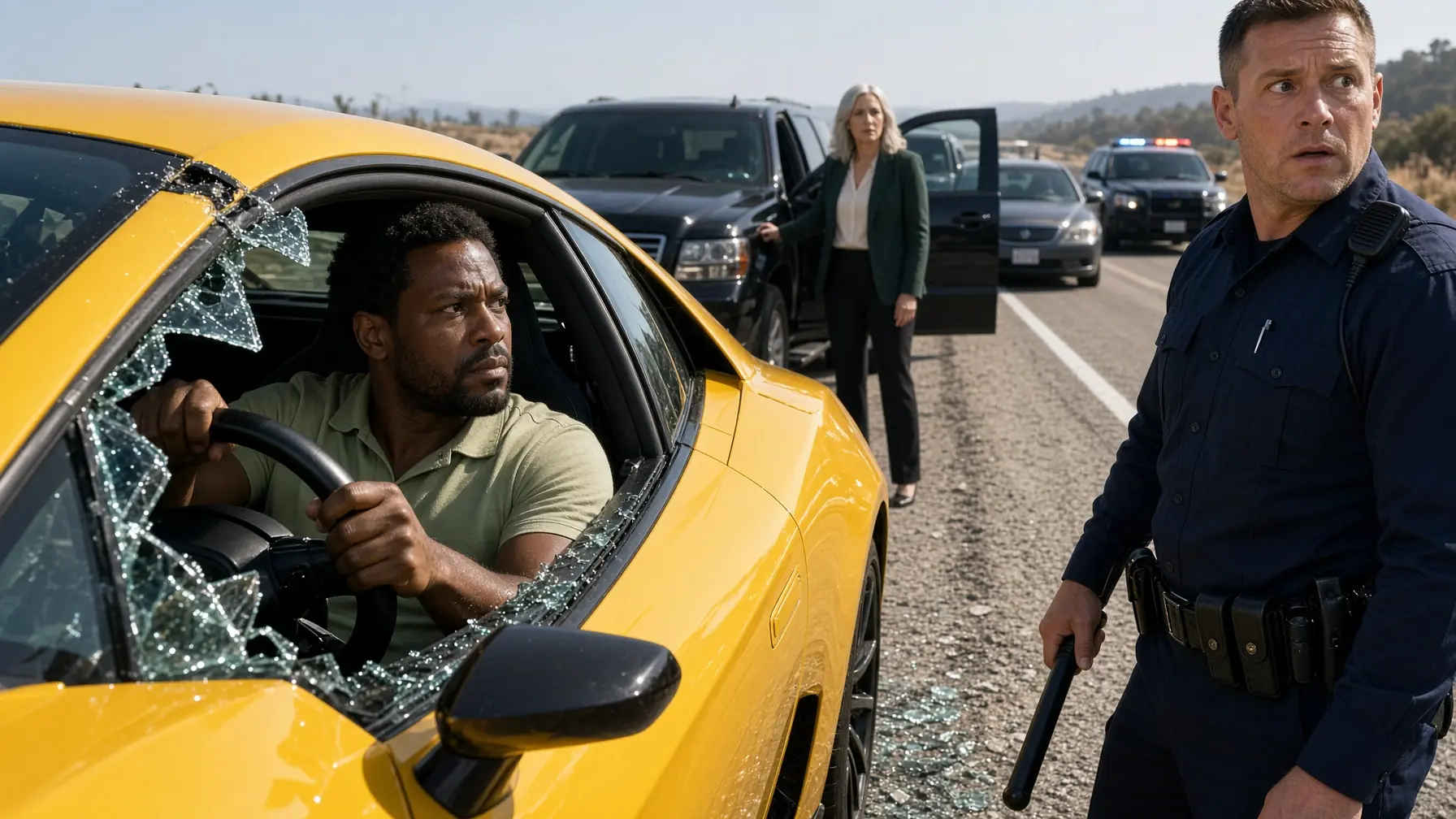
For a second, he thought the officer was speaking to someone behind him. Then he saw the finger pointed at the van and the impatient expression directed at his face.
“I’m paralyzed,” Jordan said. “I can’t step anywhere.”
Officer Daniel Kessler did not look at the footplates holding Jordan’s white sneakers. He did not look at the wheelchair’s controls, the disabled plates, or the placard hanging from the rearview mirror.
His eyes stayed on the phone.
Jordan tightened his grip.
He had started recording thirty seconds earlier, when the officer approached the accessible parking space and demanded to know why the van’s side door was open.
Now Kessler reached toward the screen.
Jordan pulled the phone against his chest and moved his chair backward.
It was a small movement. Less than the length of his shoe.
The rear of the chair bumped the rolling cart beside the deployed ramp.
The architectural model tilted.
Jordan caught its base with his free hand, but one tiny paper tree broke loose, turned once in the air, and landed on the pavement between them.
He stopped the chair.
His legs remained still.
For a moment, all he could see was the tree.
He had spent nearly an hour making that one, cutting its branches with small scissors, folding the canopy so it looked different from the others.
“Turn that phone off,” Kessler said.
Across the access aisle, Samuel Park held his own phone in both hands.
The fifty-six-year-old security guard had come outside when he heard the officer’s voice. He had stayed because he knew Jordan was expected inside, and because nothing about the conversation seemed to be improving.
“He’s here for the design presentation,” Samuel said.
Kessler did not turn toward him.
“I’m speaking to him.”
Behind the officer, a vehicle door closed.
Sergeant Melissa Chen approached from the curb, one hand near the radio on her shoulder. Her dark hair was secured in a tight bun, and her expression changed as she took in the scene.
The wheelchair.
The placard.
The ramp resting across the striped access aisle exactly where a ramp needed room.
Then the model.
“Kessler,” she said. “What exactly suggested misuse?”
He turned.
His mouth opened.
Nothing came out immediately.
Two pedestrians stopped behind Samuel. Traffic moved through the intersection, and somewhere farther down the block, a bus released its brakes.
Chen waited.
Kessler glanced at the placard.
Then at Jordan’s phone.
Jordan kept recording.
“He wouldn’t follow instructions,” Kessler said.
Chen’s expression did not change.
“That wasn’t my question.”
“He was beside the vehicle when I approached.”
“Yes.”
“The ramp was deployed.”
“I can see that.”
“And when I asked him to move, he started recording.”
Jordan felt something hot move up his neck.
He had replayed enough conversations in his head to recognize when someone was starting a story in the middle.
“I was already recording,” he said.
Kessler looked back at him.
Jordan’s fingers tightened around the phone.
“Because you kept saying the space wasn’t for waiting.”
Chen raised one hand slightly, keeping her attention on Kessler.
“What did you observe before you gave the instruction?”
The officer shifted his weight.
“I was checking whether he was authorized to use the space.”
“What suggested he wasn’t?”
Another pause.
Jordan could feel the model sliding under his hand. The impact had loosened something beneath the curved entrance ramp, and one corner of the base no longer rested flat on the cart.