Officer Daniel Kessler looked at Jordan Ellis’s wheelchair before telling him he should not be beside the van.
That was the part Jordan could not stop thinking about.
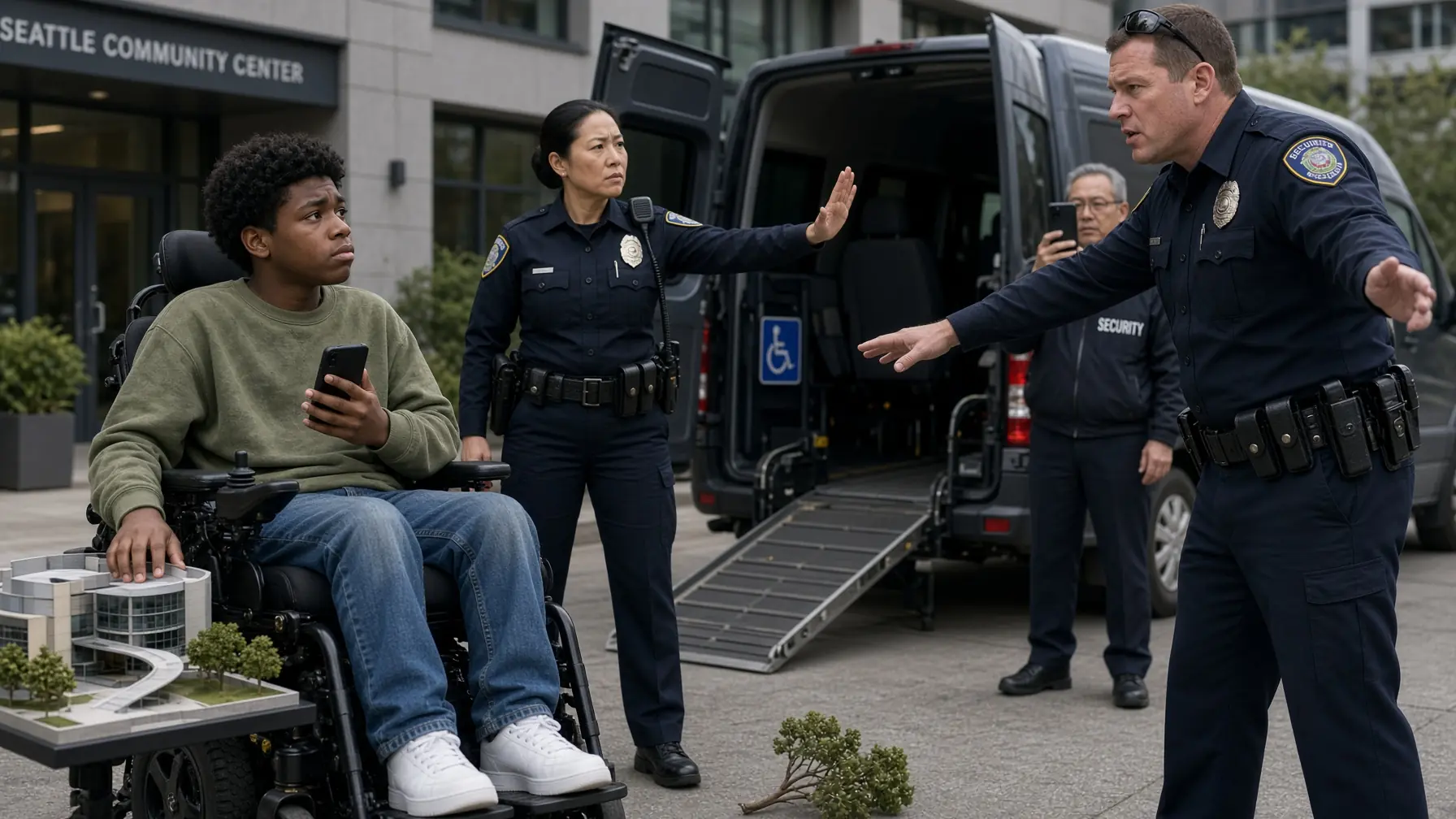
The officer had seen the black electric chair. He had seen Jordan’s still legs resting on the footplates, his white sneakers clear of the pavement, and the deployed ramp extending from the open side door onto the striped access aisle.
The accessible placard hung from the rearview mirror.
Nothing about those things was hidden.
Yet Kessler stood close enough to cast a shadow across Jordan’s lap and asked why he was there as though the answer could not possibly be what the scene suggested.
Jordan held his phone at chest level.
Beside him, an architectural model rested on a rolling cart.
He had spent more time making its entrance than any other part of the building.
Now he was afraid that moving toward it would become another thing the officer misunderstood.
Earlier that day, the model had occupied most of the table in front of Jordan.
He sat in his wheelchair with a small collection of paper trees arranged along one edge. Some stood upright. Others lay beside them, waiting to be attached.
The trees were not necessary to explain the building.
He knew that.
They mattered because he wanted the model to look like a place someone might actually choose to spend time.
A building could be technically welcoming and still feel as though nobody expected you to enjoy arriving.
Jordan had been thinking about that throughout the project.
He did not want to design an entrance that looked like an apology.
He wanted a front door people could approach together.
The curved ramp had taken the longest.
Not because the curve was especially elaborate.
Because every time he placed it beside the main entrance, he saw something he wanted to change.
Too detached from the path.
Too narrow in appearance.
Too much like something added after the rest of the building was finished.
He kept adjusting it until it felt like part of the building’s first thought.
That distinction mattered to him.
He had spent enough time being directed toward entrances that other people described as convenient without ever using them.
Around the side.
Through another door.
Wait here until someone comes.
The phrases were ordinary.
Their accumulation was not.
Jordan did not want his model to begin with those instructions.
At sixteen, he was used to adults praising the project before looking closely at it.
“That’s nice.”
“Very creative.”
“You’ve worked hard.”
Sometimes they meant those things kindly.
Sometimes the praise arrived with a tone suggesting that completing anything in a wheelchair was the part they found remarkable.
Jordan preferred specific questions.
Why put the trees there?
Why curve the approach?
What happens when two people arrive from different directions?
Those questions made the work feel like work.
They gave him something to answer besides being thanked for trying.
He set one tiny paper tree upright and leaned back to examine the entrance.
The model was not perfect.
He could see every place where his hand had been less steady than he wanted.
A faint mark near one wall.
An edge that did not meet quite cleanly.
A tree whose crown leaned even after he corrected the trunk.
He decided not to fix that one again.
He had already spent too much time on it.
At some point, continuing became a way of postponing the moment someone else would look.
Jordan understood that about himself.
He could keep improving a small detail until there was no time left to find out whether the whole idea made sense.
So he gathered the loose pieces, checked what needed to travel with the model, and took photographs.
The phone recorded the entrance from several angles.
He wanted a way to show the approach without asking people to bend over the table and guess what he meant.
One photograph caught the curved ramp in a way he liked.
The path began at the edge.
The trees framed it without blocking the front.
The entrance looked ordinary.
That pleased him more than making it look impressive.
He wanted ordinary access.
The possibility of arriving without becoming a problem someone needed to solve.
He kept that image on the phone.
Later, outside the community building, it was the last thing on the screen before the officer’s attention changed the afternoon.