David Caldwell had pulled over believing the worst part of his night would be standing beside a highway in a ruined suit. Then the officer at his window called him by name before looking at his license. As rain swallowed the sounds of passing traffic, David realized this stop had begun long before the patrol lights appeared behind him. What he did not know was whether the officer watching from the other side of his car had noticed it too.
The blue lights appeared just beyond the last exit David could have taken.
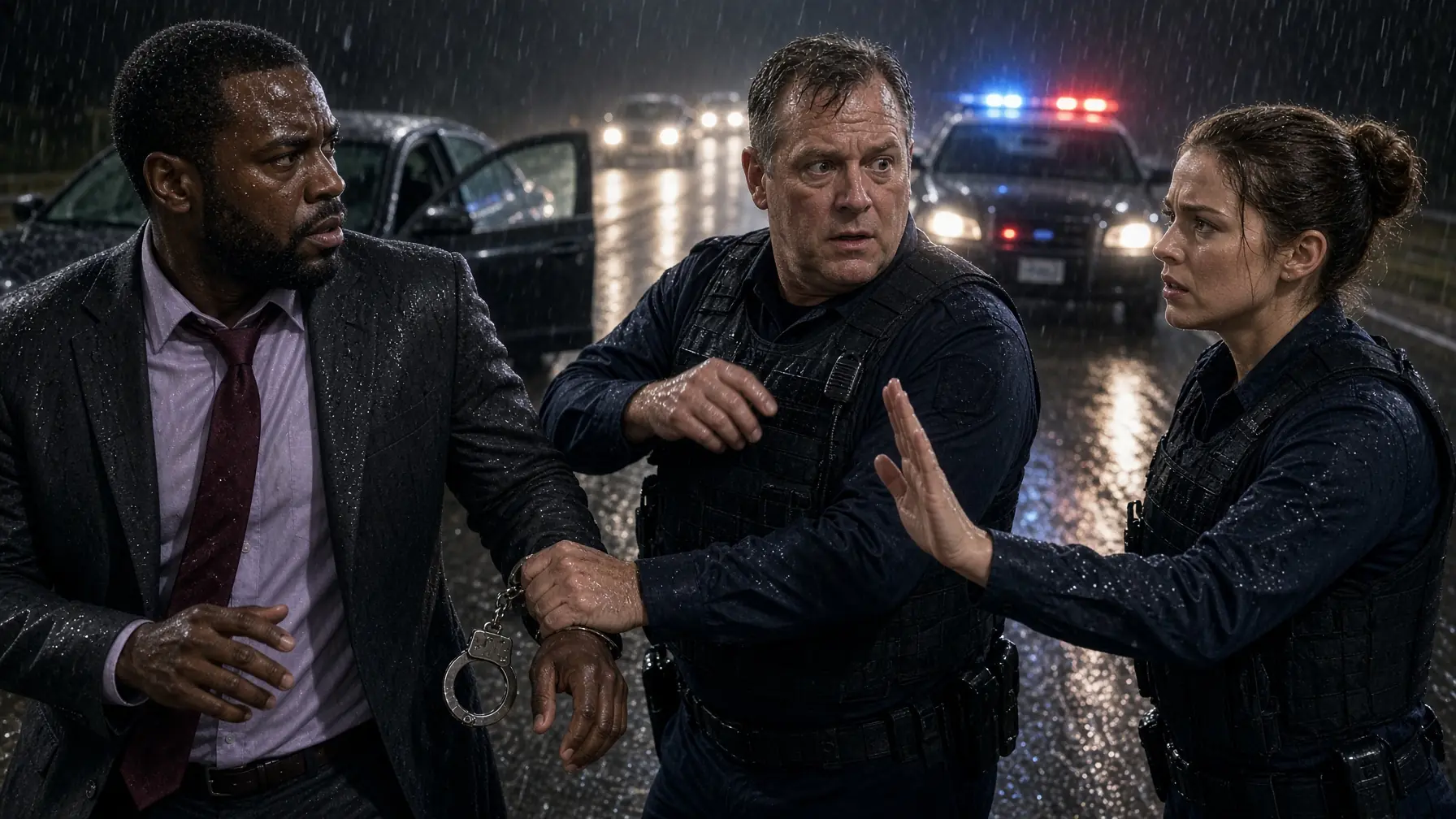
He saw them through the water sliding down his rear window, indistinct at first, then close enough to fill the mirrors. He lifted his foot from the accelerator, switched on his turn signal, and began looking for somewhere wide enough to stop without leaving the sedan exposed to passing trucks.
The highway shoulder narrowed along a concrete barrier before widening beneath an overhead lighting tower. David moved toward that brighter stretch, eased across the white line, and stopped with his wheels well clear of the traffic lane.
For a moment, he remained still.
The windshield wipers moved back and forth across an empty view of wet pavement. His dashboard clock showed that he was already later than he had intended to be, and the folder on the passenger seat contained work he still needed to review before morning.
He put the transmission in park, lowered the radio, and placed both hands on the steering wheel.
Behind him, the patrol vehicle stopped at an angle. Its white scene lights came on, washing the back of his sedan and the shoulder around it in clear, hard illumination.
David watched two doors open in the mirror.
One officer walked toward his window. The other remained near the rear of the sedan for a moment, looking along the passenger side and toward the moving traffic.
The first officer’s face became visible beneath the overhead lights.
David’s fingers tightened against the wheel.
Thomas Ryker.
For several seconds, David heard only the wipers. He recognized the officer’s heavy jaw, the stocky build beneath the tactical vest, and the short graying hair flattened by the rain.
Ryker did not hurry.
He approached as though the water pouring down his neck was an inconvenience that belonged to somebody else. When he reached the window, he bent slightly and looked into the car.
“Evening, Caldwell.”
David had not touched his wallet.
He lowered the window enough to speak, and rain immediately struck the inside of the door.
“Why did you stop me?”
Ryker’s mouth moved into a small smile. “License and registration.”
“My license is in my wallet. Registration’s in the glove compartment.”
“Then get them.”
David moved slowly, announcing the movement before reaching toward his jacket. The officer watched his hands with an expression David remembered too well.
He placed the license on the window ledge, then retrieved the registration and held it where Ryker could see it. When the officer took the papers, his smile did not change.
“Still working at that place downtown?”
David looked at his own name on the license in Ryker’s hand. “Why did you stop me?”
“Your driving.”
“What about it?”
“We’ll get to that.”
Ryker stepped back from the window.
Across the passenger side, the younger officer stood beneath the scene lights, her brown hair secured in a tight bun. She wore the expression of someone trying to watch several things at once without missing any of them.
David did not know her name yet.
He only knew that she had heard the greeting.
Earlier that evening, he had stood in a conference room with dry cuffs, a straight burgundy tie, and a cup of coffee he had barely touched. A client had asked a question about a delayed project, and David had answered without blaming the people working beneath him.
The discussion had gone well.
That mattered because he had spent months trying to prove he could manage more than his own assignments. At thirty-four, he was old enough to know that being capable did not always mean being given the chance to demonstrate it.
He had stayed late afterward, helping a colleague correct a figure in a presentation they would use the next morning. When she apologized for keeping him, he had told her he would rather find the mistake in an empty office than explain it in a room full of people.
By the time he left, most of the building was quiet.
He loosened his tie in the elevator and checked his phone. His mother had sent a message asking whether he had eaten, followed by another saying that she knew he would answer the first question with something that did not count as a meal.
David smiled and promised to call when he got home.
Then he saw the email beneath her messages.
It was an acknowledgment concerning the complaint he had filed about Thomas Ryker.
He had read it twice before putting the phone away. There was no resolution in it, only confirmation that additional material had been received and that someone would contact him if clarification was needed.
A few weeks earlier, he would have considered that message routine. Now every communication about the complaint brought a small knot into his stomach.
He had not told many people how much it worried him.
The incident had happened outside his office building during a lunch break. A maintenance worker from a nearby property had been standing beside a damaged service van while Ryker questioned him.
David had noticed because the officer’s voice carried across the pavement.
The worker kept pointing toward the open hood. He was trying to explain why the vehicle was stopped where it was, and Ryker kept interrupting him.
David initially stayed near the entrance.
He had no desire to become part of somebody else’s encounter with the police. But when the worker reached for a paper on the dashboard after being told to produce it, Ryker caught his arm and pushed him against the side of the van.
The movement was abrupt enough that David stepped forward before deciding to.