A cold wind swept across the main security gate of Fort Bragg, North Carolina, as Walter Boone lowered himself onto one knee beside an old canvas duffel bag. At seventy-eight, every movement carried the accumulated weight of damaged joints, old scars, and memories he had spent decades trying to outlive. His faded olive field jacket looked too thin for the weather, and mud darkened the toes of his scuffed boots after the long walk from the nearest bus stop. Yet when Captain Ryan Mercer leaned over him with anger tightening his square jaw, Walter raised his weathered face without surrendering a trace of dignity.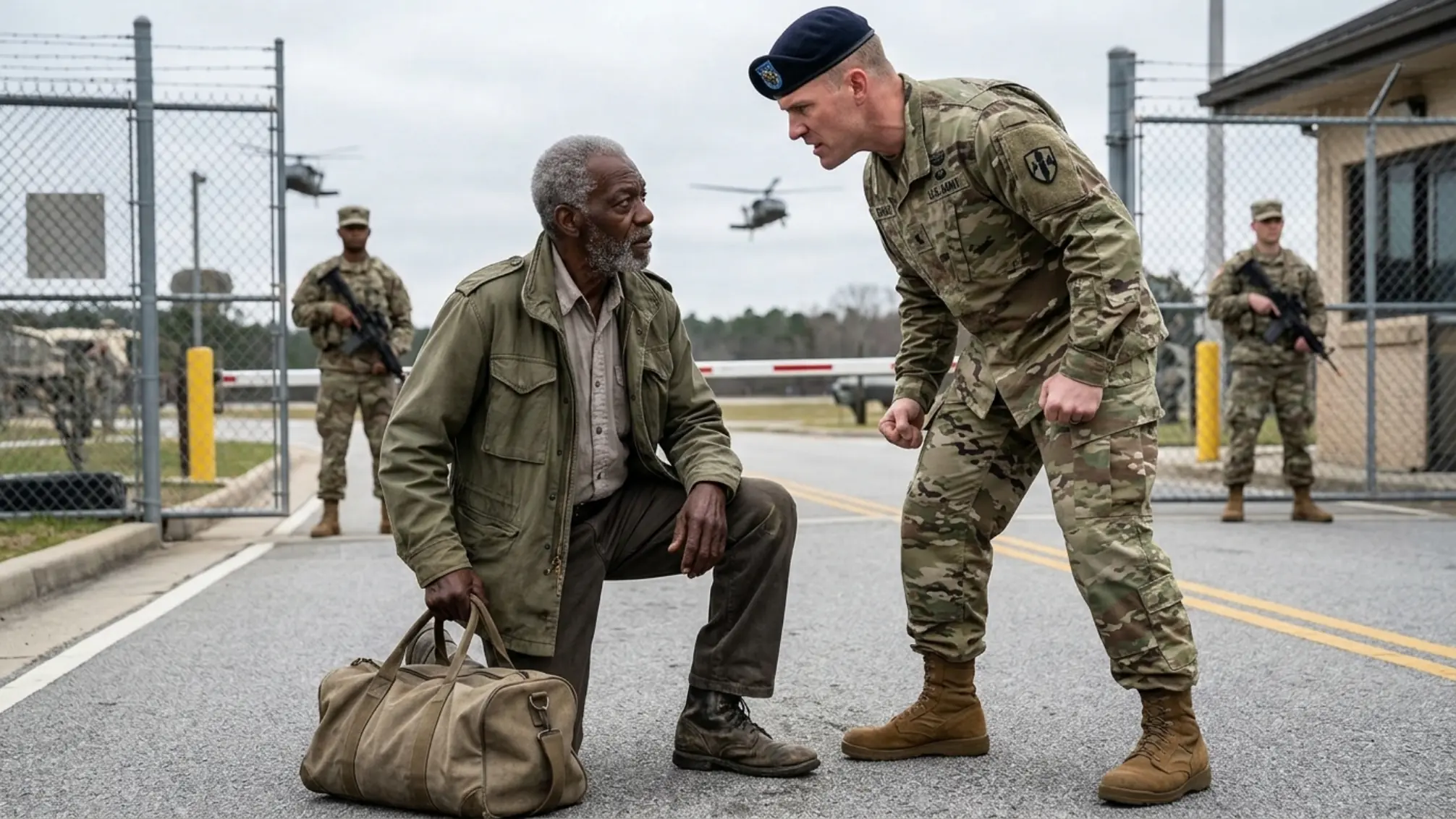
“You’re not stepping onto this base looking like that, old man,” Mercer said, pointing toward the road. “Pick up your bag and leave now.”
Walter slowly tightened his grip around the worn handles. “I didn’t come here to beg. I came because this ground remembers my blood.”
“Take one more step, and I’ll have you dragged away from this gate in front of every soldier here.”
Walter met the officer’s pale blue eyes. “Then call your commander, because he’s about to learn who built that medal wall inside.”
The soldiers standing behind Mercer exchanged uncertain looks. Three young enlisted men remained near the checkpoint booth with rifles resting across their chests, while a military police sergeant watched from beside a parked security vehicle. Helicopters moved across the gray sky beyond the fence, their rotors sending a low mechanical thunder through the afternoon. Mercer interpreted the silence around him as support.
Walter knew better.
The old veteran had arrived carrying a handwritten invitation, a sealed wooden box, and the last promise he had made to a dying friend. He had traveled by bus from a small town outside Birmingham, Alabama, changing routes twice and sleeping inside a station after a delay left him stranded overnight. The trip had taken nearly twenty hours. He had eaten half a sandwich, drunk two cups of coffee, and refused every offer from strangers to carry the duffel because he no longer trusted anyone else with what it contained.
His invitation was folded inside his breast pocket. The letter bore the official seal of the base command and requested his presence at a private memorial ceremony honoring a classified reconnaissance unit from the Vietnam era. Walter had read it every night for three weeks before deciding whether to attend. The base had once been his home, but it was also where officers had questioned his courage, buried his accomplishments, and sent him into places from which they never expected him to return.
He had avoided military ceremonies for forty-three years.
The invitation changed that because of one line near the bottom.
The final names have been approved for permanent placement.
Walter’s name was among them, but he had not come to see himself honored. He had come for Staff Sergeant Thomas Keene, the friend whose name had remained absent from every official record despite the lives he saved. Thomas died eight months earlier in a veterans’ hospital, holding Walter’s hand and asking only that the truth outlive both of them.
“I need to see your identification again,” Mercer demanded.
“You never looked at it the first time.”
“I looked long enough.”
Walter reached carefully toward his jacket. Mercer’s hand immediately dropped near the sidearm on his duty belt.
“Keep your hands where I can see them.”
“You asked for identification.”
“Tell me where it is.”
“Left pocket.”
Mercer nodded sharply. “Slowly.”
Walter removed a leather wallet and held it open. The military identification inside was old but valid, issued through the Department of Veterans Affairs and marked with a retired service designation. Beside it sat the invitation bearing Brigadier General Marcus Hale’s signature.
Mercer took the documents without asking permission. He examined the identification, then looked at Walter’s face as if searching for evidence of fraud. The photograph had been taken several years earlier, before illness hollowed the veteran’s cheeks and silver overtook the remaining black in his hair.
“This doesn’t authorize base access,” Mercer said.
“The invitation does.”
“Anyone can print a letter.”
“The commanding general signed it.”
Mercer gave a cold laugh. “You expect me to believe the commanding general personally invited a man who arrived on foot carrying a broken bag?”
Walter looked at the duffel. “This bag crossed two wars. It isn’t broken.”
A young specialist near the checkpoint lowered his eyes to hide a smile. Mercer noticed and turned toward him.
“Something amusing, Specialist?”
“No, sir.”
“Then stand properly.”
The soldier straightened. His name tape read MILLER, and Walter guessed he could not have been older than twenty-two. The young man kept glancing at the ribbon bar partially hidden beneath Walter’s jacket, though he probably did not recognize the faded arrangement.
Mercer turned back to the veteran. “Why didn’t someone from command send a vehicle?”
“They did.”
“And?”
“I told them I would make my own way.”
“Why?”
Walter looked past the gate toward the familiar trees and concrete buildings beyond it. “Because the last time I entered this base, I arrived under guard. I wanted to know whether I could walk back through the gate as a free man.”
Mercer’s expression hardened. “So you have a criminal history.”
“No.”
“You just said you were under guard.”
“I was returning from a mission the Army denied existed.”
The captain studied him, then shook his head. “I’ve heard enough stories.”
Walter had spent decades watching disbelief form in younger faces. The classified nature of his service meant official documents revealed little, and the silence ordered by the government eventually became indistinguishable from fiction. He never argued with strangers in bars or corrected men who assumed his scars came from accidents. Some truths survived best when guarded quietly.
Today was different.
Inside the duffel sat Thomas Keene’s field journal, a coded map, two bloodstained dog tags, and a camera containing photographs that had only recently been declassified. Those materials proved what happened during Operation Glass River in 1971. They also proved that the medal wall inside Fort Bragg had been built around an incomplete story.
“Call General Hale,” Walter said.
“You do not give orders at my gate.”
“I’m making a request.”
“You’re delaying security operations.”
“There is no line behind me.”
Mercer stepped closer until the toes of his polished combat boots nearly touched Walter’s worn ones. “Men like you come here every month. Old uniforms, dramatic stories, fake medals, and demands to see commanders who have actual work to do.”
Walter’s eyes narrowed. “Men like me?”
“People who need the Army to make them feel important again.”
The words struck more deeply than Mercer intended. Walter had never needed the Army to make him important. He had needed it to admit what it asked of men whose lives became expendable once missions turned politically inconvenient.
“Captain,” Walter said quietly, “the Army spent fifty years pretending men like me never existed.”
Mercer folded the invitation and slid it into his own pocket. “Then another hour won’t hurt.”
Walter’s patience ended.
He rose slowly from one knee, using the duffel for balance. Pain traveled through his right hip and along the shrapnel scar beneath his thigh, but he stood until his thin frame reached its full height. Mercer’s hand moved closer to his sidearm.
“Return my invitation,” Walter said.
“You need to leave.”
“That document does not belong to you.”
“Step back.”
Walter remained where he was.
The military police sergeant finally approached. She was a Black woman in her early forties with the name DAVIS stitched above her uniform pocket. Her expression remained professional, but concern sharpened her eyes as she looked from Walter to the captain.
“Sir, perhaps we should verify the invitation.”
Mercer did not turn. “I have this under control.”
“The general’s office can confirm it in less than a minute.”
“I said I have it.”
Sergeant Naomi Davis had served under Mercer for only six weeks, but she had already noticed how quickly he treated questions as disobedience. He had been transferred from a training command after receiving strong evaluations for discipline and efficiency. What those reports failed to mention was his need to dominate every uncertain situation before facts could challenge his judgment.
“Captain,” she said, “base policy requires confirmation when a visitor presents command correspondence.”
Mercer faced her. “Are you correcting me in front of a civilian?”
“I’m stating the procedure.”
Walter watched the exchange carefully. Naomi’s voice remained controlled, but she was taking a risk. Military rank could turn simple disagreement into career damage, especially when witnesses were present.
Mercer handed her the invitation. “Verify it, then.”
Naomi opened the folded page and read the signature. Her expression changed when she reached the guest’s full name.
“Walter Elijah Boone,” she said.
Specialist Miller looked up sharply.
Naomi read the name again, then glanced toward the base. “Sir, that name is on the Special Operations Memorial.”
Mercer frowned. “There are thousands of names.”
“No, sir. The temporary covered section installed yesterday. I supervised the security detail during construction.”
Walter’s jaw tightened. “Covered section?”
“The new plaques are being unveiled today,” Naomi explained. “The ceremony begins at sixteen hundred.”
The dashboard clock inside the security booth showed 3:41 p.m.
Walter had nineteen minutes.
“Call the general,” he said.
Naomi reached for her radio, but Mercer stopped her. “We are not contacting the commanding general directly over an unverified visitor.”
“The invitation lists his office number,” Naomi replied.
“Use the visitor control center.”
“That could take thirty minutes.”
“Then he waits.”
Walter looked at Mercer. “Thomas waited fifty-three years.”
The captain showed no recognition. “Who is Thomas?”
“The man whose place on that wall your paperwork erased.”
A dark government sedan appeared beyond the checkpoint and stopped abruptly inside the gate. Brigadier General Marcus Hale stepped from the rear passenger door before his driver could circle around. At fifty-eight, Hale was tall and broad, with close-cropped gray hair and the controlled manner of a career officer accustomed to instant obedience.
Two colonels followed him toward the confrontation.
“Captain Mercer,” Hale called. “Why is my guest still outside?”
Every soldier at the gate snapped to attention.
Mercer’s face lost color. “General, we encountered inconsistencies in his access documentation.”
Hale looked toward Walter. The severity in his expression disappeared.
“Sergeant Boone.”
Walter stood straighter despite the pain in his hip. “General.”
Hale stopped several feet away and saluted him.
The soldiers behind the gate stared in disbelief.
Walter returned the salute slowly. His hand trembled near his brow, not from fear but from the physical cost of holding it steady. Hale lowered his arm only after Walter did.
“We sent a driver to the bus station,” the general said.
“I know.”
“He searched for you for nearly an hour.”
“I needed to arrive my own way.”
Hale seemed to understand. “You always did.”
Mercer tried to recover. “General, I was protecting the installation.”
“By refusing to verify my signature?”
“The identification appeared outdated.”
“It is permanent retired identification.”
“He made unusual claims about classified operations.”
Hale turned toward him. “Those claims are the reason nearly two hundred people are waiting inside.”
Mercer’s eyes moved toward the old duffel. “Sir, I had no way of knowing.”
“You had an invitation, identification, a direct verification number, and a sergeant advising you to follow procedure.”
“I exercised caution.”
“You exercised contempt.”
The words carried quietly across the checkpoint.
Hale motioned toward the duffel. “Colonel Foster, please carry Sergeant Boone’s bag.”
Walter tightened his grip. “No.”
The colonel stopped.
“I carried Thomas home,” Walter said. “I can carry this.”
Hale nodded. “Then we walk with you.”
The general opened the gate personally.
As Walter crossed the threshold, Specialist Miller saluted him without being ordered. Sergeant Davis followed. One by one, the other soldiers raised their hands until every member of the checkpoint stood in silent recognition.
Mercer remained motionless beside the booth.
Walter stopped after several steps and looked back. “You threatened to drag me from this gate in front of every soldier.”
The captain swallowed. “I apologize.”
“Are you sorry for the disrespect—or sorry the general saw it?”
Mercer could not answer.
Walter turned away. “That is what you need to decide before you wear that uniform again.”
The memorial hall stood near the oldest section of the base, inside a renovated brick building that once housed intelligence operations. Photographs lined the entrance, showing soldiers from missions across Europe, Korea, Vietnam, the Middle East, and places still unnamed. Walter recognized young faces that remained unchanged while his own had aged beyond anything they would have imagined.
Nearly two hundred guests rose when he entered.
Some were active-duty officers. Others were veterans leaning on canes, widows holding framed photographs, and children who knew their fathers only through stories. At the front stood a wall covered by a long dark cloth.
Walter paused near the doorway.
For a moment, he was twenty-three again, standing in monsoon rain while Thomas Keene wrapped a bandage around his shoulder. He could smell wet earth, aviation fuel, and smoke. He could hear Thomas laughing because laughter was the only rebellion available when six men had been ordered to cross a border their government would later deny.
General Hale guided him toward the front row. “We can delay the ceremony.”
“No,” Walter said. “We have delayed enough.”
He placed the duffel on a table beneath the covered wall and opened it. The canvas zipper resisted before finally moving. Walter removed the wooden box and set it beside a framed photograph of six young soldiers wearing unmarked uniforms.
The image showed Walter in the center, thin and serious, while Thomas stood beside him with one hand raised behind Walter’s head in a childish gesture. Four of the six men never returned.
Operation Glass River began as a reconnaissance mission to identify an enemy supply route near the Laotian border. The team received orders to avoid contact and withdraw after forty-eight hours. On the second night, their extraction point was compromised, communications failed, and enemy forces surrounded the valley.
Thomas discovered a second route through flooded caves beneath the ridge. He led civilians and wounded soldiers through chest-deep water while Walter remained behind to delay pursuit. When an explosion collapsed the entrance, Thomas returned alone instead of escaping with the others.
He found Walter unconscious and carried him more than two miles.
Thomas was shot twice during the escape.
Official records credited an unnamed allied unit with the rescue because acknowledging American involvement threatened diplomatic negotiations. Walter received a medal under a sealed citation. Thomas received nothing. His military file described him as missing during unauthorized movement away from his assigned position.
The lie followed him for the rest of his life.
He lost promotions, struggled to obtain treatment, and spent years being told no record supported his account. Walter fought to correct it, but every request disappeared behind classification restrictions and bureaucratic silence. Thomas eventually stopped asking.
Only after declassification did the photographs, radio logs, and field journal become available for review.
General Hale stepped toward the podium.
“Today, Fort Bragg corrects an injustice that endured for more than half a century,” he began. “We recognize the members of Detachment Raven, whose service during Operation Glass River saved thirty-seven lives and prevented the destruction of an allied evacuation corridor.”
He named each soldier.
When Hale said Staff Sergeant Thomas Keene, Walter closed his eyes.
The dark covering fell from the wall.
Six bronze plaques appeared beneath the unit emblem. Walter’s name stood beside Thomas’s, both marked with decorations that had never previously been made public.
The audience applauded, but Walter did not look at his own plaque. He walked directly toward Thomas’s and placed one hand against the cool bronze letters.
“You made it,” he whispered.
A woman in her early sixties approached carrying a faded photograph. She was Thomas’s daughter, Rebecca, only a child when her father returned from war injured and disgraced. Walter had met her once at the hospital but had not seen her since the funeral.
“Did he really carry you?” she asked.
“Yes.”
“He never spoke about it.”
“He thought speaking would make the Army punish the rest of us.”
Rebecca looked toward the plaque. “All those years, he believed nobody remembered.”
“I remembered every day.”
Walter opened the wooden box. Inside rested Thomas’s dog tags, his field journal, and a silver star newly authorized after the review. Walter placed the medal in Rebecca’s hands.
“This belongs to your family.”
She closed her fingers around it and began to cry. Walter embraced her carefully, his chin resting above her gray-streaked hair. Around them, soldiers who had never known Thomas stood at attention.
The ceremony should have ended there, but General Hale returned to the podium.
“There is another matter we must address,” he said. “Sergeant Boone’s arrival today exposed a failure at our own gate.”
Mercer stood near the rear wall, having been ordered to attend after Sergeant Davis provided an initial report. He no longer wore his blue beret. His posture remained rigid, but humiliation had replaced the arrogance in his face.
Hale described the refusal to verify Walter’s invitation, the degrading language, and the threat of removal. He did not mention Mercer’s name publicly, but everyone who had witnessed the checkpoint knew whom he meant.
“Memorials are meaningless,” Hale continued, “if we honor veterans in bronze while humiliating them in person.”
The sentence moved through the hall more powerfully than any shouted accusation.
Walter had not requested a public reckoning. Still, he understood why Hale addressed it. The danger was not merely that one officer failed to recognize a decorated veteran. The danger was that respect had appeared only after rank and history became visible.
Mercer requested permission to speak with Walter after the ceremony.
They met near the uncovered medal wall. The captain stood without his usual confidence, staring at the names before turning toward the elderly veteran.
“I was wrong,” Mercer said.
Walter waited.
“I judged you by your clothes, your bag, and how you arrived.”
“You judged me before checking anything.”
“Yes.”
“What did you see?”
Mercer struggled with the answer. “An old man who might be confused.”
“Did I appear confused?”
“No.”
“You called my story fake.”
“I’ve dealt with people falsely claiming service.”
“So you treated every claim as false until someone powerful corrected you.”
Mercer looked down. “I thought firmness protected the base.”
“Firmness without judgment is only force.”
The captain’s eyes moved toward Thomas’s plaque. “I didn’t understand what this ceremony meant.”
“You didn’t need to.”
Mercer looked at him.
Walter continued. “You should not need my name on a wall before speaking to me with respect. I could have been a confused old man. I could have been homeless, mistaken, or standing at the wrong gate. None of that would have required humiliation.”
Mercer remained silent for a long moment. “What happens now?”
“That is for your commander.”
“What do you think should happen?”
Walter looked toward Sergeant Davis, Specialist Miller, and the other soldiers gathering near the exit. “You should be removed from gate command until you learn the difference between security and domination.”
Mercer accepted the words without argument.
General Hale suspended him from security duties pending a formal review. The investigation found that Mercer had ignored verification policy, used degrading language, threatened unnecessary force, and attempted to silence a subordinate who recommended the correct procedure. Previous complaints from civilians and junior soldiers were reopened.
He was not immediately dismissed from the Army. Instead, he lost command authority, received a formal reprimand, and entered an intensive leadership remediation program. Hale believed punishment without examination might remove one officer while preserving the habits that created him.
Sergeant Naomi Davis became acting checkpoint commander.
Three months later, she contacted Walter. The base had introduced a veteran-access protocol allowing elderly visitors to receive immediate assistance, transportation, and identity verification without being treated as security threats. Gate personnel received training based partly on Walter’s experience.
Naomi asked whether he would return to speak with the soldiers.
Walter initially refused.
Then Rebecca Keene called and reminded him that Thomas had returned into danger because leaving one man behind felt worse than risking himself. Walter understood her meaning. Change required returning to the place that caused the wound.
He visited Fort Bragg the following spring.
This time, a military vehicle collected him from the station. He still carried the old duffel himself. At the checkpoint, Specialist Miller had become a sergeant and stood beside the entrance.
“Welcome back, Sergeant Boone.”
Walter handed him his identification.
Miller examined it carefully, verified the appointment, and returned it with respect. He did not recognize Walter merely because of the medal wall. He followed the correct process because every visitor deserved one.
Mercer waited beyond the gate in a standard uniform without command insignia. His posture had changed, not into weakness but into restraint. He saluted Walter.
“Permission to carry your bag, Sergeant?”
Walter studied him for a moment.
Then he handed over the duffel.
Mercer received it with both hands.
They walked together toward the memorial hall while helicopters moved above the trees. Walter’s pace was slow, but no one rushed him. Young soldiers passing along the road saluted after recognizing the name on his visitor badge.
Inside the hall, Thomas Keene’s plaque caught the morning light.
Walter placed his hand against it again, no longer carrying the weight of an unfinished promise. The Army had finally written the truth into bronze, but the deeper lesson stood outside on the road leading from the gate.
Honor was not something soldiers could reserve for famous names, decorated uniforms, or men whose commanders arrived in black cars.
It began with how they treated the person standing before them when they believed he had no power at all.