Suddenly, the glass doors of the Chase Bank branch in downtown Chicago swung open, and a cold gust rolled across the polished marble floor.
Everyone near the teller counter turned their heads at once, not because the door was loud, but because the man who stepped inside looked like he belonged anywhere but there.
He was elderly, thin, and stooped, with gray hair blown wild by the wind and a torn brown coat hanging from his shoulders.
A worn canvas sack crossed his chest, sagging heavily against one hip, and his shoes looked as if they had walked through rain, alleys, and years of being ignored.
The bank lobby was full that morning.
Businessmen in fitted suits stood in line with leather folders tucked beneath their arms, two women near the waiting chairs whispered over mortgage papers, and several tellers moved behind the counter with polite smiles trained into their faces.
The branch manager, Richard Hale, stood near the glass office wall speaking to a wealthy client.
A security guard named Daniel Ross watched the door from beside the marble column, his hands folded over his belt.
The old man took three slow steps inside.
Water dripped from the hem of his coat, leaving small dark spots on the bright floor.
A few customers leaned away as if poverty were something contagious.
One young banker covered his mouth to hide a smile.
The old man did not seem to notice at first.
He stopped beneath the tall ceiling, lifted his tired eyes, and looked around the lobby as if remembering a place that no longer remembered him.
The marble, the brass fixtures, the digital screens, the polished counters, all of it seemed too new for his face.
He stood there for several seconds, breathing slowly, one hand gripping the strap of his sack.
Then he turned toward the security guard.
“This bank is mine,” the old man said quietly.
For one second, the lobby went still.
Then laughter broke across the room.
It began with a banker near the desk, then spread to customers in line, then to two tellers who quickly looked down but could not hide their smiles.
The wealthy client beside Richard Hale chuckled openly.
Even Daniel Ross, the security guard, lowered his chin and grinned.
Richard Hale turned from his client with irritation first, amusement second.
He was forty-eight, handsome in a polished way, with silver at his temples and a suit that cost more than the old man’s entire outfit.
He had built his career by welcoming rich clients before they reached the counter and removing poor ones before they became inconvenient.
To Richard, the bank was a temple of status, and this old man looked like dirt tracked across the altar.
Daniel Ross stepped closer with a smirk.
“This bank is yours?” he asked.
He looked the old man up and down, from the ripped coat to the worn shoes.
“Look at you, old man. You can’t even afford a clean coat.”
More laughter moved through the lobby.
The old man did not flinch.
“My coat is not what built this place,” he said.
Daniel’s smile weakened slightly, but Richard Hale laughed from behind him.
“Daniel, please handle this before he bothers real clients.”
The words were smooth, but the cruelty underneath them was clear.
Richard did not even ask the old man’s name.
Daniel moved closer.
“Sir, you need to leave.”
The old man looked past him toward the teller counter.
“I need to speak with the branch manager.”
Richard lifted one hand.
“You are speaking near him, and he is telling you to go.”
A woman in line whispered, “Poor thing must be confused.”
Another customer said, “Probably looking for shelter.”
A young employee near the customer service desk laughed under her breath.
The old man heard every word, but his expression remained calm.
He took one more step forward.
Daniel placed a hand against his chest to stop him.
The room reacted with more amusement than concern.
The old man looked down at the guard’s hand, then back into Daniel’s eyes.
“Son, before you push an old man out of a building, you should know whose floor you are standing on.”
Daniel’s face hardened.
“Do not threaten me.”
“I did not threaten you,” the old man said.
“I warned you.”
Richard’s smile disappeared, replaced by annoyance.
“Enough. Escort him out.”
Daniel gripped the old man’s sleeve.
The fabric was thin and damp, and the old man’s arm beneath it felt fragile.
For a moment, something like discomfort crossed Daniel’s face.
But the watching crowd made him continue.
He tugged the old man toward the door.
The old man stopped moving.
It was not strength that stopped Daniel.
It was the stillness.
The old man stood rooted to the marble floor, one hand tightening on the strap of his sack.
His eyes lifted to Richard Hale, and his voice, though quiet, carried across the lobby.
“If you throw me out before I open this bag,” he said, “you will regret it before noon.”
Richard sighed dramatically, enjoying the attention now.
“Oh, by all means,” he said.
“Let the gentleman show us what he carries in his magic sack.”
The laughter returned, louder this time.
A banker near the counter muttered, “Maybe he owns the moon too.”
The old man slowly lowered the sack from his shoulder.
He placed it on the marble floor with more care than anyone expected.
The sack was worn thin in places, patched with different pieces of cloth, and tied at the top with a faded leather cord.
Daniel stood beside him, arms crossed.
Richard watched with a smug expression, certain the old man would pull out bottles, newspapers, or some useless pile of junk.
Instead, the old man untied the cord and reached inside.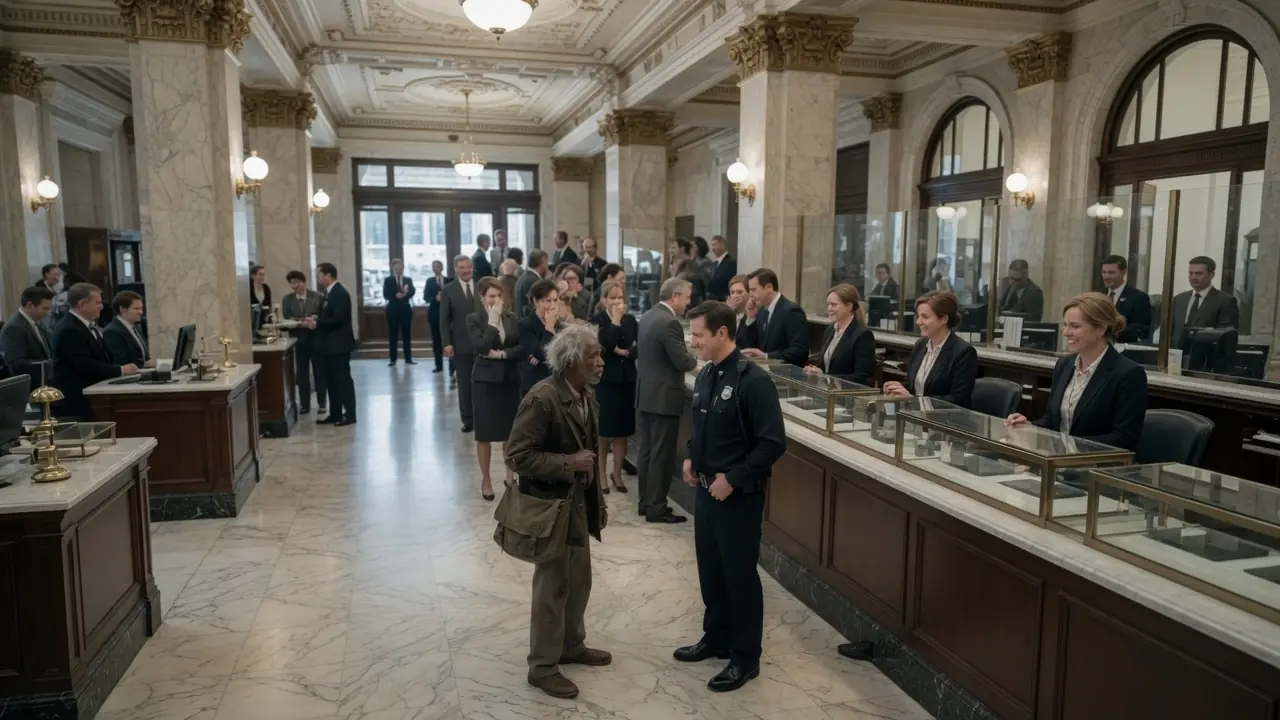
He removed a leather folder first.
It was old, dark brown, and cracked at the corners, but polished from years of careful handling.
Then he removed a framed black-and-white photograph wrapped in cloth.
Finally, he took out a sealed envelope with a red wax stamp and placed all three items on the nearest writing table.
The laughter began to fade.
The old man unfolded the cloth from the photograph and turned it toward the room.
It showed a younger version of him standing in front of a small brick bank building with a woman beside him and a group of workers behind them.
The sign above the door read Monroe Savings & Trust, 1968.
Below the photograph, in careful handwriting, were the words: First branch. Built with our hands, not borrowed pride.
Richard’s face changed, but only slightly.
“What is that supposed to prove?” he asked.
The old man opened the leather folder.
Inside were yellowed documents, ownership certificates, property deeds, merger papers, and a series of legal documents marked with seals from decades earlier.
“My name is Ezekiel Monroe,” the old man said.
An older woman near the teller line gasped.
A gray-haired teller behind the counter froze with one hand over her keyboard.
Richard’s smile vanished completely.
Daniel looked at the photograph again, then at the old man, and his hands slowly dropped from his belt.
The gray-haired teller stepped forward.
“Ezekiel Monroe?” she whispered.
The old man turned to her.
“Yes, ma’am.”
She pressed one hand to her chest.
“My father worked at Monroe Savings when I was a little girl. Your picture used to hang in the old break room.”
The lobby became silent.
Ezekiel nodded gently.
“Then your father may have known my wife, Ruth.”
The teller’s eyes filled.
“He said she kept blankets in the back office for families who came in during winter.”
Ezekiel’s face softened.
“She did.”
Richard Hale stepped forward quickly, trying to regain control.
“This is interesting history, Mr. Monroe, but this is now a Chase branch. Whatever bank you started was absorbed decades ago.”
Ezekiel looked at him calmly.
“Absorbed, yes. Forgotten, no.”
He placed a deed on the table and tapped it once with his finger.
“The building you stand in was never sold with the original merger. It remained under the Monroe Family Trust.”
He placed another document beside it.
“The local operating rights and several legacy shares stayed with that trust under a grandfathered agreement.”
Then he placed a final folder in front of Richard.
“And last month, after years of silence, the trust exercised its review authority because this branch has become the most complained-about location in the district.”
Richard’s jaw tightened.
“You cannot simply walk in here dressed like—”
Ezekiel’s eyes hardened.
“Like what?”
Richard stopped.
The question sat in the lobby like a trap.
Ezekiel took one slow step toward him.
“Like a man you can laugh at? Like a man your guard can touch? Like a man whose clothes matter more than his name?”
Richard looked around, suddenly aware that every phone, every eye, every employee was fixed on him.
His confidence began to crack.
Daniel Ross swallowed hard.
“Mr. Monroe, I didn’t know.”
Ezekiel turned toward him.
“That is the problem, son.”
Daniel lowered his eyes.
“You should not need to know who a man is before deciding whether he deserves dignity.”
No one laughed now.
Ezekiel looked around the bank lobby.
He saw the customers who had mocked him, the tellers who had smiled, the bankers who had whispered, and the manager who had ordered him removed without asking a single question.
His face showed disappointment deeper than anger.
This was not the bank he had built with Ruth.
This was a beautiful room with an ugly heart.
“When Ruth and I opened Monroe Savings,” Ezekiel said, “we served farmers, factory men, widows, teachers, janitors, and families who came in with more fear than money.”
His voice grew heavier with memory.
“We did not ask poor people to prove they were worth our time.”
He looked at Daniel.
“We did not put hands on old men because their coat was torn.”
Then he turned to Richard.
“And we did not call wealthy customers real clients while treating everyone else like trash.”
Richard’s face flushed.
“Mr. Monroe, I apologize if the situation was mishandled.”
Ezekiel shook his head.
“That is not an apology. That is a sentence trying to avoid a spine.”
A few employees looked down, but this time not from amusement.
They were ashamed.
Richard tried again.
“I apologize.”
“For what?” Ezekiel asked.
Richard stared at him.
Ezekiel waited.
Finally, Richard said, “For judging you by your appearance.”
“And?”
“For ordering security to remove you.”
“And?”
Richard’s throat moved.
“For laughing.”
Ezekiel nodded once, but his face did not soften.
A woman in the customer line stepped forward.
“I laughed too,” she said quietly.
Ezekiel turned to her.
She lowered her eyes.
“I’m sorry.”
Another man near the deposit counter cleared his throat.
“I should have said something.”
The silence that followed became heavier because everyone knew the same was true for them.
Ezekiel picked up the photograph of the first branch.
In it, his younger self stood proudly beside Ruth, both of them smiling in front of a building that looked plain compared to the marble palace around him now.
But there was warmth in that photograph.
There was purpose.
The old bank had not looked rich, but it had looked human.
“I did not come here to embarrass you,” Ezekiel said.
Richard looked surprised.
Ezekiel continued, “I came because I wanted to see whether the stories were true.”
He opened another folder from the sack.
“Customers turned away for looking poor. Elderly account holders mocked for asking questions. Small-business owners ignored while wealthy clients were served first. Employees afraid to report cruelty because management protects numbers before people.”
The gray-haired teller behind the counter began to cry.
Richard looked sharply at her.
Ezekiel saw the look.
“What is your name?” he asked her.
“Margaret,” she whispered.
“Margaret, has this branch treated people that way?”
She hesitated, looking at Richard.
Ezekiel’s voice softened.
“You may answer without fear.”
Margaret wiped her cheek.
“Yes, Mr. Monroe. Many times.”
Richard snapped, “Margaret—”
Ezekiel lifted one hand, and Richard stopped.
“Do not silence her,” Ezekiel said.
His voice was still quiet, but something in it made Richard step back.
Margaret continued, trembling now.
“I’ve seen customers with small balances ignored. I’ve seen people talked down to because they didn’t understand forms. I’ve seen Mr. Hale tell staff not to waste time on people who don’t look profitable.”
The lobby absorbed every word.
Daniel Ross removed his cap slowly.
“I’ve been told to remove people who weren’t causing trouble,” he admitted.
Ezekiel looked at him.
“And did you?”
Daniel’s face tightened with shame.
“Yes, sir.”
“Then today can either be the day you defend that, or the day you stop becoming it.”
Daniel nodded, eyes lowered.
“It stops today.”
Richard looked around, realizing the room was turning against him.
“Mr. Monroe, this is unfair. You walked in dressed like a homeless man and made a scene.”
Ezekiel’s eyes grew cold.
“I walked in dressed like the people you have been mistreating.”
Richard opened his mouth, but Ezekiel continued.
“And you proved every complaint true in less than five minutes.”
At that moment, the bank doors opened again.
Three people entered: a woman in a navy suit, a man carrying a legal case, and another man with a tablet.
The woman walked directly to Ezekiel and nodded.
“Mr. Monroe.”
Richard recognized her and went pale.
It was Elaine Porter, regional compliance director.
Behind her was an attorney for the trust.
Elaine looked at Richard.
“Mr. Hale, effective immediately, you are suspended pending investigation.”
Richard stepped back.
“You can’t do that in front of customers.”
Ezekiel looked at him without pity.
“You had no problem humiliating others in front of customers.”
Elaine held out her hand.
“Your access card and keys, please.”
Richard’s polished confidence finally collapsed.
He looked toward the wealthy client he had been speaking with earlier, but the man suddenly found the floor fascinating.
He looked toward Daniel, but Daniel did not move to help him.
He looked toward his staff, and not one person defended him.
Slowly, Richard removed his access card and placed it on the table beside the old photograph.
As Richard walked toward the door, Ezekiel called his name.
Richard turned, face tight with humiliation.
Ezekiel said, “Remember this feeling.”
Richard’s jaw flexed.
Ezekiel continued, “Then imagine giving it to someone who came here only to cash a check, ask for help, or keep their lights on.”
Richard had no answer.
The doors closed behind him.
The lobby remained silent for several seconds.
Then Ezekiel turned toward Daniel Ross.
The guard stood stiffly, expecting punishment.
Ezekiel studied him for a long moment.
“You smiled when I was mocked,” he said.
Daniel nodded.
“Yes, sir.”
“You touched me because a man in a suit told you to.”
“Yes, sir.”
“Why?”
Daniel swallowed.
“Because I thought keeping my job meant following orders.”
Ezekiel shook his head.
“No. Keeping your soul means knowing when an order is wrong.”
Daniel’s eyes shone with shame.
“I understand.”
Ezekiel picked up his sack and handed it to Daniel.
The guard blinked, confused.
“Hold this for me.”
Daniel took it carefully.
It was heavier than he expected.
Ezekiel gave him a faint smile.
“Respect starts with how you hold what belongs to someone else.”
For the rest of the morning, the branch changed in front of everyone.
Elaine Porter ordered the lobby closed temporarily, not to business, but to cruelty.
Customers were asked to sit.
Employees were asked to gather.
Ezekiel stood near the center of the marble floor, the old photograph in his hand, and told them the story of Monroe Savings & Trust.
He told them how he and Ruth opened the first branch with borrowed desks and secondhand chairs.
He told them how the first farmer who came in needed a loan for a broken tractor and offered his wedding ring as collateral because he had nothing else.
Ruth had refused the ring and made him coffee instead.
The man paid back every penny.
His children later opened accounts there.
He told them about winter mornings when the bank lobby became shelter for people waiting for buses.
He told them about widows who cried over paperwork and tellers who sat with them until the numbers made sense.
He told them about factory workers who deposited five dollars a week because Ruth told them small savings still counted as hope.
Then he looked at the marble walls.
“This building became richer,” he said.
“But I am not sure it became better.”
By noon, the video of Ezekiel’s humiliation and reveal had already spread online.
The clip showed the laughter, Daniel moving toward him, Richard ordering him out, and then the moment the founder’s photograph appeared.
People shared it with angry captions, emotional comments, and questions about how many others had been treated badly without being secret owners.
But Ezekiel refused interviews.
He did not want fame.
He wanted repair.
By the next week, the branch had a new acting manager.
Margaret, the gray-haired teller, was promoted to customer care lead.
Daniel Ross remained in security, but his duties changed.
He began greeting people at the door, not judging them from it.
Every staff member went through retraining, but Ezekiel insisted that training alone meant nothing unless policy changed too.
The Monroe Standard was restored to the branch.
The words were printed on a brass plaque and mounted near the entrance beneath the old photograph of Ezekiel and Ruth.
It read: A bank is not built by money alone. It is built by trust, dignity, and the hands of people who come here hoping to be seen.
No customer shall be judged by clothing, age, balance, accent, confusion, or fear.
Every person who enters deserves respect before profit.
Some customers came just to see the plaque.
Some came to apologize.
A few admitted they had laughed that morning and could not stop thinking about it.
Ezekiel accepted apologies but never let people use guilt as decoration.
“If you are sorry,” he would say, “be kinder next time when nobody important is watching.”
Months later, Daniel Ross saw a woman enter the bank wearing a fast-food uniform, holding a crying baby and a folder of unpaid bills.
She looked embarrassed before anyone spoke to her.
Daniel stepped forward, not to block her, but to open the door wider.
“Good morning, ma’am,” he said.
“We’re glad you’re here.”
Across the lobby, Ezekiel Monroe sat on a bench, older and weaker than before, but watching.
Daniel glanced at him once.
Ezekiel nodded.
It was a small gesture, but Daniel carried it with him all day.
A year later, Ezekiel passed away quietly in his sleep.
The bank held a small memorial in the lobby before opening hours.
Employees stood beneath the plaque, and Margaret placed fresh flowers beside Ruth’s photograph.
Daniel brought the worn canvas sack, now cleaned and carefully folded, and set it under the frame.
Inside it were copies of the original documents, the founder’s photograph, and a handwritten note Ezekiel had left for the branch.
Margaret read the note aloud.
“If you remember me only because I owned something, then you missed the lesson. Remember the coat. Remember the laughter. Remember how quickly a room can become cruel when good people stay silent. Then do better.”
No one spoke for a long time.
Years later, new employees at that branch still heard the story during training.
They heard about the old man in torn clothes who walked in with a sack and said, “This bank is mine.”
They heard how the room laughed, how security moved to remove him, and how the worn sack carried enough truth to silence marble, money, and pride.
But Margaret always ended the story the same way.
“The miracle was not that he owned the bank,” she would say.
“The miracle was that he still cared what it had become.”
And that was the lesson Ezekiel Monroe left behind.
Power does not always arrive in a limousine.
Sometimes it comes through a glass door in a torn coat, carrying a patched sack and a memory of what dignity used to feel like.
Sometimes the person everyone laughs at is the one who built the room they are standing in.
And sometimes a bank only finds its soul again after an old man dares to walk in looking like the very people it forgot how to serve.