The first time Walter Bennett saw the two boys, they were standing behind his café in the cold, sharing half a sandwich they had taken from the trash.
It was a gray February evening in Pittsburgh, Pennsylvania. The streets were wet from melted snow, and the wind moved sharply between the old brick buildings downtown.
Dirty slush lined the curbs. The streetlights had just flickered on, turning the puddles gold in some places and black in others.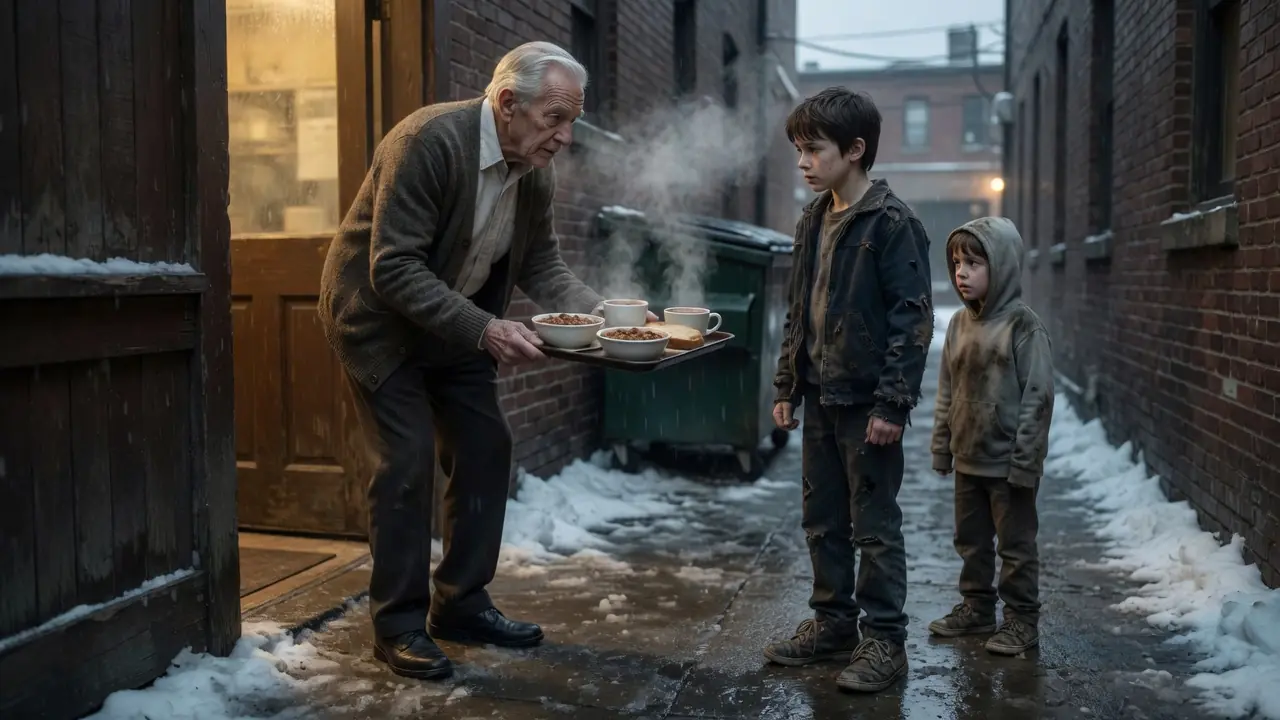
Most shops had already closed for the night, but Bennett’s Corner Café still glowed softly at the end of Monroe Street. Its old green sign flickered above the door, buzzing faintly every few seconds like it was tired but unwilling to quit.
Walter Bennett knew the feeling.
He was seventy-eight years old, with silver-white hair, a deeply lined face, tired blue eyes, and hands that still smelled faintly of coffee, bread, and dish soap after fifty years of work. He wore a faded brown cardigan over a white shirt, dark trousers, and old black shoes polished out of habit. The shoes hurt his feet now, but he still polished them every Sunday night because Helen had always said a man could be tired and still be neat.
Helen had been gone nine years.
Their only son, Matthew, lived in California with a wife, three children, and a schedule so full that phone calls had become holiday events. Walter did not blame him. Not out loud, anyway. Matthew had his own life, and Walter had learned that loneliness was easier to carry when you did not turn it into someone else’s guilt.
The café was all Walter had left.
He opened before sunrise, served coffee to bus drivers, breakfast to nurses, soup to office workers, and pie to lonely people who needed somewhere warm to sit. It was not fancy. The counter was scratched. The booths were worn. The bell above the door sounded tired. One window stuck in the summer, the register drawer sometimes needed a slap before opening, and the back door had a draft Walter had been meaning to fix for three winters.
But Walter loved the place because Helen had loved it.
She used to stand behind the counter with a towel over her shoulder and say, “Every town needs at least one door where hungry people can walk in without feeling ashamed.”
Walter had believed her then.
He believed her more now.
That evening, he was taking out the trash after closing when he heard a soft rustling near the dumpster.
He stopped.
The alley was narrow, brick on both sides, with steam rising faintly from a metal vent near the bakery next door. A torn cardboard box leaned against the wall. Snowmelt dripped from a fire escape above in slow, cold drops.
“Hello?” Walter called.
The sound stopped immediately.
Walter held the trash bag in one hand and stepped closer.
That was when he saw them.
Two boys stood beside the dumpster.
The older one was about twelve, thin and tense, with dark brown hair, sharp cheekbones, and a torn navy jacket zipped up to his chin. His hands were red from the cold. His shoes were too big and tied with different colored laces. He looked at Walter with the fierce, narrow-eyed stare of a child who had already learned adults could be dangerous.
The younger boy looked about seven, smaller, with round frightened eyes, a dirty gray hoodie, and sneakers so worn that one sock showed through the toe. His cheeks were hollow, and crumbs clung to the corner of his mouth.
The older boy held half a sandwich in one hand.
The younger one stood behind him, chewing quickly, as if swallowing fast might make the evidence disappear.
When they saw Walter, the older boy moved in front of his brother.
“We’re leaving,” he said.
His voice was rough, but too young to be that hard.
Walter looked at the sandwich, then at their faces.
“I didn’t ask you to leave.”
“We didn’t steal anything.”
“I didn’t say you did.”
The older boy’s jaw tightened.
“It was in the trash.”
Walter’s heart sank.
The younger boy lowered his eyes and tried to hide the bite of sandwich in his hand.
Walter had seen hungry people before. Plenty of them. Pittsburgh had proud men who pretended they came for coffee but always ate the crackers Walter put beside the sugar jar. It had elderly women who ordered soup and stretched it for an hour because the café was warm. It had young mothers counting change under the table and smiling at their children like dinner was a game.
But hungry children were different.
Hungry children did not just break your heart. They accused the world.
“What are your names?” Walter asked gently.
The older boy did not answer right away. His eyes moved from Walter to the back door, then to the alley entrance, measuring escape.
Then he said, “Caleb.”
Walter nodded.
“And your brother?”
The little boy whispered, “Eli.”
Caleb looked back at him quickly, as if even giving a name was dangerous.
Walter set the trash bag down.
“I’m Walter Bennett.”
Caleb glanced at the café sign.
“We know.”
“You’ve been here before?”
The boy looked away.
Walter understood.
They had probably watched the back door more than once, waiting to see what food might be thrown out. The thought made him feel ashamed, though he had not known they were there. Maybe that was the worst part. A man could spend fifty years feeding people and still miss the children hungry enough to wait behind his own building.
He looked at the half sandwich again.
“That’s no dinner.”
Caleb lifted his chin.
“It’s enough.”
Eli’s stomach growled loudly.
Caleb’s face flushed with shame.
Walter pretended not to hear it.
“I made too much stew today,” Walter said.
Caleb stared at him.
“So?”
“So it needs eating.”
“We don’t have money.”
“I didn’t ask for money.”
“We can’t come inside.”
“Why not?”
Caleb looked toward the alley, then back at Walter.
“People don’t want kids like us inside.”
Walter felt something tighten in his chest.
Kids like us.
Not hungry kids.
Not cold kids.
Not boys.
Kids like us.
He thought of Helen standing behind the counter years ago, quietly feeding anyone who looked like they needed kindness more than questions. He thought of the way she would have looked at these boys. Not with pity. Helen hated pity. She would have looked at them like they were expected, like the table had been waiting.
“Well,” Walter said, “this is my café. And I decide who comes inside.”
Caleb did not move.
Walter opened the back door, and warm light spilled into the alley. The smell of beef stew, fresh bread, and coffee drifted into the cold.
Eli looked at the doorway with open hunger.
Caleb saw it and swallowed.
Walter softened his voice.
“You can sit near the kitchen. You can leave whenever you want. But I won’t let two boys eat from a trash can while there’s food on my stove.”
Caleb’s eyes narrowed.
“Why?”
Walter looked at him steadily.
“Because I’m old enough to know when the world is wrong.”
For a long moment, no one moved.
Then Eli whispered, “Caleb, please.”
That broke the older boy’s resistance.
Caleb stepped inside first, still holding his brother’s sleeve as if Walter’s café might turn into a trap.
The kitchen was warm. Steam clung lightly to the windows. A pot of stew sat on the stove, still hot. The dining room lights were dimmed, but the counter lamps glowed softly, reflecting off the old chrome stools.
Walter led the boys to a small table near the pantry, away from the front windows.
He understood pride.
Hungry children did not need an audience.
He ladled stew into two deep bowls, cut thick slices of bread, added butter, and poured two cups of milk. Then, after a moment, he opened the pie case and placed two pieces of apple pie on small plates beside them.
Eli stared at the food like it might vanish.
Caleb stared at Walter.
“This is too much,” Caleb said.
Walter pulled out a chair and sat across from them.
“No. Too much would be giving you coffee. You’re too young for that.”
Eli gave a tiny smile.
Caleb still did not touch his spoon.
Walter said gently, “Eat before it gets cold.”
Caleb picked up the spoon, but he waited until Eli took the first bite.
The little boy’s eyes closed.
Walter looked away.
He busied himself wiping a clean counter that did not need wiping. The boys ate quickly at first, then slower when they realized no one was taking the bowls away. Eli used bread to clean the bottom of the bowl. Caleb saved half his pie and wrapped it in a napkin.
“For later?” Walter asked.
Caleb froze.
Walter nodded toward the pantry.
“I’ll pack more.”
“You don’t have to.”
“I know.”
“Then why are you doing it?”
Walter looked at the boys, their wet shoes beneath the table, their hollow faces slowly warming, suspicion still sitting beside hunger.
“Because someone should.”
Caleb looked down.
After they ate, Walter made them hot chocolate. Eli held the cup with both hands, his fingers still red from the cold. His eyelids grew heavy, but he kept forcing them open, as if sleep might cost him the food he had just been given.
Walter sat across from them again.
“Where are your parents?” he asked carefully.
Caleb’s face hardened immediately.
“Our mom died.”
Walter lowered his eyes.
“I’m sorry.”
Eli whispered, “She got sick.”
Caleb stared at the table.
“Dad left before that.”
Walter did not ask what kind of sickness. He did not ask when. Some questions were not bridges. Some were knives.
“Who takes care of you?”
Caleb’s hand tightened around his cup.
“No one,” Eli said quietly.
Caleb shot him a warning look, but it was too late.
Walter waited.
Finally, Caleb said, “We were staying with a man Mom knew. Then he said he couldn’t keep us anymore. Said we ate too much. He locked the door three nights ago.”
Walter closed his eyes briefly.
Three nights.
“Where have you been sleeping?”
“Places.”
“That isn’t an answer.”
“It’s all I have.”
Eli looked close to tears.
Walter stood slowly and went to the office near the kitchen. It was barely an office, just a cramped room with a desk, filing cabinet, supply shelves, and a calendar from three years ago because the picture on it reminded him of Helen’s favorite lake.
He opened a drawer and found an old list of emergency numbers taped inside, left over from a charity food drive Helen had organized years earlier. He called a family shelter first.
Full.
Then a church emergency line.
No answer.
Then a local social worker named Denise Porter, who had once helped arrange meal vouchers through the café.
Denise answered on the third call.
Her voice was tired but alert. Walter explained as calmly as he could. Two boys. Brothers. No guardian. Three nights outside. Hungry. Cold. Refusing to be separated.
Denise was quiet for a second too long.
Then she said, “Walter, do not send them back outside.”
Walter looked through the office doorway at Caleb, who was trying to make Eli drink more milk.
“I wasn’t planning to.”
“I’ll come first thing in the morning. I’ll start emergency intake. But tonight, they need warmth and rest.”
“They’ll have it.”
“And Walter?”
“Yes?”
“Do not promise them things you can’t control.”
Walter understood.
The system had more rules than mercy sometimes, and old men with cafés could not simply decide to keep children because their hearts said so.
“I’ll promise them tonight,” he said. “That much I can control.”
After he hung up, Walter stood in the office for a moment with one hand on the desk.
He looked at Helen’s photograph taped to the wall beside the phone. She was laughing in the picture, flour on one cheek, a rolling pin in her hand.
“Well,” he whispered, “you were right again.”
That night, Walter made beds for the boys in the small apartment above the café.
The apartment had once been his and Helen’s first home, before they bought the little house two streets away. Newly married, they had slept there while saving for a place of their own. Helen had planted herbs in cans on the windowsill and complained that the stairs were too narrow. Walter had carried her over the threshold and nearly dropped her because the doorway was smaller than he expected.
Now the apartment was used mostly for storage.
But there was a couch, a narrow bed, an old heater, a small bathroom, and quilts folded in a cedar trunk.
Walter turned on the heater, shook out the quilts, and found two towels in a cabinet. Then he took two old T-shirts from a drawer and set them on the bed.
Caleb stood in the doorway, suspicion returning now that warmth and food had softened the first emergency.
“We can’t stay here.”
“You can.”
“What if we break something?”
“Then I’ll own one less old thing.”
“What if you change your mind?”
Walter looked at him.
“I won’t.”
“People do.”
“I know.”
That answer seemed to quiet him more than any promise would have.
Eli was already half asleep on his feet. Walter gave him the bed and told Caleb to take the couch. But sometime near midnight, Walter checked on them and found both brothers curled together on the bed, Eli’s head tucked under Caleb’s chin.
Caleb had one arm around him, even in sleep.
Walter stood in the doorway for a long time.
Then he pulled the quilt higher over both of them and went downstairs.
He did not sleep much that night.
The next morning, Denise Porter arrived at 7:15 with a folder, kind eyes, and the careful patience of someone used to meeting children who did not trust adults. She wore a thick gray coat and carried a canvas bag filled with forms, granola bars, and coloring pencils. Walter had known her for fifteen years, long enough to know she had learned gentleness the hard way.
She spoke with the boys at the back table while Walter made pancakes.
Caleb answered most questions.
Eli stayed pressed against his side.
Their mother’s name was Rebecca Hale. She had died four months earlier. Their father’s last known address was somewhere outside Cleveland, but no one had heard from him in years. The man who had taken them in after their mother’s death had not been a legal guardian. Their school had marked them absent repeatedly. No reliable relatives were immediately available.
Denise wrote carefully, but her face tightened with every answer.
When she asked whether they had been separated before, Caleb’s whole body changed.
“I’m not going anywhere without him.”
Denise nodded.
“I hear you.”
“No,” Caleb said. “I mean it. I won’t.”
Eli began to cry silently.
Walter set the pancake plate down and looked at Denise.
Denise looked back at him.
There were procedures. Emergency placements. Background checks. Space requirements. Reports. Temporary permissions. Everything that existed to protect children and sometimes, because the world was complicated, made immediate kindness harder to give.
Walter wiped his hands on a towel.
“They can stay here until you find somewhere for both of them.”
Caleb’s head snapped up.
Denise hesitated.
“Walter, that is generous, but there are procedures.”
“Then start them.”
“It may not be simple.”
“I’m old, Denise. I have learned most things worth doing are not simple.”
Caleb stared at Walter like he could not decide whether to be grateful or afraid.
Walter turned to him.
“You and your brother stay together. That’s the first rule.”
For the first time, Caleb’s face cracked.
He looked away quickly, but Walter saw the tears.
What began as one night became one week.
Then two.
Denise arranged temporary approval while searching for a stable placement that would keep the brothers together. Walter completed forms, answered questions, let a caseworker inspect the upstairs apartment, and tried not to look insulted when she asked whether he was physically capable of caring for children.
“I run a café by myself,” he said.
“That is not the same as caring for two children.”
“No,” Walter said. “Running a café is harder.”
The caseworker did not laugh.
Denise did.
Walter fed the boys breakfast before school, packed lunches, and made sure they had clean clothes from the church donation closet. He bought Caleb a winter jacket that actually zipped and told him it had been donated so the boy would accept it. He bought Eli new sneakers and pretended they had been left behind by a customer who had never returned.
Caleb did not believe him.
But he wore the jacket.
Eli adjusted quickly to warmth, food, and regular bedtime stories. He began following Walter around the café, asking questions with the intensity of a child whose mind had been waiting for safety before it could become curious again.
“Why do people drink coffee if it tastes bad?”
“Because grown-ups are stubborn.”
“Why does bread get hard?”
“Because it forgets how to be soft.”
“Why do you call everyone honey even if they’re not honey?”
“Because Helen did.”
“Is Helen your wife?”
“Yes.”
“Where is she?”
Walter paused.
“Gone.”
Eli nodded solemnly.
“My mom is gone too.”
“I know.”
“Do you think they met?”
Walter felt the question land softly, painfully.
“I hope so.”
Caleb adjusted more slowly.
He washed dishes without being asked. He swept floors. He counted napkins. He watched every dollar Walter placed in the register. He carried boxes from the pantry even when they were too heavy. He woke before dawn and came downstairs quietly, pretending he had not been checking whether Walter had left.
He was a child trying to become useful enough not to be thrown away.
One evening, Walter found him in the kitchen long after closing, scrubbing an already clean pot.
“Caleb.”
The boy kept scrubbing.
“That pot has surrendered.”
Caleb stopped.
“I can help.”
“You already did.”
“I can do more.”
Walter pulled out a chair.
“Sit down.”
Caleb hesitated, then sat.
Walter sat across from him.
“You don’t have to earn the bed upstairs.”
Caleb’s jaw tightened.
“You don’t have to earn dinner either.”
“I’m not useless.”
“I never said you were.”
“If I don’t help, people get tired of us.”
Walter’s heart broke quietly.
He leaned forward.
“Listen to me. Helping is good. Working hard is good. But you are not staying here because you wash dishes. You are staying here because you are children and you need a safe place.”
Caleb stared at the table.
Walter continued, “Helen and I wanted grandchildren. Life did not give us any. Then two boys came to my back door. Maybe my empty rooms were waiting.”
Caleb’s eyes filled.
“Don’t say stuff like that.”
“Why?”
“Because if you stop meaning it, it hurts worse.”
Walter nodded slowly.
“Then I’ll keep meaning it.”
That night, Caleb did not say anything else.
But before he went upstairs, he placed the clean pot carefully on the shelf, then turned back and whispered, “Goodnight, Walter.”
It was the first time he had used Walter’s name without suspicion in it.
Spring came slowly to Pittsburgh.
Snow turned to dirty water along the curbs. The wind softened. Buses hissed through puddles instead of slush. The café windows fogged less often, and Eli began drawing flowers in the condensation with one finger.
Denise eventually found a foster family willing to take both boys.
Robert and Linda Hayes lived outside the city, in a small yellow house with a fenced yard and a patient old dog named Biscuit. They were experienced foster parents, steady and kind, with grown children of their own. They had enough space for Caleb and Eli to share a room if they wanted to, and separate rooms if they ever felt ready.
Walter knew it was right.
He also hated it.
That was the strange cruelty of loving children who had needed you in an emergency. If things went well, they left.
The night before the boys moved, Walter made beef stew, fresh bread, and apple pie.
Nobody ate much.
Eli cried into Walter’s sweater after dinner.
Caleb did not cry.
That worried Walter more.
“You can visit,” Walter said.
Caleb looked at him.
“People say that.”
“I’m saying it.”
“You’ll forget.”
Walter went behind the counter and took down a small brass key from a hook beside the back door.
“This opens the back door of the café.”
Caleb’s eyes widened.
Walter placed it in his hand.
“You don’t use it without telling me. But you keep it. So you know there is still a door.”
Caleb closed his fingers around the key.
His face twisted, and for the first time since Walter had met him, he cried like a child.
Not quietly.
Not carefully.
He cried like someone had finally handed him permission to stop being the oldest person in the room.
Walter held him.
Eli wrapped his arms around both of them.
The next morning, Robert and Linda came to pick them up. Denise came too. Everyone tried to be calm. Adults are always trying to make heartbreak look organized.
Eli hugged Walter three times.
Caleb stood near the door, the brass key in his pocket, his eyes red but dry.
Walter walked them to the car.
“You listen to Robert and Linda,” he said.
Caleb nodded.
“You go to school.”
Another nod.
“You don’t act like you’re forty.”
Caleb almost smiled.
“I’m twelve.”
“I know. Try it sometime.”
That got the smile.
Small.
But real.
The boys moved.
But they did not disappear.
Robert and Linda brought them to the café every Saturday. Eli ran inside first every time, shouting, “Grandpa Walt!” at the top of his lungs until Walter finally stopped correcting him.
Caleb always walked in slower, pretending he was too old for excitement, but he went straight to the kitchen and checked whether Walter needed help.
Years passed.
Eli became cheerful, talkative, and obsessed with drawing. He covered napkins with sketches of customers, coffee cups, buildings, pigeons, buses, and once a very unflattering picture of Walter as a superhero holding a soup ladle.
Walter framed it.
Caleb became steady, thoughtful, and serious about food.
He loved the rhythm of the café: prep, cook, serve, clean, repeat. He liked how meals could make people lower their guard. He liked how Walter remembered everyone’s usual order. He liked how soup could make an elderly man talk about his late wife, how pie could make a nurse smile after a hard shift, how coffee could give a tired bus driver ten minutes of peace before the next route.
At fourteen, Caleb could make soup from scratch.
At fifteen, he knew how to stretch a pot of chili without making it taste stretched.
At sixteen, he ran the grill during Saturday breakfast rush better than most adults.
At seventeen, he told Walter, “I want a place like this one day.”
“A café?”
Caleb nodded.
“But bigger. With meals for kids who don’t have money.”
Walter smiled.
“Helen would like that.”
Caleb looked toward her old photograph behind the counter.
“I wish I had met her.”
Walter’s voice softened.
“She would have packed you too much food.”
“She sounds like you.”
“No,” Walter said. “I learned from her.”
When Caleb graduated high school, Walter sat in the front row beside Robert, Linda, Denise, and Eli. Caleb received a scholarship to culinary school. Eli, two years younger, was already talking about art school in Philadelphia.
After the ceremony, Caleb walked up to Walter in his cap and gown. He looked taller than Walter now, broad-shouldered and serious in the way he had always been, except his eyes were no longer guarded.
He placed something in Walter’s hand.
The brass key.
Walter looked down at it.
“Why?”
Caleb reached under his shirt and pulled out a chain. A newer copy of the key hung there.
“I had one made,” Caleb said. “I’m keeping the promise. This one belongs back by the door.”
Walter laughed through tears.
Caleb hugged him carefully, like he knew old bones could ache.
“Thank you,” Caleb whispered.
Walter patted his back.
“For what?”
“For not asking us to leave.”
Walter closed his eyes.
Caleb left for culinary school.
Eli later left for design school.
They both called.
They both visited.
Every time they returned, they slept upstairs above the café like boys coming home from a long day. Caleb complained that the mattress was terrible. Eli said the pipes sounded like ghosts. Walter told them both that free lodging came with free opinions from the landlord.
But time moved, as it always does, whether people are ready or not.
Walter grew older.
By eighty-six, he could no longer handle the café alone. His hands shook when pouring coffee. His knees hurt after standing two hours. He forgot small things. Not dangerous things, but enough to frighten him. He left an order ticket in his cardigan pocket. He put salt in the sugar container once and received complaints that were gentler than they deserved to be.
Business slowed too.
Newer restaurants opened nearby, with bright windows, clean menus, and coffee names Walter could not pronounce. Office workers changed. Bus routes shifted. The hospital cafeteria improved. People who once came every morning now came once a week, then once a month, then only when nostalgia made them hungry.
The building needed repairs.
The roof leaked near the pantry. The stove failed twice. The floor in the storage room sagged. The landlord raised rent after selling the building to a management company with an office in another state and no memory of Helen Bennett feeding half the block during snowstorms.
Walter tried to hide the bills.
Caleb found them during a visit.
He was twenty-eight now, tall and strong, with calm eyes and the quiet confidence of a man who had built himself from difficult beginnings. He had worked in restaurants in Pittsburgh, Cleveland, and New York. He had learned from chefs who shouted, chefs who taught, and chefs who cared more about garnish than hungry people. He had saved every dollar he could.
Eli was twenty-three, a talented designer working in Philadelphia, visiting that same weekend with sketchbooks, a laptop, and paint on his jacket sleeve.
Caleb stood behind the counter holding the rent notice.
“Grandpa Walt.”
Walter sighed.
“That tone means I’m in trouble.”
“You were going to close?”
“I was going to think about it.”
“That means yes.”
Eli looked around the café, stricken.
“You can’t close Bennett’s.”
Walter tried to smile.
“Everything closes eventually.”
Caleb shook his head.
“Not this.”
“Boys…”
“We’re not boys,” Caleb said softly.
Walter looked at them.
For a moment, he saw them as they had been: cold, thin, standing in the alley with food from the trash in their hands.
Then he saw them as they were: grown men, standing in the café that had become their first safe home.
Caleb placed the notice on the counter.
“You fed us when we had nothing. You gave us a bed. You kept us together. You gave me a key when I thought every door would close.”
Eli stepped forward.
“You gave me paper and pencils when I didn’t know what to do with all the things in my head.”
Walter’s eyes filled.
“I just did what anyone should have done.”
Caleb’s voice trembled.
“But you were the one who did it.”
For the next hour, Walter argued.
He said the building was too expensive.
Caleb said he knew.
Walter said the repairs would cost too much.
Eli said he had already made sketches.
Walter said he was too old for big changes.
Caleb said the change was not for him to carry.
Walter said he did not want their money.
Caleb said, “Good. Because this is not repayment. This is inheritance.”
Walter frowned.
“I’m not dead.”
“Exactly,” Eli said. “So you get to see it.”
Three months later, Walter stood across the street from the café with Caleb on one side and Eli on the other.
The old green sign was gone.
In its place was a new sign, painted deep blue with gold letters.
Bennett Brothers Café
Beneath it, in smaller letters:
Founded In Honor Of Walter And Helen Bennett
Walter stared at it.
His mouth opened, but no words came.
Caleb smiled.
“We bought the building.”
Walter turned to him.
“You what?”
“Robert helped with the legal side. Linda helped with the loan paperwork. Denise connected us to a community grant. Eli designed the renovation. I’m running the kitchen.”
Eli grinned.
“And before you complain, yes, we kept the bell above the door.”
Walter looked back at the sign.
“Bennett Brothers?”
Caleb touched the key around his neck.
“You made us Bennett boys long before the name went up there.”
Walter covered his face.
The renovation kept everything that mattered.
Helen’s photograph stayed behind the counter.
The old scratched counter was sanded and sealed but not replaced.
The booth where Eli used to draw remained.
The bell above the door was cleaned and rehung.
The upstairs apartment became emergency lodging for children and families through a local outreach partnership, properly managed and safe. There were fresh sheets, real beds, locks on the doors, and a small bookshelf filled with donated children’s books.
The back kitchen was expanded into a community meal program.
Caleb designed the menu so paying customers could still enjoy the café, but every afternoon from three to five, hot meals were served free to children and families referred by shelters, schools, churches, and social workers.
No one had to prove hunger publicly.
No one had to stand in line outside.
No one had to feel ashamed.
Eli painted a mural on the side wall of the dining room. It showed the café at night with warm light pouring from the back door into a snowy alley. Two small shadows stood in the glow, and above them, written in Helen Bennett’s old handwriting copied from recipe cards Walter had saved, were the words:
There is still a door.
On opening day, the café was packed.
Former customers came.
Social workers came.
Robert and Linda came.
Denise Porter came, older now, wiping tears before anyone even spoke.
Bus drivers, nurses, teachers, neighbors, and children from shelters filled the room. The café smelled like coffee, bread, stew, and fresh paint.
Caleb stood at the front wearing a white chef’s coat.
Eli stood beside him, holding a framed copy of the original brass key.
Walter sat in the first booth, overwhelmed.
He wore his brown cardigan because Caleb had asked him to. His shoes were polished. His hands trembled slightly around his coffee cup.
Caleb spoke first.
“When my brother and I were children, we stood behind this café eating from the trash because we had nowhere else to go.”
The room became very still.
“Walter Bennett opened the back door. He gave us stew, bread, pie, and a warm place to sleep. But more than that, he kept us together.”
His voice broke slightly.
“He taught us that food is not just food. It is safety. It is dignity. It is someone saying, ‘You are not forgotten.’ This café will now do for others what he did for us.”
Eli lifted the framed key.
“He gave us this key so we would know there was still a door. Now we want that door open for every child who needs one.”
The room stayed silent for one breath.
Then everyone clapped.
Walter sat with tears running down his face.
After the ceremony, Caleb brought him a bowl of stew.
The same recipe.
The same smell.
The first food Walter had ever served the boys.
Walter looked down at it and laughed softly through tears.
“You remembered.”
Caleb sat across from him.
“I remember everything.”
Eli slid into the booth beside Walter.
“Especially the pie.”
Walter looked around the café: the warm lights, the children eating without shame, the brothers moving through the place with purpose, Helen’s photograph watching over everything.
“I thought I was just feeding two hungry boys,” he whispered.
Caleb shook his head.
“You fed our future.”
Years later, Bennett Brothers Café became a landmark in Pittsburgh.
Not because it was fancy.
It was never fancy.
The counter still had old marks under the sealant. The bell still sounded tired. The coffee was strong enough to argue with. The booth cushions did not match perfectly because Eli said matching was less important than comfort.
But people came.
They came for soup.
They came for pie.
They came because the place felt like someone had been expecting them.
Every afternoon, children from nearby shelters and struggling families received hot meals. Teenagers learned cooking skills in the kitchen. Young artists painted with Eli in the back room. Caleb trained apprentices who had grown up believing no one expected anything good from them.
Walter no longer worked the counter, but he came every morning at eight.
He sat in Helen’s favorite booth, drank coffee, gave opinions no one asked for, and greeted every child who came through the door.
Sometimes, when a new child looked frightened, Walter would wave them over and say, “You hungry?”
And if they said they had no money, someone always answered the way he had once answered.
“I didn’t ask for money.”
One snowy evening, many years after the first night Caleb and Eli stepped through the back door, Walter sat in the booth by the window while snow fell over Monroe Street.
He was ninety-one now.
Smaller.
Slower.
But his eyes were still clear.
Caleb was in the kitchen, tasting soup from a spoon. Eli was touching up paint on the mural because he insisted one of the stars looked wrong. The café was full but not loud. A nurse drank coffee at the counter. A retired bus driver argued with a teenager over chess near the window. Two children colored at a small table by the bookshelf.
Then the bell above the door rang.
A little boy stood nervously at the entrance with his younger sister beside him. He looked about eleven. She looked six. Their coats were too thin. Their shoes were wet. The boy held her hand with the careful grip of someone who had decided he was responsible for the whole world.
Caleb saw them first.
Then he looked at Walter.
Walter nodded.
Caleb walked to the door, opened it wider, and smiled.
“You hungry?”
The boy looked down.
“We don’t have money.”
Caleb’s eyes softened.
He glanced back at Walter, then repeated the words that had saved him years earlier.
“I didn’t ask for money.”
The little girl looked past him toward the warm lights, the smell of bread, the tables, the mural, the people eating without shame.
The boy hesitated.
Then his sister whispered, “Please.”
Caleb looked at him with the patience of someone who remembered exactly what that kind of hesitation cost.
“You can sit near the kitchen,” he said. “You can leave whenever you want. But I won’t let two kids stand in the snow while there’s food on my stove.”
Walter closed his eyes.
For one moment, he felt Helen beside him.
Not as a ghost.
As a promise kept.
The café bell rang gently as the children stepped inside.
Warm air reached them.
Another door opened.
Long ago, Walter Bennett had found two homeless brothers behind his café, sharing half a sandwich from the trash. He had given them stew, bread, pie, and a safe place to sleep.
He had thought it was one meal.
But kindness is never only one meal.
It became a key.
A home.
A future.
A café filled with children who no longer had to eat in alleys.
And in the final years of Walter’s life, the two boys he once fed returned not just to save his café, but to keep his door open forever.