Jacob Walker had always believed a man could outwork sorrow if he rose early enough. Every morning before the Montana sun touched the peaks, he was already outside with his coat buttoned, his hands stiff around a fence tool, and his boots moving through grass silvered with frost. The Walker ranch stretched across open land east of Copper Ridge, wide enough to make a man look small and quiet enough to make his thoughts sound too loud. For twenty-eight years, Jacob had built that place with his own hands, but for the last six, every board, gate, and empty room had carried the memory of the woman he lost.
His wife, Margaret, had been the laughter of the house. She had filled the kitchen with songs, scolded him for eating supper too fast, and planted wildflowers along the porch even though the wind kept trying to steal them. When she passed, the ranch did not fall apart all at once. It simply grew quieter, one small silence at a time, until Jacob stopped noticing how long he went without hearing his own name spoken gently.
By the spring of 1886, Jacob was fifty-three years old and known in town as a good rancher, a fair man, and a widower who had already given his heart to the past. He did not argue with that reputation because it was easier than explaining the truth. The truth was that grief had become a room he knew how to live inside. It was cold, narrow, and lonely, but at least it was familiar.
Clara Bennett arrived in Copper Ridge on a cloudy April morning with a trunk full of books and a spirit no amount of travel dust could dull. She was thirty-one, a schoolteacher from Nebraska, and she had come west after her father died and her brothers sold the family farm without asking what she wanted. The town hired her to teach the children in the little one-room schoolhouse near the church. From the first week, people noticed she smiled easily, listened carefully, and looked directly at a person when she spoke, as if she believed every word mattered.
Jacob first met her at the mercantile when she was trying to carry a sack of flour, a box of chalk, and three school primers at the same time. He watched the box tilt dangerously under her arm and stepped forward before it fell. Clara looked up at him with bright, steady eyes and said, “I had it handled until gravity disagreed with me.” Jacob almost smiled, which surprised him enough that he quickly looked away.
After that, he saw her now and then around town. She taught children their letters, helped old Mrs. Wilkes carry water from the pump, and once stood in the middle of Main Street arguing with a wagon driver who had frightened a stray dog. Clara had a way of making people feel seen without making them feel studied. Jacob told himself she was simply kind to everyone, and that was all there was to it.
The first time Clara came to the Walker ranch, it was because one of her students, little Amos Pike, had left his reader in Jacob’s barn after helping his father deliver grain. Jacob found the book tucked behind a feed barrel and rode into town to return it, but Clara insisted on coming herself to thank him. She arrived near sunset, her brown dress dusty at the hem, her hair pinned loosely at the back of her neck. Jacob expected her to leave after a polite word, but she stood on the porch looking out across the pasture like the land had spoken to her.
“It’s beautiful here,” she said. Jacob leaned against the porch post and followed her gaze. “It’s work.” Clara turned slightly. “Most beautiful things are.” He did not know what to say to that, so he said nothing, but her words stayed with him long after she rode back toward town.
Over the next few months, Clara’s visits became less rare. Sometimes she came to borrow fresh milk for a school supper, sometimes to return a tool Amos had carried off, and sometimes simply because the road from town passed near the ranch and she had chosen to take the longer way home. Jacob should have discouraged it. Instead, he found himself listening for her horse at the gate.
Clara never treated the ranch as a place haunted by another woman’s memory. She respected Margaret without acting afraid of her. When Jacob mentioned his late wife, Clara did not look uncomfortable or hurry to change the subject. She asked what Margaret had planted, what songs she liked, whether the blue quilt in the sitting room had been hers, and Jacob answered because Clara made remembering feel less like drowning.
One evening in June, a hard wind rolled over the fields and knocked part of the east fence loose. Jacob went out after supper with wire, nails, and his old hammer, knowing he should wait until morning but unable to sleep while work remained undone. Half an hour later, Clara appeared on the rise, holding her hat against the wind and looking displeased. “You are either very stubborn or very lonely,” she called.
Jacob frowned at her over the fence rail. “Those are not mutually exclusive.” Clara reached him and took the coil of wire from his hand before he could refuse. “Then I suppose I’ll help both problems at once.” He should have told her to go home, but the wind was in her hair and laughter was in her eyes, and for one weak moment Jacob let himself accept the company.
They worked until the sky turned purple behind the mountains. Clara held boards while Jacob nailed them, passed tools before he asked, and scolded him twice for pretending his hands were not stiff. When they finished, she leaned against the fence and looked proud of the crooked but serviceable repair. “There,” she said. “The cattle will be impressed by our craftsmanship.”
Jacob gave a quiet laugh before he could stop himself. Clara turned to him so quickly he felt embarrassed. “You do know how to laugh,” she said softly. He looked toward the pasture, unwilling to meet her eyes. “I used to.”
From that night on, something changed between them. It was not sudden, and it was not spoken aloud, but it lived in the pauses between their words. Clara began bringing books she thought Jacob might like, though he told her he had no time for reading. Jacob began finding excuses to stop by the schoolhouse with extra firewood, repaired shelves, or a basket of apples from the old tree behind his barn.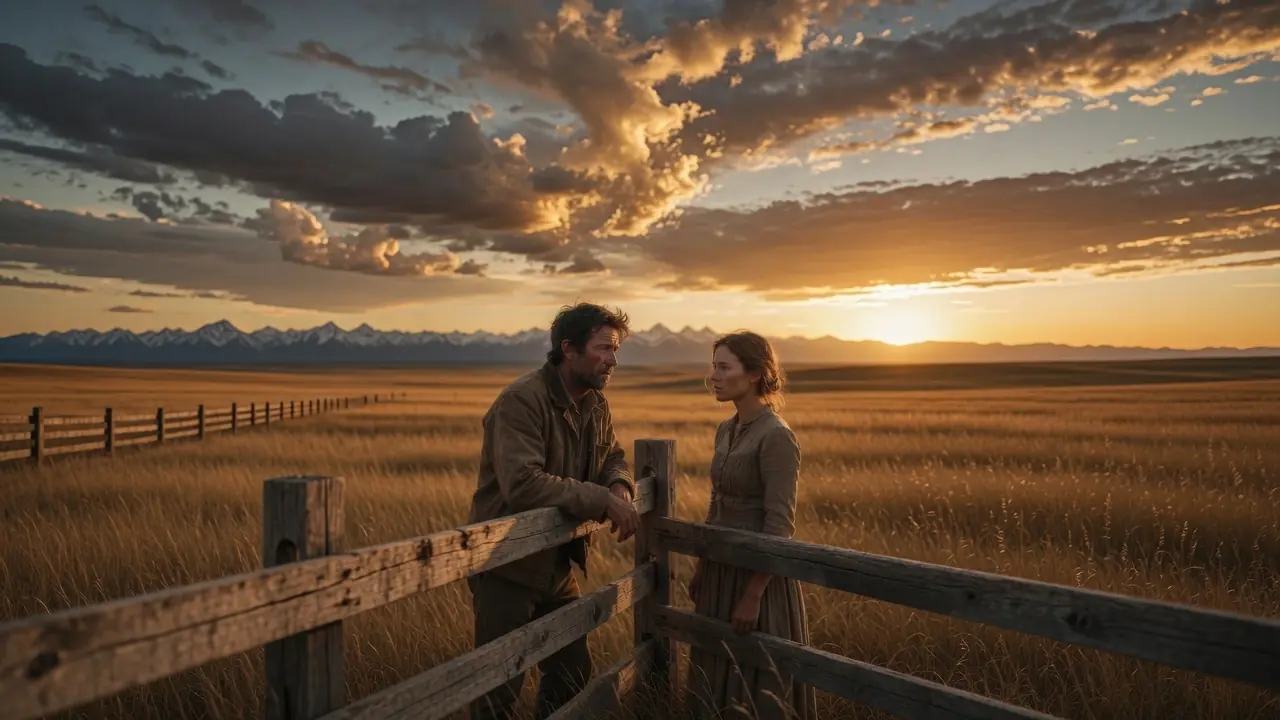
The town noticed, as towns always do. At first, the remarks were harmless, wrapped in smiles and teasing. Then they sharpened. Men at the livery joked that Jacob had found himself a young bride, women at church wondered whether Clara knew what life with a man so much older would mean, and one afternoon Jacob overheard Mrs. Pritchard say Clara was wasting her future on a widower who still belonged to a grave.
Jacob told himself gossip did not matter. He had lived long enough to understand that people often talked because silence forced them to face themselves. But the words followed him home that evening and sat beside him at the empty supper table. Clara was young enough to want laughter, children, travel, music, and a future not crowded by old sorrow.
That night, Jacob walked through his house with a lamp in his hand. Margaret’s quilt lay folded over the chair, her blue teacup still sat on the kitchen shelf, and the upstairs room they had once hoped would belong to a child remained closed. He stopped at the doorway and felt the full weight of years press against his chest. He loved Clara enough, or feared loving her enough, to decide she deserved better than him.
For two days, he avoided her. He sent a ranch hand to deliver firewood to the schoolhouse, rode the long road home to avoid town, and worked until his shoulders burned. Clara understood avoidance better than he hoped. On the third evening, she came to the ranch without warning and found him beside the east fence, repairing a gate that did not need repairing.
The sun was sinking behind the mountains, and the grass moved in long waves around them. Jacob heard her steps before she spoke, but he did not turn around. His hands tightened on the fence rail. He knew if he looked at her too soon, he might forget every hard thing he had come out there to say.
“You have been avoiding me,” Clara said. Jacob kept his eyes on the pasture. “I’ve been busy.” Her voice remained calm, but it carried hurt. “Jacob, I teach children who lie about broken slates and missing homework. You will need to do better than that.”
He exhaled slowly, then turned to face her. She stood just beyond the fence post in her gray-brown dress, her hair loosened by the wind, her face open but guarded. For a moment, Jacob saw not a young woman chasing romance, but a person who had also lost things and chosen not to become hard. That made what he had to say more difficult.
“You shouldn’t be here,” he said. Clara did not answer immediately. She only watched him, waiting for the truth beneath the sentence. Jacob looked down at his worn hands. “You’re too young for an old rancher like me.”
The words hung between them. Clara’s eyes changed, but she did not step back. Jacob forced himself to continue before courage failed him. “I have already lived most of my life, Clara. I am a widower, this ranch takes everything I have left, and most days there is nothing here but work, old memories, and rooms that know too much silence.”
Clara’s fingers tightened around the edge of her shawl. Jacob saw it and hated himself for causing even that small hurt. “You deserve someone who can give you dancing, travel, laughter, and years that do not already feel spent,” he said. “You deserve a man who does not wake up some mornings still reaching for the woman he buried.”
Her face softened, but he mistook the softness for pity and pushed harder. “I can’t ask you to carry my years,” he said. “I can’t ask you to carry Margaret’s memory, or the empty places in this house, or the grief I have learned to hide better than I have learned to heal.” He swallowed hard. “If I care for you at all, I should let you go before you make a mistake out of kindness.”
Clara stood very still. Jacob expected tears, anger, or quiet acceptance. He expected her to turn away because he had given her every reason to do so. Instead, she took one slow step toward him.
Then she took another.
Jacob looked up sharply. Clara stopped close enough that the wind moved a loose strand of her hair against his sleeve. She was not crying. Her eyes were bright, but her voice was steady when she spoke.
“You really believe that is all I see when I look at you?” she asked. Jacob had no answer. Clara looked directly into his eyes, refusing to let him hide behind the fence, the years, or the grave that had held him too long. “You see age,” she said. “I see every season you survived.”
Jacob’s throat tightened. Clara continued, each word gentle but unyielding. “You see gray hair. I see years of work, loyalty, and weather that did not break you. You see a lonely ranch. I see a home built by honest hands that forgot it was still allowed to be warm.”
He looked away, but she reached for his hand before he could retreat fully. Her fingers were trembling, but they closed around his weathered knuckles with firm certainty. “You think losing Margaret means your heart has nothing left to give,” Clara whispered. “I think it means you know what love costs, and you still have enough courage to be afraid of it.”
Jacob breathed unsteadily. No one had spoken to him like that since Margaret. No one had looked at his grief and seen not a ruin, but a place where something might still grow. Clara squeezed his hand, and he felt years of loneliness shift inside him like snow breaking loose from a roof in spring.
“I am not a girl chasing a story,” Clara said. “I am a grown woman who has buried her father, lost her home, crossed miles alone, and chosen every step that brought me here. Stop deciding I do not understand sorrow simply because I am younger than you. Stop calling your fear a kindness to me.”
Jacob closed his eyes briefly. Her words struck too close to truth. He had thought pushing her away was noble, but somewhere beneath that noble shape was terror. He was afraid to love again, afraid to lose again, afraid that happiness at his age would be borrowed only long enough to make the next loneliness worse.
When he opened his eyes, Clara was still there. She looked smaller than the mountains behind her, yet stronger than anything he had known in years. “Clara,” he said, his voice rough, “I don’t know how to begin again.” Her expression softened. “Then don’t begin with promises you’re not ready to make. Begin by not walking away.”
The wind moved through the tall grass, and the sun lowered behind them, turning the sky into deep amber and rose. Jacob looked at their joined hands resting on the fence rail. His hand was rough, scarred, and older. Hers was slimmer, warmer, and holding on as if she had already decided he was worth the effort.
“I loved my wife,” he said quietly. Clara nodded. “I know.” His voice shook. “A part of me always will.” Clara stepped closer. “Good. I would not trust a man who could stop loving someone simply because she was gone.”
That answer broke something open in him. Jacob had expected Clara to compete with the past or resent it. Instead, she had made room for it without surrendering her own place. He lifted his free hand and covered hers with it, slowly, carefully, as if touching hope too quickly might frighten it away.
“You deserve more than an old man learning late how to live,” he said. Clara smiled then, and tears finally gathered in her eyes. “And you deserve more than spending the rest of your life punishing yourself for surviving.” Jacob stared at her, speechless.
She leaned closer, her voice dropping to a whisper. “Stop measuring yourself by birthdays. Stop counting the years you lost. Stop telling me what my heart is allowed to choose.” Her thumb brushed once over his hand. “To me, Jacob Walker, you are not too late.”
For a long moment, he could not speak. The ranch behind him, the fields before him, the mountains, the fence, the years, everything seemed to hold still around her words. He had spent so long believing his life was behind him that he had forgotten the horizon still existed in front of him. Clara stood there like proof.
At last, Jacob lifted his eyes to hers. “If I let myself want this,” he said slowly, “I may do it badly.” Clara’s smile trembled. “Then do it honestly.” He gave a broken, quiet laugh. “That may not be enough.”
“It will be enough for the first step,” she said. “And tomorrow, we can decide on the second.” The simplicity of it nearly undid him. Jacob had been trying to solve a whole future before allowing himself one honest evening.
He looked toward the house, its windows catching the last light. For six years, he had seen only what was missing. Now he imagined Clara in the kitchen, books on the table, flowers along the porch, and laughter returning cautiously like a stray animal that needed patience before it trusted the door. The image hurt because it was beautiful.
“Would you walk back with me?” he asked. Clara’s face changed, not with triumph, but with quiet relief. “Yes,” she said. Jacob stepped around the fence gate and offered his arm awkwardly, like a man who had forgotten the custom and cared deeply about remembering it correctly.
They walked toward the house slowly. Clara did not lean too heavily, and Jacob did not pretend he was steady when he was not. The tall grass brushed their boots, and the Montana sky darkened above them. At the porch steps, Jacob paused beside the flower bed Margaret had planted years before.
Nothing had grown there that spring because Jacob had not tended it. Clara looked down at the dry soil, then at him. “What did she plant here?” Jacob swallowed. “Blue flax, mostly. Some wild roses.”
Clara nodded as if receiving something important. “Then we should plant them again.” The word we moved through him with a force he did not expect. He looked at her, and for once he did not correct her, warn her, or retreat behind grief.
The next Sunday, Clara came after church with seed packets wrapped in brown paper. Jacob had prepared the soil at dawn, though he pretended it had taken no effort. Together they knelt beside the porch and planted blue flax, wild roses, and a few marigolds Clara insisted were necessary because “a house needs at least one cheerful argument with the dirt.” Jacob laughed, and this time he did not hide it.
People in town continued talking, but gossip lost some of its power once Jacob stopped letting shame carry it for him. When Mrs. Pritchard hinted that Clara might regret tying herself to a man with gray in his beard, Clara smiled politely and said, “Gray is not a character flaw.” When a ranch hand teased Jacob about courting a schoolteacher, Jacob only looked at him until the man remembered work elsewhere. Clara found this very amusing.
Their love did not become easy overnight. Jacob still had mornings when grief rose before sunrise and sat beside him like an old companion. Clara still had moments when the weight of choosing a life so different from what others expected pressed on her chest. But now they spoke, sometimes clumsily, sometimes with tears, and sometimes with laughter that came after honesty had done its difficult work.
One evening near harvest time, Jacob found Clara on the porch reading one of her schoolbooks aloud to herself. The new flowers moved in the wind beside her, small but stubborn. He stood at the bottom of the steps and watched her for a moment, overwhelmed by the quiet miracle of her presence. Clara looked up and raised one eyebrow. “Are you going to stand there brooding, or come sit?”
Jacob climbed the steps and sat beside her. “I was not brooding.” Clara closed the book. “Jacob Walker, you brood like it is part of your livestock operation.” He smiled, and she smiled back, and the porch no longer felt like a place built for ghosts.
In October, he took her to the east fence again. The same rail stood repaired beneath his hands, weathered but strong. The fields had turned pale gold, and the mountains wore the first white dusting of snow. Clara seemed to understand why he had brought her there, because she fell quiet beside him without being asked.
Jacob rested one hand on the rail and turned to her. “This is where I nearly lost the best thing that had happened to me in years.” Clara’s expression softened. “Nearly.” He nodded. “I was a fool.”
“You were frightened,” she said. “There is a difference.” Jacob looked at her with gratitude that had become too deep for easy words. “You left me speechless that day.” Clara smiled. “You recovered eventually.”
He reached into his coat pocket and withdrew a small wooden box. It had belonged to Margaret once, used for buttons, and Clara recognized it immediately from the sitting room shelf. Jacob opened it, revealing a simple silver ring inside, newly polished but old in design. Clara’s breath caught.
“It was my mother’s,” Jacob said. “Margaret kept it safe because she said good things should not be buried with sorrow.” His voice trembled, but he did not stop. “I do not offer it to replace anything that came before. I offer it because I want whatever years I have left to begin with truth.”
Clara’s eyes filled. Jacob took her hand, the same hand that had held his beside that fence months earlier. “Clara Bennett, I am older than you, slower than I used to be, and still learning how to let joy stay in my house. But I love you with everything in me that survived. If you will have me, I will spend every day proving you were not wrong to choose me.”
For once, Clara did not answer immediately. She looked at the ring, then at the fence, then out across the Montana fields where the wind moved in waves. When she turned back, her smile was bright through tears. “Jacob,” she whispered, “I chose you long before you were brave enough to ask.”
He laughed softly, but the sound broke at the edges. She held out her hand, and he slipped the ring onto her finger. It fit as if it had been waiting through generations for that exact moment. Clara stepped into his arms, and Jacob held her carefully at first, then fully, with all the years he had spent holding back.
They married in November, in the little church near the schoolhouse, with half the town crowded inside and the other half pretending they had never gossiped. Clara wore a simple cream dress, and Jacob wore his best dark coat with hands that shook only slightly. When he saw her walking toward him, he did not think of age, loss, or fear. He thought only that grace sometimes arrived late and still arrived in time.
After the wedding, Clara moved into the ranch house and brought with her books, lesson plans, laughter, and a stubborn belief that every curtain should be opened in the morning. Jacob kept Margaret’s quilt on the chair, but now Clara sat beneath it on cold evenings while reading aloud. The past did not vanish. It became part of a larger room.
By spring, blue flax bloomed beside the porch again. Wild roses climbed the fence, marigolds argued cheerfully with the dust, and the house no longer sounded empty. Children from the school sometimes came to visit, ranch hands lingered longer at supper, and Jacob found himself singing under his breath while repairing tack in the barn. The first time Clara heard him, she did not tease him. She simply smiled and let the song live.
Years later, people in Copper Ridge still told the story of the aging rancher who tried to send away the woman he loved because he believed time had made him unworthy. They told how she stood beside the east fence, took his weathered hand, and answered every fear with truth. Some said her words saved him, but Jacob knew better. Clara had not saved him from age or grief.
She had shown him that neither one had to be the end of love.