The snow came down the way it does in the mountains of Colorado, thick and relentless, erasing the world one flake at a time.
At first, it had looked almost beautiful.
By noon, it had turned cruel.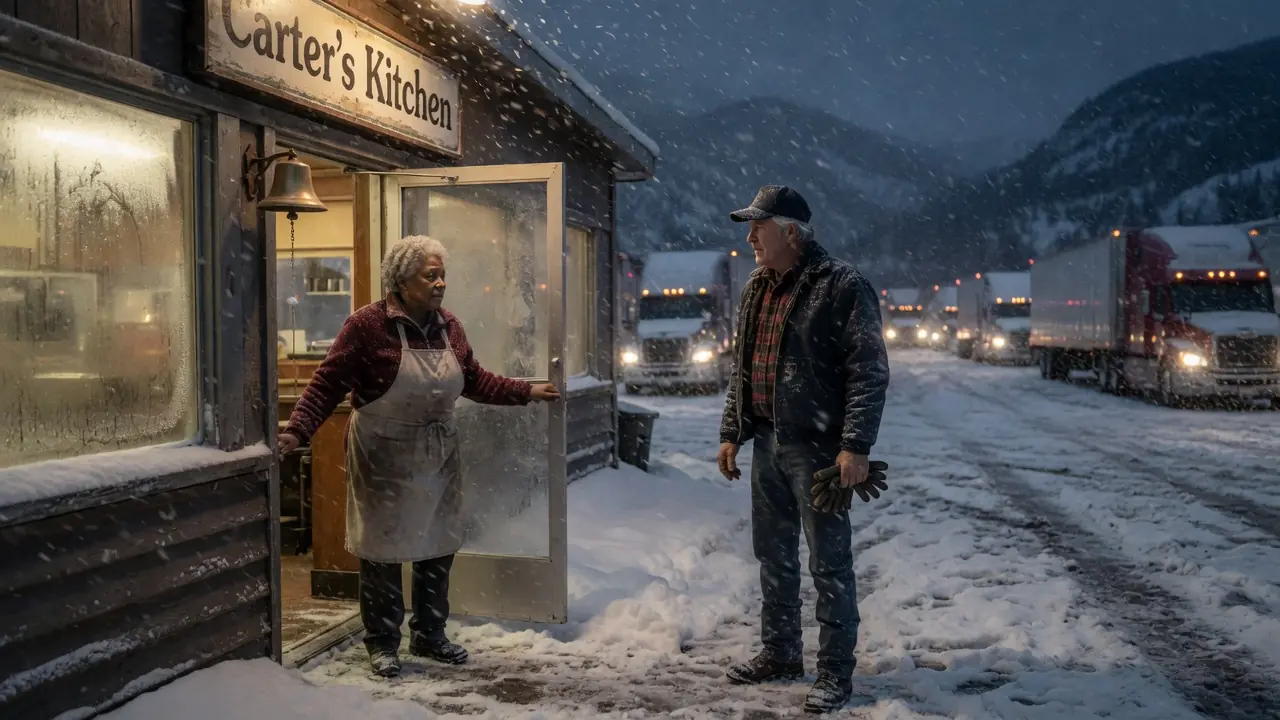
Wind dragged white sheets of snow across the empty road. The mountains behind Holbrook Pass disappeared behind a wall of gray. Highway 29, once the lifeline of Carter’s Kitchen, stretched past the diner like a forgotten scar, quiet except for the occasional groan of wind pushing against the old telephone wires.
Inside Carter’s Kitchen, Sarah Carter stood behind the cash register, her thumb smoothing the creases of yet another overdue notice from the bank.
She had read it so many times that she knew every word without looking.
Final notice.
Thirty days.
Past due balance.
Foreclosure proceedings.
The paper felt thin between her fingers, as fragile as everything else in her life lately.
“Mama, it’s almost ten,” Maya said softly from across the diner.
Her daughter was twenty-three, with her father’s dark eyes and Sarah’s quiet determination. She had been wiping down the same table for the past five minutes, the kind of busy work a person does when there is nothing left to do but keep moving.
Sarah nodded but did not reach for the door sign.
“Just a few more minutes,” she said.
They both knew no one was coming.
No one had come since noon, and that had been old Joe Miller, who ordered the same bowl of chili every Tuesday even though Sarah knew he made better chili at home. He came out of loyalty. He came because Marcus Carter had once towed his pickup out of a ditch in 2004 and refused payment. He came because some people still remembered what a place used to be before the world passed it by.
The highway reroute three years earlier had been the beginning of the end.
Before that, Carter’s Kitchen had been alive from before sunrise until after dark. Truckers heading east through the Rockies pulled in for coffee strong enough to hold a spoon upright, biscuits as wide as a working man’s palm, and Marcus Carter’s famous chicken-fried steak.
The booths had been filled with road dust, laughter, CB chatter, tired shoulders, and stories that stretched from Maine to California. Men and women in heavy boots and weathered jackets came through those doors carrying loneliness and hunger, and Marcus always treated both like they mattered.
Then the state rerouted the main highway five miles east.
The traffic vanished almost overnight.
The new route had a chain truck stop with polished floors, fuel pumps, showers, digital ordering screens, and bright signs visible from half a mile away. It had corporate efficiency and clean bathrooms.
Carter’s Kitchen had cracked vinyl booths, a brass bell above the door, a hand-painted sign, and a widow who still remembered every regular’s order even though most of them no longer passed by.
The cash register held twenty-seven dollars and forty-three cents.
The bills stacked beside it told a different story.
Three months behind on the mortgage.
Two months behind on the electric.
A furnace that sounded like it was being kept alive by stubbornness alone.
A roof that leaked near the back hallway when snow melted too fast.
A refrigerator that wheezed every time the compressor kicked on.
And one final notice from the bank giving Sarah thirty days to find twelve thousand dollars she did not have.
She traced the edge of the foreclosure letter with one finger.
Her eyes drifted to the photograph hanging near the coffee station.
Marcus stood beside his Peterbilt in the picture, one hand on the chrome bumper, his smile wide enough to light up the entire frame. The photo had been taken thirty-two years earlier, before he and Sarah bought the diner, before Carter’s Kitchen became the center of their universe, before Marcus collapsed behind the counter on a spring morning with one hand pressed to his chest and Sarah screaming his name as the coffee pot shattered on the floor.
He had been fifty-eight.
Too young to die.
Too generous to leave so many people owing him stories he would never hear again.
Sarah still remembered that morning with cruel precision.
The smell of bacon on the grill.
The bell above the door ringing as a local rancher walked in.
Marcus laughing at something Maya had said on the phone.
Then his hand going to his chest.
His knees folding.
His body hitting the floor behind the counter where he had stood almost every day for twenty-seven years.
The ambulance had come fast.
Not fast enough.
After the funeral, people told Sarah that Marcus would want her to keep going.
They meant well.
But wanting to keep going and knowing how were two different things.
Marcus had been the heart of Carter’s Kitchen. Sarah knew recipes, payroll, cleaning schedules, supplier invoices, and how to stretch food when money was tight. But Marcus had known people. He knew which driver had a bad back, which one had a daughter in nursing school, which one needed to talk and which one needed silence.
He had treated the diner like a church for travelers.
Sarah had spent five years trying to keep the light on in his church, and now the bank was preparing to close the door.
“Mama,” Maya said again.
Sarah looked up.
Maya stood by the window, her dishrag frozen in one hand, her voice different now.
“Someone’s pulling in.”
Sarah turned.
Through the snow, headlights appeared at the edge of the lot.
At first, she thought it was one of the local plow trucks. Then the lights turned slowly, carefully, and a large rig emerged from the white curtain of weather like a ship pushing into harbor.
The truck rolled into the parking lot and stopped at an angle, its engine rumbling deep enough to vibrate the glass panes.
For one foolish second, Sarah felt eighteen years younger.
For one second, she expected Marcus to come through the door with snow on his shoulders and say, “You put coffee on, baby? Road’s mean tonight.”
The door opened with the jingle of the brass bell.
A gust of wind and snow blew in, and with it came a man Sarah had never seen before.
He was maybe fifty, with tangled gray hair visible beneath a dark blue trucker’s cap. His beard was trimmed but rough around the edges, and his face was weathered in that particular way that came from years behind a windshield, watching America pass through glass.
“Evening, ma’am,” he said, his voice low and gravelly. “Any chance you’re still serving? It’s turning into a real mess out there.”
9:54.
Every practical instinct told her to say no.
To tell him they were closed.
To flip the sign, shut down the grill, and go upstairs to the tiny apartment where the heat still worked better than it did in the dining room.
To stop pretending that staying open another six minutes would save a business the bank had already begun to bury.
But something in the man’s eyes stopped her.
They were tired eyes.
Worried eyes.
The eyes of someone who had driven too long and still had too far to go.
“Kitchen’s still hot,” Sarah heard herself say. “What can I get you?”
The man’s shoulders dropped with visible relief.
“Coffee, first. Then whatever you’ve got that’s warm.”
He crossed to the counter, his boots tracking snow across the floor Sarah had mopped three times that day out of sheer nervous energy.
“Name’s Raymond,” he said, settling onto a stool. “Everybody calls me Ray.”
“Sarah Carter.”
He nodded toward Maya.
“My daughter, Maya,” Sarah added.
“Ma’am,” Ray said politely, dipping his chin to Maya.
Maya gave a small smile.
Sarah poured coffee into a thick white mug and slid it toward him.
Ray wrapped both hands around it but did not drink immediately. He just held the mug close and let the warmth sink into his fingers.
“Appreciate you being open,” he said. “They closed the highway about ten miles back. Total whiteout. Patrol’s blocking everything eastbound until morning at least.”
Sarah’s hand froze halfway to the coffee pot.
“Until morning?”
“Maybe longer if this keeps up.”
Ray pulled off his cap, revealing short gray hair flattened by sweat and snow.
“I was lucky to make it this far before they shut the gate behind me.”
The bell above the door rang again.
Two more truckers came in, shaking snow from their jackets like wet dogs.
Then another.
Then three more.
Their voices were low, tired, and relieved as they realized they had found shelter.
By 10:15, Sarah had twelve truckers scattered throughout her diner, and their presence filled the space with a sound she had not heard in months.
The scrape of chair legs.
The clink of coffee cups.
The low rumble of conversation.
The simple sound of people being human together.
Sarah’s mind raced as she moved through the kitchen.
She had enough soup for maybe six people.
The freezer held three pounds of ground beef, half a bag of chicken breasts, a frozen casserole she and Maya were supposed to eat for the next two nights, and not much else.
The bread shelf was nearly empty.
The coffee tin was low.
She had planned to restock on Friday when a small disability check arrived, the only reliable money she had left since a back injury the year before made it hard to work long shifts without pain.
“Mama,” Maya whispered, appearing at her side with worried eyes. “We don’t have enough food for all of them.”
Sarah looked at her daughter and saw the little girl Marcus used to carry on his shoulders around the diner.
Then she saw the young woman Maya had become.
The girl who had turned down a full scholarship to Denver State to stay and help after Marcus died.
The girl who had taken a waitressing job she was far too bright for because her mother needed her.
The girl who had never once complained about the sacrifice, though Sarah sometimes heard her crying late at night through the thin apartment walls.
“We’ll make it work,” Sarah said quietly.
“Mama, that casserole was our dinner for the week.”
Sarah looked through the serving window at the truckers in the dining room.
A woman with silver streaks in her braids was rubbing warmth back into her hands. A young man barely older than Maya had his head bowed over his coffee as if he might fall asleep in it. An older driver in a red flannel shirt kept checking his phone, probably worrying about someone waiting for him at home.
Sarah thought of Marcus.
She thought of how many times he had come home from a run and told her about a driver stuck somewhere, hungry, cold, ashamed to ask for help.
She thought of what he would say if he were standing beside her.
We don’t turn away hungry people, Sarah Jane. Not when the stove’s still got heat.
“We don’t turn away hungry people,” she said. “Not in this house.”
Maya held her gaze for a long moment.
Then she nodded.
“All right,” she said, tying her apron tighter. “Tell me what to do.”
Sarah moved through the kitchen with the kind of efficiency that comes from thirty years of practice.
She stretched the soup with potatoes, canned corn, and extra broth.
She browned the ground beef with onions and turned it into chili.
She sliced the last of the bread and grilled sandwiches with cheese that had begun to dry around the edges.
She heated the casserole and cut it into small squares.
Maya ran upstairs to raid their personal pantry.
Pasta.
Canned green beans.
Instant rice.
A jar of peaches Marcus had loved but Sarah had not been able to bring herself to open.
When it became clear even that would not be enough, Sarah opened the drawer where she kept the emergency biscuit mix.
Maya stared at her.
“That’s the last of it.”
“I know.”
“We were saving it.”
Sarah started measuring.
“For what, baby?”
Maya had no answer.
The food that left the kitchen was simple.
Not elegant.
Not abundant.
But warm.
And sometimes warm is the holiest thing you can offer.
The truckers ate slowly at first, almost carefully, as if they sensed there might not be more. When Sarah came around with refills, several tried to refuse, but she gave them the look that had once made Marcus laugh and made grown men straighten up in their booths.
“If I offer you food in my diner, you either eat it or explain to my face why you think I can’t feed people,” she said.
Ray laughed first.
Then the others did too.
The tension loosened.
By eleven, the storm outside had turned violent.
Snow struck the windows in white bursts. The old neon sign above the parking lot flickered, then steadied. Wind crawled under the door, carrying threads of cold along the floor.
“You folks planning to head out once you’ve eaten?” Sarah asked Ray, who seemed to have become the group’s unofficial spokesman.
Ray shook his head slowly.
“Highway patrol says nothing’s moving till morning. Motels in Holbrook are full. Called around already.”
He gestured toward the window where his rig sat half-hidden by snow.
“Looks like we’ll be sleeping in the trucks.”
Sarah followed his gaze.
The thermometer outside the kitchen window read eleven degrees.
The wind was picking up, rattling the old windows and howling around the corners of the building like something alive and angry.
She knew what it meant to sleep in a truck during weather like that.
Marcus had done it more times than she could count before they bought the diner.
He told her about waking with ice on the inside of the windshield. About running the engine all night and praying fuel would hold. About the bone-deep cold that settled into a man and stayed for days.
“You can’t sleep in your trucks in this,” Sarah said.
“Wouldn’t be the first time,” the younger driver called out, trying to sound brave.
But Sarah could see their faces.
They were doing the math.
Fuel.
Battery.
Engine trouble.
Carbon monoxide.
Wind chill.
What happened if someone slept too deeply and did not wake up.
She thought of the empty booths.
The floor space.
The apartment upstairs.
The bills she could not pay.
The foreclosure notice that said thirty days.
Then she looked at Marcus’s photograph.
“The diner stays open all night,” Sarah said.
The room went quiet.
Maya turned toward her.
Sarah continued before fear could talk her out of kindness.
“I’ve got blankets upstairs. Some pillows. A couple old quilts. It’s not much, but it’s warm and dry. You’re welcome to stay here until the roads open.”
Ray set his mug down carefully.
“Mrs. Carter, that’s real generous, but you don’t know us.”
“I know you’re people stuck in a storm.”
“That’s not always enough reason to trust folks.”
“No,” Sarah said. “But it’s enough reason not to leave them outside.”
Ray studied her for a long moment.
Then he lowered his eyes.
“Thank you,” he said, and the roughness in his voice told Sarah the words were heavier than they looked.
By midnight, Carter’s Kitchen had become a shelter.
The older drivers took the booths.
The younger ones insisted on the floor.
Maya brought down quilts from the apartment and apologized that some were threadbare.
One woman named Deanna accepted a blanket and said, “Honey, I’ve slept in truck stops where the floor was stickier than regret. This is luxury.”
Sarah laughed despite herself.
At 12:30, the furnace made a sound she had been dreading for two winters.
A deep mechanical groan.
A rattle.
A shudder.
Then silence.
Sarah froze near the coffee station.
Maya looked up sharply.
The dining room seemed to hold its breath.
A few minutes later, the temperature began to drop.
Sarah went into the utility room alone, because some humiliations felt more private if no one watched them happen. She stared at the old furnace as if she could will it back to life by the force of need alone.
“Please,” she whispered. “Not tonight.”
The furnace did not answer.
“Mind if I take a look?”
Sarah turned.
Ray stood in the doorway, wiping his hands on a paper napkin.
“I don’t have money to pay you,” Sarah said, hating how quickly the words came. Hating how poverty made dignity impossible to preserve.
Ray’s face did not change.
“Didn’t ask for money. Asked if I could look.”
He crouched beside the furnace with a grunt that spoke of bad knees and years of climbing in and out of cabs. His large hands moved with surprising gentleness over the machinery.
Touching.
Testing.
Listening.
He asked Maya for a flashlight and Sarah for a wrench.
Another driver named Gus came in to help.
Then Deanna.
Then a younger man called Trey who said he had once worked HVAC for six months before deciding attics were worse than traffic.
For forty minutes, the utility room was full of low voices, tools, and breath hanging in the cold air.
Then Ray tightened one last bolt.
“Try it now.”
Sarah flipped the switch.
The furnace coughed.
Rattled.
Then roared reluctantly back to life.
Heat began moving through the vents.
Sarah pressed one hand to her mouth.
Ray stood slowly, rubbing his lower back.
“Should hold through the night. But you’ll want someone proper to look at it soon. Pilot assembly’s about shot, and the heat exchanger’s not happy.”
“Add it to the list,” Sarah murmured.
Ray looked at her.
“Tough times?”
Sarah usually did not answer that kind of question.
She had learned young, being one of the few Black families in a small mountain town, that needing help out loud made some people look at you differently. She had carried that lesson through adulthood, through business ownership, through widowhood, through every bank meeting where men in pressed shirts asked whether she had considered selling.
But Ray had fixed her furnace without making her feel small.
So she told him the truth.
“The highway reroute took most of my customers. We used to feed fifty, sixty people a day. Now we’re lucky to see six. Bank’s foreclosing at the end of the month unless I come up with twelve thousand dollars.”
She gave a tired laugh with no humor in it.
“Tonight is probably the busiest we’ve been in a year, and I don’t even have enough food to charge you properly.”
Ray was quiet.
He did not tell her everything happened for a reason.
He did not say God never gave people more than they could handle.
He did not insult her with easy comfort.
He just nodded, slow and respectful.
“Your husband?” he asked, glancing toward the photograph by the coffee station.
“Marcus,” Sarah said. “Heart attack five years ago. He drove fifteen years before we bought this place. Loved the road and hated it. Used to say trucking was freedom with a deadline.”
Ray’s eyes lingered on the photo.
“Marcus Carter?”
Sarah turned.
“You knew him?”
Ray moved closer to the photograph.
In it, Marcus stood beside his old Peterbilt with several other drivers. One of them was younger Ray, thinner, darker-haired, grinning like a man who had not yet learned how hard life could hit.
“Well, I’ll be,” Ray whispered.
Maya came over, looking from Ray to the photo.
“That’s my daddy.”
Ray’s jaw worked.
“Your father saved my hide once. Wyoming, winter of ’99. My rig broke down, no cell service. I was a rookie, scared stupid, didn’t know enough to be embarrassed yet. Marcus stopped and spent three hours in the cold helping me get moving again.”
He looked at Sarah.
“Wouldn’t take a dime.”
“That sounds like him,” Sarah said, her throat tightening.
From the counter, Deanna called out, “Marcus Carter? Channel 19 Marcus?”
Another driver sat up.
“The one who used to guide drivers through Holbrook Pass during storms?”
“My husband loved that old CB,” Sarah said, nodding toward the base unit still sitting on a shelf behind the counter. It had been silent for five years. “Said it was a trucker’s lifeline.”
Then the stories began.
Not all at once.
One at a time.
Like candles being lit in a dark room.
Deanna remembered Marcus talking her through a panic attack on an icy bridge near Pueblo. His voice over the CB had been calm, steady, practical. “Breathe with the mile markers,” he had told her. “One breath to the sign, one breath past it. You’re not alone out here.”
Gus remembered Marcus leading three rigs through a mudslide detour after a spring storm washed out part of the road.
Trey had never met Marcus, but his father had. “Dad said there was a driver named Carter who paid for his meal at a truck stop in Utah when his wallet got stolen. Told him, ‘Road’s hard enough without hunger riding shotgun.’”
Sarah listened, tears running freely now.
Marcus had never told her most of these stories.
He had come home tired, kissed her forehead, asked what Maya had done at school, and gone to sleep with grease under his nails and goodness tucked quietly inside him.
She had known her husband was kind.
She had not known how far that kindness had traveled.
“He never bragged,” Ray said softly, as if answering the question she had not asked. “Some men do good because they want their name spoken. Marcus did good because somebody needed it done.”
Maya wrapped her arm around Sarah’s waist.
They stood together, mother and daughter, learning the size of the man they had lost.
By dawn, the snow had stopped.
The world outside was buried under white drifts, but the sky had gone pale and clean. The highway was still closed while plows worked east of the pass, and Carter’s Kitchen smelled of coffee, wet wool, biscuits, and human warmth.
Sarah had slept maybe twenty minutes.
Maya had slept less.
When highway patrol finally announced the road would reopen by noon, the truckers moved reluctantly, folding blankets, cleaning tables, carrying trash bags out, mopping footprints from the floor despite Sarah’s protests.
Ray came to the register when the others were warming their rigs.
“What do we owe you?”
Sarah shook her head.
“Not a thing.”
“Mrs. Carter.”
“No,” she said. “You fixed my furnace. You gave me the best night I’ve had in five years. You told me stories about my husband I never knew. That’s payment enough.”
Ray pulled out his wallet anyway.
She placed one hand over his.
“Ray.”
He stopped.
Sarah softened her voice.
“Let me do this for Marcus.”
Ray looked down for a moment.
Then he nodded.
The others still left tips for Maya, pressing folded bills into her hands and telling her to go back to college, to follow the dreams her father would have wanted, to keep her head up because the road needed women who knew how to run things.
Ray was the last to leave.
He paused by the door, looking back at the diner.
The cracked booths.
The worn counter.
The photograph of Marcus.
The CB radio on its shelf.
“That for sale sign,” he said. “Is it the diner or the whole property?”
“Both,” Sarah replied. “Apartment upstairs too. Bank takes it all if I don’t catch up.”
Ray nodded once, slow and unreadable.
“Shame to see a place like this go dark.”
“Life moves on,” Sarah said, trying to sound matter-of-fact.
Ray looked at her for a long moment.
“So does the road,” he said. “But sometimes it circles back.”
Then he stepped into the morning, climbed into his truck, and rolled away with the rest of the stranded drivers.
The diner fell quiet again.
But it was not the same quiet as before.
Before, silence had felt like abandonment.
Now it felt like something waiting.
The next three days passed in a strange half-dream.
Sarah and Maya cleaned the diner, washed every blanket, and tried not to talk too much about what had happened. It felt fragile somehow, like speaking of it too loudly would make it smaller.
The storm moved east.
The new truck stop on the rerouted highway reopened.
Holbrook returned to ordinary business.
Only Carter’s Kitchen felt changed.
At night, Sarah stood by Marcus’s photograph and replayed the stories.
Channel 19 Marcus.
The bridge.
The mudslide.
The stolen wallet.
The Wyoming breakdown.
Each memory was proof that Marcus had existed beyond the walls of her grief.
On the fourth evening, Sarah began packing.
Not because she wanted to.
Because the bank would not wait for miracles twice.
She started with the photographs.
Marcus at the grand opening, holding a spatula like a sword.
Marcus and Maya at age seven, both wearing flour handprints on their cheeks.
Marcus with a group of drivers outside the diner in 1998.
Marcus behind the counter, laughing at something Sarah could no longer remember.
She wrapped each photo in newspaper.
Then she took down the CB radio.
It had gathered dust for five years.
Sarah held it in both hands, feeling its surprising weight, running her thumb over the volume knob Marcus had turned thousands of times.
“Miss you, old man,” she whispered. “I tried. I really did.”
She was wrapping the radio in bubble wrap when she heard it.
Air brakes.
One truck.
Then another.
Then another.
Sarah moved to the window.
Ray’s rig was pulling into the lot.
Behind it came another semi.
Then another.
Then five more.
Then a line of headlights stretching down the old road like a river of stars.
Maya came running from the kitchen.
“Mama?”
Truck after truck rolled in, filling the lot, the shoulder, the access road, even the empty field beside the diner where Marcus used to say he wanted to build a bigger parking area someday.
Engines rumbled like thunder.
Some drivers tapped their horns in greeting, not loud, not rude, but rhythmic and joyful.
A convoy.
For Carter’s Kitchen.
Sarah stepped outside without her coat.
Cold hit her immediately, but she barely felt it.
Ray climbed down from his truck and walked toward her, a smile spreading across his weathered face.
“What is this?” Sarah asked, barely able to speak over the sound of engines.
Ray took off his cap.
“We got to talking.”
“Talking?”
“On the CB. Truckers forums. Company channels. Text threads. Everywhere.” He looked back at the line of trucks. “About you. About Marcus. About what you did during the storm. About what this place used to mean and what it still could mean.”
Truckers began climbing down from their cabs.
Men and women.
Young and old.
Black, white, Hispanic, Asian, Native.
Some wore company jackets. Some wore hoodies and work boots. Some carried thermoses, toolboxes, envelopes, sacks of groceries, boxes of coffee, and folded papers.
“Turns out,” Ray said, “damn near everybody out there has a Marcus Carter story, or knows somebody who does.”
A woman with silver hair called out, “Marcus paid for my motel room when my alternator died in Glenwood Springs.”
A Hispanic driver lifted one hand. “He stood up for me at a truck stop in Texas when some men didn’t want me eating at their counter. Sat right beside me until I finished breakfast.”
A young driver said, “My dad told me Marcus Carter was the reason he stayed on the road long enough to build a career.”
An older man stepped forward, face lined like a map.
“He pulled me from a jackknifed rig in ’02. Never even told me his last name. Just said, ‘Get home safe and help the next one.’”
Sarah covered her mouth.
Maya began crying beside her.
Ray raised his voice.
“Marcus’s family fed us when they had almost nothing left. So the road is here to answer.”
A man in a company polo stepped forward.
“Mrs. Carter, my name is William Porter. I’m regional operations manager for Porter Continental Trucking. We run about eighty rigs through this region.”
Sarah stared at him, not understanding.
“My drivers need places where they’re treated like human beings,” he continued. “Not numbers. Not wallets. Human beings. I would like to make Carter’s Kitchen an official stop for our company routes. Guaranteed weekly traffic. Meal accounts. Regular business.”
Before Sarah could answer, a woman in a navy coat stepped beside him.
“Tamika Washington, Midwest Express,” she said. “Forty-five drivers through Colorado, Wyoming, and Nebraska. We’d like to do the same.”
Then another.
And another.
Company representatives.
Independent drivers.
Dispatchers.
Fleet managers.
People Sarah had never seen before were pledging business, not charity.
Ray handed her a thick envelope.
“This is from the community. Drivers, companies, old friends of Marcus, people who heard the story. It should cover the mortgage arrears and restocking.”
Sarah’s hands shook.
“I can’t accept this.”
Ray’s eyes softened.
“Yes, you can.”
“No. It’s too much.”
“Mrs. Carter, when Marcus helped us, he never asked whether we were comfortable receiving it. He just helped. Let the road do for you what he did for the road.”
Another older driver came forward then, holding something carefully in both hands.
His name was Terrence Miller.
He had white hair, deep brown skin, and eyes full of old miles.
“I’ve had this twenty years,” he said.
He held out a CB handset.
The plastic was worn smooth. The cord was frayed near the end.
“Marcus gave it to me when mine broke down. Said he had an extra. I meant to return it one day. Never got the chance. Figured it should come home now.”
Sarah took it, and her knees nearly gave way.
Maya caught her.
Inside the diner, someone had already unwrapped the CB base unit and set it back on its shelf. Ray connected the handset.
The radio crackled.
Static.
Then a voice.
“Breaker 1-9, this is Nighthawk eastbound. Heard Carter’s Kitchen is back on the air. You got ears on, Mrs. Carter?”
Sarah stared at the mic.
Ray nodded.
She lifted it with trembling hands.
“This is Sarah Carter at Carter’s Kitchen,” she said, voice breaking. “I’ve got ears on.”
The radio exploded with voices.
“Bless you, Mrs. Carter.”
“Tell Marcus the road remembers.”
“We’re adding Carter’s to the route.”
“Coffee better be hot when I get there.”
Sarah laughed through tears.
“Oh, coffee’s hot,” she said. “Marcus would haunt me if it wasn’t.”
The crowd cheered.
That was the night Carter’s Kitchen became something new.
Not just a diner.
Not just a failing roadside business saved by luck.
A haven.
A home for the road.
By midnight, the envelope had been counted three times.
Forty-seven thousand dollars.
Sarah sat behind the counter, staring at the number written on a napkin because she could not make herself believe it.
Enough to catch up the mortgage.
Enough to restock.
Enough to repair the furnace properly.
Enough to replace the refrigerator and fix the roof.
Maya sat beside her, crying quietly.
“We’re going to make it,” Maya whispered.
Sarah looked at Marcus’s photograph.
“We’re going to make it,” she said.
Then Terrence asked if he could speak with her outside.
They sat on the old bench where Marcus used to drink coffee during slow afternoons.
Snow shone under the parking lot lights. Engines idled low around them. The night smelled of diesel, coffee, and cold air.
Terrence pulled another envelope from his coat.
Sarah shook her head immediately.
“No.”
“You haven’t heard me yet.”
“I already know it’s money.”
“It is.”
“Then no.”
Terrence placed the envelope between them.
“Winter of ’98,” he said. “Wyoming. I was running from my life. My wife had left me. Took our boy, Kevin. I had spent more time loving the road than loving them, and she finally got tired of waiting for me to notice.”
Sarah turned toward him.
“My rig started to jackknife near a drop-off. Your husband was behind me. He blocked the road with his own rig, got me safe, then stayed with me three hours while we waited for a tow.”
Terrence’s voice roughened.
“That night, I told Marcus things I had never told anyone. That I was tired. That I had thought maybe if the road took me, nobody would have to be disappointed in me anymore.”
Sarah’s eyes filled.
“Marcus talked me down,” Terrence said. “Made me promise to call my son. Made me promise to stay alive long enough to repair what I broke.”
He looked across the parking lot where Kevin Miller, now grown, was talking with Maya near the door.
“I called Kevin the next morning. Took years to rebuild us, but we did. That young man over there is in my life because Marcus Carter refused to let a stranger disappear into a snowstorm.”
Terrence tapped the envelope.
“Twenty thousand dollars. I’ve been saving for the right time to pass forward what Marcus gave me.”
Sarah could not speak.
“If you refuse it,” Terrence said gently, “you’re not refusing charity. You’re refusing to let me become the man Marcus told me I could be.”
Sarah lowered her head.
The tears came hard then.
Not quiet.
Not controlled.
They came from five years of grief, fear, exhaustion, pride, and loneliness finally breaking open beneath the weight of grace.
Maya came outside and sat on Sarah’s other side.
Terrence stayed too.
No one told her to stop crying.
That was another kind of kindness.
In the weeks that followed, Carter’s Kitchen changed almost faster than Sarah could understand.
The mortgage was brought current.
The furnace was replaced.
The roof was repaired.
A commercial refrigerator arrived with a red bow tied around the handle because Ray thought it was funny.
The parking lot was graded and expanded.
Kevin Miller designed a new sign.
Carter’s Trucker Haven.
Where the Highway Meets Home.
Beneath the name, in smaller letters, it read:
Built on kindness. Sustained by community.
Sarah hired Miguel Garcia, who had been out of work since a restaurant in Riverside closed.
She hired Darla, a sixty-four-year-old waitress who could balance six plates and silence rude customers with one look.
She hired Keisha, a nineteen-year-old single mother who needed flexible shifts.
She hired James, a quiet man recently released from prison who wanted a chance and looked like he expected the world to say no.
Sarah said yes.
The diner became busy again.
Not exactly like before.
Better, somehow.
Drivers came because the companies routed them there. Then they came because they wanted to. Then they told other drivers.
The CB stayed on all day.
Sarah learned to answer calls, share weather updates, warn drivers about icy stretches, and occasionally remind grown men to eat something besides jerky and gas station peanuts.
Maya enrolled in community college for business management.
She still worked the counter, but now she did it with purpose, not resignation.
One night, Sarah found her daughter studying invoices and route schedules beside a half-eaten plate of fries.
“You know,” Sarah said, “your daddy always said you were going to run this place one day.”
Maya smiled down at the papers.
“I used to think that sounded like a sentence.”
“And now?”
“Now it sounds like a choice.”
Sarah touched her shoulder.
“That’s all I ever wanted for you, baby. Choices.”
But no miracle goes uncontested.
Three months after the convoy, a man named Richard Holbrook walked into Carter’s Trucker Haven wearing an expensive suit and a smile Sarah disliked immediately.
He represented Mountain West Development Corporation.
They wanted the property.
Two hundred thousand dollars cash.
A clean sale.
A corporate truck stop.
Fuel pumps.
Digital kiosks.
Standardized menus.
“Professional facilities,” Holbrook said, placing papers on her counter as if the matter were already decided.
Sarah looked at him.
“This is a professional facility.”
His smile tightened.
“With respect, Mrs. Carter, sentiment is not a business model.”
Sarah thought of Marcus.
Of the old CB.
Of truckers writing stories in the leather-bound journal now kept behind the counter.
Of Maya laughing again.
Of Ray calling at night from Nebraska just to ask whether the furnace was behaving.
“Maybe not,” she said. “But neither is greed dressed up as progress.”
Holbrook’s expression cooled.
“You should consider the offer. Support like this fades. People move on.”
Sarah leaned on the counter.
“Then you don’t know truckers.”
He left without ordering coffee.
Two weeks later, the inspections began.
Health department.
Building code.
Fire marshal.
Environmental runoff.
One citation after another.
Some legitimate.
Some suspicious.
All expensive.
Holbrook was trying to bury her under paperwork.
When a fake food poisoning lawsuit arrived, Sarah nearly broke.
For one long night, she sat behind the counter with the legal papers spread out before her, feeling the old despair return. The lawsuit was vague, anonymous, and almost certainly manufactured, but fighting it would cost money they did not have.
Maya found her there at 2:00 a.m.
“Mama,” she said, reading the papers. “We go public.”
Sarah shook her head.
“No. I’m not turning this place into a spectacle.”
“It already is one. He made it that way. We just tell the truth.”
The next week, Maya became a force Sarah had never seen before.
She gathered documents.
Kevin built a website.
Ray and Terrence recorded video testimonies.
Drivers sent statements.
Darla called local reporters she somehow knew from “a situation in 1987” and refused to explain.
A young reporter named Jasmine Williams came to interview Sarah.
“What would you say to the corporation trying to take this place?” Jasmine asked.
Sarah looked into the camera.
“I would say some things are worth more than money. This diner was built by my husband’s kindness, kept alive by my daughter’s sacrifice, and saved by a community that still believes people matter more than profit.”
Her voice steadied.
“We’re not asking for special treatment. We’re asking not to be crushed because someone with deeper pockets wants our land.”
The story spread.
Local news.
Then regional.
Then national trucking pages.
Truckers flooded the county with calls.
Emails poured into the town council.
Mountain West Development’s tactics came under scrutiny.
A paralegal from Holbrook’s legal team leaked documents proving the lawsuit had been encouraged by company representatives. The anonymous plaintiff was connected to one of Holbrook’s subcontractors. Several inspection citations were placed under review.
At a county meeting, dozens of truckers lined the road outside with signs.
Save Carter’s.
Community over greed.
Marcus fed the road. Now the road stands with Sarah.
Sarah spoke before the council with Maya beside her.
“I have followed the rules,” she said. “I have paid what I could, fixed what I could, and asked for no favors. But when regulations are used as weapons by people who want to force a sale, that is not public safety. That is intimidation.”
The room erupted in applause.
The council suspended the questionable citations and opened an investigation into Mountain West Development’s conduct.
Within two weeks, Holbrook resigned.
Within a month, Mountain West withdrew its interest in the property.
They called it a strategic shift.
Everyone knew it was a defeat.
The first anniversary of the storm arrived quietly.
Then all at once.
Snow began falling late in the afternoon, gentle this time.
By evening, Carter’s Trucker Haven was full.
Truckers came from six states.
Ray arrived with snow on his cap.
Terrence and Kevin came carrying a framed photograph of Marcus standing beside his Peterbilt, CB mic clipped to his shirt, one hand raised in greeting.
Beneath it was a brass plaque.
Marcus Carter.
Guardian of the Road.
His kindness still travels.
They hung it above the CB radio.
For a moment, the diner went quiet.
Then the radio crackled.
“Breaker 1-9, this is Silver Fox calling Carter’s Trucker Haven. You got ears on, Mrs. Carter?”
Sarah picked up the mic.
“This is Carter’s Trucker Haven. We got ears on.”
“Eastbound convoy is twenty minutes out. And Mrs. Carter?”
“Yes?”
“Tell Marcus we’re still listening.”
Sarah looked up at the photograph.
“I think he knows,” she whispered.
The room cheered.
Outside, engines rolled in one after another, headlights cutting through the falling snow like stars coming home.
Sarah stepped onto the porch for a moment, needing cold air, needing space to understand the fullness of the life that had returned to her.
Maya came out and stood beside her.
“You okay, Mama?”
Sarah slipped an arm around her daughter.
“I’m more than okay.”
They watched trucks fill the lot.
The diner glowed behind them, warm and loud and alive.
“A year ago,” Sarah said quietly, “I thought your father’s kindness had cost us too much. All the money he lent. All the favors. All the times he gave when we barely had enough for ourselves. I used to wonder if we would have been safer if he had been more careful.”
Maya leaned her head against her mother’s shoulder.
“And now?”
Sarah smiled through tears.
“Now I think kindness was the only investment he ever made that truly lasted.”
Inside, Ray lifted his coffee mug.
“To Marcus,” he called.
The whole diner answered.
“To Marcus.”
Sarah and Maya went back inside, where the air smelled of coffee, bacon, pie, and home.
The snow kept falling outside, but no one was cold.
No one was alone.
And somewhere, if love could travel beyond this life and into the next, Marcus Carter was surely smiling.
Because the road had remembered him.
Because the little diner he built had become what he had always dreamed it would be.
Not just a place to eat.
Not just a business.
A shelter.
A family.
A light left on for anyone still trying to find their way home.
Years later, people would still tell the story of the night Sarah Carter opened her door during a snowstorm.
Some would say she saved twelve truckers.
Others would say the truckers saved her.
Sarah knew the truth was bigger than either version.
Kindness had saved all of them.
It had moved through Marcus first, mile after mile, year after year, one good deed at a time.
Then it had circled back through Ray, Terrence, Maya, and every driver who chose to remember.
That was the miracle.
Not the money.
Not the convoy.
Not even saving the diner.
The miracle was learning that no act of kindness ever truly disappears.
It travels.
It waits.
It gathers strength in places you cannot see.
And one day, when you are standing in the ruins of everything you tried to keep alive, it may come rolling back down an old forgotten road, headlights shining through the snow, engines roaring like thunder, carrying proof that love still knows the way home.