Every Tuesday, just after sunrise, two flatbed trucks turned off County Road 14 and rolled through an open gate onto eleven acres of neglected farmland outside Millbrook, New York.
Nobody came down to unlock it anymore.
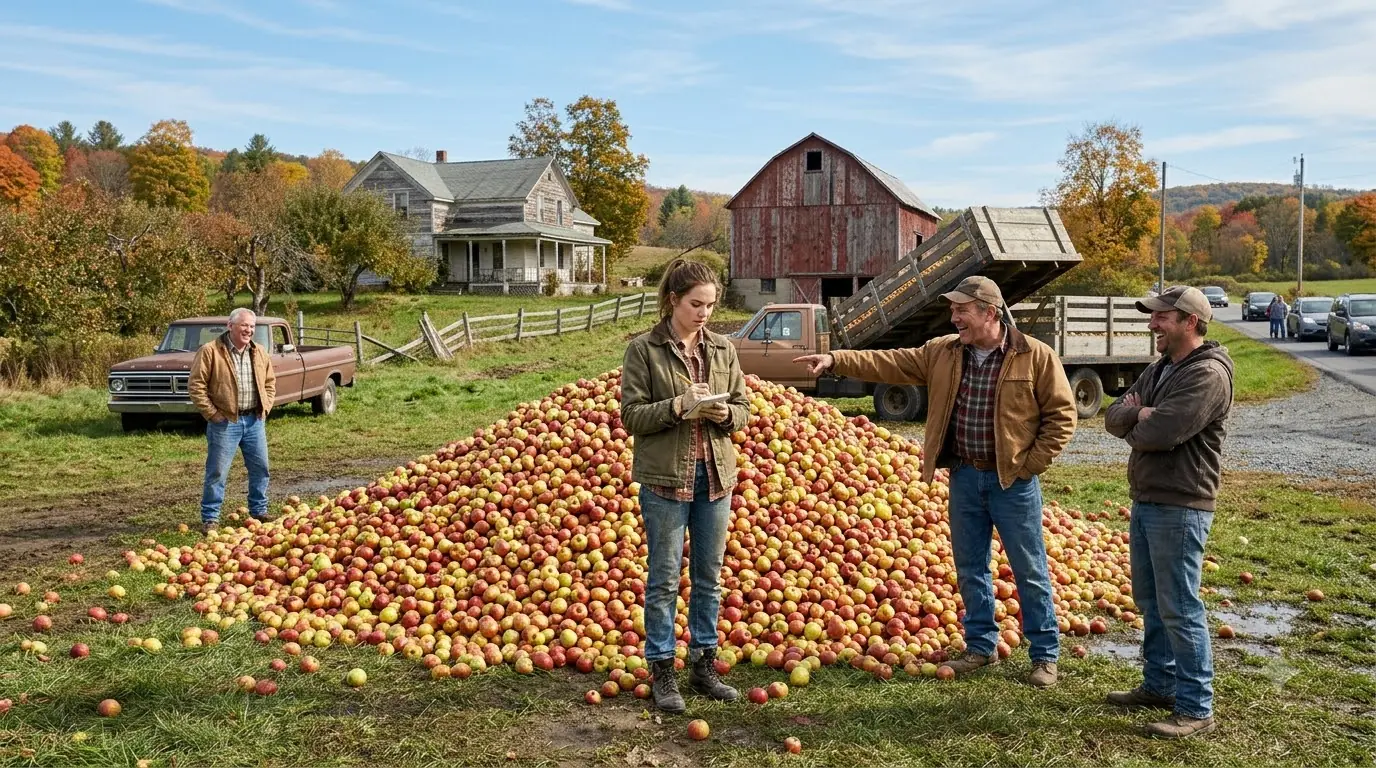
The drivers knew where to go.
They passed the old farmhouse with the leaning porch, followed a rutted lane around a stand of sugar maples, then backed toward the long grass behind a weathered cider barn that had not produced cider commercially in more than twenty years.
The first driver would climb down.
Release the tailgate.
Then let gravity do the work.
Apples came out in a slow, heavy avalanche.
Thousands of pounds at a time.
Red.
Yellow.
Green.
Some intact.
Some bruised.
Some split.
Some too soft around the shoulders to survive another day in a packing line.
The sound was surprisingly dull.
Thud.
Thud.
Thud.
Hundreds at once.
Fruit rolled into the grass, piled against itself, then settled.
The smell came next.
Sweet.
Sharp.
Yeasty.
The smell of sugar beginning to become something else.
By the time the second truck emptied, there might be fifteen thousand pounds of apples behind the barn.
Anyone passing on the county road could see the piles.
And plenty of people looked.
Cars slowed.
Pickup trucks stopped.
One man pulled halfway onto the shoulder and stared long enough that the driver behind him honked.
Another neighbor later asked Emily Carter whether she was trying to attract every bear between Millbrook and the Massachusetts line.
Someone else asked whether she was building the world’s least effective landfill.
A high-school acquaintance posted a photograph online.
The caption read:
EMILY CARTER’S BUSINESS PLAN APPARENTLY = ROTTEN APPLES.
The post collected seventy-three laughing reactions.
Emily saw it.
She closed the app.
Then went back outside.
For eleven months, the trucks kept coming.
Every Tuesday.
Sometimes only one.
Sometimes three during heavy packing weeks.
Emily never asked Halverson Orchards to pay her for taking the fruit.
She never called Grant Ashby and complained about the volume.
If anything, she repeatedly said the opposite.
“Send me more.”
Grant thought she was joking the first time.
The second time, he asked:
“You’re serious?”
“Yes.”
“You understand we can give you more.”
“I know.”
“A lot more.”
“I know.”
“You're a strange woman, Carter.”
“So I’ve been told.”
What almost nobody driving past understood was that the enormous visible pile was not Emily’s final product.
It was not even one category of material.
By then, she had learned to separate every load.
Sound culls suitable for processing went one direction.
Fruit that had deteriorated too far for food use went another.
Leaves and woody debris went somewhere else.
The unusable portion became compost.
The usable portion became juice.
The juice became alcohol through controlled fermentation.
And under carefully monitored conditions, that alcohol eventually became vinegar.
Eleven months earlier, Emily had not known how to do any of that properly.
Eighteen months earlier, she had not even known she would still be living in Millbrook.
She was twenty-four years old and sitting in a one-bedroom apartment outside Rochester, staring at a laptop screen while trying to make a disposable insulated tumbler sound emotionally important.
The client had requested:
A warmer lifestyle voice.
Emily had rewritten the paragraph five times.
Adventure begins wherever you take it.
She deleted that.
Built for moments worth remembering.
Deleted.
Your everyday companion for wherever life takes you.
She stared at the sentence.
Then at the actual product photograph.
It was a cup.
A perfectly acceptable cup.
Probably a useful cup.
But still a cup.
Her job was to make people feel something about it.
Emily had always been good with words.
That was the problem.
She had been good enough at marketing to build a career she increasingly did not want.
Her agency worked with food brands, outdoor companies, local retailers, and consumer products.
She understood campaigns.
Customer personas.
Email conversion.
Retail positioning.
Packaging.
Brand voice.
She received good reviews.
Her salary was decent.
Her manager liked her.
Nothing was objectively wrong.
Yet every Sunday evening, something inside her tightened.
She would prepare for Monday.
Coffee.
Laptop.
Meeting calendar.
And think:
Is this really what I am going to do for forty years?
Then Ruth Carter died.
Emily’s grandmother was eighty-one.
Heart failure.
Not unexpected.
Still devastating.
Ruth had lived outside Millbrook most of her life on eleven acres that had once supported a small orchard, vegetables, chickens, and a family cider business too modest ever to become famous.
Emily spent enormous pieces of childhood there.
Her parents had divorced when she was nine.
Her father moved to Buffalo.
Her mother worked long shifts at a hospital.
Ruth became the place between everything.
School vacations.
Summer afternoons.
Snow days.
Bad report cards.
First breakup.
The first person Emily called after getting accepted to college.
The property was never impressive.
The farmhouse leaned slightly to the west.
One barn door never shut properly.
The upstairs bathroom pipes complained whenever anybody used hot water.
The orchard had been commercially useful decades earlier, but by Emily’s childhood Ruth kept only enough trees to sell some fruit locally and make applesauce, pie filling, and cider for neighbors.
Ruth wasted almost nothing.
That was what Emily remembered most.
A bruised tomato became sauce.
Stale bread became crumbs.
Soft berries went into jam if still sound.
Vegetable scraps went into stock or compost.
Old shirts became cleaning rags.
Twine got wound around the same nail in the pantry until needed again.
Ruth was not ideological about it.
She was practical.
Once, when Emily was ten, they walked through the Millbrook farmers market near closing time.
A grower had two wooden crates beneath his table filled with ugly apples.
Small.
Misshapen.
Scabbed.
Some with superficial bruising.
Emily pointed.
“Why aren't those up there?”
“Because nobody wants to buy them.”
“They look fine.”
“They taste fine too.”
The farmer heard her.
“Take the whole crate for five dollars.”
Ruth bought both.
They spent that evening peeling.
Emily complained halfway through.
“Why don't you buy good apples?”
Ruth looked up.
“These are good apples.”
“They're ugly.”
“The fruit doesn't know it's supposed to be worth less.”
Emily laughed.
Ruth kept peeling.
“People decided that.”
Then:
“Nature never did.”
Emily forgot the sentence for fourteen years.
After the funeral, she stayed at Ruth’s farmhouse three days longer than planned.
The will was simple.
Very little cash.
No investments of consequence.
The eleven acres.
House.
Barn.
Old equipment.
All to Emily.
Her mother had known.
Emily had not.
She stood in the lawyer’s office holding the document.
“Why me?”
Her mother, Catherine, answered before the attorney could.
“Because she knew you loved it.”
“I live in Rochester.”
“You can sell it.”
Emily looked at her mother.
Catherine shrugged.
“Your grandmother knew that too.”
The property appraised high enough that selling would have been rational.
Developers had been moving outward.
The eleven acres sat near a paved road.
A buyer could tear down the farmhouse, divide the land, and probably make several times what Ruth had ever earned farming it.
Emily drove back to Rochester.
Monday morning came.
Then Tuesday.
She opened campaign analytics.
A client wanted the word authentic used more often.
At lunch, Emily searched the property listing value.
That night, she looked at old photographs.
Ruth in the barn.
Ruth under an apple tree.
Emily at seven holding a basket.
Emily at twelve rolling pie dough.
Thursday morning, her manager asked why she had missed a deadline.
Emily apologized.
Friday, she requested a meeting.
Two weeks later, she gave notice.
Her mother thought she was having a breakdown.
“You're quitting?”
“Yes.”
“To farm?”
“No.”
“What are you going to do?”
“I don't know.”
“That is not comforting.”
“I know.”
“Do you have savings?”