Every Tuesday, just after sunrise, two flatbed trucks turn off the county road and roll onto 11 acres of unused farmland outside Millbrook, New York.
The gate is already open. Nobody has to unlock it.
The drivers know the route better than they know their own driveways by now.
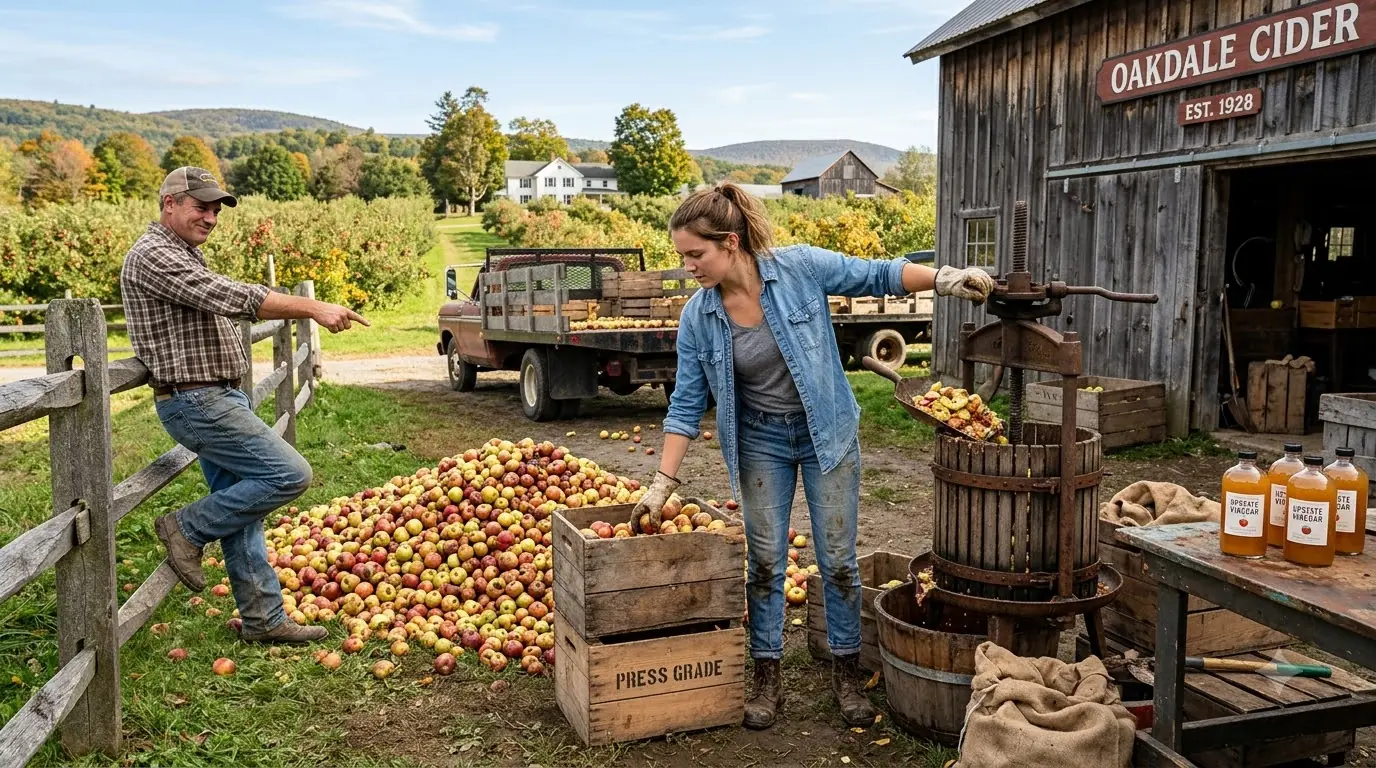
They back up to the same stretch of grass behind an old cider barn, drop the tailgates, and let gravity do the rest.
Thousands of pounds of apples spill out in a slow, thudding avalanche. Bruised skins, split flesh, a sweet-sour smell of fruit already giving itself over to rot. These are the apples nobody wanted, too soft for the grocery store, too blemished for the juice plant, too far gone even for the orchard that grew them, which would rather pay someone to haul the fruit away than let it sit and attract wasps in the processing yard.
For 11 months, a 24-year-old woman named Emily Carter has taken every truckload without complaint. She has never asked to be paid for accepting them. She has never asked the orchard to stop. If anything, she has asked them to send more.
Cars slow down on the county road. A few pull over entirely. Engines idling, drivers squinting at the mountain of rotting fruit rising behind the barn like something out of a fever dream.
Some laugh.
One neighbor asked, half joking, whether Emily was planning to bury something under there. Another suggested she call the county extension office before the smell brought in every bear in the township.
Emily says nothing.
She watches the piles grow week after week and does something with them that not one person driving past has ever guessed.
What is she doing with fruit that everyone else has already thrown away? Why would an orchard practically beg a stranger to take their rejects? And what does a 24-year-old with no farming background and no business experience see in a mountain of rotten apples that an entire industry has decided is worthless?
By the end of this story, those apples will have changed her life completely. Not through luck, not through a shortcut, through 11 months of failure, science, stubbornness, and one sentence her grandmother told her that she didn't understand until it was almost too late to remember it.
If you love stories about people who see value where everyone else sees waste, hit subscribe before we go further. Like the video if you're already curious where this ends. And tell us in the comments where in the world you're watching from.
18 months before the first truckload arrived, Emily Carter was living in a one-bedroom apartment 40 minutes from downtown Rochester, working a marketing job she was good at and hated in roughly equal measure.
She spent her days writing copy for products she didn't care about and her evenings scrolling past a life that felt like it belonged to someone else.
Then her grandmother, Ruth Carter, passed away and left her the only thing she had of any real value: 11 acres of overgrown farmland on the outskirts of Millbrook, a farmhouse with a leaning porch, a barn full of rusted equipment, and an orchard that hadn't been pruned in over a decade.
Emily drove out for the funeral and stayed three extra days.
Then she went back to Rochester, gave notice at her job, and moved into the farmhouse with four boxes of clothes and no plan beyond fixing the porch before winter set in.
The property told its own story if you knew how to read it.
Wild grass had swallowed the old rows of apple trees her grandmother once tended. The cider press in the barn had gone stiff with rust. Fence posts leaned at angles that suggested decades of frost heave and nobody caring enough to straighten them.
It was, by any reasonable measure, a mess.
Three miles down the county road sat Halverson Orchards, one of the largest commercial apple growers in the region, moving tens of thousands of tons of fruit each season into supermarkets and juice plants across the Northeast.
Not every apple that came off those trees was fit for either market.
Bruised drops, fruit stung by hail, apples that sat one day too long before picking and went soft at the shoulder.
The orchard's disposal costs for unsellable fruit ran into real money every autumn. Tipping fees, hauling, diesel for trucks that carried rejects to a composting facility two counties over.
When the orchard's operations manager, a weathered man named Grant Ashby, heard through a mutual acquaintance that the Carter Place had empty acreage and a young owner looking for any kind of income, he made her an offer that sounded almost too easy.
Free apples.