For three days, Nell Whitmore kept walking because stopping felt too much like dying. Snow covered the Wyoming hills in a white silence so deep it seemed to swallow every sound except her own breath and the weak little breaths of the baby in her arms. Jasper was twenty months old, wrapped inside their father’s old wool coat, his face pale against the collar, his tiny hands tucked beneath the cloth where the wind could not bite them. Nell was only eleven, but grief had aged her faster than the storm.
Her mother had died first, just before dawn, with one hand on Nell’s cheek and the other reaching blindly toward Jasper’s cradle. The fever had taken the song out of her voice, then the warmth from her fingers, then the last light from her eyes. Their father, Thomas Whitmore, had buried her behind the house while snow began gathering on his shoulders like dust. By nightfall, he was coughing blood into a rag and telling Nell where he had hidden two coins beneath the loose floorboard.
“Take your brother toward Ridgeline,” he had whispered. “Find shelter before the storm turns hard.” Nell had shaken her head, crying so badly she could hardly speak, but her father had gripped her wrist with the last strength in his body. “You’re not walking away from us, Nell,” he said. “You’re carrying us forward.” Those were the last words he gave her before the fever pulled him under too.
By morning, the house was colder than a shed, and Jasper was crying from hunger. Nell waited for someone to come, but nobody came. Their nearest neighbor lived miles away, and the snow had covered the road until the world outside looked smooth and empty. So Nell packed what she could: one heel of bread, a tin cup, her mother’s scarf, and the baby.
The first day, she believed she could make it before dark. She knew the old road because her father had taken her once to sell firewood near Ridgeline, and she remembered the shape of the hills more than the distance. But the storm erased tracks faster than she could make them. By afternoon, her skirt was soaked, her boots were stiff, and Jasper’s cries had become thin and tired.
The first house she reached never opened its door. She knocked until her knuckles hurt, then shouted through the wind, but no voice answered. Smoke rose from the chimney, so someone was inside, but the curtains stayed still and the latch never moved. Nell stood there for a long moment with Jasper pressed to her chest, then turned back into the snow because pride could not feed him and anger could not warm him.
The second house belonged to a widow with frightened eyes. She opened the door only wide enough to see Nell’s face and the baby’s pale hair peeking from the coat. The woman gave her a heel of cornbread wrapped in cloth, then looked past Nell toward the storm as if danger might be standing behind her. “There’s a church east of the creek,” she said softly. “I can’t take you in. I’m sorry.”
Nell thanked her because her mother had taught her that even almost nothing was still more than nothing. She broke the cornbread into tiny pieces and softened them with snow in her mouth before pressing them against Jasper’s lips. He swallowed two crumbs, then turned his face into her neck. That scared her more than his crying had.
The third door was opened by a man who smelled of whiskey and horse sweat. He looked at Nell, then at Jasper, then at the storm behind them. “I got nothing here,” he muttered, though she saw firelight behind him and a pot hanging over the stove. He shut the door before she could answer.
That night, Nell slept beneath a fallen pine with Jasper tucked under her coat. She did not really sleep. She drifted between shivering and waking, between prayer and panic, between dreams of her mother’s hands and the weight of Jasper’s body against hers. Twice she pressed her ear to his mouth to make sure he was breathing.
On the third day, the world seemed farther away. Nell could no longer feel the ends of her fingers. Her feet had gone from pain to numbness, which frightened her because pain at least meant something still belonged to her. Jasper had stopped crying completely. His silence pushed Nell forward when her own body begged to fall.
Then she saw smoke.
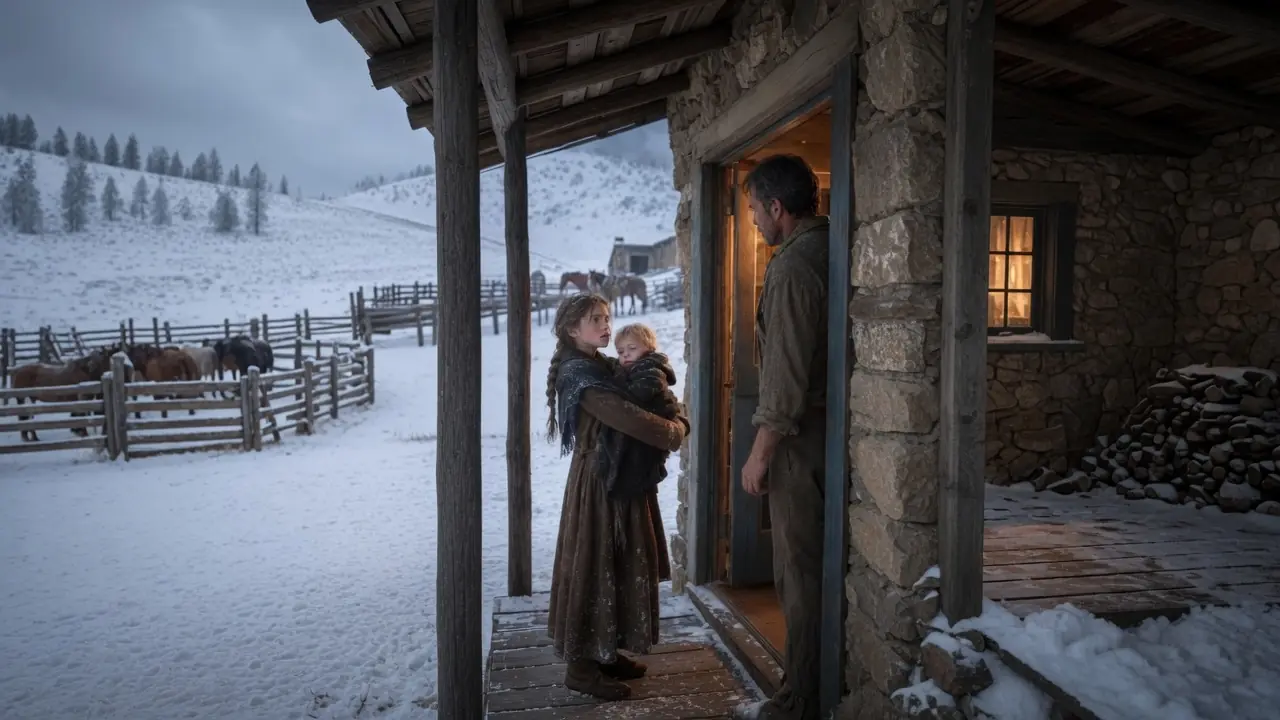
At first, she thought it was a trick of the snow, a gray ribbon curling out of the pale sky beyond a line of hills. She blinked hard, stumbled, and nearly dropped to one knee. The smoke stayed. It rose from a chimney attached to a stone-and-timber ranch house standing beyond a corral where two horses shifted heavily against the fence.
Nell climbed the ranch fence because her frozen fingers could not open the latch. She fell on the other side, twisting her shoulder to keep Jasper from hitting the ground. For several seconds, she lay in the snow, breathing through her teeth while the baby gave one weak sound against her chest. That little sound was enough to make her rise.
The porch steps felt taller than hills. Three steps. Each one seemed to ask whether she wanted to live enough to hurt one more time. Nell reached the old blue door and knocked with the heel of her palm because her fingers would not bend.
The door opened.
A large man stood inside, filling the doorway with broad shoulders and a face cut by years of weather. His dark hair was touched with gray, his beard rough, his sleeves rolled despite the cold because the cabin behind him was warm. Firelight spilled around him and touched the snow at Nell’s feet. He looked at her first, then at the bundle in her arms.
Nell straightened her spine because she would not cry in front of a stranger. “Please,” she said, though her voice cracked. “My brother needs food. I’ll work for it. Anything you have.” The man did not answer at once. He stared as if she had knocked on more than his door, as if she had struck some hidden place inside him that had not heard a sound in years.
Then he reached out, not for Jasper, but for Nell’s arm. His hand was warm through her sleeve. The shock of that warmth nearly made her knees give out. “Come inside,” he said quietly. “Both of you. Right now.”
His name was Abel Thorne, though Nell did not learn it until later. In that first moment, he was only warmth, height, and a voice that did not send her away. He took Jasper from her arms with such careful hands that Nell almost fought him from pure habit. For three days, she had carried her brother as if the whole world wanted to take him.
Abel seemed to understand. “I’m only carrying him to the stove,” he said. “You can watch every step.” So Nell watched. She followed him into the kitchen like a half-wild little animal, eyes fixed on Jasper while the room swam with heat, firelight, hanging pots, and the smell of oats.
Abel laid the baby on a folded quilt near the stove, then knelt beside him. “How long since he ate?” he asked. Nell tried to answer, but her mouth trembled. She counted in her head and realized she did not know whether it had been a day or more. “Too long,” she whispered.
He moved quickly then, but never roughly. He warmed milk in a small pan, thinned it with water, and dipped a clean rag into it. “Small amounts first,” he said. “Too much too fast and his stomach will fight it.” Jasper stirred when the milk touched his lips, weakly at first, then with a desperate little searching motion that made Nell press both hands over her mouth.
“Sit,” Abel said without turning.
“I can stand.”
“You’ll sit before you fall. A person on the floor is no good to a baby.”
The chair caught Nell like her bones had finally surrendered. Abel set a bowl of warm oatmeal in front of her, sweetened with a little molasses. Nell stared at it suspiciously, as if kindness might disappear if she moved too quickly. “Eat,” he said, still feeding Jasper drop by drop. “Nobody at this table charges children for not dying.”
That sentence broke something in her. Not all the way. Nell had learned too quickly that breaking meant losing strength. But her eyes filled, and she shoveled one spoonful into her mouth before the tears could fall. The warmth of it hurt going down, then spread through her chest like a small lantern being lit.
Later, when Jasper had swallowed enough milk to sleep, Abel carried him to a quilt beside the stove and examined Nell’s hands and feet. He did not touch without warning. He held his palms near her skin first, letting warmth return slowly. “You walked a long way,” he said.
“From Ridgeline.”
His eyes lifted sharply. “That’s near twenty miles in weather like this.”
Nell looked toward Jasper. “He was still breathing.”
Abel said nothing after that for a while. He wrapped her feet in dry cloth, gave her wool socks too large for her, and placed her wet boots near the fire. Nell watched every movement, waiting for the moment kindness would end and debt would begin. Adults always wanted something eventually, even if it was only gratitude shaped like obedience.
“You said you’d work,” Abel said at last.
Nell stiffened. “Yes, sir.”
“You can start tomorrow by staying alive.”
She blinked at him.
“That’s the work,” he said. “Eat, sleep, keep the boy breathing. We’ll discuss chores after your hands stop shaking.” His voice was gruff, but something in it made Nell’s throat tighten. Not pity. Pity made people look away. Abel looked straight at her.
As the storm pressed against the windows, Abel opened a narrow hallway door that looked as if it had not moved in years. The hinges resisted. He stood there with one hand on the knob, his shoulders rigid, before pushing it wider. The smell of cedar, old linen, and trapped memory drifted out.
“There’s a bed made up,” he said. “You can take the boy in there.”
Nell stepped into the room slowly. It was small and plain, with a child’s bed against one wall and a shelf holding a wooden horse, a cracked blue cup, and a little box carved with flowers. The quilt was faded but clean. On the wall hung a tiny wool coat that had never been worn out by growing.
“Whose room was it?” Nell asked.
Abel’s face changed.
“My daughter’s,” he said quietly. “She was three.”
Nell did not know what to say. She was a child, but grief had made her recognize grief in others. It sat in Abel’s eyes like an animal that had learned to sleep but not leave. Before she could answer, Jasper woke screaming.
The sound tore through the room. It was not the weak cry from hunger. It was pure terror, sharp and sudden, his small body stiffening in Nell’s arms. She grabbed him close, whispering, “I’m here, I’m here,” while Abel stood frozen in the doorway, staring at the baby in the dead little girl’s room.
For a moment, Abel was not in the room with them. Nell saw it. He was somewhere years behind his own eyes, standing at another bed, hearing another child cry. His hand gripped the doorframe so hard his knuckles whitened. Jasper kept screaming.
“Sir,” Nell said, frightened now. “Mr. Thorne.”
Abel blinked. The present returned to his face slowly, painfully. He crossed the room and knelt beside the bed, not too close. “He’s warm now,” he said, voice rough. “Sometimes warmth wakes the hurt back up.”
Nell rocked Jasper until his crying softened. Abel looked at the wooden horse on the shelf, then reached up and took it down. His fingers trembled when he held it out. “My Ruth liked this,” he said. “Maybe he will too.”
Jasper’s sobs turned into hiccups. His small hand reached for the horse and closed around one carved leg. Abel’s face tightened like the sight hurt him. He stood abruptly and left the room.
Nell found him later at the kitchen table, staring into a cup of coffee gone untouched. She stood in the hall with Jasper asleep against her shoulder. “I’m sorry,” she said.
Abel looked up. “For what?”
“For making you open the room.”
He rubbed one hand over his face. “You didn’t make me.”
“But it hurt.”
“Yes,” he said. “It did.”
Nell shifted on her sore feet. “We can sleep by the stove.”
“No.” The word came too fast. He softened it with a breath. “No. That bed has been empty long enough.” He looked toward the hallway. “Maybe some rooms don’t heal until someone needs them again.”
The next morning, the storm had not ended, but the house felt different. Nell woke under Ruth’s quilt with Jasper warm beside her, one hand still gripping the carved horse. For the first time in days, she did not wake afraid of silence. She woke to Abel moving in the kitchen, the scrape of a pan, the low mutter of a man unused to cooking for children but determined not to fail.
After breakfast, Nell insisted on helping. Abel told her she could fold cloths near the stove. She argued she could carry firewood. He looked at her thin wrists, then at the fierce set of her chin, and handed her three small pieces. “That’s enough for now.”
By the third day, Jasper’s color improved. He cried when hungry, which Nell decided was the most beautiful sound in the world. Abel pretended the crying bothered him, but he always turned toward it first. He learned how Jasper liked to be held, how he calmed when Abel hummed low without words, how he reached for the wooden horse whenever Nell laid him down.
Nell learned things too. Abel Thorne had once had a wife named Miriam, who baked bread every Saturday and sang hymns badly on purpose to make Ruth laugh. Fever took Ruth in spring, not winter, which Abel said felt like a betrayal because flowers were blooming outside while his little girl burned. Miriam died less than a year later, not from fever but from the kind of sorrow that stops eating. After that, Abel kept the ranch alive because animals needed him, but he stopped opening rooms that remembered voices.
Nell told him about her parents in pieces. Her mother, Anna, had saved ribbon scraps in a jar. Her father carved small birds from leftover wood and left them on windowsills when the house felt sad. Jasper had loved pulling at Thomas’s beard. Nell spoke carefully at first, afraid that saying too much would make the dead more gone, but Abel listened without rushing her.
A week after Nell arrived, two riders came through the snow. Abel saw them from the window and told Nell to stay inside with Jasper. But Nell stood near the kitchen door, listening. One rider was a county man from Ridgeline. The other was from the church the widow had mentioned.
They had heard about the Whitmore children. They had also heard Abel had taken them in. The county man spoke politely, but Nell heard the meaning beneath the politeness. Orphaned children had to be placed somewhere proper. A bachelor rancher living alone did not look proper on paper.
Abel’s voice stayed calm. “They’re warm, fed, and safe.”
“For now,” the county man said. “But the girl may have relatives.”
“She have any?”
“We are looking.”
Abel’s jaw tightened. “Look slowly, then.”
The church man cleared his throat. “Mr. Thorne, no one doubts your intention. But grief can make a man reach for what he lost.”
Inside, Nell froze. She understood then that they were not only talking about her and Jasper. They were talking about Ruth. They thought Abel had opened his dead daughter’s room because he wanted to replace her.
Abel’s voice dropped low. “Nobody replaces a child.”
The porch went silent.
When the riders left, Abel stayed outside longer than he needed to. Nell watched through the window as he stood by the fence, snow around his boots, head bowed against the wind. She wanted to go to him, but she was afraid of making everything worse. Then Jasper began fussing, and Abel turned toward the sound before he seemed to realize he had moved.
That night, Nell stood in the kitchen while Abel washed a bowl. “Are they going to take us?” she asked.
He did not lie quickly, and she respected him for that. “They may try.”
“Can you stop them?”
“I don’t know.”
Her fingers tightened around her sleeve. “If I work harder, will that help?”
Abel set the bowl down slowly. “Nell, you don’t earn a place here by making yourself useful.”
“I have to earn it somehow.”
He turned to face her. “No. You don’t.”
She stared at him, confused and frightened by a kindness that asked nothing first.
Abel crouched so his eyes were level with hers. “Listen to me. Work is for chores. Worth is not. You and Jasper don’t get to stay because you carry wood or scrub floors. You get to stay because children belong somewhere safe.”
Nell tried to hold herself together, but the words were too much. Her face crumpled. She cried silently at first, then hard, with both hands pressed to her mouth as if she could stop grief from making noise. Abel did not grab her. He opened one arm, awkward and unsure, and waited.
Nell stepped into it.
He held her like something breakable that still deserved strength. Jasper cried from the bedroom, woken by her sobs, and Abel gave a rough little breath that almost sounded like a laugh. “Well,” he said, voice thick, “we’ve got one more opinion from the boy.”
Spring came slowly to the Wyoming hills. Snow retreated from the fence lines, mud took over the yard, and the horses began nosing at patches of stubborn grass. Nell grew stronger. Jasper learned to toddle from chair to stove, falling often and looking offended each time the floor refused to move for him.
The county men returned twice. Each time, Abel had more papers ready: baptism records, death notices, statements from the widow who had given Nell cornbread, and a letter from the Ridgeline doctor confirming the children had likely survived because Abel took them in quickly. Nell did not understand all the words, but she understood Abel’s hands when he held the documents. He was not letting go.
By summer, the court hearing was set. Nell wore Ruth’s old blue ribbon in her braid because Abel had found it in the carved flower box and asked if she wanted it. “Are you sure?” she had whispered. He had nodded once, though his eyes shone. “Things kept in boxes too long forget they were made for living.”
In the courthouse, a judge asked Nell where she wanted to stay. The room smelled of paper, dust, and men trying to sound kind. Nell looked at Abel, standing stiffly near the back in his cleanest shirt. He looked terrified, though most people would not have noticed.
“I want to stay with Mr. Thorne,” she said.
The judge peered at her over his spectacles. “Why?”
Nell swallowed. “Because he opened the door.”
Some people in the room shifted, thinking that was too simple. Nell knew it was not simple at all. Doors were everything. Doors decided whether a baby lived. Doors decided whether grief stayed locked away or made room for someone else.
The judge granted Abel temporary guardianship first, then permanent guardianship months later. Abel did not celebrate loudly. He took Nell and Jasper home, made stew, and burned the biscuits because he kept looking at the papers on the table like they might vanish. Nell laughed for the first time without guilt. The sound startled all three of them, even Jasper, who laughed because she did.
Years passed, and the ranch changed. Ruth’s room became Nell and Jasper’s room, though Ruth never disappeared from it. Her wooden horse stayed on the shelf, joined by Nell’s books, Jasper’s carved birds, and a small framed drawing of four stick figures standing beside a blue door. Abel never called Nell his daughter at first, and she never called him father. They moved toward those words slowly, with respect for the dead who had loved them first.
When Nell was fifteen, she found Abel standing at Ruth’s grave on the first day of spring. He had placed wildflowers there, the first of the season. Nell stood beside him with two flowers of her own, one for Ruth and one for Miriam. After a while, she slipped her hand into his.
“I used to think saving us made you stop missing her,” she said.
Abel looked down at her. “No.”
“I know now.”
His thumb tightened gently around her hand. “Missing her taught me how much room love can leave behind.”
Nell nodded, her eyes wet but steady. “Then I’m glad she had a room.”
“So am I,” Abel whispered.
By the time Nell turned eighteen, Jasper was a wild, healthy boy with sunburned cheeks and a laugh that carried across the yard. He called Abel “Pa” as naturally as breathing. Nell called him that too, though the first time she said it, Abel had to sit down on the porch steps and pretend something was wrong with his boot. She let him pretend because love sometimes needed privacy to survive its own happiness.
On the tenth anniversary of the storm, Nell returned to the old blue door with Jasper beside her. He was nearly twelve then, taller than she had been when she first knocked, with their father’s eyes and their mother’s smile. Abel stood inside, older now, his beard silvered, his shoulders still broad. Nell held a bundle wrapped in cloth.
“What’s this?” Abel asked.
She handed it to him. Inside was a new carved sign, made by Jasper and sanded smooth by Nell’s hands. The letters were simple and deep.
Thorne Home.
Not ranch. Not property. Home.
Abel stared at it for a long time. His hands trembled slightly, the way they had when he first offered Jasper Ruth’s wooden horse. Nell stepped closer, no longer the frozen child from the snow, but a grown young woman with steady eyes and a heart shaped by loss, shelter, and choosing to stay.
“You opened the door,” she said softly. “So we stayed alive long enough to open the rest of the house.”
Abel looked at her, then at Jasper, then past them toward the yard where horses moved under a pale winter sky. “I thought that day the past had come to punish me,” he said. “Two children at my door, one screaming in Ruth’s room. I thought God was showing me everything I failed to save.”
Nell shook her head, tears shining. “No, Pa. He was showing you what you still could.”
Abel pulled them both into his arms then, Jasper protesting that he was too old for squeezing while holding on just as tightly. Snow began to fall again, soft and quiet, covering the porch rail in white. But inside the blue door, fire burned, supper waited, and Ruth’s room was no longer silent.
It had become the place where grief made room for love.
And Nell Whitmore, who had once walked through three days of snow because her brother was still breathing, finally understood what her father had meant. She had not walked away from the dead. She had carried them forward, straight into the arms of a man who had forgotten warmth, until all of them remembered how to live.