“You’re not boarding,” Captain Richard Hale said, planting himself in front of the private jet’s stairs. “Women like you don’t own six-hundred-million-dollar aircraft.”
Amara Bennett stood motionless on the tarmac at Miami-Opa Locka Executive Airport, her structured burgundy handbag resting against one cream trouser leg. The custom Airbus A380 towered behind him, its four engines silent beneath the late-afternoon sky and its upper-deck windows reflecting the private terminal. She lifted her phone, displaying the aircraft’s digital ownership authorization. “Point at me again,” she said, “and you’ll never enter one of my cockpits.”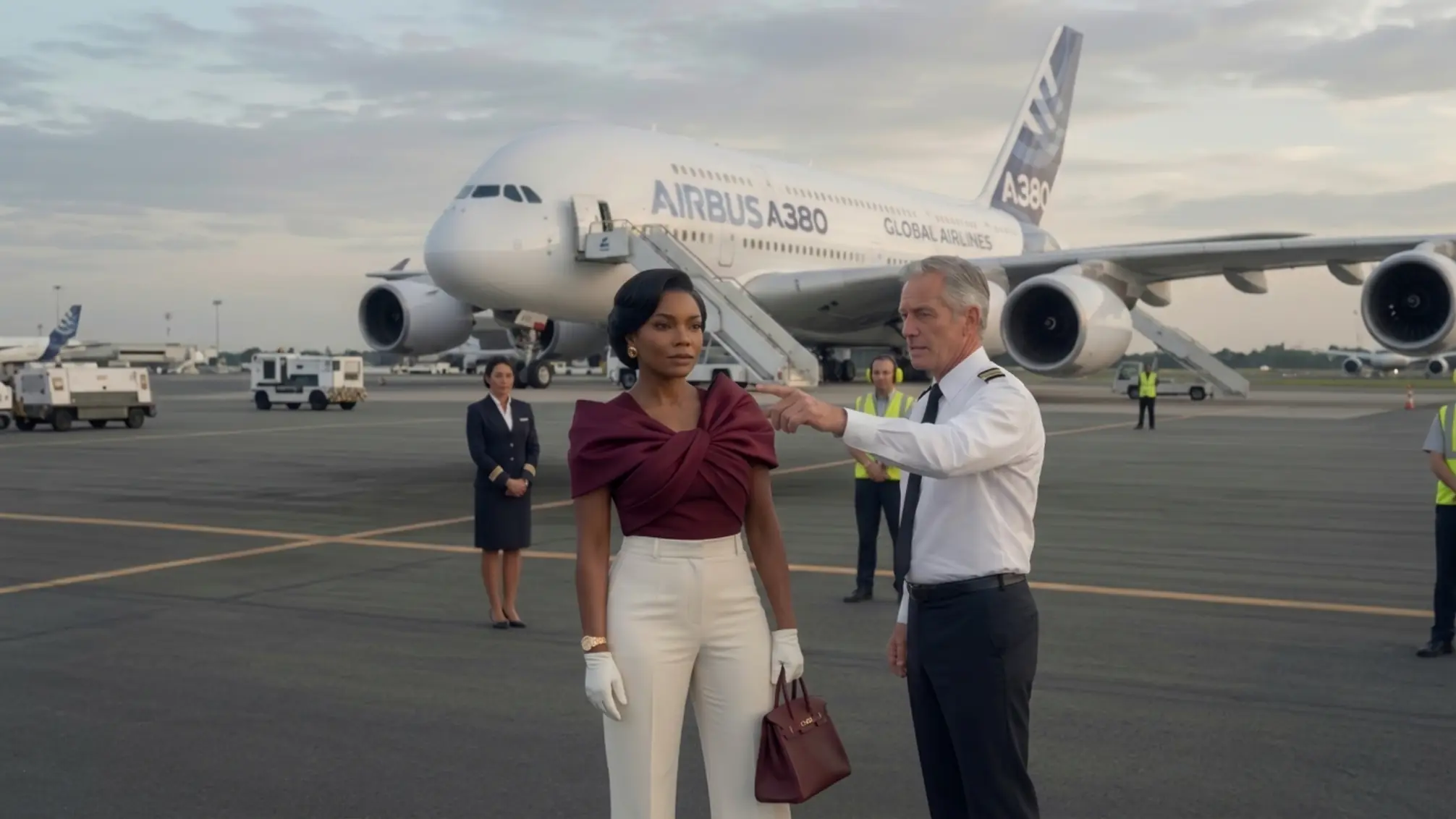
Richard stepped closer, contempt tightening his weathered face. “I’ll have security drag you away and blacklist you worldwide.”
Amara tapped the screen once. “Call them. My board is timing your final three minutes.”
Richard laughed.
The sound carried across the concrete toward the ground crew positioned beside the enormous aircraft. Two baggage handlers wearing reflective vests lowered their eyes, while the first officer remained near the boarding stairs pretending to study a tablet. At the open door above them, the lead flight attendant watched without intervening.
None of them looked surprised by Richard’s behavior.
That interested Amara more than the insult itself.
She was thirty-eight years old, founder and chief executive officer of Bennett Meridian Holdings, and one of the wealthiest self-made women in the United States. Her company controlled medical logistics networks, renewable-energy infrastructure, luxury hospitality properties, and Meridian Crown Aviation, a private-flight operator serving executives and heads of state.
The Airbus behind Richard belonged to her personally.
It had taken four years to design and convert. The lower deck contained a formal conference suite, medical treatment room, secure communications center, staff quarters, and private dining room. The upper deck held Amara’s office, bedroom, library, and a quiet lounge she used during long international flights.
The aircraft was worth approximately $600 million after customization.
Yet Amara rarely discussed its price.
To her, the jet’s real value was time. It allowed her to visit a rural hospital project in Kenya, negotiate a European energy agreement, and return to the United States for a board vote without losing days to commercial schedules. It also carried emergency equipment and specialist teams during humanitarian missions funded through her foundation.
Richard saw only a wealthy possession and a Black woman he believed could not possibly own it.
Amara had met him once before, though he clearly did not remember her.
Six months earlier, she attended a Meridian Crown Aviation safety reception without introducing herself as the parent company’s CEO. Richard spent ten minutes complaining to another pilot that company diversity programs were placing “the wrong faces” in executive lounges and cockpits.
Amara heard every word.
She did not confront him that evening. One careless conversation could reveal prejudice, but it did not prove someone was abusing authority or compromising an aircraft. She instructed compliance director Naomi Price to begin a discreet review of Meridian Crown’s senior crews.
The first findings were troubling.
Fuel expenses on Amara’s A380 exceeded projected use by nearly seventeen percent. Catering invoices appeared on dates when she had not scheduled flights. Maintenance records showed unexplained hours on the auxiliary power unit, while duty logs contained handwritten corrections entered after trips had supposedly ended.
Richard captained most of those flights.
His official explanations sounded reasonable when reviewed separately. He claimed extra fuel resulted from repositioning, weather deviations, and maintenance testing. The catering charges were attributed to training exercises, and the altered logs were dismissed as administrative corrections.
The pattern still bothered Amara.
Three weeks before the tarmac confrontation, Naomi found photographs on a private social-media account belonging to a junior flight attendant. They showed wealthy passengers drinking inside the A380’s upper lounge during a night the aircraft was listed as undergoing maintenance.
One passenger was Victor Lang, a real-estate developer whose companies were under federal investigation for bribery.
The images disappeared two hours after Naomi discovered them.
By then, she had saved copies.
Amara ordered a full forensic review but told no one on Richard’s crew. She wanted to know whether the unauthorized flight was an isolated favor or part of a larger operation. The investigators found encrypted invoices describing the A380 as “Project Ivory,” with private clients paying hundreds of thousands of dollars for undocumented travel.
The money never reached Meridian Crown Aviation.
It flowed through a consulting company owned by Richard’s brother-in-law.
Someone had been secretly chartering Amara’s aircraft.
The scheme required cooperation from more than one pilot. Passenger manifests had to be altered, security cameras disabled, cabin services arranged, and maintenance records manipulated to conceal flight hours. Amara did not yet know how many crew members were involved.
She decided to test them personally.
Her executive office scheduled an official departure from Miami to London. The crew received written notice stating that the aircraft owner and company chairwoman would arrive at 4:30 p.m. The passenger manifest listed Amara Elise Bennett in the primary suite.
There was no ambiguity.
Amara arrived at 4:22 wearing a burgundy designer top, cream wide-leg trousers, burgundy heels, and gold jewelry. She brought no assistants, security detail, or public-relations team. Naomi and two compliance investigators waited inside the private terminal, monitoring through airport cameras and the aircraft’s secure systems.
Richard confronted her before she reached the stairs.
He did not request identification politely.
He looked at her clothing, skin, and handbag, then told her the service entrance was on the other side of the terminal. Amara explained that she was boarding the aircraft.
Richard laughed and asked whether she was a newly hired attendant.
She showed him the digital authorization bearing her full name, biometric confirmation, and aircraft registration.
He refused to examine it.
Instead, he ordered the first officer to call airport security.
That was when Amara began the three-minute timer.
“Captain Hale,” she said, “ask your first officer to read today’s primary passenger name aloud.”
Richard glanced toward the younger pilot. “She doesn’t need to read anything.”
The first officer, Daniel Cross, held the flight tablet against his chest. He was thirty-four, ambitious, and two years away from qualifying for senior command. His eyes moved from Amara to Richard.
Amara addressed him directly. “Open the manifest.”
Daniel hesitated.
“Now.”
Richard turned sharply. “Do not take instructions from her.”
Daniel’s hand remained frozen over the tablet.
The first thirty seconds passed.
Amara looked toward the aircraft door. “Ms. Sutton, please come down.”
Lead flight attendant Claire Sutton slowly descended the stairs. Her navy uniform was immaculate, and her dark hair sat in a polished bun. She carried the controlled expression of someone who had already decided which version of events she intended to support.
Amara asked, “Who occupies the owner’s suite today?”
Claire looked at Richard before answering. “The principal passenger.”
“Name her.”
“I’m not authorized to disclose private passenger information.”
“I am the passenger.”
Richard stepped between them. “Enough. Security will handle you.”
Amara’s phone vibrated.
Naomi had sent a single message.
Unauthorized guests inside upper lounge.
Amara looked through the open aircraft door. “Who is already aboard?”
Nobody answered.
The second minute began.
Richard’s confidence shifted slightly. He did not know how Amara had learned about the hidden passengers, but he recovered quickly.
“The cabin is being prepared for an important client,” he said.
“Which client?”
“That is confidential.”
“Confidential from the aircraft’s registered owner?”
“You keep repeating that fantasy.”
Amara turned her phone outward again. “Look at the authorization.”
Richard struck her hand aside.
The phone did not fall, but the movement was visible to every camera covering the tarmac.
Amara’s voice became colder. “You just put your hand on me while blocking access to my property.”
“You’re trespassing in a controlled aviation area.”
“My biometric credentials opened the gate.”
“A system error.”
“My name is painted on the holding company that signs your salary.”
Richard smirked. “People like you always think dropping a famous name will frighten someone.”
Amara stared at him.
The insult itself no longer mattered. He had now ignored official documents, concealed unauthorized passengers, physically interfered with an owner, and encouraged his crew to support a false account.
She looked at Daniel again. “Last opportunity. Read the manifest.”
Daniel opened the tablet.
Richard grabbed it from him.
That action answered more than words could have.
Two minutes and twenty seconds had passed.
Amara placed her phone on speaker and called Naomi.
The compliance director answered immediately. “Board line is secure.”
“Connect everyone.”
Within seconds, five voices joined the call: Meridian Crown Aviation’s board chair, chief legal officer, safety director, director of human resources, and senior representative from the aircraft insurer.
Richard’s face changed when he heard the board chair introduce himself.
Amara spoke calmly.
“I am standing beside aircraft N781MB. Captain Richard Hale has refused my boarding authorization, concealed the identities of passengers currently aboard, ordered his crew not to verify the manifest, and physically struck my hand while threatening to involve security.”
“That is a lie,” Richard interrupted.
Amara turned toward him. “State your position for the recorded line.”
He suddenly noticed the cameras.
The first officer noticed them too.
Claire took one step away from Richard.
The final twenty seconds began.
Naomi’s voice emerged from the phone. “We have remotely accessed the cabin-security system. Four unauthorized individuals are inside the upper lounge. Two match persons appearing in the prior unreported flight photographs.”
Richard’s face lost color.
Amara asked, “Are the flight-control credentials frozen?”
The safety director answered. “Captain Hale and First Officer Cross have been removed from active status. Their digital cockpit access is disabled.”
“Cabin crew?”
“Suspended pending investigation.”
“Aircraft release?”
“Canceled. No movement authorized.”
The timer reached three minutes.
The massive jet remained silent behind them.
Richard looked toward the stairs as if he could still reach the cockpit and reclaim control. A red access indicator appeared beside the open door, showing that the secure flight deck had locked automatically.
“You cannot do this,” he said.
Amara picked up her phone. “I already did.”
Airport security vehicles approached from the terminal, followed by two black Meridian Crown compliance cars. Richard straightened his shirt and attempted to restore the commanding tone that had worked on junior employees for years.
“This woman created a security incident,” he told the first officer. “You witnessed it.”
Daniel said nothing.
Richard turned toward Claire. “Tell them she tried to force her way aboard.”
Claire looked at Amara, then toward the cameras.
“I didn’t see that,” she said.
Richard stared at her. “You were standing there.”
“I saw you refuse to read her credentials.”
“You knew the plan.”
Claire’s expression tightened.
Amara heard the accidental confession.
“So there was a plan,” she said.
Nobody answered.
Naomi Price stepped onto the tarmac holding a sealed evidence folder. She was a composed forty-six-year-old Black woman who had spent nineteen years investigating aviation fraud and safety failures. Two compliance officers followed carrying company-issued evidence bags.
“Captain Hale,” Naomi said, “surrender your flight tablet, company phone, identification card, and aircraft keys.”
Richard laughed nervously. “You have no grounds.”
Naomi opened the folder. “We have encrypted invoices, maintenance discrepancies, hidden charter payments, altered manifests, and cabin footage from three unauthorized flights.”
Daniel closed his eyes.
Claire whispered something that sounded like a curse.
Richard pointed toward them. “They handled the paperwork. I only flew the routes.”
Naomi did not react. “Thank you for clarifying your role on the recorded tarmac system.”
Airport officers boarded the A380 and escorted the four unauthorized passengers down the stairs. Victor Lang appeared first, wearing an expensive gray suit and an irritated expression.
He stopped when he saw Amara.
“Ms. Bennett,” he said carefully.
Richard looked between them.
“You know her?”
Victor’s face revealed that he finally understood how thoroughly the situation had collapsed. “Everyone knows Amara Bennett.”
The words landed harder than any accusation.
Richard had stood beside a $600 million aircraft, looked directly at its owner, and decided her identity was impossible because of his own prejudice. The man he had secretly promised the jet to recognized her immediately.
Victor attempted to explain that he believed the flight was a legitimate private charter.
Amara asked for his invoice.
He produced an electronic receipt from Ivory Global Consulting for $420,000. The document promised exclusive use of the aircraft from Miami to Monaco, with a refueling stop in the Azores.
Meridian Crown Aviation appeared nowhere on it.
Naomi preserved the receipt as evidence.
Victor and his guests were escorted back to the terminal for interviews. Their luggage remained aboard until investigators obtained permission to search it. Inside one case, officers later found contracts connected to bribery allegations and more than $300,000 in undeclared cash.
Richard watched the luggage being removed.
“This is getting out of control,” he said.
Amara faced him. “It was out of control when you used my aircraft as your private business.”
“You don’t understand aviation operations.”
“I own the operator.”
“That doesn’t make you a pilot.”
“No. It makes me responsible for every passenger your fraud placed at risk.”
Richard tried another approach. “Those flights helped the crew. Salaries have been stagnant. Everyone benefited.”
Daniel looked at him sharply.
Claire’s expression turned furious.
Richard had just implicated the entire crew to reduce his own responsibility.
Amara noticed.
“Did everyone receive money?”
Silence followed.
She repeated the question.
Daniel answered first. “I received two payments.”
Claire looked at him.
He continued, speaking faster now. “Captain Hale said they were discretionary duty bonuses approved through executive management. I should have verified them.”
“You altered flight logs,” Naomi said.
Daniel lowered his head. “Yes.”
“Why?”
“Richard said the owner rarely used the aircraft and would never examine individual hours.”
Amara felt no satisfaction hearing that.
Daniel was old enough and experienced enough to understand the seriousness of false logs. Yet he also appeared to be the first person willing to speak honestly now that the scheme had failed.
Claire admitted arranging cabin service for four unauthorized flights. She received cash payments through a catering company controlled by Richard’s brother-in-law. Two additional attendants had participated, while one junior crew member raised concerns and was removed from the A380 rotation.
That detail led investigators to Natalie Brooks.
Natalie had been transferred after reporting an unidentified passenger during a supposed maintenance flight. Richard described her complaint as emotional instability and recommended she undergo a fitness review.
The accusation nearly ended her career.
Amara called her that evening.
Natalie answered from a commercial aircraft crew hotel in Dallas. She became silent when Amara identified herself.
“I thought no one believed me,” Natalie finally said.
“I believe you.”
“They told me the passenger was a maintenance representative. He stayed in your bedroom.”
Amara closed her eyes briefly.
“What else did you see?”
Natalie described cash envelopes, hidden catering deliveries, and Richard ordering technicians to disable cabin cameras. She had saved copies of messages before losing access to the crew system.
Those messages completed the case.
Over fourteen months, Richard’s group operated nine unauthorized charter flights. They earned more than $3.8 million, falsified maintenance records, exceeded legal duty limits, and carried passengers without proper security screening.
On two flights, the aircraft’s weight documents were inaccurate because the crew concealed additional luggage.
That was not merely theft.
It was a serious safety violation.
The A380 remained grounded for twelve days while independent engineers inspected every system and reconstructed its true operating hours. Amara canceled three international meetings and traveled commercially rather than pressure inspectors to rush.
She wanted the aircraft cleared honestly.
Meridian Crown Aviation terminated Richard, Daniel, Claire, and four other crew members after disciplinary hearings. The company referred its findings to federal aviation authorities, law enforcement, insurers, and tax investigators.
Richard’s attorney claimed racial allegations were being used to distract from a contract dispute.
The tarmac recording destroyed that argument.
His opening sentence was unmistakable.
“Women like you don’t own six-hundred-million-dollar jets.”
The recording also captured him ignoring the manifest, striking Amara’s hand, concealing passengers, and instructing colleagues to support his account. His prejudice had exposed the scheme because it made him underestimate the one person capable of examining every record.
Daniel cooperated fully.
His pilot certificates were suspended during the investigation, and he later accepted responsibility for falsifying logs. He lost his position and paid restitution, though his cooperation prevented the most severe criminal charges.
Claire also cooperated after investigators showed her the financial transfers. She admitted helping Richard silence Natalie and testified about the unauthorized flights.
Richard refused every offer requiring a truthful admission.
He went to trial.
Prosecutors presented payment records, flight data, messages, altered manifests, cabin footage, Victor’s invoice, and testimony from multiple crew members. They demonstrated that Richard’s secret charters operated beyond approved duty limits and without required maintenance-hour reporting.
The jury convicted him of fraud, conspiracy, falsifying aviation records, and unauthorized commercial operation.
At sentencing, Richard asked to speak.
He described himself as a pilot with forty years of experience who had made financial mistakes late in an otherwise honorable career. He said Amara had destroyed him publicly rather than resolving the matter privately.
The judge looked down at the tarmac transcript.
“You used another person’s aircraft for profit, falsified safety records, endangered passengers, and attempted to remove the owner from her own property because you could not imagine a Black woman possessing authority over you,” she said. “Public humiliation was not imposed upon you. It was recorded while you created it.”
Richard received a prison sentence and was prohibited from acting as pilot in command during supervised release. His aviation career was over.
Amara made changes throughout Meridian Crown.
Anonymous reporting systems were moved outside local management. Crew members could challenge manifests, duty hours, and safety decisions without approval from a captain. Every company aircraft received independent flight-data reconciliation, preventing handwritten corrections from hiding unauthorized use.
Natalie Brooks returned.
Amara offered her compensation, restored seniority, and invited her to join the aviation ethics team. Natalie accepted only after confirming she could continue flying.
“I reported it because I loved the work,” she explained. “I didn’t want one dishonest captain to take the sky away from me.”
Amara understood.
Six months later, the A380 stood on the same Miami tarmac, cleared for a humanitarian flight carrying surgical equipment to West Africa. A new captain waited beside the stairs.
Captain Elena Marquez was a forty-nine-year-old former Air Force pilot with twenty-seven years of flight experience. She examined Amara’s credentials even though she knew exactly who stood before her.
“Identity confirmed,” Elena said.
Amara smiled. “You recognize me.”
“I do.”
“Then why check?”
“Because procedures should protect everyone equally, including owners.”
“That is the correct answer.”
Natalie stood at the open door, now serving as senior cabin manager. Ground teams loaded medical equipment below while physicians reviewed the onboard treatment room.
Before climbing the stairs, Amara looked across the tarmac where Richard had blocked her six months earlier.
The confrontation had lasted only three minutes.
The investigation lasted months.
People later described the incident as the moment a billionaire fired an entire crew after being insulted. That version missed the truth.
Amara did not end their careers because Richard failed to recognize a wealthy woman. She ended their access because recognition was never supposed to determine whether safety rules, ownership records, and human dignity applied.
Richard’s prejudice revealed his corruption.
He believed Amara was powerless, so he spoke openly, ignored documentation, touched her phone, and ordered others to lie. Each decision exposed another part of the scheme he might otherwise have hidden for years.
Amara climbed the stairs.
Behind her, the immense Airbus A380 reflected the evening light across its white fuselage. Ahead waited a crew that understood the aircraft was not a personal kingdom, no matter who sat in the cockpit or owned the title.
Elena followed proper procedure.
Natalie closed the door only after every passenger was confirmed.
The engines started one by one.
As the $600 million jet rolled toward the runway, Amara opened the secure board report on her tablet. The final page contained a still image taken from the tarmac recording.
Richard was pointing toward the terminal.
Amara stood before him, calm and unmoved, while the timer on her phone continued counting.
He believed those three minutes measured how long she had left before security removed her.
In reality, they measured the final moments before every lie, every stolen flight, and every falsified record caught up with the crew that thought the aircraft belonged to anyone bold enough to take it.
The pilot ordered the billionaire away from her own jet.
Three minutes later, the cockpit locked him out.
And it never opened for him again.