“Sign this, or deal with my lawyers.”
Grant Mercer laid the document across the hood of his truck and pressed one finger against the signature line. Behind him, a convoy waited on the county road, engines running.
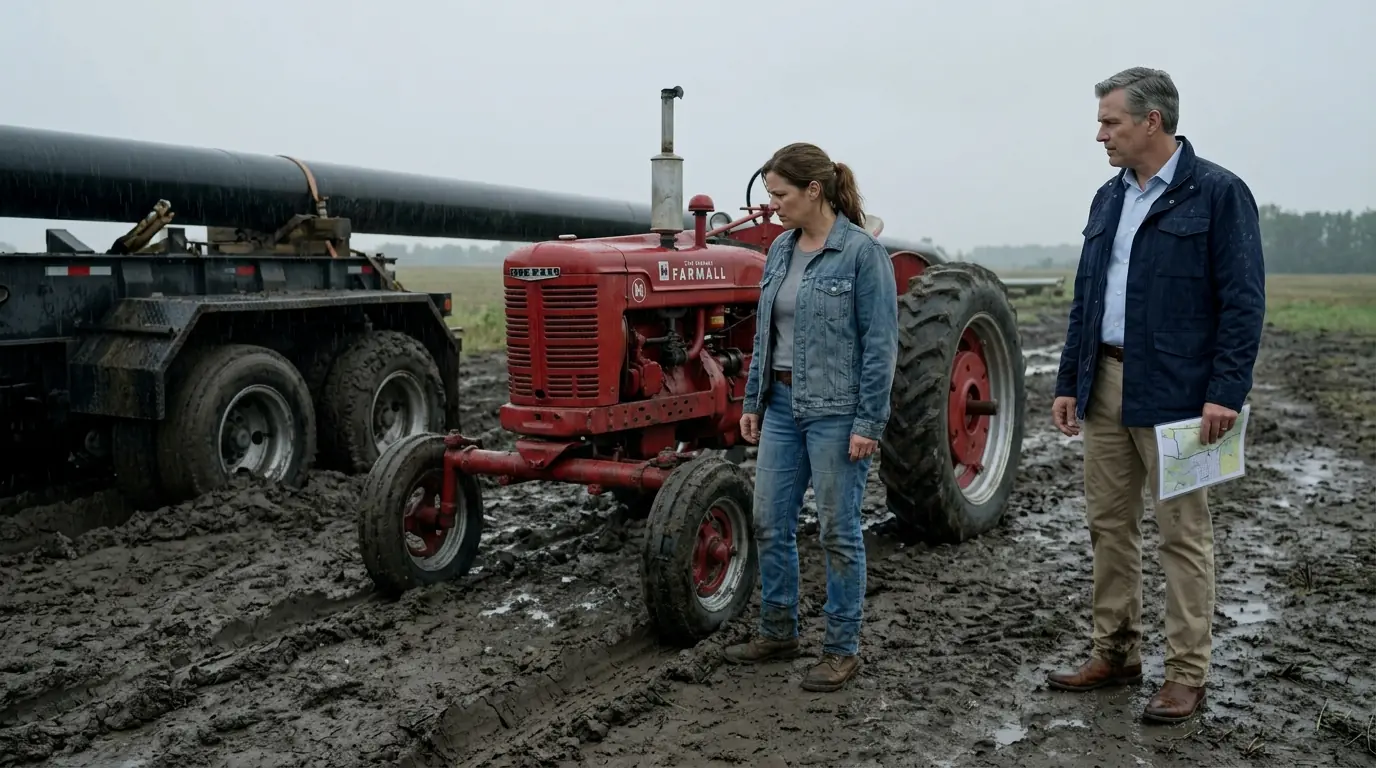
Clare Bennett looked past the paper toward the northern field. Four days of rain had left standing water beneath the grass, and the red line on Grant’s laminated map crossed land her father had spent years restoring.
“You’re not moving anything until my attorney reviews your claim.”
Grant checked his watch.
“Miss Bennett, we have permits.”
“Then you won’t mind showing them to her.”
His expression remained pleasant, but his finger lifted from the document. He folded the agreement, picked up his radio, and stepped away from the truck.
Clare heard his voice before she understood that he had stopped speaking to her.
“All units, advance the rig toward the north field now.”
At the road, a diesel engine deepened its note.
Clare moved toward the gate.
“Grant. I said no.”
He did not answer. The rig turned onto her property, its weight pressing the wet ground into two dark tracks.
Minutes later, a long mechanical groan rolled across the field.
Then the engine strained, the wheels stopped moving, and seventy-six thousand pounds of equipment settled into Bennett soil.
Grant stared at the rig.
Clare stared at the tracks.
Something about where they began was wrong.
Her father had taught her to notice things like that.
Thomas Bennett had died in March, in the farmhouse where he had been born.
There had been no final speech about the land, no dramatic instruction delivered from a hospital bed. By the time Clare received the call in Minneapolis, there was nobody left to ask what he had intended.
She was forty-two.
For nearly eighteen years, she had lived in a city where her mornings began with traffic, calendars, and work that rarely required her to check the weather before making a decision. She had built a career and a life there.
The farm existed at the edge of that life.
She called her father. She came home when she could. She listened to him report on rain, machinery, and neighbors, usually in the same restrained voice he used to discuss everything else.
If she asked whether he needed help, he said he was managing.
Now she walked through rooms where managing had left its evidence everywhere.
An unpaid bill sat beneath a jar on the kitchen counter. A chair leg had been repaired with a metal brace, and an old coat hung beside the back door with fencing staples in one pocket.
In the barn, the 1950 Farmall stood where it had stood since before she was born.
Its red paint had faded. Oil darkened the concrete beneath it, and the seat carried a split her father had covered more than once.
Clare put her hand on the steering wheel.
She remembered sitting there as a child while Thomas stood beside the tractor and explained what each lever did. He had made her repeat the instructions before allowing her to try anything.
He never assumed that being small meant she could not learn.
Later, when she left for Minneapolis, he had not asked her to stay. That silence had been a kindness, although sometimes she had mistaken it for indifference.
People expected her to sell.
A neighbor brought a casserole and mentioned how difficult farming had become. Another told her that she should not feel guilty about making a practical decision.
Even the attorney handling Thomas’s estate seemed to pause after explaining the property, waiting for the question about finding a buyer.
Clare did not ask it.
At first, she told herself she was staying only long enough to understand the accounts and finish the work already underway. Then she began getting up before dawn.
She walked the fields.
She found a broken fence post, repaired it badly, and repaired it again. She learned which bills could wait and which could not.
The farm had been running lean.
There were mornings when staying looked less like a choice than an expensive refusal to accept the obvious. On those mornings, Clare thought about her apartment in Minneapolis and the ease of turning a key in a door that did not require her to maintain everything beyond it.
Then she would step outside.
She recognized the rise near the northern boundary, the low wet section below it, and the diagonal farm lane that seemed to disappear beneath the grass. Her father had walked those places so often that knowing them felt like remembering him without having to stand still.
Six weeks after the funeral, Grant Mercer arrived.
He introduced himself at the farmhouse steps.