"Control your dog, Miller!"
Titan was already moving. Ninety-five pounds of muscle, tan fur, and blind determination dragged me off the concrete and into a row of folding chairs. A woman screamed. Somewhere the bagpipes stopped playing. The mayor ducked behind two officers, and a little boy who had come to place flowers at the memorial began to cry.
"Titan, heel! Hier!"
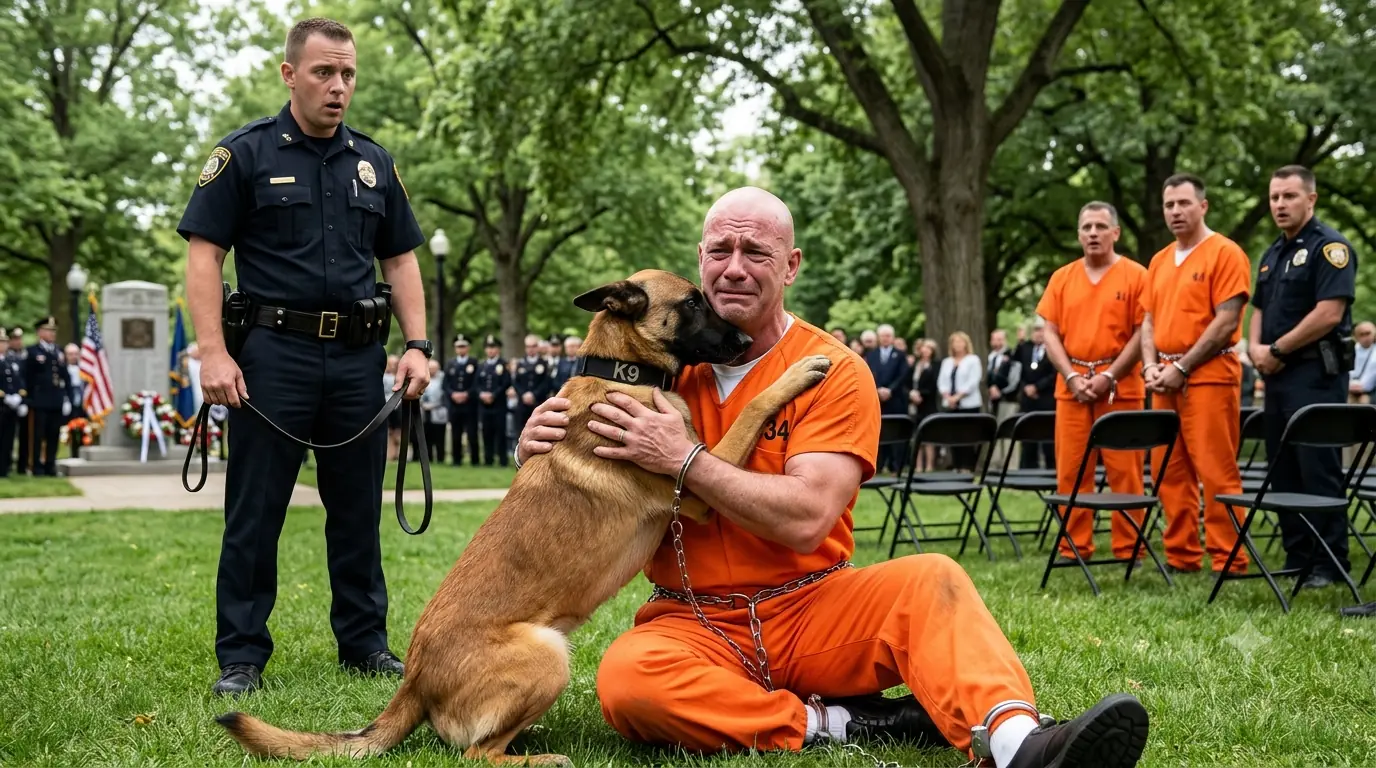
For three years that voice had been enough to bring him through smoke, noise, and chaos. Not today. His ears were flat, his eyes locked on a line of orange uniforms crossing the park, and he was pulling so hard his collar pressed against his throat.
Six prisoners shuffled along the far path with ankle chains linked to waist restraints. Three corrections guards walked alongside them. The third prisoner in the line had stopped. I could see a shaved head, broad shoulders, and a pair of hands rising slowly as if the man expected to be attacked.
One guard raised a shotgun.
"Don't shoot!" I shouted.
My boot struck the wet edge of the lawn. I slipped to one knee, and the leash vanished from my hands. Titan cleared the grass in a blur. He shot past the guard, vaulted a low stone wall, and launched himself at the prisoner. The man went backward under his weight.
I ran after them with my Taser in my hand. By the time I arrived, two guards had raised their batons and the shotgun was still pointed toward the tangled bodies.
"Wait!" I screamed. "Don't touch him!"
Then I saw what Titan was doing.
He had laid his paws over the prisoner's shoulders. His muzzle was buried against the man's neck. The sound coming from him was neither a warning nor a growl. It was a broken, aching whine unlike anything I had heard from the best-trained dog in our county.
The prisoner wrapped his chained hands around Titan's neck and began to sob.
"Hey, buddy," he whispered. "Look at you. Look how big you got."
I forgot the Taser. I forgot the crowd. When his sleeve pulled up, I saw a faded jagged tattoo on his forearm: three mountain peaks, a narrow river, and a small star beneath the last ridge.
I had seen that mark before. Not on a prisoner. On a photograph the department had ordered me to stop asking about.
Three years earlier, when Titan first arrived at the county K9 unit, he came in an unmarked transport van just before dawn. His transfer packet said he was twenty-two months old, healthy, certified, and reassigned after the closure of a regional training program. The form had the correct signatures and the appropriate veterinary entries. There was nothing obviously false about it.
Except for a blank space where the previous handler's name should have been.
I was Officer Daniel Miller then, recently selected for the canine assignment after seven years of ordinary patrol. My wife, Anna, said I had talked about the opportunity so often that she already knew the German commands better than I did. We had a daughter, Sophie, who loved dogs and believed every police canine should receive an official badge made of glittering cardboard.
I had wanted to work with dogs since my first month in uniform. My former patrol partner used to say that I trusted animals more easily than people. That wasn't entirely true. Animals could be frightened, confused, stubborn, and wrong. But when Titan looked at me, I always knew exactly what question I was trying to answer: could he trust me to keep him safe while asking him to do dangerous things?
The first morning we met, I held out a tennis ball. Titan stared at it without moving. He was lean then, all long legs and restless energy. His eyes were unusually steady, and when I reached for his collar, he moved away with a quickness that looked more like a warning than shyness.
Our kennel technician, Rosa Delgado, noticed.
"He learned to expect somebody else," she said.
"Everybody has a first handler."
"Not everybody gets this quiet when a new one walks in."
Rosa had worked with service dogs and shelter animals long before joining the unit. She didn't invent dramatic explanations for behavior. If a dog refused food, she checked his teeth and stomach before assuming he was grieving. If he barked at a uniform, she looked at what the person had done, not what the fabric represented.
But Titan's behavior bothered her. He accepted commands, followed routines, and passed evaluations with remarkable precision. Sometimes, when a man with a particular deep laugh approached the kennel, Titan would run toward the entrance, stop, and stare past him toward the parking lot. He was listening for somebody who never arrived.
The first week, I brought his file home. Anna read the transfer summary while Sophie drew a blue collar on the dog she hoped to meet.
"Why doesn't it say who trained him?" Anna asked.
"Maybe the previous program didn't keep complete records."
"Maybe," she said. "But you don't believe that."
She was right. The veterinary records were detailed down to the dates of routine ear examinations. The training scores were complete. Only the history that connected the dog to a person had gone missing.
When I asked Captain Henderson, he looked at the folder as though it contained a dead battery.
"You're getting an excellent dog. Train him. Stop digging around old paperwork."
"I'm not trying to cause trouble. I'd like to know which commands he knows."
"You have the training sheet."
"And whether he has a former handler."
Henderson's face hardened. "That part of the program ended badly. We don't need to reopen it."
He offered nothing else. At the time, I let it go. I wanted the assignment more than I wanted to win a pointless argument with the captain. I told myself that if Titan and I built enough trust, the missing pages would no longer matter.
For a while, I was nearly right.
Titan learned my pace on foot patrol, the sound of my breathing before a search, and the difference between a command and an ordinary conversation. He never liked loud celebrations, but he could work through fireworks, shouting, and the roar of traffic. On duty he was disciplined; at home he was capable of stealing Sophie's socks with the sincerity of an accomplished criminal. He would carry them to his bed and wait for us to notice.
The first time Sophie came to the kennel, Titan pressed his nose against her hand and sat so gently that she declared him a gentleman. Rosa watched his ears, then laughed.
"He's made his decision," she said.
"About what?"
"Your family."
He became part of it without ever becoming merely a pet. There were doors he had to enter first, smells he had to follow, and situations where my responsibility was to put him between danger and another human being. That responsibility changed the way I looked at every assignment. I could send myself toward a suspect and accept the consequences. Sending Titan required another kind of trust because he didn't have the same choices I did.
We worked missing-person calls, narcotics searches, and long nights in damp fields. Twice Titan found people the search teams might otherwise have passed. The commendations came later; at the time, what I remembered was his breathing beside me and the relief of hearing someone answer from the dark.
Still, his past found ways to enter our ordinary days. Once, when a television interview played in the station lounge, Titan lifted his head at a voice on the broadcast. I turned just in time to see a correctional official discussing an old regional drug task force. Titan pressed toward the television, nose working, tail stiff. When the clip ended, he sat there for several seconds, waiting.
Rosa had noticed that, too.
"Find the original trainer," she told me. "Not because the dog needs him to work. Because somebody went to trouble to keep him out of the packet."
I tried. The regional program's phone number had been disconnected, and the listed administrator had moved. An old online photograph showed a line of officers outside a training building. A man at the far end held a young tan-and-black dog by a loose lead. He was turned slightly away from the camera, but a tattoo showed above his wrist. The image was too grainy to read clearly.
I printed it anyway.
A week later, a lieutenant came to my desk and asked why I was requesting records from the closed program. I told him honestly. He said the department had acquired Titan lawfully and that any remaining questions should go through command. Then he took the photograph out of the file I had left open and said it was an unofficial image that didn't belong in the dog's record.
"Will you return it?" I asked.
"It's a photocopy, Miller."
"It's my photocopy."
He laid it back on the desk. "Then keep it at home."
That was the first time I understood the problem might be more than incomplete paperwork. Somebody was watching the questions.
I folded the image into a book and put it in the bottom drawer of my home office. Anna asked whether I was going to continue. I said I didn't know. She was quiet for a moment before answering.
"You can stop asking about him," she said. "But don't tell yourself that means the answer stopped existing."
The years passed. Titan settled into the life we gave him, and my curiosity became something I could put away until it no longer occupied every spare minute. I did not forget the photograph, but I began to trust the work in front of me more than the uneasiness attached to the past.
Then the memorial ceremony arrived.
The Annual Fallen Officers Memorial was held on a municipal plaza bordered by a park and a low stone wall. More than five hundred people attended, among them families who had lost spouses, parents, sons, and daughters. Titan and I were scheduled to stand at the edge of the honor detail. He had done this twice before, calm and attentive while the bagpipes played and the names were read aloud.
I checked his collar that morning. Rosa had noticed a worn stitch on the leather lead and offered a replacement from the supply closet. I thanked her and swapped it out. In retrospect, I remembered the gesture with painful clarity. Even a good leash would not have held a dog determined to reach someone across a park, but we had done everything ordinary training taught us to do.
Henderson inspected the line before the ceremony. He stopped beside Titan and looked down.
"He's getting gray around the muzzle."
"A little."
"Don't let him embarrass us."
He said it with the faint smile he used when he wanted a warning to sound like a joke. I promised Titan would behave. Henderson moved on. I noticed he spent longer than usual speaking to a county official near the park path, but the detail did not strike me as important then.
The inmate work crew arrived shortly after the ceremony began. I caught sight of orange fabric beyond the crowd and wondered why corrections had scheduled a cleanup detail so close to a solemn public event. The prisoners had apparently been collecting trash along the perimeter before visitors arrived. It was a strange decision, but public agencies often made strange decisions through poor coordination rather than malice.
Titan noticed them before I did.
His body changed in one continuous motion. First his head lifted. Then his ears turned toward the park. He sniffed the air, took a step, and stopped. I gave a quiet command and felt his muscles tremble through the leash.
"Easy."
He wasn't watching the entire group. His eyes had fixed on one man, the third prisoner from the front. I turned to look, and Titan surged forward.
What followed took less than a minute, though I would remember it as a sequence of separate disasters: the leash burning my hands, Henderson shouting, folding chairs overturning, a guard racking a shotgun, and Titan running through the final open stretch before colliding with prisoner number 34.
At first I feared he had attacked. Then he made that terrible whimper, and the prisoner's hands found his fur.
"Hey, buddy. Look how big you got."
No dog could have recognized a man that deeply without history. I knew that much before I saw the tattoo. When I did see it, the printed photograph came back with such force that I felt dizzy. Three mountains, one river, one small star. The design had been distinctive even in black-and-white, partly because the last peak was broken by a thin white line where a scar crossed the ink.
The same scar ran across prisoner 34's forearm.
I knelt beside them. "Who are you?"
He did not answer immediately. He was trying to breathe while Titan pressed his face into the hollow of his neck. One corrections guard insisted that I pull the dog away. Another had already lowered his shotgun and was staring in disbelief.
The prisoner finally looked up.
"My name is Caleb Ward," he said. "I trained him when he was a puppy."
I felt my stomach tighten. The transfer packet had never contained that name, but the prisoner said it like an ordinary fact, one he had grown tired of being denied.
"From the regional program?"
"From before you ever heard of it."
A guard reached for his shoulder. Titan raised his head and barked once. The sound brought everyone back to the danger of the scene.
"Titan, down," I said.
For the first time that day, he obeyed. He lowered himself across Caleb's knees, still trembling. I clipped the lead back onto his collar and kept it loose. Caleb stroked the dog's neck with awkward, chained hands, and Titan's breathing gradually eased.
Captain Henderson arrived with two supervisors. He took one look at Caleb's face and stopped so abruptly that the officer behind him nearly collided with his back.
"Get that inmate away from the dog," Henderson said.
"He's calm," I replied. "We need a moment."
"That wasn't a request."
Caleb's hands went still. He looked directly at Henderson.
"Hello, Captain."
The captain's expression did not change, but his voice did. "You know the rules, Ward."
"I've had three years to learn them."
It was the first sentence that frightened me more than Titan's escape. Henderson knew him. Not as a name from an old case. He knew him well enough to speak as if an old disagreement had merely resumed.
I asked the guards to allow Caleb to stand without yanking on his chains. Titan followed the movement and sat pressed against his leg. A circle of officers had formed, cutting us off from the crowd. Someone had begun recording with a phone. I could hear people asking whether the prisoner had been injured, whether the dog would be removed from service, and why the captain looked as if he had been caught doing something he could not explain.
Henderson ordered me to return Titan to the kennel immediately and surrender the dog pending investigation. I understood the first part. A trained K9 that broke free during a public ceremony required evaluation. The second part sounded like an attempt to separate him from the one person who could explain his behavior.
"I'm taking him to Rosa," I said. "And I'm filing an incident report."
"You'll file what I tell you to file."
I looked at him. "I'll file what happened."
Caleb lifted his eyes from Titan. For a moment, there was gratitude in his face. Then the guards led him away, chains rattling across the grass. Titan whined until the group disappeared behind the correctional transport van.
The memorial resumed after a delay. I never heard the rest of the names. My hands were wrapped in temporary bandages, my shoulder throbbed, and I could not stop thinking about the way Henderson had spoken to Caleb. At the kennel, Titan lay with his muzzle against the gate and refused the toy Rosa offered him.
She read my report twice.
"He didn't attack," she said.
"No."
"He recognized him."
"Yes."
"Do you believe the man is his handler?"
I looked through the kennel bars. Titan had been trained to ignore strangers under almost any circumstance. On that grass, he had ignored me because a person from his past mattered more than anything I could command.
"I believe Titan does."
Rosa sat down at the workbench. "Then we need to find out how a man who taught that dog ended up on a chain gang and disappeared from a department file."
The video reached my phone that evening, sent by an officer who did not add a comment. I watched it once without sound. That was enough to see my mistakes: the way I had allowed the distance to open between Titan and the work detail, the moment the leash pulled taut, the awkward fall that gave him his chance. Then I watched the end. The camera caught the guard lowering his weapon and Caleb folding himself around Titan as though he had been holding his breath for three years. Even through the shaky image, the change in the dog's posture was unmistakable. This was not a pursuit that had ended in a capture. It was a search that had ended in recognition.
Anna found me sitting at the kitchen table with the screen dark. She did not ask whether the recording made me look bad. She asked whether anyone had helped the prisoner to his feet. I told her that the guards had, eventually, and that they had taken him away almost immediately. She asked whether he had been allowed to say goodbye. I shook my head. That was when I realized my anger was aimed in several directions: at Henderson, at the officers who had nearly struck Titan, and at myself for having stood there too stunned to ask for one more minute. Anna placed a glass of water beside my bandaged hands. "You can still ask what happened to him afterward," she said. "That's different from pretending you could have fixed it on the lawn."
The distinction kept me from making the worst decision available to a frightened person: telling the story before I understood it. By morning I had written down every detail I could still separate from interpretation, including the guards' commands, Henderson's words, and the prisoner's exact sentence to the dog. The report would be less dramatic than the video. I intended it to be more useful.
My first report lasted eleven pages. I described the breakaway, the guards' responses, the absence of a bite, and the prisoner's identification of himself as Caleb Ward. I included the tattoo and my prior unanswered questions about Titan's records. I made no claim that the prisoner's conviction was wrongful. The fact that a dog recognized him did not prove innocence, and I knew a disciplinary board would dismiss my whole account if I pretended it did.
When I submitted it, Henderson summoned me behind closed doors.
"You're putting your career on the line over an inmate," he said.
"I'm putting my name on an accurate report."
"Ward is a convicted felon."
"What was he convicted of?"
Henderson pushed a printed summary across the desk: evidence tampering and theft of controlled substances from a regional task force storage facility. The case had ended in a plea agreement. The sentence had been long, but a portion was suspended. There were dates, docket numbers, and a judge's signature.
"He confessed," Henderson said.
"Did he?"
"It's in the paperwork."
"You knew him."
Henderson's chair creaked. "I knew the case. That's different."
I remembered the man's greeting. Hello, Captain. I remembered Henderson saying, You know the rules. I didn't argue. I took the summary and left.
That night Anna helped me clean my scraped hands. Sophie had already gone to bed. Titan remained at the kennel because the department required temporary observation after a public handling incident. The house felt empty in a way I had not anticipated.
"You've got the look," Anna said.
"What look?"
"The one that says you won't sleep until you understand something."
I told her about the tattoo and the old photograph. She went to the office drawer where I kept documents I hadn't found the courage to throw away. The photograph was still folded inside a paperback. She carried it to the kitchen under the overhead light.
There he was. Younger. Standing beside a training building. One hand resting on the head of a puppy whose dark muzzle and white patch beneath the chin I would have recognized anywhere.
The tattoo was visible above the man's wrist.
I had been looking at Caleb Ward for three years without knowing his name.
The next morning, I requested public court records. I could review them on my own time without touching a department evidence system. The criminal docket showed that Caleb had pleaded guilty after an internal investigation led by Henderson's task force. A signed statement said he had removed sealed evidence from a secured room and delivered it to an unauthorized location. It also said he accepted responsibility in exchange for reduced charges against his younger brother, Evan.
I stopped reading. The statement did not explain how Evan had become part of the case. A separate petition, filed by Caleb's former lawyer, challenged the plea as coerced and claimed that evidence logs had been altered. The petition had been denied because the lawyer could not produce the original electronic access records.
The case was old, but the missing records were not the kind of detail that vanished accidentally. An evidence room could change software, and a computer could fail. Yet the petition described access logs that had been reviewed during the internal inquiry and then declared unavailable when the defense asked for copies.
I called the former lawyer, Margaret Ellis. She was still practicing, though her office had moved across town. She listened while I explained the incident at the memorial and asked to meet me after work.
"Bring the picture," she said. "And don't bring a police car."
Her office sat above a pharmacy and smelled faintly of coffee and old paper. She looked older than her online photograph, but her questions were sharp.
"Did the dog bite him?"
"No."
"Did the man identify himself?"
"Caleb Ward."
"And your captain tried to separate them?"
"Yes."
Margaret looked at the old photograph, touched the faded shape of the tattoo without obscuring it, and closed her eyes for a moment.
"He loved that dog," she said. "His brother helped him raise it before the regional program took over."
"What happened to Evan?"
"Charges were never filed. Caleb agreed to the plea after he was told they would be. Evan was nineteen and had been working nights as a temporary maintenance assistant at the task force facility."
"So Caleb took responsibility to protect him."
"That's what he told me. But he also said the statement they gave him contained details he knew were false."
"Why plead?"
"Because a trial with no usable records and a brother facing charges looked worse to him than prison."
She handed me a copy of the original petition. It identified a task force vehicle that entered a storage facility on the night the evidence disappeared. Caleb had said the vehicle belonged to a supervisor, but the internal review found no reason to doubt the supervisor's account that it was parked elsewhere. The missing access logs would have shown whether the supervisor's keycard entered the room.
"Was Henderson that supervisor?" I asked.
"He chaired the review. Another officer managed the storage room."
"Who?"
"Lieutenant Paul Rourke. He retired last year."
The name meant something. Rourke was the man who had come to my desk after I requested Titan's old training records. He had not been retired then. He had warned me to stop asking questions and told me to keep the photograph at home.
Margaret watched my face. "You know him."
"I know he knew I was looking."
I left the office with a harder problem than I had entered. Caleb might have been telling the truth, but my personal belief could not undo a conviction. We needed records, witnesses, and a route that did not pass through Henderson. I told Margaret I would provide an accurate sworn statement about the ceremony. Anything beyond that had to be discovered lawfully and independently.
"Good," she said. "A dramatic reunion will make people curious. Curiosity doesn't overturn a guilty plea. Evidence might."
The department moved faster than I expected. By the afternoon, I received written notice that Titan had been suspended from operational duty pending an internal canine evaluation. Henderson also ordered me not to discuss the incident publicly. The first order was reasonable, though the timing hurt; the second would later raise questions because officers were ordinarily permitted to make truthful statements to outside investigators.
I did not give an interview. I sent my report to the department's professional standards unit and requested that the investigation be assigned to someone outside Henderson's command. The request was denied without explanation.
Rosa was instructed to transfer Titan to a training vendor three counties away. She called me as soon as she received the order.
"They want him moved before the evaluation," she said. "That doesn't make sense."
"Can they do it?"
"They can issue the order. But the vendor's supposed to receive a veterinarian's certificate first. There isn't one."
"Then document that. Don't break policy."
"I wasn't planning to. I was planning to ask why a dog that hasn't bitten anyone is being shipped before the vet sees him."
I admired her for making the distinction. We could not fight a suspicious process by inventing our own rules. That would give Henderson exactly what he needed: a reason to dismiss us as insubordinate and reckless.
Two days later, my locker was searched under an administrative inspection policy. Nothing improper was found. Henderson informed me that my access to certain files would be restricted while the department assessed my judgment at the ceremony. My colleagues stopped talking when I entered the break room. Some privately offered support; others believed I was risking the unit for a man who had already admitted guilt.
They weren't wrong about the risk. They were wrong about what I was trying to prove.
I wasn't trying to prove a prisoner was innocent because my dog cried. I wanted to know why a dog's history had been deliberately removed and why senior officers had become alarmed when that history surfaced.
On Friday, a local reporter called Margaret. A spectator had recorded the reunion on a phone, and the video was circulating online. The image of Titan pressing his face into a prisoner's neck had already drawn thousands of comments. Some said the dog recognized an abusive former owner. Others insisted it must have been a father-and-son reunion in disguise. A few treated Titan's behavior as proof that Caleb was innocent.
None of those explanations was evidence. Margaret released a short statement confirming that she represented Caleb and that she was examining potential new information. She declined to discuss the merits.
The publicity produced something we had not expected: an email from a retired equipment technician named Samuel Price. He said he remembered a problem with the regional task force's electronic door system during the week of Caleb's arrest. Margaret verified his work history before arranging a meeting. I attended only as a witness to explain the dog transfer; I left the evidence questions to her.
Samuel was a quiet man who brought a small notebook and a folder of invoices. He had serviced cameras and card readers at the facility before retiring. He said an access controller had failed shortly after the evidence disappearance. The official repair note called it a power problem. His own invoice described a manual reset performed at the direction of Lieutenant Rourke.
"What did the reset do?" Margaret asked.
"It cleared recent events from the local controller. The server should have retained the audit trail."
"Did you warn them?"
"I told them they'd need to preserve the server export if there was an investigation. Rourke said internal affairs had already copied everything."
"Did you see that copy?"
"No. I was there to fix a door."
He shifted in his chair. "But I remember something else. They had me replace the camera beside the loading bay a week later. Rourke said it was damaged in a storm. The old unit wasn't damaged. The recording drive was missing."
The statement was troubling, not conclusive. A drive could have been removed for legitimate reasons. The invoice gave us dates and the name of a technician who had no reason to know why the evidence mattered. It was the first independent detail that connected Rourke to missing records.
Margaret filed a renewed motion requesting preservation of any remaining server backups and related records. She asked the court for independent review of the evidence handling because Henderson and Rourke were both involved in the original investigation. She also requested an interview with Caleb under conditions that would not put him in the custody of officers associated with the case.
Meanwhile, Titan stopped eating his morning ration. Rosa examined him with a veterinarian. There was no immediate medical problem; he took food by hand and slept normally when someone remained near the kennel. The veterinarian recorded stress associated with the abrupt routine change and recommended a stable environment. The report undercut the justification for moving him to a distant vendor without first completing the local assessment.
Henderson accused Rosa of interfering with command decisions. She kept the veterinarian's report, the transfer order, and every response in a neat folder. When I thanked her, she shook her head.
"I'm not doing it for a courtroom scene," she said. "He's a dog. He needs people to make decisions that actually consider what happens to him."
That was Rosa. Practical even when the rest of us were tempted to dramatize everything.
The next break came through a person who had no interest in dogs. A former evidence clerk, Nina Foster, contacted Margaret after seeing Samuel's name in a news report. She had worked with Rourke before leaving the department. She did not remember Caleb as dishonest. She remembered an argument about a sealed narcotics package that had been checked out for a laboratory transfer and returned with a different weight.
Nina said she had reported the discrepancy to Rourke. He told her to correct the entry because the laboratory scale was probably wrong. She refused. The next morning, the entry appeared changed under a supervisor account.
"Did you report it?" Margaret asked.
"I emailed the discrepancy to the internal review address."
"Do you have the email?"
"I thought it was gone. But the old account forwarded to my personal address when our department system was being replaced. I found a copy last night."
Her phone contained a forwarded message with a date, subject line, and attachment identifying the original package number. Margaret asked her to preserve the device and the original message without editing it. Nina agreed to let a forensic specialist make a copy.
For the first time, I saw Margaret look hopeful without immediately covering the feeling.
"This still doesn't prove who took anything," she said. "But it proves somebody had reason to investigate a discrepancy before Caleb was accused."
The packet contained one other detail. Nina's attachment showed that the original seal had been logged as intact before Caleb began his shift. The state claimed he had broken that seal hours earlier. One of those accounts was wrong, and the earlier log had a timestamp from a system separate from the access controller.
A judge ordered an evidentiary hearing.
Henderson came to my house the night before I was scheduled to give a deposition. He did not arrive in uniform. He stood on the porch holding a folded sheet of paper, looking older than I remembered from the station.
Anna saw him through the front window and took Sophie to the kitchen. I stepped outside, leaving the door partly open.
"You shouldn't be here," I said.
"I wanted to save you the trouble of a public mistake."
"Then speak to your lawyer."
He held out the paper. It was a copy of the suspension notice for Titan, marked with comments about my judgment.
"You think Ward is a hero because a dog remembered him," Henderson said. "He wasn't. He was in a dirty operation and he knew things were missing."
"Then testify to that under oath."
"You have a family. A career."
"I know."
"Sometimes doing the right thing means leaving the past alone."
I looked at him for a long moment. "No. Sometimes leaving the past alone is the thing that made the present possible."
He turned away. Before stepping off the porch, he said, "You're making a mistake about who the villain is."
I had no answer. Not because I believed him, but because I had not yet seen enough to name a villain honestly. He was counting on that uncertainty to keep me quiet.
The hearing opened in a small courtroom crowded with local reporters and officers who remembered the original case. Caleb appeared in civilian clothing, his ankles no longer linked to a work crew. He looked thinner than he had on the lawn. Margaret sat beside him and arranged a stack of exhibits without making a show of it.
I testified about Titan, the old photograph, and the conversation at the ceremony. The state's lawyer asked whether a dog could reliably distinguish an innocent man from a guilty one.
"No," I said.
"Then this reunion has no bearing on Mr. Ward's conviction, does it?"
"It has bearing on whether the transfer documents were complete and why people were told not to ask about his previous handler. It doesn't prove what happened in the evidence room."
The lawyer paused. The truthful answer left less room for him to portray me as a sentimental fool.
Rosa testified next. She explained canine bonding and the transfer packet's gaps. She did not claim Titan possessed supernatural memory or moral judgment. She said a dog could retain strong recognition of a familiar person for years, particularly someone associated with early training. Titan's behavior was consistent with recognition, not proof of any legal fact.
Samuel described the controller reset. Nina described the altered evidence entry. The prosecution objected to some of the documentary claims, and the judge required a careful foundation for each. It was slower than the dramatic revelation viewers expected from the viral video. I had never felt more grateful for something being slow.
Then a court-appointed forensic examiner testified about a backup recovered from an archived county server. The backup had not contained a complete evidence-room history. It contained a partial export from the week before Caleb's arrest. A keycard assigned to Rourke had entered the secure room during the period when the missing narcotics package was supposed to be untouched.
The state argued that supervisors sometimes entered the room on legitimate business. That was true. The record alone did not prove theft. Then the examiner described a second entry: an administrative account had edited the package weight after Nina's email. The edit originated from a workstation assigned to Rourke's office.
Margaret let the facts sit before asking her next question.
"Was that information disclosed to Mr. Ward's defense before his plea?"
"Not in the production I reviewed," the examiner said.
The judge asked the state's lawyer directly whether the archived export had ever been produced. The lawyer requested time to check. The court recessed. Nobody cheered. Caleb stared at his hands as if afraid that moving would disturb the fragile possibility opening in front of him.
In the corridor, his younger brother Evan waited with a folded jacket. He had not spoken to Caleb in person since the plea hearing because their relationship had become tangled with guilt. I watched them from a distance. Evan tried to say something. Caleb shook his head and pulled him into an embrace.
"You didn't put me here," Caleb said.
Evan began to cry. "You took the deal for me."
"I chose it. We can sort out why later."
That answer stayed with me. Caleb had made a painful decision to protect his brother, and the consequences belonged partly to systems and partly to the limits of what he had known. The new evidence didn't make him perfect. It made the original version of his guilt impossible to accept without a fuller hearing.
When the hearing resumed, the state confirmed that it had not produced the archived data. A subsequent independent review found another problem: the written statement attributed to Caleb included language about a storage-room access event that the timestamps placed after he had been taken into custody. Caleb had signed the document, but the chronology could not be reconciled with the records.
The judge did not immediately announce that every allegation against Caleb was false. She ordered a new evidentiary process and directed the state to review the plea's reliability in light of evidence that had not been disclosed. Caleb remained in custody while the motion proceeded. I found that delay harder to bear than the hearing itself.
The public had seen Titan cry. They expected a miracle by Friday. The law required work that a dog could not perform.
For the next six weeks, independent investigators interviewed former task force staff, examined financial records, and compared laboratory receipts with storage logs. Nina's note led them to two more packages whose weights had changed after transfer. A state laboratory confirmed that the seals and item descriptions did not match its original receipt records. The discrepancy predated Caleb's alleged access.
Rourke was interviewed through counsel. He denied theft. He acknowledged using the administrative workstation but said he had been correcting errors under Henderson's direction. Henderson denied ordering any false corrections. Their accounts could not both be accurate.
An old departmental vehicle mileage log supplied another contradiction. It placed a task force SUV at the storage facility on a night Henderson had told the internal review it had never left headquarters. A fuel-card record supported the vehicle's movement. The driver field had been left blank. The records did not reveal who drove, but they weakened the story that the original investigation had been complete and straightforward.
Investigators also found a request to close the training program and reassign its canine assets. The request was signed shortly after Caleb began contesting his statement. The written reason cited budget reductions. Yet the department had transferred most of the program's equipment to neighboring units rather than selling it. Titan's file alone had been separated from the previous handler roster. That removal was signed by Rourke and approved through Henderson's command.
The pieces began to fit without requiring Titan to have understood anything about the crime. Caleb had been part of a canine team attached to the regional task force. When questions arose about evidence discrepancies, he had seen a supervisor move packages without the required sign-out. He reported it. Soon afterward, his younger brother became the focus of a threatened theft allegation involving an access card he was permitted to use only for maintenance. Caleb took a plea deal he believed would protect Evan. The program closed, the dog moved, and the man's name disappeared from the transfer packet.
But another question remained. Why would Henderson risk involvement if Rourke had made the alterations? The answer arrived through a source nobody had considered valuable: the purchasing records for the missing narcotics, maintained separately for a federal audit.
That night I went back through the file at my own kitchen table. The individual records were ordinary: repair dates, shift assignments, storage entries, and a transport mileage sheet. Nothing in isolation looked like a confession. Together they described a system in which one man could change a number, another could approve a disposition, and a third could be blamed when the totals failed to agree. I copied the timeline onto a sheet of paper, leaving blank spaces where the evidence still did not answer me. It was a habit from patrol investigations: mark the uncertainty rather than allowing the most persuasive theory to fill it silently.
Sophie came into the room for a glass of water and saw the old photograph beside the timeline. "Is that Titan when he was little?" she asked. I said yes. She pointed to Caleb standing at the edge of the image. "Who's that?" I almost answered with the word prisoner, but it was a label that described where the man had been when she saw the news, not who he had been when the photograph was taken. "Someone who knew him first," I said. Sophie considered that and went back to bed. After she left, I looked at the paper again and thought about how many different ways a person could disappear without leaving the room.
An independent accountant found that certain evidence packages had been listed as destroyed under one reference number while remaining active under another. The duplicate entries allowed quantities to disappear from the county record without immediately disrupting the audit trail. Henderson had signed the destruction approvals. Rourke had modified the storage entries. Their roles were different but complementary.
The discovery did not automatically establish that both men had stolen the material. It established that two supervising officials had approved or performed an irregular process, failed to disclose records that challenged Caleb's account, and then allowed a guilty plea to stand. Prosecutors from outside the county took over the inquiry. A grand jury reviewed the documentary evidence and witness statements. I learned most of that later from public filings, not secret phone calls.
My own department reacted in stages. At first, Henderson went on leave. Then he was removed from command pending an independent internal investigation. Rourke's retirement did not shield him from a criminal inquiry, though his attorney insisted he had acted under orders. Officers who had once avoided my desk began asking whether I had known all along.
"I didn't," I told them. "I just knew I didn't know."
The state agreed to vacate Caleb's plea after the new evidence undermined the factual basis of the conviction and the disclosure process. The original charges were dismissed without prejudice while the independent inquiry continued. Later, prosecutors announced that they would not refile the theft and evidence-tampering case against him because the available reliable evidence did not support it.
Caleb walked out of the correctional facility on a gray morning with a cardboard box holding his papers and two books. Evan waited beside Margaret, eyes red from a night without sleep. A reporter called out a question about whether he wanted revenge.
Caleb looked toward the road.
"I want breakfast with my brother," he said.
It was the first answer anyone had given that seemed large enough to contain the ordinary life he had lost.
I was there, but Titan wasn't. The canine suspension had not yet been lifted. I didn't bring him because I had no right to use the dog's longing as a public performance. Caleb understood when I explained. He looked disappointed for one second, then nodded.
"He's safe?"
"Yes. Rosa's taking care of him."
"Then tell him I'm coming."
The first private reunion happened three days later in a fenced training yard with a veterinarian present. Caleb approached slowly. He did not whistle, shout a command, or try to recreate the scene at the memorial. Titan spotted him halfway across the grass and stood absolutely still.
Then he ran.
This time there were no chains, no shotgun, and no crowd. Caleb knelt before Titan reached him. The dog pressed into his chest so hard they both sat down, and Caleb laughed through tears.
"You still don't know how big you are," he said.
Rosa turned away, pretending to inspect the gate. I watched from a bench with my hands resting on my knees, feeling something I had not expected: happiness mixed with grief. For three years Titan had been my partner. Caleb had loved him before I knew him. Neither truth erased the other.
Afterward, Caleb explained how he had raised Titan as a young dog. The Belgian Malinois and German Shepherd mix had arrived at the regional program frightened by machinery and suspicious of sudden voices. Caleb worked with him every morning before shift. He built trust slowly, often sitting in the kennel until Titan chose to come closer. When the dog began training, Caleb rewarded him with a scratched rubber ball that squeaked only when squeezed on one side.
"He hated the other toys," Caleb said. "That one was ugly as sin."
I laughed. "He still hides socks."
"He did that as a puppy. Took one of my boots once, too."
For the first time, I heard Titan's behavior described as a continuous life rather than an animal with two separate owners. The small habits connected us. Caleb told me the tattoo on his arm represented the hills near the place where he and Evan grew up. Their father had drawn the river and star on a scrap of paper before he died. Caleb had the design tattooed on his forearm in his twenties. The picture from the training facility had captured it by chance.
"I thought nobody had kept that picture," he said.
"Somebody didn't want me keeping it."
His smile faded. "That's a different thing."
The independent investigation continued after Caleb's release. Months later, charges were filed against Rourke for records-related offenses and alleged diversion of seized property. Henderson was charged separately with obstruction and making false statements during the renewed investigation. The cases followed different paths. Rourke entered a plea to certain counts and agreed to testify about the altered logs. Henderson disputed the allegations, but at trial the combined testimony and archived records supported convictions on obstruction and false-statement charges. The court's findings did not require a claim that every missing item had been recovered or every suspicious decision explained.
Caleb was not in the courtroom when the verdict was read. He had been offered a seat in the front row and declined it. He told Margaret he had spent enough of his life being made into an exhibit. He wanted to learn whether the outcome changed anything practical for people whose records could disappear as his had.
The county began an outside audit of evidence storage and disclosure procedures. The review found other documentation failures, including ones unrelated to the criminal cases. No one pretended that catching two officials had solved everything. New rules required independent preservation of electronic audit data, documented approval for administrative edits, and disclosure checks before a plea involving evidence handling could be finalized.
Henderson lost his position. Rourke's retirement benefits and criminal sentence became subjects of separate legal proceedings. Neither offered an apology to Caleb. He said he did not need one to establish what had happened, though there were nights when the absence still bothered him.
I faced my own hearing, too. The department cleared Titan of aggressive misconduct after reviewing the ceremony footage, the veterinary assessment, and the circumstances of the breakaway. I received corrective counseling for losing physical control of the leash during a crowded event. I accepted it. The fact that Titan had recognized Caleb did not make it safe for him to run unrestrained toward chained prisoners and armed guards. We changed our ceremony protocols, crowd spacing, and emergency handling plans.
Rosa was promoted into a position where she could review canine transfer records before new dogs entered service. She insisted that every dog should arrive with a complete behavioral history unless there was a documented legal reason for withholding a detail. The rule sounded dull. That was precisely what made it useful.
I expected the department to ask Titan to return to regular duty. Instead, after consultation with our veterinarian, the unit proposed early retirement. Titan was older now, and his recent stress had made the public demands of service less suitable for him. I wanted him home with us. Caleb wanted him near the person he had once been. Neither of us wanted another institution deciding his future without looking at the animal in front of us.
We talked about it over coffee at my kitchen table. Sophie sat nearby, drawing two houses with a dog running between them. Anna listened while Caleb described the little place he hoped to rent once he found work. He had been offered a position helping a dog-training nonprofit with kennel maintenance, pending a routine review of his record's correction.
"You should keep him," Caleb said at last. "You've been his person for three years."
"You were his person first."
He looked at Titan sleeping beside Sophie's chair. "Maybe he's got room for both."
We made an arrangement that didn't require pretending one relationship replaced the other. Titan retired to our home, where he knew the rooms and belonged with our family. Caleb visited regularly, sometimes taking him for slow walks, sometimes simply sitting on the porch while the dog slept between his boots. When Caleb found a nearby rental that allowed dogs, Titan spent some weekends there too. Rosa helped us keep the routine consistent. If Titan ever showed discomfort, we would change it.
During Caleb's first visit to our house, he stopped in the doorway of the kitchen and seemed uncertain where to put his hands. Anna offered him coffee. He asked if he could help instead, and she handed him a stack of mugs. The task was simple enough that nobody needed to make anything of it. While he set them on the table, Titan moved from room to room collecting the people he trusted, as if the dog could not quite believe they had all agreed to occupy the same afternoon.
Caleb stood near the back door watching Sophie toss the battered rubber ball across the grass. The first throw went short. Titan retrieved it and brought it back anyway. Caleb laughed and then fell quiet. "I used to picture him every day," he told me. "But after a while I stopped being sure I remembered the sound of his feet." I had no answer that could return those years. Instead I told him how Titan tapped his claws twice against the kennel floor whenever he was waiting for breakfast. Caleb nodded immediately. "He did that with me, too." For a moment his expression changed from disbelief to something gentler. A piece of his past had survived in another person's ordinary morning.
The first few months were not easy for Caleb. Freedom did not restore lost birthdays, missed funerals, or the confidence that people would believe him when he said what had happened. He attended counseling through a local support program and struggled with ordinary choices that had once been made for him. Some employers still looked at his history despite the court order. His relationship with Evan required more than one embrace to recover.
One evening he confessed that he sometimes heard chains in his sleep. We were sitting on the porch while Titan chewed an old rubber ball. I had no useful answer. I didn't tell Caleb to focus on his freedom or promise the nightmares would stop.
"You want me to stay awhile?" I asked.
"Yeah," he said. "That'd be good."
We sat until the light changed and Titan dropped the ball at Caleb's feet for the third time.
The civil case came later. Caleb sought compensation for the years lost and for the evidence failures that contributed to his conviction. It was settled through a documented agreement after prolonged negotiations. The amount helped him find secure housing and establish a modest future; it did not make the past vanish. He used part of it to fund legal assistance for defendants facing evidence-disclosure disputes. The rest went toward the unremarkable needs of living: a reliable truck, rent, insurance, and a small savings account.
As for the public, people continued asking me why Titan cried. They wanted an answer that sounded extraordinary, a declaration that the dog had sensed injustice or recognized innocence. I never gave them that. Titan knew Caleb because Caleb had loved and trained him. The dog recognized the person, not the verdict. It was the people who had to examine the verdict afterward.
That distinction mattered to me because the reunion could easily have become a comforting story in which an animal fixed what humans had broken. Titan had opened a door, but he could not read the logs behind it, question a witness, or compare a timestamp with a sworn statement. Samuel, Nina, Margaret, the independent examiners, and the court had done that work. Titan had reminded us there was a person missing from a file.
A year after the memorial, the city held the ceremony again. I attended without a dog beside me. Titan was retired. I stood near the back with Anna and Sophie, listening as the names were read. Henderson was no longer on the platform. The department had changed more than its seating chart, though plenty of work remained.
When the bagpipes began, Sophie slipped her hand into mine. She asked whether Titan would have liked the music.
"He would've waited until it was over," I told her. "Then he'd ask for a treat."
She smiled. "He asks for treats even when there isn't music."
"That's true."
That afternoon, we drove to a small park where Caleb and Evan were waiting. Titan walked beside us on a loose leash, his gray muzzle lifted toward the breeze. There were no prisoners, guards, or cameras. There was a wooden bench, a narrow path, and enough room for an old dog to stop and investigate every interesting smell.
Caleb knelt when Titan reached him. The dog leaned against his shoulder with the steady confidence of someone who no longer expected the person in front of him to disappear.
"Hey, buddy," Caleb said. "Look at you."
Titan looked up, gave one contented sigh, and settled on the grass between us.
For the first time since the day the leash tore through my hands, I did not wonder why he had run. I knew he had been trying to get back to someone he remembered. What mattered now was that nobody had to run anymore.