The first thing Rick Harlan noticed about Caleb Durst was his boots. Not his face, not the small thermos in his hand, not the quiet way he stood near the back fence of the Harding County Agricultural Auction, but his boots. The toes were patched with black electrical tape, the left heel leaned lower than the right, and dried mud clung to the leather like the farm itself had refused to let go. To Rick, a man who made his living judging machines and men in under five seconds, those boots said everything he thought he needed to know.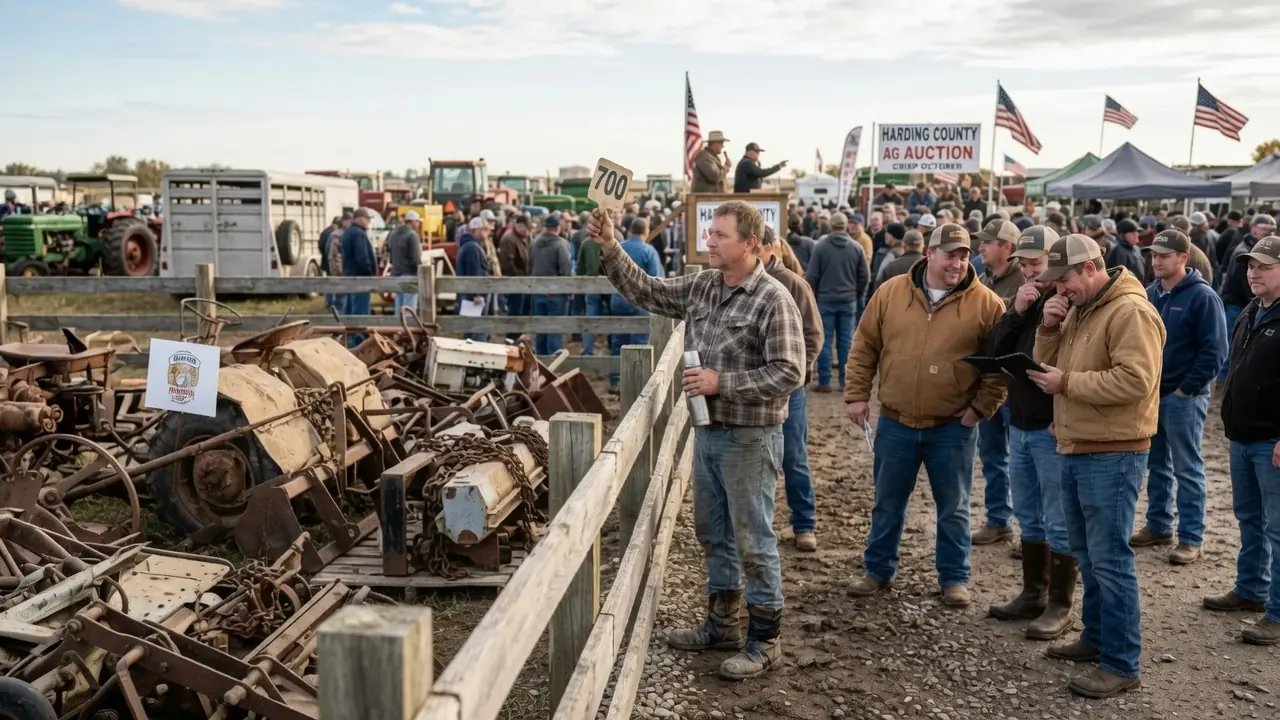
Caleb Durst was fifty-three years old, a dryland farmer from twelve miles northwest of town, and he had come to the auction with seven hundred dollars in cash. That was not seven hundred dollars for fun, not seven hundred dollars for gambling, and not seven hundred dollars he could replace next week. It was the ceiling, the last careful amount he had allowed himself after studying his checking account, his operating line, and the list of repairs waiting for him at home. He carried it folded inside an envelope in his jacket pocket, close enough to feel the weight of every bill.
Rick Harlan stood near the front with a tablet in one hand and a coffee in the other, dressed in a clean brown jacket and new work boots that had never been asked to survive a bad harvest. He had driven in from Omaha with two other equipment buyers, men who spoke in quick numbers and half-smiles. They knew auctions like this well. Fall sales brought desperate sellers, and desperate sellers brought bargains for people who arrived with cash and confidence.
Caleb arrived with neither, at least not in any way Rick understood. He did not sit under the canvas canopy or mingle with the larger buyers. He stood at the back fence, one boot resting on the lower rail, watching the sale ring with patient eyes. Every now and then, he unscrewed the cap of his thermos and drank coffee that had been bitter since dawn.
“Look at that one,” Rick muttered to the dealer beside him. “Man came to an equipment sale dressed like the equipment already beat him.”
The other dealer glanced at Caleb’s boots and smiled. “Maybe he’s here to bid on scrap by the pound.”
Rick chuckled, not loudly enough to become openly cruel, but loudly enough for the people around him to hear. That was his favorite kind of insult, the kind that let other men join without taking responsibility. Caleb heard it, because men like him always heard things people thought they were too far away to hear. He gave no sign of it.
The Harding County sale opened at 9:30 that morning beneath a pale October sky. The wind moved steadily across the auction grounds, carrying the smell of diesel exhaust, wet dirt, cattle pens, and fried food from the trailer near the east gate. Equipment sat in rows beyond the fence: combines with tired paint, trailers with warped boards, irrigation parts, toolboxes, cultivators, and a dozen machines waiting for men to argue over what remained of their usefulness. Caleb watched them all, but his mind stayed on one line in the catalog.
Lot 39.
“Contents of storage unit, Baker Road property, sold as is, buyer responsible for removal.”
The description was plain enough to make most buyers bored before they finished reading it. The auction photos had shown rusted shapes under canvas tarps, old metal frames, curved pieces, and nothing clean enough to excite a dealer. To Rick and men like him, the lot looked like a removal headache. To Caleb, it looked like the only reason he had come.
Two nights earlier, he had sat at his kitchen table with the catalog open beside a cup of instant coffee. His house was quiet in the way houses become quiet after grief has settled into the corners. Marie had been gone four years, and in the first two winters after her death, Caleb had learned that silence could either swallow a man or teach him. He chose to read.
He read agricultural history, not glossy farm magazines or nostalgic books with pretty pictures, but dense technical histories of equipment manufacturing, soil management, patent design, and market shifts. He read about machines that had disappeared because companies failed, not because the machines were useless. He read about grain handling systems from the 1930s and 1940s, about small manufacturers whose inventions had been forgotten after larger companies swallowed the market. Most people in Harding County did not know that about him, because most people never asked.
Caleb had noticed something in the preview photos for Lot 39 that made his pulse slow instead of race. A curved auger housing beneath a torn tarp. A cast bracket with a shape he had seen only in an old university press book. A side plate, barely visible through rust and dust, that matched a Columbus, Nebraska manufacturer that had closed in 1948. Three intact grain-handling units from that company should not have been sitting forgotten in a Baker Road storage unit, but there they were.
He drove out to the preview two days before the auction and confirmed what the photos suggested. The machines were old, ugly, rusted on the surface, and ignored by nearly everyone who walked past. But they were complete. The auger flights were intact. The angles were right. The design was rare enough that an active grain equipment company in Winnipeg, Northgate Grain Systems, had been trying to recreate similar performance from incomplete measurements.
That was the secret inside Lot 39.
Caleb did not tell anyone.
By noon, the sale had lost its early energy. The big items had already gone: a John Deere combine to a phone bidder, irrigation pivots to a dealer from Kearney, trailers to men who needed them more than they wanted them. The crowd had thinned, and half the buyers had drifted toward food and coffee. Rick Harlan had nearly stopped paying attention by the time Phil Garrett, the auctioneer, read the description for Lot 39.
“Contents of storage unit, Baker Road property,” Phil called. “Sold as is, buyer responsible for removal.”
The photos flashed on the screen. Rust. Canvas. Bent metal. A storage unit that looked like a place where usefulness went to die.
Rick looked at the screen and snorted. “There’s your lot,” he said toward Caleb, not caring if the man heard. “Looks about right for those boots.”
A few men laughed.
Caleb lifted his thermos, took a slow drink, and waited.
Phil started the bidding at four hundred dollars. Silence stretched across the ring for several seconds, long enough for everyone to feel the lot struggling before it had even begun. Finally, Hess, a salvage dealer from Grand Island, raised his paddle. He was bidding on the weight of metal, nothing more.
“Four hundred,” Phil called. “Do I hear four-fifty?”
Hess raised again.
Caleb kept still.
“Five hundred?” Phil asked, scanning the room.
Caleb raised his paddle.
Rick turned his head. “Well, I’ll be.”
The laugh that moved through the crowd was small, but Caleb felt it anyway. It slid across his back like cold rain. He had been laughed at before, for his boots, his old truck, his quietness, his refusal to sell land that bigger men wanted to absorb into cleaner spreadsheets. Laughter did not frighten him. The danger came when a man began needing the laughter to stop.
Caleb had learned not to need that.
Hess raised to five-fifty.
Caleb bid six hundred.
Now more heads turned. Rick tapped something into his tablet, perhaps finally curious, perhaps only amused that the poor farmer was pushing a scrap lot past scrap value. The screen still showed nothing impressive, just old metal in bad light. Rick’s eyes moved between the photos and Caleb, and his mouth curled.
“You know what that is, Durst?” Rick called. “That’s rust with a removal bill attached.”
Caleb did not answer.
Hess raised to six-fifty.
Caleb’s voice came clear. “Seven hundred.”
The ring quieted a little. It was unusual to speak instead of using the paddle, and Phil Garrett looked over with raised eyebrows. Hess studied Caleb for a moment, then shook his head. Seven hundred was more than the lot was worth as scrap, and Hess was too practical to chase pride.
Phil looked around. “Seven hundred. Any advance?”
Rick’s fingers moved quickly across his tablet now. Caleb saw it. Too late, he thought. Auction decisions happen in seconds, and Rick had spent his seconds laughing.
“Seven hundred going once.”
A man in the second row chuckled. “He must have lost a bet.”
“Seven hundred going twice.”
Rick opened his mouth, hesitated, then looked back at the screen.
“Sold,” Phil called. “Seven hundred dollars.”
The gavel came down.
The laughter came with it.
Rick walked toward Caleb before Caleb had even left the fence. He had a grin on his face, the kind men wear when they want the whole crowd to understand they are about to be entertaining. Caleb screwed the cap back onto his thermos and looked at him without expression.
Rick pointed at Caleb’s taped boots. “You spent seven hundred dollars on rust because that’s all a broke farmer like you understands.”
Caleb’s eyes stayed calm. “No, Rick. I spent seven hundred because your fancy tablet was too stupid to see what your eyes missed.”
The men nearby went quiet.
Rick’s smile twitched. “That junk pile won’t even pay for your gas home.”
Caleb stepped just close enough that Rick had to stop smiling or pretend harder. “Then remember this laugh when Northgate pays me more for that junk than you made all morning.”
For one second, Rick’s face changed.
It was quick, but Caleb saw it. Recognition. Not full understanding, but the first flash of worry that he had missed something. He looked down at his tablet again and typed Northgate with fast, angry fingers.
Caleb walked away before Rick could ask another question.
At the registration desk, he paid fourteen fifty-dollar bills in cash. The woman behind the desk counted them twice, then handed him the receipt. He folded it carefully and placed it inside his coat pocket. Seven hundred dollars was most of what he had brought and most of what he could risk, but Caleb did not feel fear yet.
Fear comes when you act without knowledge.
Caleb had come with knowledge.
He returned Thursday morning with his old flatbed trailer and spent half the day removing the contents of the Baker Road storage unit. The work was harder than the bidding. The units were heavy, awkward, and stubborn with age, but Caleb had brought chains, blocking, a come-along, and patience. A younger auction hand offered to help for twenty dollars, and Caleb accepted because pride was not the same thing as foolishness.
Under the canvas, the machines looked worse before they looked better. Rust covered the outer frames. Dust packed into corners. One housing had a dent along the side, and two bolts had frozen so badly Caleb had to soak them before they would move. But beneath the surface damage, the shapes were clean, the castings uncracked, and the rare auger flights remained exactly as he had hoped.
When he pulled the third unit into his machine shed that evening, he stood looking at them for a long time. To anyone else, they might still have looked like junk. To Caleb, they looked like a language he had spent years learning to read. The secret had been there all along, hidden beneath rust, waiting for someone prepared enough to recognize it.
That night, Caleb made one phone call.
Northgate Grain Systems answered from Winnipeg with a receptionist who transferred him twice before he reached someone in product development. Caleb spoke carefully. He gave the manufacturer name, the approximate year, the condition, and the specific pitch of the auger flight. The engineer on the other end grew quiet.
“You have three of them?” the man asked.
“Yes.”
“Complete?”
“Looks that way.”
“Where are you located?”
“Central Nebraska.”
A pause.
“We need to send someone.”
Twelve days later, a Northgate representative named Paul Mercer arrived at Caleb’s farm in a rental car. He was younger than Caleb expected, with a trimmed beard, a measuring kit, and the serious manner of a man who understood that old machines could answer expensive questions. He spent two hours in Caleb’s machine shed measuring, photographing, and inspecting every inch of the units. Caleb stayed nearby, saying little.
Finally, Paul straightened and looked at him. “Mr. Durst, do you understand what you bought?”
Caleb wiped his hands on a rag. “Enough.”
Paul smiled slightly. “I think you understand more than enough.”
They went inside, and Caleb made instant coffee at the kitchen table. Marie’s chair remained where it had always been, though no one sat in it unless Caleb invited them to, and he did not invite Paul. The Northgate representative explained what Caleb already suspected: the units were valuable not as decoration, but as reference machines. Their product team needed exact measurements from working examples, and these were the best examples Paul had seen outside archived photographs.
Caleb listened until Paul finished.
Then he asked, “What’s that worth to you?”
Paul blinked once.
Caleb took a drink of coffee.
The agreement took two weeks and one local lawyer who charged one hundred eighty dollars to make the paperwork proper. Northgate would pay for a short-term access arrangement, with the units staying on Caleb’s property while their engineers completed measurements and calibration work. They would also have an option to purchase the units later. The total figure came to forty-seven thousand dollars.
When the first wire transfer arrived, Caleb sat in his truck outside the bank for almost ten minutes before going in. He did not cry. He did not shout. He simply looked at the receipt and allowed himself one slow breath that seemed to come from somewhere deeper than his lungs.
Forty-seven thousand dollars did not make him rich. It did not turn his farm into an empire or erase every hardship waiting down the road. But it repaired the north fence line, replaced the leaking hydraulic cylinder on his grain cart, covered overdue bills, reduced the operating line, and left enough in savings to let him sleep through a night without waking at three in the morning to count debts in the dark.
The town did not find out immediately. Caleb did not tell them. He did not walk into Miller’s Diner with the wire receipt, did not confront Rick at the co-op, and did not correct every man who joked about the junk pile. He had waited too long in life to start mistaking noise for victory.
But word moves in farming towns like water through cracked soil. A parts clerk heard Caleb had ordered repairs he had delayed for years. A bank teller mentioned, without meaning to, that Caleb looked less burdened lately. A Northgate truck came once, then twice, then a Canadian engineer stayed half a day in Caleb’s machine shed. By spring, the laughter around Lot 39 had changed into questions.
Rick Harlan heard the rumor at another sale. He dismissed it first, then checked, then went quiet. Northgate’s new auger line had gained serious attention across the northern plains, and suddenly a set of rare Columbus units sounded different than “rust with a removal bill.” He remembered Caleb’s words at the fence and felt them burn.
He found Caleb at the co-op in April, loading mineral supplement into his truck. Rick approached with his tablet under one arm, but without the grin this time. Caleb saw him coming and kept working.
“Durst,” Rick said.
Caleb lifted the bag into the truck bed. “Rick.”
“I heard Northgate came out to your place.”
“Did they?”
Rick’s jaw tightened. “What was in Lot 39?”
Caleb brushed dust from his hands. “Same thing that was in the photos.”
“Don’t play stupid.”
Caleb looked at him then. “I never was. That was your mistake.”
Rick’s face flushed. “You could’ve said something.”
“At an auction?” Caleb asked. “While you were laughing?”
Rick looked away first.
That was the moment Caleb knew his reputation had changed. Not because Rick apologized, because men like Rick rarely apologized when embarrassment could be hidden under irritation. It changed because Rick no longer looked at Caleb like a poor farmer who had accidentally wandered into a sale he could not afford. He looked at him like a man who might know something expensive.
At the next Harding County fall auction, Caleb arrived with the same thermos and stood at the same back fence. His boots were still old, though he had finally replaced the electrical tape with a proper patch. Rick stood twenty feet away at first, then drifted closer. Two other dealers did the same.
Caleb noticed all of them.
He did not smile.
Lot 12 came up, a set of seed drill coulters that needed work but would fit one of Caleb’s older machines. He bid two hundred thirty dollars, won them without excitement, paid at the desk, and left before the afternoon session. The dealers watched him go, uncertain whether he had bought something ordinary or whether they had once again missed the kind of value that only announces itself after the hammer falls.
That uncertainty was worth more than revenge.
Phil Garrett, the auctioneer, later caught Caleb at the diner and asked the question others had been circling for months. “What did you see in those storage units that nobody else did?”
Caleb considered giving a simple answer. Luck, maybe. Or a farmer’s eye. Something easy for the room to swallow.
Instead, he told the truth.
“I read about them,” Caleb said. “That’s all.”
Phil nodded slowly, but they both knew it was not all. It was six weeks of reading a book nobody else had opened. It was years of quiet evenings after Marie died, turning grief into attention. It was patience, memory, curiosity, and the discipline to care about things that did not promise immediate reward.
It was preparation.
The world was full of Lot 39s, full of things laughed at because nobody had done the reading required to recognize them. Old machines. Quiet people. Widows. Failed farms. Boys who struggled in school. Men in taped boots standing at the back fence with a thermos in hand.
People laughed when they could not see value.
Caleb had learned not to hate them for it.
But he had also learned not to let their blindness become his own.
Years later, men at Harding County still talked about that sale. The story grew with each telling, as auction stories do. Some said Caleb turned seven hundred dollars into fifty thousand. Some said the machines were priceless. Some said Rick Harlan still opened every storage-unit lot photo twice before laughing at anything.
Caleb never corrected them unless the details mattered.
He kept farming his 280 acres. He fixed what he could fix, paid what he could pay, and read at night when the house grew quiet. The Northgate money did not change the size of his land or the age of his truck, but it changed something in the way people paused before dismissing him. That was enough.
Because the real secret inside Lot 39 was not only the rare Columbus machines.
It was Caleb Durst himself.
A man everyone had seen, but almost no one had bothered to read.