Thomas Werner stepped out of his black BMW at two o’clock in the afternoon with a foreclosure folder tucked beneath his arm and the tired patience of a banker who thought he already knew how this visit would end. He had been to Daniel Cooper’s farm three times in the last four months, and each time the place looked smaller beneath the weight of debt. The barn needed paint, the porch sagged slightly near the left post, and the old combine behind the shed had not moved since the previous harvest. To Thomas, it was the familiar shape of a failing farm.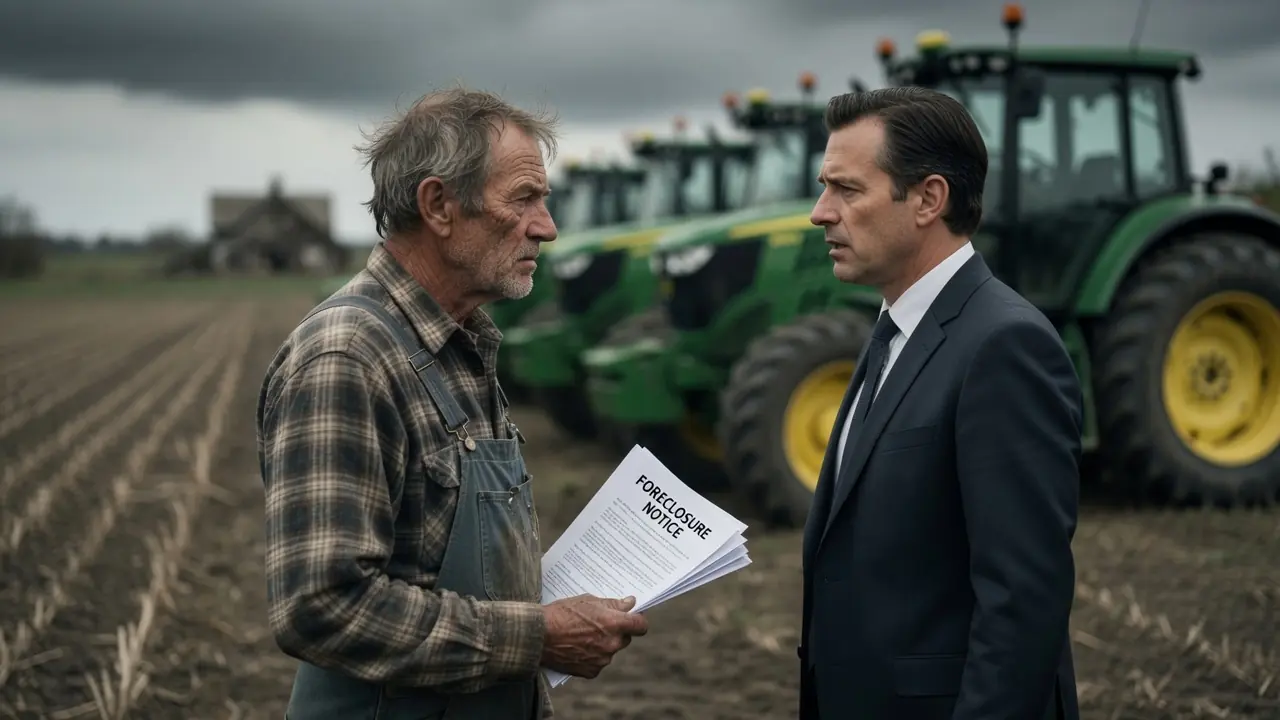
Then he saw the South Field.
Rows of brand-new John Deere 6155R tractors stood across forty acres of land like a green and yellow army. Protective wrapping still clung to some of the seats, sunlight flashed along fresh paint, and tire marks from the flatbed trucks still scarred the edge of the field. Thomas stopped walking, his professional expression breaking before he could hide it. Daniel Cooper stood near the porch with foreclosure papers in one hand and a sealed note in the other, watching the banker finally understand that something impossible had happened.
“A field full of tractors doesn’t erase your debt, Daniel,” Thomas said, trying to recover his voice. “Until I see real proof, the foreclosure continues.”
Daniel’s tired eyes sharpened. He had been awake since before dawn, since the first diesel engines rolled up his gravel driveway and changed the shape of his life. He had spent the morning shaking, crying, counting, doubting, and staring at machines he never ordered and could never have afforded. But by the time Thomas arrived, fear had begun to loosen its grip.
“Then open your eyes, Thomas,” Daniel said, pointing across the field. “That’s twelve million dollars of proof sitting on the land you came to take.”
Thomas looked from Daniel to the tractors, then back again. “Who would give a ruined farmer a hundred brand-new John Deeres?”
Daniel lifted the handwritten note with trembling fingers. His voice came out low, but it carried. “Someone I helped when he had nothing, which is more than this bank ever did.”
The banker did not answer. For three months, Thomas had spoken to Daniel in careful phrases about procedure, missed payments, final notices, and regrettable outcomes. He had told Daniel that the foreclosure date was set, that extensions were unlikely, and that sympathy did not change paperwork. Now all that paperwork seemed embarrassingly small beside one hundred tractors lined up under the Illinois sun.
Daniel had been sitting on that same porch at 6:47 that morning, drinking coffee that had gone cold an hour earlier. The foreclosure papers lay beside him, folded and unfolded so many times the creases had begun to split. He knew every number by heart: two hundred thirty-seven thousand dollars owed after fees, penalties, interest, and missed restructuring payments. In seventeen days, the bank would take the 240 acres his hands had worked his entire life.
His wife Martha was at her diner shift in town, and Daniel had not told her how long he had stared at the papers before sunrise. He had wanted to be strong for her, but strength was getting harder to perform. At sixty-three, his knees ached, his hands stiffened in cold weather, and the farm that had once felt like his future now felt like a clock counting down toward loss. He had just lifted the coffee to his mouth when he heard the trucks.
At first, he thought one semi had taken the wrong road. Then the sound grew. Diesel engines rolled over the gravel like thunder, not one or two, but dozens, filling the road and driveway until the morning air shook. Daniel stood slowly, walked to the edge of the porch, and stared as flatbed after flatbed appeared, each carrying a brand-new John Deere tractor.
The lead driver climbed down with a clipboard. “Mr. Daniel Cooper?”
Daniel nodded because speech had abandoned him.
“I’ve got a delivery for you,” the man said. “One hundred John Deere 6155R tractors. Where would you like us to unload them?”
Daniel gripped the porch railing. “There’s been a mistake.”
“No mistake, sir. Paid in full. Cash confirmed. Delivery address matches.”
“Paid by who?”
The driver looked at his paperwork. “I don’t have that information. But there’s an envelope for you.”
That envelope had been in Daniel’s hand ever since. Inside was one sheet of paper, written by someone who had known him 42 years ago. The note said Daniel had saved his life when he had nothing. It said Daniel had given him a job, a place to sleep, and a chance when everyone else turned away. It said kindness mattered more than money, and Daniel had taught him that.
There was no signature.
That was the part that haunted Daniel most. Someone remembered him so deeply that they had spent twelve million dollars to save him, and he could not even remember the person’s name. He had sat on the porch steps while tractors unloaded into his field, crying harder than he had cried since his father’s funeral. Not because of the money alone, but because a forgotten kindness had returned wearing the shape of a miracle.
When Martha came home and saw the field, she nearly drove into the ditch. She ran to the porch, still wearing her diner apron, and Daniel handed her the note without speaking. She read it once, then again, then pressed it against her chest while tears filled her eyes. “Forty-two years ago,” she whispered. “Danny, that was 1982.”
They sat together on the steps, searching memories from a lifetime ago. Daniel had been twenty-one in 1982, newly married, working his father’s struggling farm outside Carterville, and trying to save enough to buy land of his own. The summer had been brutal, dry, and desperate, with crops wilting and farmers losing money on every bushel. They had helped people when they could, but neither of them could remember anyone who matched the note.
Thomas Werner read the note that afternoon and walked slowly toward the tractors. He touched the hood of one machine as if expecting it to disappear. “Mr. Cooper,” he said, “each one of these is worth roughly one hundred twenty thousand dollars.”
Daniel did not smile. “Then selling two of them covers the debt.”
“Yes,” Thomas admitted. “More than covers it.”
“Then stop the foreclosure.”
Thomas hesitated out of habit, but not because there was any real answer left. The bank wanted money, and Daniel now had more than enough value sitting in the field. Within an hour, Thomas drove away promising to halt proceedings once the first sale cleared. For the first time in months, Daniel watched the banker leave without feeling like the land was leaving with him.
But saving the farm was only the first question. The larger question remained: who had done it?
For the next six days, Daniel and Martha searched the past. They pulled photo albums from closets, opened old boxes, and read Martha’s early journals. They called relatives, former neighbors, old farmhands, and anyone who might remember the summer of 1982. Daniel made a list of names, twenty-three at first, then thirty-one, but none of them felt right.
Then Martha found the journal entry.
It was dated August 3rd, 1982, written in her neat hand. Danny brought home a stray today, kid named Marcus from Iowa, eighteen and homeless. Danny gave him a job even though we can barely afford to pay ourselves. I love my husband’s heart, even when it scares me financially.
Daniel stared at the words until the kitchen blurred.
Marcus.
The name opened a door in his memory, and suddenly the boy was there again. Skinny, sunburned, desperate, standing in the driveway beside a battered backpack and asking for any kind of work. Daniel remembered the hollow cheeks, the torn jeans, the way Marcus tried to stand straight even though hunger made him sway. He remembered asking when the kid had last eaten, and Marcus lowering his eyes before admitting it had been the previous morning.
Daniel had brought him inside. Martha made sandwiches and soup, and Marcus ate like every meal might vanish if he blinked. The story came out slowly. His stepfather had thrown him out in Des Moines, and he had been walking south, taking odd jobs, sleeping where he could, trying to survive long enough to become someone different. Daniel’s father could not afford another worker, but Daniel offered Marcus forty dollars a week, meals, and the bunkhouse.
Marcus worked like a boy trying to outrun hunger. He learned equipment maintenance, drove tractors, repaired fences, helped with harvest, and never once complained about the heat. When the harvest came in worse than expected and Daniel’s father said they could not keep him, Daniel took a cut in his own pay so Marcus could stay through fall. It had seemed like a small sacrifice at the time, the kind decent people make because the alternative is sending a hungry boy back to the road.
When Marcus left for a factory job in St. Louis, he hugged Daniel with tears in his eyes. “You saved my life,” he said. “I’ll never forget.”
Daniel had told him, “Everyone deserves a chance, Marcus. You just needed someone to give you one.”
Then life moved on. Crops, children, bills, aging parents, bad seasons, good seasons, repairs, storms, and forty-two years of ordinary struggle buried that summer beneath everything else. Marcus Webb became a name Daniel had forgotten, but Daniel Cooper had become a foundation Marcus never stopped standing on.
Daniel searched online with shaking hands. Marcus Webb, Iowa. Marcus Webb, St. Louis. Marcus Webb, agriculture. The first major result made him stop breathing.
Marcus Webb, CEO of Webb Technologies, valued at $4.2 billion after successful public offering.
The man in the photograph had silver hair, a tailored suit, and the confident smile of someone who had walked into rooms most people never saw. But the eyes were the same. Intense, watchful, hungry in a different way now. Daniel looked at Martha, and she covered her mouth with one hand.
“It’s him,” she whispered.
Daniel called the law office that had sent the trust letter, but the attorney would neither confirm nor deny. He said only that his client wanted anonymity and hoped Daniel would accept the gift without feeling obligated. Daniel’s voice broke as he said what he needed passed along. “Tell him I remember now. Tell him I’m proud of him. Tell him he owed me nothing.”
Two days later, a courier delivered a package.
Inside was a framed Polaroid from August 1982. Daniel and Marcus stood beside an old tractor in the machine shed, both covered in grease, Daniel’s arm around the boy’s shoulders. On the back, written in the same handwriting as the note, were words that made Daniel sit down before his knees gave out.
This was the day I stopped being nobody and started believing I could be somebody. Thank you for seeing me when I was invisible. The tractors are nothing compared to what you gave me.
It was signed: Marcus Webb.
Marcus came to the farm in April, driving himself in a modest Ford pickup that looked almost comically ordinary after the gift he had sent. He stepped out slowly, silver-haired now, older and successful, but when Daniel saw his eyes, the forty-two years between them collapsed. For a moment, he saw the hungry eighteen-year-old again, standing in the driveway with nothing but a backpack and hope nearly gone.
Neither man spoke at first.
Then Marcus crossed the distance and hugged Daniel like a drowning man reaching shore. Daniel held him tightly, and both of them cried in the farmyard. Martha stood on the porch wiping her face with a dish towel, watching the past and present finally find each other.
“I’m sorry I stayed anonymous,” Marcus said later, sitting on the porch beside Daniel. “I didn’t want you to feel trapped by gratitude.”
Daniel shook his head. “Marcus, twelve million dollars in tractors is not gratitude. It’s a thunderstorm.”
Marcus laughed through tears. “Then let it rain.”
They sat for hours while Marcus told the story Daniel had never known. After leaving the Cooper farm, Marcus had gone to St. Louis, worked double shifts, and saved every possible dollar. He enrolled in community college, studied computer science, earned scholarships, and later built farm management software because he understood the needs of farmers from those months in the fields. Webb Technologies grew from a one-room operation into a global agricultural software company.
“Every decision I made,” Marcus said, “came from that summer. You treated me like I mattered before I had proof that I did.”
Daniel looked down. “I just gave you a job.”
“No,” Marcus said firmly. “You gave me dignity.”
Those words silenced Daniel. He had always thought of kindness as ordinary, something his father taught him and Martha practiced without applause. But to Marcus, that ordinary kindness had been the difference between collapsing and continuing. A sandwich, a bunkhouse, and forty dollars a week had become education, a company, a foundation, and now a field full of tractors.
Then Marcus pulled another envelope from his jacket.
Daniel sighed. “No.”
Marcus smiled. “You haven’t opened it.”
“I already know I’m going to say no.”
“You can try.”
Inside was a certified check for two million dollars.
Daniel stared at it, then pushed it back. “I can’t.”
“You can,” Marcus said. “And you will, because this is not payment. This is freedom.”
“I don’t need freedom. I need the farm.”
“You need both.” Marcus leaned forward. “The tractors keep you farming. This lets you breathe. It lets you help others without breaking yourself. It lets you pass on what you gave me.”
Daniel looked across the field at the tractors. The morning light had shifted, turning the green paint bright beneath the sky. For months, he had lived with the humiliation of nearly losing everything. Now he was being asked not only to receive mercy, but to become responsible for what mercy could do next.
Six months later, Daniel stood in front of two hundred people at the Southern Illinois Farm Bureau meeting and told the story publicly for the first time. He told them about foreclosure, the trucks, the anonymous note, and the boy from Iowa he had forgotten but who had never forgotten him. He told them that kindness is not wasted just because the giver does not see where it goes. He told them a hungry kid in a driveway became a man who saved his farm four decades later.
By then, Daniel had sold sixty of the tractors and kept forty for his own use and future programs. With the proceeds and Marcus’s check, he created the Second Chance Farm Fund. The fund helped struggling farmers facing foreclosure, provided equipment support, covered emergency operating costs, and gave families enough time to recover before the bank could take everything. Each family received the same note: Someone helped me when I had nothing. Now I’m helping you. When you’re able, help someone else.
The ripple began almost immediately. A farmer whose debt Daniel paid hired a homeless veteran for harvest work. That veteran helped his sister with medical bills. His sister volunteered at a food pantry. Families who had nearly lost land began helping neighbors repair machinery, cover feed costs, and survive bad months. Marcus called it the Cooper Initiative, but Daniel never got comfortable with seeing his name on it.
One afternoon, Daniel and Marcus stood together in the South Field where the tractors had first appeared. Many had already been sold, but enough remained to keep the field glowing green under the sun. Daniel held the old Polaroid in his hand, studying the boy and the young man they had once been. He wondered how many moments in life pass unnoticed while carrying the power to change everything.
“I forgot you,” Daniel said quietly.
Marcus looked at him. “You didn’t forget me when it mattered.”
Daniel’s eyes filled.
“That summer was when it mattered,” Marcus continued. “You remembered my hunger. You remembered I needed work. You remembered to treat me like a person. The rest is just time.”
Daniel folded the photograph carefully and placed it back in his shirt pocket. Across the field, one of the remaining tractors started up, driven by a young farmer Daniel had hired through the fund. The engine rolled steady and strong, a sound Daniel had loved his entire life. But now it sounded different.
It sounded like a circle closing.
It sounded like a chance being given again.
It sounded like proof that a good deed can sleep quietly for forty-two years and still wake up strong enough to save a farm.