The bidding stopped.
Not slowed.
Stopped cold, like a river hitting ice.
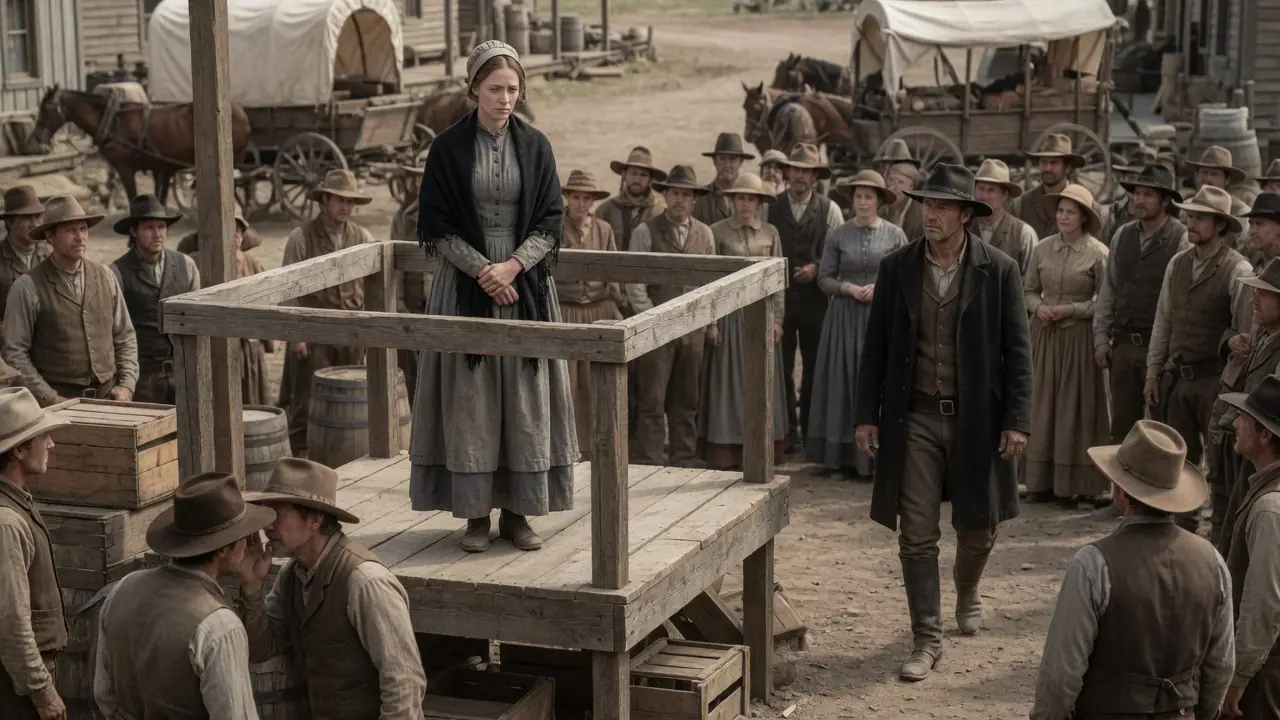
Lorna Hayes stood on the auction platform in the center of Crestwood's town square, hands folded tight in front of her plain gray dress, eyes fixed on the horizon beyond the crowd.
She was 29.
Too old, they whispered.
Too plain.
Too broken by the life she had already left behind.
The auctioneer cleared his throat.
"Going once for $40 to Mr. Garrett."
Silence.
"Going twice."
A tall man stepped forward from the back of the crowd. He wore a dark coat, hat pulled low, shoulders broad as fence posts. His voice was quiet, but it carried.
"$500."
The whole town fell silent.
Now rewind six hours.
Morning had broken pale and cold over Crestwood, Wyoming. Lorna woke on the narrow cot in the church basement where she had been staying since the bank foreclosed on her late husband's debts.
Reverend Clark had been kind, but charity had limits.
The auction was her only option.
A bride auction, legal in the territory, shameful everywhere else. Women in desperate straits could offer themselves for marriage. Men bid. The highest bidder won a wife and whatever hope came with her.
Lorna had buried her husband two years prior. Martin Hayes had been a gambler, a drinker, a man whose promises dissolved like sugar in rain.
He left her with nothing but his name and his debts.
She had worked as a seamstress, a laundress, and a cook. It was never enough.
Now she stood before the cracked mirror in the church basement, pinning up her dark blonde hair. Her reflection showed a woman worn thin by work and worry. Her hands were rough. Her dress was mended in three places.
She was not the kind of woman men fought over.
Outside, the town square filled with noise. Vendors sold apples and cider. Children ran between wagons. Men gathered near the platform, some curious, some cruel, some desperate themselves.
The auction began at noon.
Three women stood waiting.
The second was a widow with a sweet voice and gentle manner. She went for $250.
Then Lorna climbed the steps.
She felt every eye on her. She heard the whispers.
"That's Hayes' widow."
"Older than she looks."
"Heard she can't bear children."
The last part was a lie, but lies traveled faster than truth.
The auctioneer began.
"Lorna Hayes, age 29, sound health, skilled seamstress."
"$40," a man called from the crowd.
Lorna recognized him. Ben Garrett, a cattle hand known for rough words and rougher hands.
No one else spoke.
The auctioneer's voice grew strained.
"Surely we can do better for a woman of Mrs. Hayes' experience."
Silence.
Lorna's chest tightened.
$40.
Less than the cost of a decent horse.
"Going once."
She prepared herself. Marriage to Garrett would be survival, nothing more.
But survival was survival.
"Going twice."
Then the voice came from the back.
"$500."
The crowd parted.
The man walked forward slowly, boots crunching gravel. He was tall, perhaps 40, with dark hair touched by gray at the temples. His face was weathered, his eyes a clear, steady gray.
He moved like a man who spent his life working land, not words.
The auctioneer blinked.
"I... did you say $500?"
"I did."
Murmurs rippled through the crowd.
That was more than the pretty girl had brought, more than anyone expected.
Ben Garrett spat in the dirt and walked away.
The auctioneer recovered quickly.
"Sold to... I'm sorry, your name, sir?"
"Caleb Merrick."
Lorna stared at him.
She had seen him before, riding through town once or twice a year for supplies. He owned land north of Crestwood, high country where few men settled. He was known as a decent man, quiet, and kept to himself.
Why would a man like that pay $500 for a woman no one wanted?
Caleb stepped onto the platform. Up close, she saw kindness in his face and something else.
Loneliness, maybe.
He removed his hat.
"Mrs. Hayes," he said quietly, "if you're willing, we'll marry today. If not, I'll pay your debts and you can go where you please."
Her voice came out smaller than she intended.
"Why?"
"Because no woman should be sold for $40," he replied. "And because I need a partner, not property."
Something in her chest cracked open.
"I'm willing," she whispered.
They married an hour later in the same church where she had slept on charity. Reverend Clark spoke the words quickly. Caleb placed a simple gold band on her finger.
When he kissed her cheek, it was brief and respectful.
Afterward, he helped her into his wagon.
They rode north in silence, the town disappearing behind them. Lorna watched the landscape change, rolling plains giving way to pine forests, then rocky hills.
Finally, she spoke.
"You paid $500."
"I did."
"That's more than I'm worth."
Caleb glanced at her, his expression unreadable.
"You're worth what you decide you're worth, not what desperate men bid in a square."
The words settled into her like warmth.
But as the wagon climbed higher into unfamiliar country, doubt crept in. She knew nothing about this man, nothing about the life waiting for her.
And she had learned long ago that kindness could be a mask.
The ranch appeared as the sun dipped low, casting long shadows across a valley ringed by pine and stone.
The house was solid timber, two stories, with a wide porch and smoke curling from the chimney. A barn stood nearby, sturdy and well kept. Cattle grazed in distant pastures.
It was more than Lorna had expected.
Much more.
Caleb stopped the wagon and climbed down, then offered his hand. She took it, her fingers small against his calloused palm.
"It's not fancy," he said. "But it's sound."
"It's beautiful," she replied honestly.
Inside, the house was clean and spare. A stone fireplace dominated the main room. Wooden furniture, simple but well made, stood neatly in place. Shelves were lined with books. The kitchen smelled faintly of bread and coffee.
Caleb set her small bag near the stairs.
"There's a bedroom upstairs for you," he said. "I sleep down here by the fire most nights. You'll have privacy."
She looked at him carefully.
"We're married."
"We are," he agreed. "But you didn't choose this freely. I won't expect what you're not ready to give."
The words should have relieved her.
Instead, they confused her.
Martin had taken without asking. This man offered without demanding.
"I'll start supper," she said quietly.
They worked in comfortable silence. She found flour, salt, and a tin of beans. He built up the fire.
When they sat to eat, the meal was simple but warm.
"How long have you lived here?" she asked.
"Twelve years. Built the house myself."
"Alone?"
He hesitated.
"I had a wife once. She died in childbirth our second year. The baby, too."
Lorna's throat tightened.
"I'm sorry."
"It was a long time ago." He looked into the fire. "I buried them on the hill behind the house, under the aspens."
She understood then.
He knew loss.
He knew the weight of grief carried alone.
"Why did you come to the auction?" she asked.
Caleb set down his coffee.
"I heard about it in town last month. Didn't plan to go, but the night before, I couldn't stop thinking about it. Women standing on a platform like livestock. It didn't sit right."
He met her eyes.
"When I saw you up there and heard that man bid $40 like you were nothing, I couldn't abide it."
"So you paid $500 out of anger?"
"Out of principle," he corrected gently. "You deserved better."
Tears burned behind her eyes, but she blinked them away.
She was tired of crying.
That night, alone in the upstairs bedroom, Lorna lay beneath clean quilts and stared at the ceiling. The bed was soft. The room was warm.
For the first time in two years, she felt safe.
But safety was not trust.
Not yet.
Days passed into a rhythm.
Caleb worked the ranch, mending fences, tending cattle, chopping wood. Lorna cleaned, cooked, and mended his shirts.
They spoke little, but the silence between them was not uncomfortable.
She noticed small things.
The way he always filled her coffee cup first. How he built the fire high before dawn so the house would be warm when she woke. The careful distance he kept, never crowding her.
One afternoon, she found him in the barn repairing a saddle. She brought him water.
"You're good with your hands," she observed.
"Learned young. My father was a carpenter."
"Is he still living?"
"No. Lost both my parents to fever when I was 16."
She sat on a hay bale.
"So you've been alone most of your life."
"I have."
"Then why marry at all?"
Caleb paused, his hand still on the leather.
"Because alone stops feeling like freedom after a while. It just feels empty."
She understood that, too.
One evening, as they sat on the porch watching the sunset, Lorna asked the question that had haunted her.
"What if I can't give you children?"
Caleb turned to her, surprised.
"Who said you couldn't?"
"People in town. They said I was barren."
His jaw tightened.
"People say a lot of foolish things."
"But if it's true?"
"Then it's true," he said firmly. "I didn't marry you for children, Lorna. I married you because you deserved someone to stand beside you."
Her breath caught.
"I've already lost a child," he continued quietly. "If God gives us another, I'll be grateful. If not, I'll be grateful for you."
Something broke open inside her then, years of shame, years of believing she was not enough.
She reached for his hand.
He took it carefully, as though it were something precious.
But the next morning, riders appeared on the horizon.
Caleb stepped onto the porch, his expression hardening. Lorna joined him, her stomach dropping.
Three men.
The one in front was Ben Garrett.
They stopped at the fence.
Garrett's smile was ugly.
"Heard you bought yourself Martin Hayes' widow," he called. "Thought I'd come see if she's worth $500 after all."
Caleb's voice was low and cold.
"You're trespassing."
"Just being neighborly."
"Turn around. Now."
Garrett laughed.
"Or what?"
Caleb descended the porch steps slowly.
He did not carry a rifle.
He did not need to.
Everything about him radiated quiet, controlled danger.
"You've got ten seconds," Caleb said.
Garrett's smile faded.
Something in Caleb's eyes made him reconsider. He spat, then turned his horse.
"She ain't worth it, Merrick," he called over his shoulder.
After they left, Lorna stood trembling.
Caleb returned to the porch.
"I'm sorry," she whispered. "I brought trouble to your door."
"No," he said firmly. "Martin Hayes brought trouble. Garrett brought trouble. You brought nothing but yourself, and that's all I wanted."
She looked up at him, this quiet man who had defended her without hesitation.
And for the first time since the auction, she let herself believe she might be safe here.
Truly safe.
Winter came early to the high country, wrapping the ranch in silence and snow.
Lorna had feared the isolation, but instead she found peace in it. The world narrowed to firelight and warm bread, to the rhythm of work shared between two people learning to trust each other.
Caleb taught her to ride.
At first, she was terrified, gripping the saddle until her knuckles whitened. But he was patient, walking beside her horse, his voice low and steady.
"You're stronger than you think," he told her one afternoon as she managed a slow trot across the meadow.
She laughed, a sound that startled them both.
She could not remember the last time she had laughed.
In the evenings, they sat by the fire. Caleb read aloud from his books, poetry mostly, and stories of faraway places. Lorna mended clothes and listened, drawn into worlds beyond the Wyoming hills.
One night, she set down her sewing.
"May I ask you something?"
"Always."
"Why did you never remarry? Before now."
Caleb closed his book slowly.
"I tried once, three years after Sarah died. A woman came west with her brother's family. We courted for a while."
"What happened?"
"She wanted me to leave the ranch, move to town. Said this place was too lonely, too hard." He stared into the flames. "But this land is part of me. I couldn't leave it. And I couldn't ask someone to stay who didn't want to."
Lorna understood.
"You were waiting for someone who wanted this life, not just you."
"I suppose I was."
She looked around the cabin at the sturdy walls, the warm fire, the shelves of books.
"I want this life," she said softly.
His eyes met hers.
"Do you?"
"Yes."
Something shifted between them then, subtle but undeniable.
That night, when Lorna went upstairs, she paused at the top of the steps. Below, she heard Caleb banking the fire, preparing to sleep alone by the hearth as he had every night since their wedding.
She made a decision.
She returned downstairs.
He looked up in surprise.
"Lorna?"
"I don't want you to sleep down here anymore," she said quietly.
Understanding dawned in his eyes.
"Are you sure?"
She stepped closer.
"I'm sure."
He rose slowly, crossing the room until he stood before her. He cupped her face gently, his thumb brushing her cheek.
"I will spend the rest of my life proving you made the right choice," he whispered.
"You already have," she replied.
When he kissed her, it was tender and unhurried, full of quiet promises.
Spring arrived with wildflowers and new calves.
Lorna's laughter became a common sound around the ranch. She planted a garden, baked bread that Caleb claimed was the finest he had ever tasted, and rode beside him across the high meadows.
One afternoon, as they worked together repairing a fence, she paused.
"Caleb?"
"Mhm?"
"I think I'm with child."
His hands went still on the wire. He turned to her slowly, hope and fear warring in his expression.
"Are you certain?"
"As certain as I can be."
He set down his tools and pulled her into his arms, holding her as though she might disappear. She felt his shoulders shake and realized he was crying.
"I've got you," she whispered. "We've got each other."
The baby came in late autumn, a daughter with dark hair and her father's gray eyes.
They named her Sarah, after the wife Caleb had lost, and after the hope of the life they had found.
Lorna held her daughter and wept, not from sorrow, but from overwhelming gratitude.
This tiny, perfect child was proof that shame did not define her, that her past did not own her future.
Caleb sat beside the bed, his hand resting gently on Lorna's.
"She's beautiful," he said hoarsely.
"She is," Lorna agreed.
Then she looked at him.
"Thank you."
"For what?"
"For seeing me when no one else did. For believing I was worth more than $40."
He leaned forward and kissed her forehead.
"You were always worth everything," he said. "I just had to make sure you knew it, too."
Years passed.
The ranch grew. Sarah was joined by a son they named Samuel, then another daughter, Grace. The house filled with noise and laughter, with the sweet chaos of family.
Lorna sometimes stood on the porch in the evenings, watching her children play in the meadow while Caleb worked nearby. She thought of the woman she had been, standing on that auction platform, convinced she was nothing.
That woman felt like a stranger now.
One evening, Caleb joined her on the porch, slipping an arm around her waist.
"What are you thinking about?" he asked.
"How different my life could have been."
"Regrets?"
She turned to him, smiling.
"Not a single one."
He kissed her temple.
"Neither do I."
The sun set over the mountains, painting the sky in shades of gold and rose. Inside, their children's laughter rang out. The fire crackled. Supper waited on the stove.
Lorna Hayes Merrick had been sold at auction for less than the price of a horse.
But the quiet rancher who had seen her worth had given her something no amount of money could buy.
A home.
A family.
And the knowledge that she was loved, not for what she could give, but for who she was.
In the end, that was worth more than all the bids in all the towns in all the world.