Marin Whitlock arrived at Black Hollow Ranch with one patched travel bag, one six-year-old daughter, and a silence that made every cowboy on the yard think she would not last a week. The stagecoach left her standing near the hitching rail beneath a hard white sky, her coat too thin for the wind and her little girl tucked close against her skirt. Men stopped what they were doing to stare, not with welcome, but with the disappointed curiosity of people who had expected help and found trouble instead. Black Hollow needed a cook who could feed forty hungry ranch hands, not a tired widow with dust on her hem and a child clinging to her hand.
Gideon Cross stood outside the cookhouse with his hat low and his jaw tight. He had hired Marin by letter because her handwriting had been steady, her references brief but respectable, and because his last cook had run off after throwing a pot at the bunkhouse door. But the woman standing before him looked smaller than the life he had imagined behind those letters. Her eyes were calm, but the calm looked earned the hard way, and that made him uneasy.
The cowboys noticed his hesitation and took permission from it. A young hand near the water trough muttered, “That one couldn’t boil coffee for a church picnic.” Another laughed and said, “Maybe the little girl can stir beans when her mama faints.” Marin heard them. Her daughter, Clara, heard them too, because her fingers tightened around her mother’s skirt.
Marin did not answer the men. She only lowered one hand to Clara’s shoulder and looked at Gideon Cross. “Mr. Cross?” she asked. Her voice was quiet, but it did not tremble. “I was told the cookhouse needed hands before supper.”
Gideon looked toward the cookhouse, then toward the bunkhouse, where forty men expected a meal before nightfall. He had no better option, and he disliked that the decision felt like surrender. “Can you cook for a whole outfit, Widow Whitlock?” he asked, his tone colder than he meant it to be. “I don’t run a tea room here.”
Marin’s eyes moved past him to the iron stove inside the cookhouse, the flour sacks stacked near the wall, the hanging pots, the smoke-dark beams, and the long table scarred by years of hungry men. Then she looked back at him. “I once fed a hundred starving railroad men with less fire than this,” she said. “If your outfit can sit long enough to eat, I can cook long enough to feed them.”
The yard went still. Gideon’s eyes narrowed, not because he believed her, but because she had answered like a woman who knew exactly what she was worth. The young cowboy who had laughed looked down at his boots. Marin lifted her bag, guided Clara toward the cookhouse, and passed Gideon without waiting for permission twice.
Inside, the cookhouse smelled of old grease, damp wood, and burnt coffee. The stove sat black and stubborn in the center, its fire low, its lids cold, and its ash drawer overflowing. Marin set her bag on the bench, removed her gloves, and rolled her sleeves with the calm speed of someone stepping into familiar territory. Clara climbed onto a stool near the flour barrel and watched silently.
Gideon stood in the doorway, still doubtful. “Supper is in two hours,” he said. Marin opened the pantry, studied the supplies, and found beans, salt pork, flour, onions, dried apples, cornmeal, molasses, and coffee. “Then I have one hour more than I need,” she replied. Gideon almost smiled, but caught himself before it reached his mouth.
The first hour told the ranch more than words could have. Marin cleaned the stove, built the fire properly, set beans to boil, cut salt pork thin, mixed dough, and had Clara sorting dried apples by size before the men had finished their evening chores. She moved without panic and without asking where things were more than once. When she found the coffee scorched in its tin, she threw it out and started fresh, which caused three men watching from the window to gasp as if she had shot a horse.
By sundown, the smell had begun to change the mood of Black Hollow Ranch. It was not fancy food, not city food, not the delicate sort served on china in parlors. It was stew thickened with onions and pork, cornbread browning in heavy pans, biscuits rising in rows, apples simmering with molasses, and coffee strong enough to make a tired man remember he still had bones. Even Gideon, who had trained himself not to expect comfort from meals, stopped outside the door and breathed in before he realized he was doing it.
The first spoonful changed the room. Men who had expected watery beans and burnt bread looked down into their bowls as if they had found something lost. The stew was rich, the bread crisp at the edges and soft inside, and the coffee carried a hint of molasses that cut the bitterness without making it weak. Nobody spoke for nearly five minutes.
Then old Earl Foss lifted his head from his bowl. Earl was nearly seventy, with a white beard, a crooked shoulder, and eyes that had seen more trail than most men saw in dreams. He stared at Marin so hard that Gideon set down his spoon. “What is it, Earl?” he asked.
Earl did not answer him. He looked straight at Marin, his weathered face slowly losing color. “I know this cooking,” he whispered. “I’ve tasted it before.”
Marin’s hand froze around the ladle. Clara looked up quickly. Gideon saw the change in the widow’s face, not fear exactly, but a door closing behind her eyes.
Earl stood slowly, one hand braced on the table. “Platte Grade,” he said. “Rail camp, winter of ’72.” Several men looked at one another. “There was a fever, supply wagons delayed, men dropping where they stood.” His voice roughened as memory took him. “We would’ve died if not for a woman who kept fires going for three weeks.”
Marin lowered her eyes. “Sit down, Mr. Foss.”
But Earl did not sit. Tears had gathered in his old eyes, and the room seemed to lean toward him. “They called her the Stove Angel,” he said. “I was too sick to lift my own head, but I remember that bread. I remember molasses coffee. I remember a woman walking cot to cot with broth, telling men too stubborn to die that she hadn’t cooked enough for quitters.”
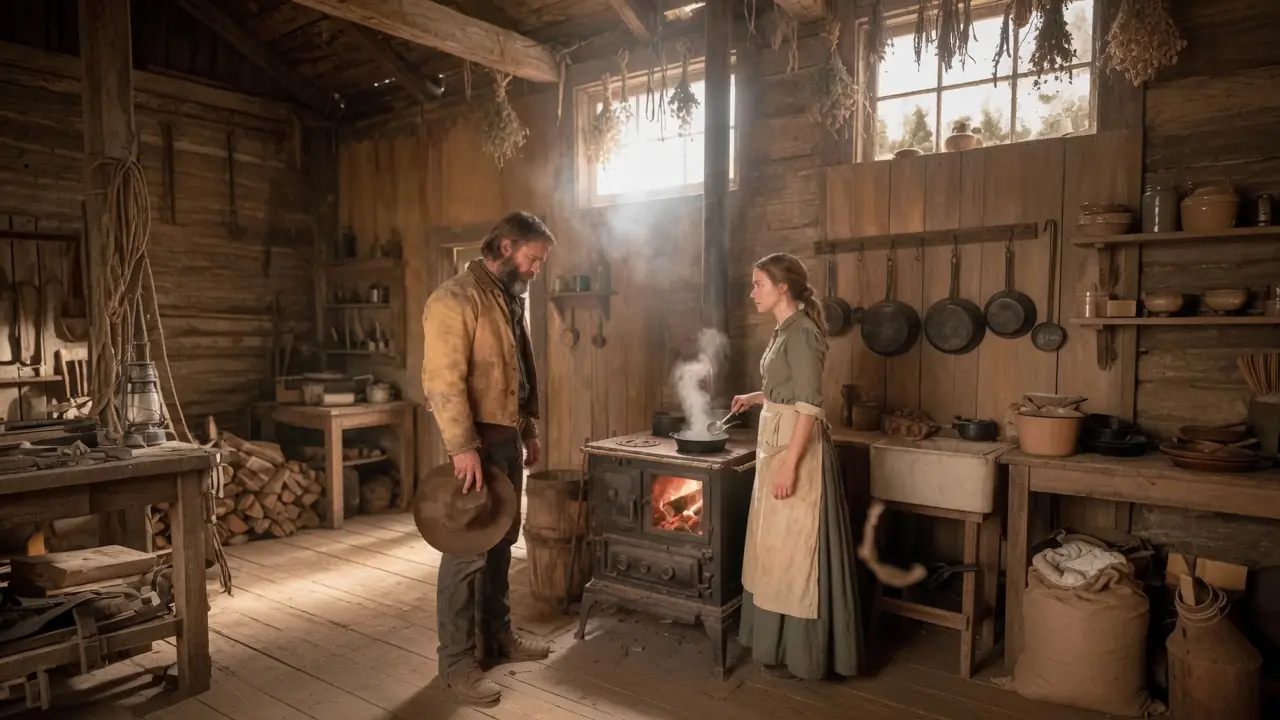
The cookhouse went silent. Gideon looked at Marin again, truly looked this time, and saw what he had missed at the stagecoach. Not frailty. Not burden. History.
One of the younger cowboys frowned. “Widow Whitlock, was that you?” Marin set the ladle down with care, as if any sudden movement might break the past open too wide. “It was a long time ago,” she said. “And men say things in fever that sound larger than truth.”
Earl shook his head. “Truth was larger than us that winter.” He turned toward the room. “Her husband had died on the trail two weeks before. She buried him, then walked into that camp and cooked for men she did not owe a thing. When flour ran low, she stretched it. When water froze, she broke ice. When the dead wagon came, she stood between it and men still breathing.”
Marin’s face tightened. “Enough.”
The word was quiet, but everyone heard it. Earl slowly sat down, wiping his eyes with the back of one hand. “I’m sorry, ma’am,” he said. “But if these boys looked down on you, they needed their eyes cleaned.”
Gideon felt the shame of his own question return to him. Can you cook for a whole outfit? He had asked it like a challenge, as if hunger and hardship had not already tested her harder than he ever could. He looked at her across the room, and for once, no command came easily.
Marin lifted the coffee pot and moved down the table, refilling cups. “Eat while it’s hot,” she said. “Legends don’t keep men full.” That broke the silence enough for a few men to lower their eyes and return to their plates, but something had changed. The widow was no longer a burden in their minds. She had become a woman they had failed to recognize.
After supper, the men cleared their own plates without being told. One washed bowls. Another carried water. The young cowboy who had mocked her near the trough approached the stove with his hat in both hands. “Mrs. Whitlock,” he said, his ears red, “I spoke wrong earlier.”
Marin looked at him for a long second. “Yes,” she said. “You did.” He swallowed. “I’m sorry.” She nodded once. “Then tomorrow you may chop extra wood before breakfast. Apologies work better with hands attached.”
The men laughed, but not at her this time. The young cowboy nodded like he had been given mercy and sentence together. Gideon watched from the doorway, and Earl caught his eye with a look that said the ranch owner had his own apology to make.
That night, after Clara had fallen asleep on a folded blanket in the small room beside the pantry, Gideon found Marin outside the cookhouse. She stood near the water barrel with her arms wrapped around herself, looking toward the dark fields beyond the yard. The sky was clear, and the stars spread over Black Hollow like scattered salt.
“I owe you an apology,” Gideon said.
Marin did not turn right away. “For asking if I could cook?” “For asking it the way I did.” He removed his hat. “For seeing a widow and a child before I saw a worker who had crossed country enough to stand at my door.”
She turned then, her face tired in the lantern light. “Most men see the child first. Then the widow. If they see anything else, it is usually too late.” Gideon accepted the rebuke because it was deserved. “Earl says you saved a hundred men.”
Marin looked away. “Earl was fevered. The number grows each time men repeat it.”
“How many?”
She was quiet for a long time. “Seventy-eight lived through it,” she said finally. “Nineteen did not. My husband was not counted among them because he died before we reached the camp.” Her hand moved unconsciously toward the small locket at her throat. “His name was Thomas. He wanted land. I wanted a stove that did not smoke. We were simple people with simple dreams.”
Gideon’s voice softened. “What happened?”
“The rail company abandoned a crew during sickness and weather because no one wanted to risk fresh men.” Marin looked toward the bunkhouse, where rough laughter now rose through the walls. “Thomas and I came upon them by chance. He helped carry supplies until fever took him too. After I buried him, I kept cooking because grief was too large to sit with and men were still hungry.”
Gideon said nothing because some stories did not need words placed on top of them. Marin brushed her hands down her apron, as if wiping away memory. “When it ended, the company men came back and wrote reports about leadership, endurance, and discipline. Nobody wrote much about the dead. Nobody wrote about the women who boiled sheets, carried water, and kept fires from going out.”
“Earl remembered.”
“One man remembering does not change what was buried.”
“No,” Gideon said. “But it can start digging.”
She looked at him then, and he saw tears bright in her eyes, though none fell. “I did not come here to be known,” she said. “I came because Clara needs a roof and I need wages. If men start calling me a legend, they will expect me to be made of iron. I am not.”
Gideon put his hat back on slowly. “Then I will not call you that.” He paused. “But I will not let them call you weak either.”
Marin held his gaze. “I can answer for myself.”
“I believe that now,” he said. “I only ask permission to stand nearby if the room is full of fools.”
For the first time since she arrived, Marin almost smiled. “Black Hollow has plenty of room for standing nearby.”
Winter came early that year. Snow rolled down from the north before the last cattle had been brought in, and sixteen riders were caught beyond the east ridge during a freezing storm. They returned at dusk two days later, half-frozen, hollow-eyed, and stumbling in their saddles. Men rushed to help them down, and Gideon shouted orders across the yard.
Marin had already seen the storm coming in their faces before the first horse reached the fence. She lit both stoves, set kettles to boil, sent Clara for blankets, ordered the young cowboy to split kindling, and had broth warming before the last rider was carried inside. Nobody questioned her this time. Even Gideon took orders when she gave them.
The cookhouse became a place of rescue. Men sat wrapped in blankets, hands trembling around cups of broth, while Marin moved from stove to table to shelf with tireless focus. She fed them slowly, warmed them carefully, and slapped one foolish rider’s hand when he tried to gulp hot coffee too fast. “You want to live or burn your own throat?” she snapped, and the whole room obeyed her after that.
By midnight, every rider was breathing steady. Gideon stood near the door, covered in snow, watching Marin bend over a young hand who had begun to cry from pain, exhaustion, and relief. She spoke to him softly, not like a cook, not like a nurse, but like someone who knew the edge between survival and surrender. Gideon understood then why Earl had remembered her for all those years.
The next morning, Earl told the story again, but differently. He did not make her into an angel. He told the truth. He told the men about labor, loss, burned hands, sleepless nights, and a woman who kept moving because stopping would have meant drowning in sorrow. This time, Marin did not silence him.
She stood at the stove, stirring porridge, Clara tucked beside her, and listened as the men of Black Hollow learned that courage did not always wear a gun belt or ride into gunfire. Sometimes it tied an apron, fed the hungry, and refused to let despair have the last word.
From that day on, the ranch changed. Men washed before meals without being shouted at. They brought kindling before the box emptied. They spoke politely to Clara, who became the unofficial keeper of biscuit counts and corrected any cowboy who tried to sneak extra before supper. Marin’s kitchen became the center of the ranch, not because it was pretty, but because every man who entered knew he would be fed and expected to be decent.
Gideon changed too. He found reasons to come by the cookhouse, though he rarely admitted them. He repaired the broken pantry shelf, sharpened her knives, brought in better flour from town, and once returned with a little slate board for Clara because he had heard her asking how to write larger words. Marin noticed each act and pretended not to understand its tenderness, because tenderness was harder to accept than wages.
One evening, Clara fell asleep at the table while practicing letters. Gideon picked up the chalkboard and saw she had written three names: Mama, Clara, Gideon. He held it quietly, then looked at Marin. “She writes my name better than half my cowboys.”
Marin smiled. “She likes names that stay.” The words came out before she could soften them. Gideon placed the slate down gently. “I intend to.”
That was the first time silence between them felt like something growing.
Spring brought green back to the valley and with it a visitor Marin had hoped never to see again. A rail company agent named Victor Lyle rode into Black Hollow wearing a fine coat and a smile shaped like ownership. Marin was in the yard hanging sheets when she saw him dismount. Her hands went still.
Gideon noticed immediately. “You know him?” “He was at Platte Grade after the sickness ended,” she said. “He signed the company report.” Victor smiled when he saw her, but there was no warmth in it. “Mrs. Whitlock,” he said. “Still feeding rough men, I see.”
Gideon stepped beside Marin. “State your business.”
Victor ignored him at first. “The rail company has heard interesting rumors. Men claiming you were responsible for operations during the Platte incident.” He pulled a folded paper from his coat. “We cannot have old stories damaging reputations or inviting claims.”
Marin’s face tightened. “Claims?”
“Back wages, negligence, wrongful death.” Victor’s smile sharpened. “Your husband died there, did he not? If stories grow wild, people ask costly questions. I’ve come to encourage your silence.”
Gideon’s hand curled once at his side, but Marin spoke first. “My silence has fed enough men.”
Victor blinked. It was the first time he looked directly at the woman he had expected to frighten. Marin stepped closer, sheets snapping behind her in the wind. “You wrote that the camp survived because company discipline held. You wrote that supplies were sufficient. You wrote that no avoidable hardship occurred.”
Victor’s eyes hardened. “Careful, Mrs. Whitlock.”
“No,” she said. “I was careful when men were dying. I was careful when water froze. I was careful when I buried my husband and went back to stir a pot for men who still had breath.” Her voice rose, and men from the bunkhouse began gathering. “I am done being careful with liars.”
Victor looked toward Gideon. “Control your cook.”
Gideon’s voice came cold. “She is not mine to control.”
Marin untied her apron slowly, just as she had once rolled her sleeves on the day she arrived. “Earl Foss remembers. Others remember. And I remember every name of the nineteen men your company forgot to write properly.” Victor took a step back. “You have no proof.”
Earl’s voice came from behind the men. “She has me.” The old cowboy stepped forward, hat in hand, his crooked shoulder rigid with fury. “And I know six others still living who can swear to what happened.”
Victor’s face lost its smoothness. Gideon stepped close enough to make the agent understand that Black Hollow was not a place where threats could wander freely. “Leave,” Gideon said. “And tell your company that if they come for her again, they will find forty men suddenly gifted with memory.”
Victor left with his dignity cracked and his horse moving faster than necessary.
That night, Marin sat alone in the cookhouse after everyone had gone. Gideon found her by the stove, one hand resting on the iron door. “You stood against him,” he said. She nodded. “I should have done it years ago.”
“You did it when you were ready.”
She looked up at him. “I was not ready. I was angry.” Gideon smiled faintly. “Sometimes anger opens the door courage was leaning against.”
A small laugh escaped her, and then tears followed. Gideon did not move until she reached for his hand. When she did, he crossed the room and held it gently, as if he understood that a woman like Marin did not need rescuing from her own sorrow. She needed someone willing to stand in it without asking her to make it smaller.
“I am tired,” she whispered.
“I know.”
“I am not made of iron.”
“No,” Gideon said, his thumb resting lightly over her knuckles. “Iron would have broken colder.”
By summer, Marin’s past had become known beyond Black Hollow. Letters came from men she had saved at Platte Grade, some shaky, some stained, all grateful. One contained money collected by former railroad workers who had heard the truth and wanted her to have what the company never paid. Marin cried over that letter for an hour, then used the money to improve the cookhouse and set aside schooling for Clara.
Black Hollow Ranch prospered that year. Not because Marin cooked like a legend, though men still said she did, but because the ranch became a place where people worked harder after being treated like they mattered. Gideon understood that the kitchen had done what no threat from him ever managed. It had made the outfit loyal.
On the anniversary of Marin’s arrival, the men surprised her with a long table set outside beneath the cottonwoods. Earl made a speech so rambling it wandered through three decades and two states before finding its point. The young cowboy who once mocked her presented a carved sign for the cookhouse door. It read: Whitlock Kitchen — No Man Leaves Hungry, No Fool Leaves Uncorrected.
Marin laughed until she cried. Clara clapped. Gideon stood at the edge of the gathering, watching her with a softness he no longer tried to hide.
Later, when the lanterns burned low and the men drifted back toward the bunkhouse, Marin found Gideon near the corral. “Did you know about the sign?” she asked. “I knew about the spelling,” he said. “That seemed miracle enough.” She smiled, then looked toward the cookhouse glowing with light. “I thought this place would only be shelter.”
“And now?”
She turned to him. “Now it feels like something I was afraid to want.”
Gideon removed his hat, the way he had the day she arrived. “I have been afraid too.” Marin looked at him, and he continued before courage could leave him. “Not of you. Of asking anything from a woman who has already carried too much.”
Marin’s eyes softened. “Then do not ask me to carry it.” She reached for his hand. “Ask me to share it.”
He closed his fingers around hers, and for once, no grief stood between them without room to breathe. The night wind moved softly through the cottonwoods, and somewhere inside the cookhouse, Clara laughed in her sleep.
Marin Whitlock had come to Black Hollow as an unwanted widow, judged by men who thought survival made a woman pitiful. She had fed them, corrected them, saved them, and shown them that strength could smell like bread, coffee, and a stove kept burning through the worst hours of night. The secret she carried was not that she had once fed a hundred railroad men. It was that loss had not emptied her of love.
At Black Hollow, the men learned her name.
Gideon learned her heart.
And Marin learned that after years of cooking warmth for others, she was finally allowed to sit at the table and receive it too.